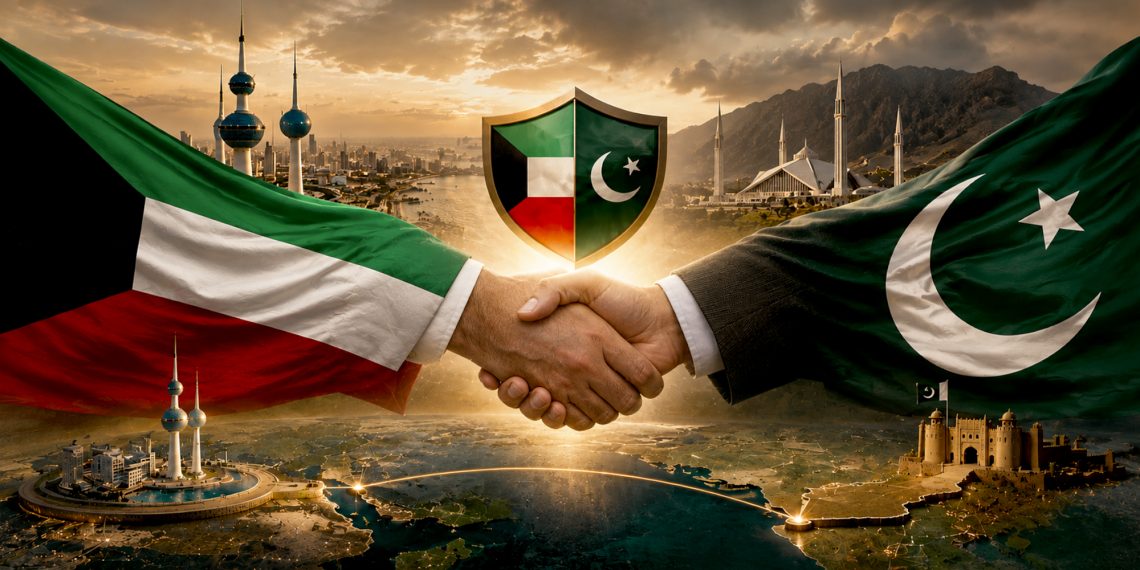
The defence agreement Kuwait ratified in July 2026 is not a new departure in Pakistan’s foreign policy. It is the trade Islamabad struck with Saudi Arabia ten months earlier, executed with a lighter hand. Both agreements convert Pakistan’s military into Gulf capital. The difference between them is not purpose but price, and the price Pakistan accepted in Kuwait was lower in the currency that matters most to a state in its position, which is strategic exposure. Read together, the two pacts do not describe two events. They describe a learning curve. This article argues that Pakistan has learned to extract the economic yield of selling security while shedding the strategic cost that the first sale carried, and that the refinement, impressive as it is, deepens the dependence it was designed to manage.
A Surplus of Force, a Shortage of Cash
The strategy begins in an imbalance that Pakistan does not choose and cannot quickly change. The state holds a surplus of military capital and a chronic foreign exchange deficit. One asset it can spare. The other it cannot generate. A country in that position does not decide whether to trade the first for the second. The trade is forced on it by arithmetic, and the only latitude it retains is over the terms. This is the mechanism beneath every Gulf agreement Pakistan sign, and treating the pacts as expressions of solidarity mistakes the packaging for the content.
The compulsion becomes visible once the reserves are examined rather than announced. Pakistan operates under an Extended Fund Facility of 7 billion dollars whose survival the Fund made conditional on Saudi Arabia, China and the United Arab Emirates holding roughly 12.5 billion dollars at the State Bank until the programme expires in September 2027 (Express Tribune, 2026a). Those deposits are a large part of the headline reserves, which is why the Fund measures performance on net international reserves rather than gross, and why that net figure has stayed negative even as it improves against target (Express Tribune, 2026a). The reserves that make Pakistan look solvent are borrowed from the same governments it signs defence agreements with. Solvency and security have become the two ends of one transaction. When Saudi Arabia rolled its 5 billion dollar tranche forward for three years in late July, the relief it bought was real, but it lengthened the leash rather than loosening it (Profit, 2026). A state financed this way cannot conduct foreign policy from conviction. It conducts it from the need to keep the deposits in place.
If the trade is forced and only the terms are open, then the Saudi and Kuwait agreements are best read as two answers to a single optimisation. Each seeks the most capital for the least exposure. They differ because Pakistan solved the problem crudely the first time and precisely the second.
In contrast, Saudi Arabia bought the maximal version. The Strategic Mutual Defence Agreement of September 2025 treats an attack on one state as an attack on both, which is the most valuable assurance Pakistan can offer and therefore the most expensive it can charge for (Shah and El Dahan, 2025). Its value was inflated further by what was left unwritten. The text says nothing of nuclear weapons, yet a senior Saudi official spoke of all military means, analysts inferred an umbrella, and Pakistan’s minister denied the nuclear reading while extending the offer to other Gulf states (Shah and El Dahan, 2025; Daily Sabah, 2025). The ambiguity was not a diplomatic accident. It was the pricing strategy. Pakistan sold the impression of a shield while conceding none in writing, and in return it secured its standing with its largest financier (Arab News, 2025). The cost sat on the other side of the ledger. An attack clause is entanglement by definition, and it binds Pakistan to a state exposed to Yemen, to Iran and to Israel. The Saudi pact maximised the yield and accepted the exposure that came with it.
Kuwait bought the opposite configuration, and the design of its agreement shows Pakistan pricing exposure out. Decree-Law No. 73 of 2026 ratifies a framework for training, logistics, personnel and technological cooperation overseen by an annual committee (Government of the State of Kuwait, 2026; Kuwait Times, 2026). The clause that made the Saudi pact costly is absent. Nothing commits either army to the other’s defence, and the instrument is institutional collaboration rather than troop deployments or weapons procurement (Kuwait Times, 2026). It runs for five years and lapses on notice, so even the commitment it does make is provisional (PTI, 2026). The preamble confirms where the value was meant to travel, placing economic and developmental cooperation ahead of defence (Government of the State of Kuwait, 2026), and the reporting supplies the substance the preamble implies, since Kuwait paired its defence outreach with energy and investment (Dawn, 2026). Kuwait sends Pakistan under a billion dollars in remittances, so its worth to Islamabad was never the existing labour flow but the prospective capital the framework was built to unlock (The News, 2026). Pakistan took the money channel and declined the attack clause. The same optimisation solved for a different point on the curve.
What Islamabad Withheld, and Why It Matters
The claim that Pakistan learned, rather than merely signed again, rests on what it declined to do when it had every reason to do more. The Kuwait text predates the Saudi treaty by two years, so the learning cannot lie in the drafting. It lies in the ratification, and specifically in a refusal.
Kuwait did not want the light version. It sought the Saudi model, including Pakistani troops, jets and an air defence system on its soil, an appetite sharpened by drones over its cities (Dawn, 2026). Pakistan met that request at a moment of maximum leverage and maximum need, when a larger commitment would have commanded a larger price and the treasury had obvious use for it. It ratified the modest 2023 framework unchanged and withheld the guarantee. That withholding is the whole argument in miniature. A state selling security for solvency will take the higher payment unless it has learned that the higher payment carries a risk it can no longer afford. Having already accepted one entangling guarantee in a volatile theatre, Pakistan refused a second in a hotter one. The restraint priced exposure as a cost in its own right, which the Saudi deal had not done, and that is what distinguishes a strategy from a habit.
Seen this way, the two pacts are not a repetition but a graduated architecture. Saudi Arabia holds the treaty tier and pays at the treaty tier. Kuwait holds the framework tier and opens an economic channel without the collective liability. The tiering is the mature form of the strategy, and it converts a weakness into a method. Pakistan cannot stop selling, so it has learned to sell at calibrated depths, keeping its hands free at the lower tiers and reserving its scarce willingness to be entangled for the partner that pays the most.
The strategy is broader than the pacts, and reading the pacts in isolation understates it. The asset Pakistan monetises is not only its army, but the strategic weight the army confers, and that weight can be converted through diplomacy as readily as through a treaty. Pakistan’s mediation of the April 2026 ceasefire between the United States and Iran is the same capital spent through a different channel (CNN, 2026a). The brokering placed Islamabad at the centre of the region’s diplomacy while the pacts placed it at the centre of the region’s security, and both purchases were made in the same coin. A state that can pause a war and rent a deterrent has two routes to the standing that underwrites its deposits, and it has learned to run them together. This is why the mediation belongs inside the fiscal account rather than beside it. It raised the value of everything Pakistan then sold. The Gulf pays more readily for capability from a state it has just watched manage a crisis, and Pakistan converts that elevated standing back into the deposits and investment its balance of payments requires.
However, three objections test the reading, and each refines it rather than unseating it.
- The first holds that the pacts are genuinely strategic and that a fiscal account understates Pakistan’s ambition to lead the Muslim world.
Ambition is real, but motive and mechanism are separate questions, and a state can pursue standing while financing it by using its military. The fiscal reading earns its place because it explains what prestige cannot, namely why the two agreements were priced differently. Solidarity does not tier. An optimisation does.
- The second holds that the restraint was Kuwaiti caution rather than Pakistani learning.
The evidence points to a mutual choice, which strengthens the argument. Kuwait hosts more American troops than any other state in the region and would not invite a Pakistani guarantee that alarmed Washington or provoked Tehran (Dawn, 2026). It also tiers its own partners, since its Ukraine agreement, unlike Pakistan’s, covers weapons acquisition and production licensing while an Italian pact and an American Patriot package fill other roles (Kuwait Times, 2026). Two states arriving independently at the light instrument is calibration by design, not the accident of one side’s hesitation.
- The third holds that frameworks of this kind are routine and often dormant.
The modesty of the text is the point rather than a flaw in it. A dormant clause that nonetheless unlocks energy and investment, ratified at the moment of greatest regional stress, is doing work its language conceals. The significance sits in the timing and the exchange, not in the ambition of the wording.
Geography Restores the Risk the Contract Removed
The refined instrument solves the problem Pakistan set itself, and in solving it exposes a deeper one. Removing the attack clause removes the legal obligation to fight. It does not remove the physical fact of being present in a theatre under fire. The ceasefire Pakistan brokered is violated repeatedly, an American strike on Iran was threatened and withdrawn within the past week, and Kuwaiti airspace was under drone threat in the same days (CNN, 2026b). A framework can draw a state toward a crisis without a clause compelling it, so the exposure Pakistan priced out of the contract re-enters through geography.
The contradiction sharpens when the yield and the danger are set side by side, because in the Kuwait case they are inversely timed. The danger is present, and the payment is prospective. Pakistan accepts proximity to a live conflict now in exchange for energy and investment that remain promises, and promises made under regional stress are the first commitments to lapse. The revocability is not hypothetical. The United Arab Emirates withdrew its deposit, and Saudi Arabia covered the gap, which demonstrates that these lifelines are conditional and that the instability drawing Kuwait toward Pakistan could as easily persuade Gulf treasuries to hoard their reserves (Khaleej Times, 2026; Express Tribune, 2026a). The strategy that Pakistan has refined is therefore most fragile precisely where it looks most clever. The lighter the pact, the more its value depends on a stability that the pact itself presupposes and cannot supply.
The deepest problem is not any single agreement but the logic that generates them. Security for solvency funds stabilisation without funding reform, so it reproduces the dependence that makes the next sale necessary. Each rollover and each pact buys time, and the lengthening of the Saudi rollover to three years buys more of it than before, but time spent servicing a balance of payments is not time spent repairing the economy that unbalances it (Profit, 2026). The refinement makes the strategy safer to operate, which makes it easier to continue, which postpones the reform that would end the need to operate it at all. Pakistan has not found an exit from the trade. It has made the trade more efficient, and efficiency in a trap is not the same as escape.
The two pacts are one argument stated at two volumes. Saudi Arabia was the proof of concept, valuable, binding, and dangerous. Kuwait is the same concept executed with discipline, cheaper in obligation and freer in exit, and the mediation that raised Pakistan’s standing sits inside the same account rather than apart from it. Between them, Islamabad has learned to convert its security into capital at calibrated prices and to keep the lower prices safer. The learning is genuine, and the record shows it. What none of it touches is the condition that compels the selling in the first place. Pakistan has made the sale of its security safer without reducing its need to make the sale, and a strategy that can only be refined and never retired is a measure of how little room the arithmetic leaves.
See also: Moazam Jahangir, “The Crisis Brokers of a Fragmented World Order”, GSSI, 25 April 2026.
See also: Moazam Jahangir, “Narrative Wars and the Verdict Set in Advance”, GSSI, 31 May 2026.
See also: Moazam Jahangir, “The War Without a Ceasefire”, GSSI, 22 July 2026.
References
Arab News (2025) ‘Pakistan eyes over $6 billion in Saudi support as top foreign financier in FY26’, Arab News, 13 June. Available at: https://www.arabnews.com/node/2604355/pakistan (Accessed: 4 August 2026).
Belfer Center (2025) ‘Beyond the hype: Pakistan-Saudi defense pact is not a Saudi nuclear umbrella’, Belfer Center for Science and International Affairs, 18 September. Available at: https://www.belfercenter.org/research-analysis/beyond-hype-pakistan-saudi-defense-pact-not-saudi-nuclear-umbrella-0 (Accessed: 4 August 2026).
CNN (2026a) ‘The US and Iran have agreed a ceasefire, with talks to bridge the gulf between them’, CNN, 8 April. Available at: https://www.cnn.com/2026/04/08/world/us-iran-ceasefire-explainer (Accessed: 4 August 2026).
CNN (2026b) ‘US-Iran war: State Department warns US citizens across the Middle East’, CNN, 1 August. Available at: https://www.cnn.com/2026/08/01/world/live-news/iran-war-trump (Accessed: 4 August 2026).
Daily Sabah (2025) ‘Saudi-Pakistan pact puts nuclear umbrella into Mideast security equation’, Daily Sabah, 19 September. Available at: https://www.dailysabah.com/business/defense/saudi-pakistan-pact-puts-nuclear-umbrella-into-mideast-security-equation (Accessed: 4 August 2026).
Dawn (2026) ‘Pakistan and Kuwait “mulling defence pact”‘, Dawn, July. Available at: https://www.dawn.com/news/2016348 (Accessed: 4 August 2026).
Defence Security Asia (2026) ‘Pakistan-Kuwait defence talks emerge as Iran war batters Kuwait’s air defences’, Defence Security Asia, July. Available at: https://defencesecurityasia.com/en/pakistan-kuwait-defence-talks-iran-war-2026-gulf-security/ (Accessed: 4 August 2026).
Express Tribune (2026a) ‘Saudi support and economic sovereignty’, The Express Tribune, July. Available at: https://tribune.com.pk/story/2619194/saudi-support-economic-sovereignty-1 (Accessed: 4 August 2026).
Government of the State of Kuwait (2026) Decree-Law No. 73 of 2026 approving an agreement between the Government of the State of Kuwait and the Government of the Islamic Republic of Pakistan concerning cooperation in the field of defence. Kuwait Alyawm (Official Gazette), 19 July.
ICAN (2026) ‘Pakistan-Saudi Arabia: a mutual defence pact with nuclear shadows’, International Campaign to Abolish Nuclear Weapons, February. Available at: https://www.icanw.org/pakistan_saudi_arabia_a_mutual_defence_pact_with_nuclear_shadows (Accessed: 4 August 2026).
IMF (2026) Pakistan: IMF Country Report No. 26/101. Washington, DC: International Monetary Fund. Available at: https://www.imf.org/-/media/files/publications/cr/2026/english/1pakea2026001.pdf (Accessed: 4 August 2026).
Khaleej Times (2026) ‘Pakistan completes repayment of $3.45 billion to UAE’, Khaleej Times, 24 April. Available at: https://www.khaleejtimes.com/business/pakistan-completes-repayment-of-345-billion-to-uae (Accessed: 4 August 2026).
Kuwait Times (2026) ‘Kuwait ratifies wide-ranging defense cooperation agreement with Pakistan’, Kuwait Times, 26 July. Available at: https://kuwaittimes.com/article/47133/kuwait/other-news/kuwait-ratifies-wide-ranging-defense-cooperation-agreement-with-pakistan/ (Accessed: 4 August 2026).
Profit (2026) ‘Saudi Arabia rolls over $5 billion cash deposit with Pakistan, easing external financing pressure, SBP governor says’, Profit by Pakistan Today, 30 July. Available at: https://profit.pakistantoday.com.pk/2026/07/30/saudi-arabia-rolls-over-dollar5-billion-cash-deposit-with-pakistan-easing-external-financing-pressure-sbp-governor-says (Accessed: 4 August 2026).
PTI (2026) ‘Kuwait ratifies defence cooperation pact with Pakistan’, Press Trust of India, 28 July. Available at: https://www.dtnext.in/news/world/kuwait-ratifies-defence-cooperation-pact-with-pakistan (Accessed: 4 August 2026).
Shah, S. and El Dahan, M. (2025) ‘Analysis: Saudi pact puts Pakistan’s nuclear umbrella into Middle East security picture’, Reuters, 18 September.
The News (2026) ‘Caught in the Gulf crosswinds’, The News International, 16 March. Available at: https://www.thenews.pk/print/1404698-caught-in-the-gulf-crosswinds (Accessed: 4 August 2026).