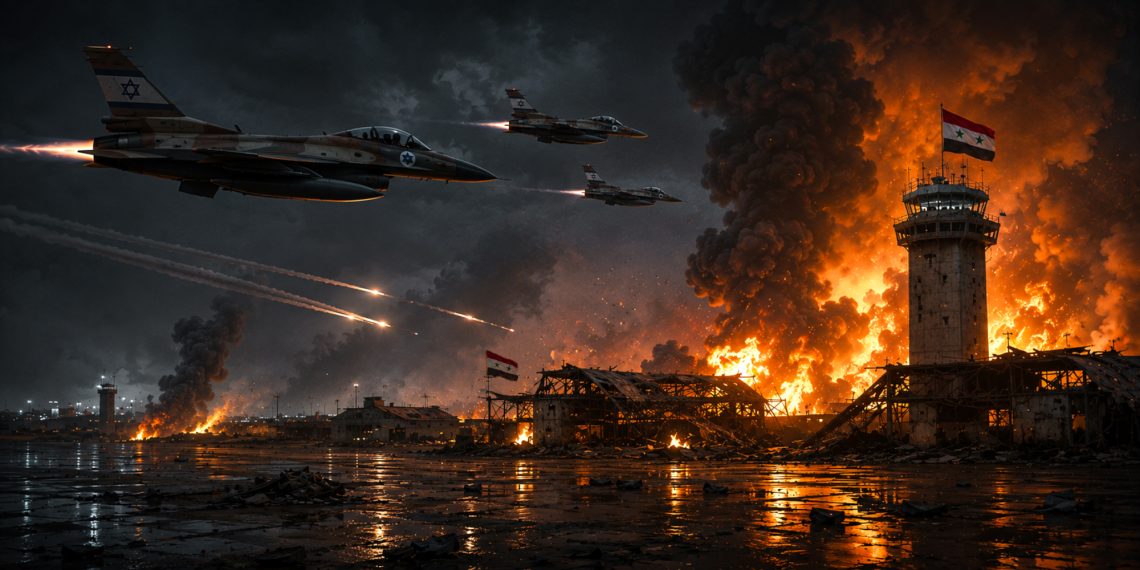
The Israeli strike on Abu al-Duhur Airport does not appear to be an isolated or merely tactical operation, but rather part of a broader policy through which Israel seeks to impose limits on the capabilities of the new Syrian state before it rebuilds its military infrastructure. Simultaneously, it aims to prevent Turkey from transforming its political and military influence in Syria into a permanent base network that could potentially curtail Israel’s freedom of aerial movement in the future.
The strike gains added significance because Israel acknowledged that its objective was to prevent a potential Turkish deployment at the base, while Damascus stated that the site was being upgraded for the benefit of the Syrian Air Force, not for the establishment of a Turkish base. Reuters also confirmed that Syrian and Israeli officials had indeed discussed the issue of Turkish deployment prior to the strike, indicating that the operation followed political and security communications and warnings, rather than a mere miscalculation on the ground.
The most important outcome is that Israel is effectively establishing a new precedent in Syria: any military facility that could potentially develop Syrian or Turkish capabilities that Tel Aviv perceives as limiting its air superiority could become a target before it becomes operational. Why Abu al-Duhur specifically?
Abu al-Duhur differs from most recent Israeli targets in Syria in both location and significance. It is in the northwest of the country, far from the Golan Heights and the southern region where Israel typically concentrates its ground and air operations.
Furthermore, the airstrike came after a Turkish delegation visited the airport. The Associated Press reported that the strike occurred hours after the delegation’s departure, while Axios stated that Israel targeted the runways and hangars to prevent a potential Turkish deployment. This timing sends a message to three parties simultaneously:
To Damascus: Rebuilding the Syrian army is not a purely internal sovereign process from an Israeli perspective, but rather is subject to Israeli oversight by force.
To Ankara: Turkish military support for Syria has limits set by Israel, especially when it shifts from training and arming to establishing permanent bases or air facilities.
And to Washington: Israel is prepared to act unilaterally, even when the United States is attempting to build a broader regional security understanding. The Turkish dimension is at the heart of the strike.
In my view, it would be a mistake to interpret the raid as targeting Syria alone. It is also a new chapter in the Turkish-Israeli rivalry over the shape of post-Assad Syria. Turkey views the stability of the new Syrian government and the rebuilding of its military institutions as integral to its national security. Israel, on the other hand, does not want Syria to become an advanced Turkish military sphere of influence, especially if Turkey acquires air bases, air defense systems, drones, or a training and armament infrastructure capable of altering the balance of power.
Reuters reported that prior communications before the strike specifically addressed Israeli concerns about Turkish forces and arms and drone sales to the Syrian army. This means the conflict is no longer about “Is Iran present in Syria?” as it was previously, but rather the new Israeli question:
Who will fill the military and strategic vacuum left by the collapse of the previous regime? Turkey is the most likely candidate.
Why didn’t Israel target Turkish forces?
This is a crucial point because targeting runways and infrastructure while avoiding Turkish casualties indicates that Israel wants to establish deterrence without resorting to war with Turkey. In other words, the Israeli message is: “We will not target you directly now, but we will not allow the establishment of the infrastructure that would enable you to entrench yourselves.” This is a preemptive policy based on striking the facility at an early stage, when the cost of the operation is low, rather than waiting for Turkish forces to be stationed there. Any subsequent strike would be more politically and militarily dangerous and could lead to a direct confrontation between two countries with significant military capabilities.
Will the Israeli airstrikes continue? The likely answer is: Yes, but in a selective and calculated manner. It is unlikely that Israel will completely halt its operations due to American protests, as Benjamin Netanyahu has publicly stated that the strike was a response to what Israel perceived as an attempt to allow a Turkish presence at the base. While the US-sponsored Syrian-Israeli talks have yet to produce a final security agreement, the nature of the targets will be significantly influenced by Turkish and Syrian behavior and the strength of US intervention. The most likely targets for future strikes are air bases undergoing upgrades, air defense installations, missile and drone depots, training facilities with direct Turkish involvement, and any infrastructure that could be used to restrict Israeli freedom of flight. Therefore, Israel does not need to strike every aspect of the Syrian army’s reconstruction program; it is sufficient to convince Damascus and Ankara that any qualitative capability that could alter the balance of deterrence will be met with a preemptive strike.
American guarantees: Are they enough? This is the core issue.
The United States did not endorse the operation. Tom Barrack described the airstrikes as an “unnecessary escalation,” stating that Ahmed al-Sharaa’s government had not adopted an aggressive policy toward Israel and that Washington would continue to push for dialogue rather than military action. More importantly, however, Washington has begun working on a deconfliction mechanism between Turkey, Israel, and Syria. American officials recognized that the operation could have resulted in a Turkish-Israeli confrontation had Turkish military personnel been present at the site of the strike. This mechanism might include sharing information about troop positions, advance notification of specific military activities, designating sensitive areas, and establishing direct communication channels in emergencies. However, it does not constitute a complete guarantee of Syrian sovereignty. More precisely, Washington can reduce the risk of accidental clashes between Turkey and Israel, but it has not yet demonstrated its ability or willingness to prevent Israel from carrying out a strike it deems essential to its national security. The fact that Israel informed the White House in advance of the operation, according to Axios, illustrates this gap: Washington knew, but did not prevent it.
What does Israel want from the new Syria?
Four strategic Israeli objectives can be identified: first, to keep southern Syria militarily weak and prevent the deployment of units or weapons that Israel considers a threat to the Golan Heights; second, to guarantee the freedom of Israeli air operations in Syrian airspace; third, to prevent the re-emergence of a missile or air defense infrastructure capable of challenging Israeli superiority; and fourth, and most recent, to prevent Turkey from becoming a military guarantor for Syria, thus making any future Israeli operation contingent on calculating the Turkish reaction. In this context, Abu al-Duhur becomes a model of what can be described as a policy of preventing Syrian military empowerment.
Damascus’s Dilemma: The new Syrian government finds itself facing an extremely difficult equation. It needs to rebuild the army’s institutions to control the country, secure the borders, contain armed groups, and protect the airspace. However, it does not possess the necessary capabilities and resources on its own, and therefore relies heavily on Turkey. But the more military cooperation with Ankara increases, the greater Israel’s concerns become.
Thus, Damascus enters a paradoxical security cycle: the weakness of the Syrian army breeds internal instability, but attempting to strengthen the army could invite Israeli strikes that prevent it from regaining its capabilities. This is one of the most dangerous strategic contradictions at the present time. Turkish Options
Ankara faces three scenarios: 1. Containment and negotiation, the most likely in the short term. Turkey would continue training the Syrian army but avoid establishing clear bases in locations Israel considers sensitive, and would use the American channel to prevent escalation. 2. Gradually continuing to build Syrian capabilities while distributing facilities and not concentrating them in large bases that could be easily targeted. This could lead to a protracted game of building military infrastructure and targeting parts of it. 3. Imposing a direct Turkish military presence by deploying forces and air defense systems at a specific base. This is the most dangerous scenario because it could turn any Israeli strike into a direct test of Turkish-Israeli deterrence. So far, the Turkish position after the strike indicates a desire to avoid sliding into the third option, despite strong political condemnation of the operation. Reuters reported that Ankara rejected the Israeli justifications, while maintaining its commitment to cooperation with Damascus. The Syrian instability factor: Syria’s instability itself encourages continued foreign intervention, because the new Syrian state has not yet regained its complete monopoly on force, the army is still being rebuilt, and the central authority is still dealing with complex security, political, and economic issues. In this environment, Israel sees the cost of military action as relatively low. There is still no Syrian air defense system capable of creating an effective deterrent, no binding security agreement, and no regional arrangements that would make striking a Syrian facility costly enough to deter Israel. Therefore, Syria’s instability is not a mere incidental cause of the raids; rather, it is one of the conditions that makes their continuation possible.
The most likely scenario in the coming months: The most probable scenario is not an Israeli-Turkish war, nor a complete cessation of airstrikes, but rather the emergence of a controlled friction model: Turkey continues to build up and train the Syrian army, Israel monitors military projects and strikes certain facilities when it deems them to have crossed its red lines, and Washington intervenes after each crisis to enhance coordination and prevent Turkish casualties or the escalation into a direct confrontation. Meanwhile, Damascus continues to protest politically while avoiding a direct military response. This model may persist until a clear Syrian-Israeli security arrangement is reached with American guarantees.
What could stop the airstrikes?
The American statement alone is not enough to actually reduce operations. The security environment needs a clearer agreement defining three issues: the limits of the Syrian military deployment in the south, the nature of the Turkish presence and the bases it can use, and the limits of Israel’s freedom of military action. Without an understanding on these issues, the phrase “potential threat” will remain broad enough for Israel to use to justify future operations. According to Syrian Foreign Minister Asaad al-Shaibani, contacts between Damascus and Tel Aviv had made progress toward a security understanding before Israel reneged on some of its commitments. The Abu al-Duhur raid indicates that the Syrian arena is shifting from a struggle for Iranian influence to a struggle over the shape of the new Syrian state and the limits of Turkish power within it. Israel does not necessarily want the collapse of Syria, as complete chaos poses security risks to it as well. However, at the same time, it does not seem prepared to accept a Syria regaining its conventional military capabilities under Turkish auspices if this would restrict its superiority and operational freedom. Turkey, for its part, cannot build a stable Syrian state without rebuilding its military institutions, but it does not want Syria to become a cause for open confrontation with Israel. Washington is theoretically the only party capable of managing this contradiction, but so far it has acted more as a manager of friction than as a guarantor preventing the use of force.
Therefore, it can be said that Israeli raids on Syria are likely to continue in the foreseeable future, but selectively, focusing on qualitative capabilities and facilities related to rebuilding the Syrian military or the Turkish presence. American guarantees will not be sufficient to stop them unless they evolve from deconfliction arrangements into a clear security agreement that defines red lines binding on Israel, Turkey, and Syria alike. The real danger is not the Abu al-Duhur strike itself, but that this policy will become a fixed rule preventing the Syrian state from rebuilding the minimum of its sovereign capabilities, because the continuation of a Syria that is militarily weak but security-unstable may seem tactically useful to Israel, but in the long run it could produce a vacuum, chaos and regional competition that is difficult to control.