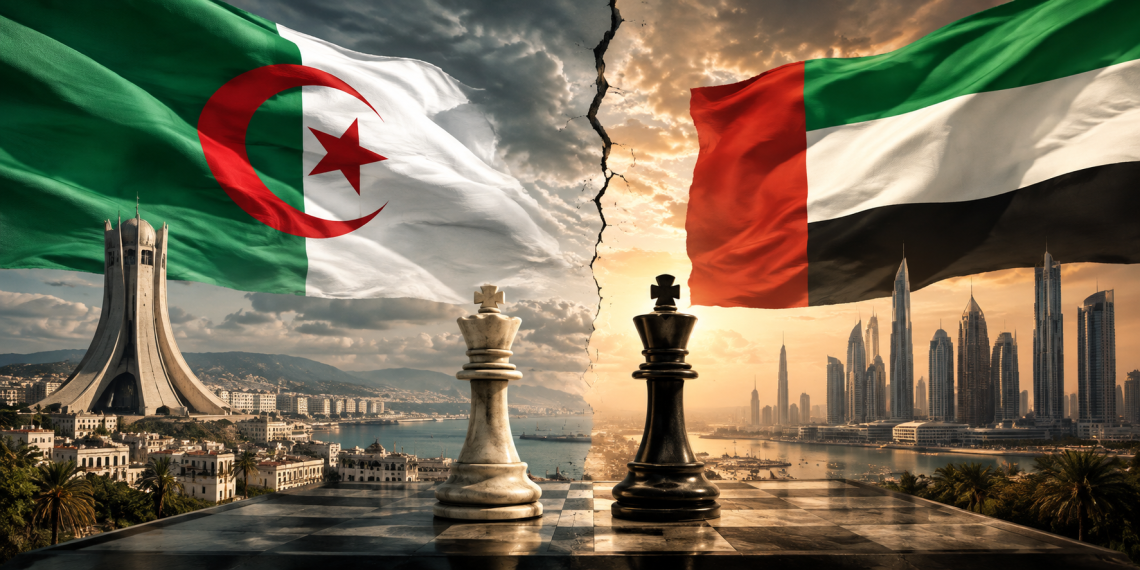
The deterioration of relations between Algeria and the United Arab Emirates is no longer easily explained as a conventional bilateral dispute. Beneath the diplomatic friction lies a deeper strategic divergence over the future of North Africa, the African Sahel, and the wider Arab regional order. Algeria’s foreign-policy tradition is built around sovereignty, non-interference, territorial integrity, self-determination, and the preservation of state institutions. Abu Dhabi, however, has emerged as one of the Arab world’s most aggressive regional powers, combining financial resources, diplomatic activism, security partnerships, and relationships with a diverse range of state and non-state actors.
From Strategic Partnership to Strategic Distance
Algeria was among the first countries to recognize the United Arab Emirates following its creation in 1971. Diplomatic relations were established in 1976 and elevated to ambassadorial level in 1980, while a joint commission created in 1984 provided an institutional framework for bilateral cooperation.
Relations initially rested on political solidarity and mutual recognition of each country’s role in the Arab and African worlds. During the 2000s, economic cooperation expanded significantly. Emirati companies became involved in Algeria’s infrastructure, ports, agriculture, industry, and commercial sectors. Dubai Ports World, for example, obtained a concession to manage the Port of Algiers in 2009.
For years, economic interests helped insulate the relationship from political differences. But that equilibrium depended on a degree of strategic convergence that has progressively disappeared. The turning point came as the regional environment changed, as Abu Dhabi and Algiers began interpreting those changes through increasingly incompatible geopolitical lenses.
2020 and the New Maghreb Equation
The UAE’s normalization of relations with Israel in 2020 was an important marker of this transformation. Algeria, which has consistently rejected normalization and maintained strong political support for the Palestinian cause, viewed the emerging UAE–Israel relationship from a fundamentally different strategic position.
In December 2020, the United States recognized Moroccan sovereignty over Western Sahara. France and Spain subsequently adopted positions that Algiers considered increasingly favorable to Rabat. Algeria’s already deep strategic rivalry with Morocco consequently acquired a new international dimension.
For Algiers, Western Sahara is not simply a territorial dispute. It is closely connected to the principle of self-determination, the balance of power in the Maghreb, and Algeria’s own national-security calculations. Algeria’s rupture with Morocco in August 2021 formalized the regional polarization.
Within this environment, the UAE’s growing strategic relationship with Morocco, opening a consulate in occupied Dakhla in Western Sahara, became increasingly sensitive for Algiers. Abu Dhabi’s ties with Rabat, its normalization with Israel, and its expanding regional partnerships were interpreted in Algeria as components of a broader alignment capable of challenging Algeria’s traditional strategic position.
The issue was therefore no longer simply whether Algeria and the UAE disagreed. The question became whether the regional network being built by Abu Dhabi was beginning to encroach upon Algeria’s strategic neighborhood.
The President Tebboune Factor
Political mistrust has also been fueled by allegations concerning Algeria’s 2019 presidential transition and the emergence of Abdelmadjid Tebboune. Various accounts circulating amid the deterioration of Algerian–Emirati relations have alleged that Emirati-linked interests sought to influence Algeria’s political transition in favor of an alternative figure considered more receptive to Abu Dhabi.
What is documented, however, is that President Abdelmadjid Tebboune had previously clashed with foreign commercial interests, including those associated with the Emirati developer Emaar, during his period as Minister of Housing. Between 2008 and 2015, he reportedly resisted or refused authorization for aspects of Emaar’s proposed Dounia Park project.
The project’s investment value was publicly associated with approximately $500 million, although substantially larger figures concerning potential returns have circulated subsequently without sufficient documentary support. The political significance of the controversy lies less in the disputed financial figures than in what the episode represents within Algerian strategic thinking: the fear that economic influence can eventually become political leverage.
Whether or not the allegations concerning the 2019 election are ultimately substantiated, they have contributed to an atmosphere in which commercial competition and geopolitical rivalry increasingly overlap.
Libya and Sudan: Two Different Concepts of Stability
Algeria’s approach to regional conflicts has traditionally emphasized political dialogue, national sovereignty, territorial integrity, and the preservation of state institutions. This position is deeply rooted in the country’s historical experience and its longstanding fear that state collapse in neighboring countries can produce insecurity far beyond their borders.
In Libya, Abu Dhabi became a major supporter of Khalifa Haftar and the Libyan National Army in Eastern Libya. In Sudan, the UAE has faced repeated accusations of supporting the Rapid Support Forces, led by Mohamed Hamdan Dagalo, or Hemedti. Abu Dhabi has denied providing military support to the RSF. The competing narratives surrounding Sudan are important, but the larger issue for Algeria is strategic perception.
From Algiers’ perspective, the UAE represents a regional power increasingly capable of projecting influence through financial resources, political relationships, and security networks across theaters extending well beyond the Gulf.
That perception was reflected in unusually pointed Algerian statements in 2024. Algeria’s High Security Council referred in January to “hostile behavior” originating from a “brotherly Arab country,” widely interpreted in Algerian political and media circles as a reference to the UAE. President Tebboune subsequently criticized Emirati financial involvement in several regional conflict zones.
The African Sahel: The Strategic Frontier
For Algeria, the Sahel constitutes strategic depth. Instability in Mali, Niger, Libya, and neighboring states directly affects Algerian security through terrorism, arms trafficking, organized crime, migration, and the movement of armed groups. The collapse of the previous regional security architecture has made the situation more difficult. Military coups, the retreat of Western influence, new security partnerships, and increasing competition among external powers have transformed the Sahel into one of the world’s most fluid geopolitical environments.
Algeria has responded by reinforcing relations with neighboring states, strengthening border security, and increasing military preparedness. Its reported defense allocation of approximately €23.8 billion for 2025 illustrates the scale of the security challenge perceived by Algiers.
For Algeria, military strength is increasingly becoming an extension of diplomacy. Political mediation remains central to its foreign policy, but mediation without credible deterrence has become increasingly difficult in an unstable neighborhood. Algeria seeks to preserve states and contain fragmentation. The UAE has demonstrated greater willingness to operate through flexible partnerships and networks of influence. In a fragmented Sahel, those approaches can produce very different outcomes—and very different perceptions of threat.
August 2026 and the New Security Environment
The reported failed coup attempt of August 28, 2026, added another layer of uncertainty to the regional environment. For Algiers, political instability in the Sahel is never merely an internal matter. Developments south of Algeria’s borders can quickly become security problems for Algeria itself.
The episode consequently reinforced concerns about the growing involvement of external powers in regional political crises and the possibility that instability could become a vehicle for geopolitical competition. The central Algerian concern is therefore broader than the identity of any particular faction or foreign sponsor. It is whether external intervention is accelerating the fragmentation of states along Algeria’s southern and eastern periphery.
In sum, the African Sahel is particularly important in this evolving equation. Algeria has historically considered the region part of its strategic depth. Instability in Mali, Niger, Libya, and the wider African Sahel directly affects Algeria through terrorism, arms trafficking, migration, organized crime, and political instability.
The political upheavals that have transformed the region in recent years have complicated Algeria’s traditional diplomatic approach. Military coups, the weakening of Western influence, the emergence of new security partnerships, and competition among external powers have created an increasingly fragmented geopolitical environment, As a result, Algeria has sought to strengthen its relations with neighboring states, including Tunisia, Mauritania, Mali, and Niger, while reinforcing its border-security posture.
Its increased military spending also reflects this changing environment. Military allocations for 2025 reportedly reached the equivalent of approximately €23.8 billion, representing a substantial increase compared with 2022 and roughly one-fifth of the national budget. For Algeria, military preparedness is increasingly linked to diplomatic credibility. A state surrounded by unstable neighbors and competing external powers cannot rely exclusively on political mediation.