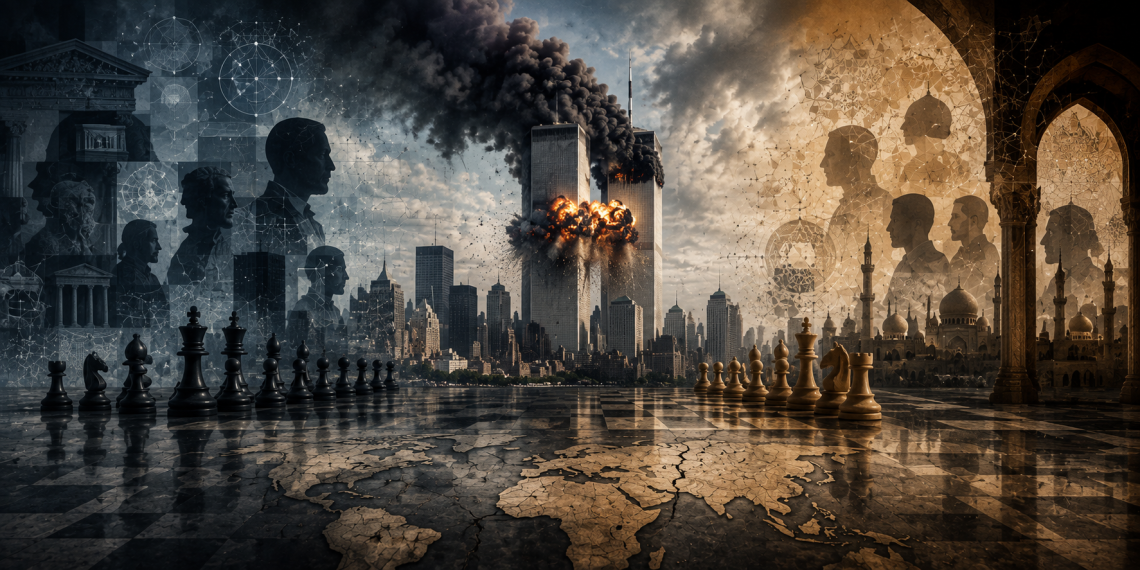
More than two decades after 11 September, the twenty-first century’s most consequential confrontation between the West and parts of the Muslim world continues to be analysed through the familiar lenses of terrorism, war, and security. Yet a far deeper question remains unexamined: what if the very vocabulary used to describe Islam post-9/11 has itself become part of the problem?
Since 2001, Western governments, think tanks, media organisations and academic institutions have developed and popularised a vocabulary distinguishing the “Muslim” from the “Islamist”, “moderate Islam” from “political Islam”, the “traditionalist” from the “modernist”, and the “moderate” from the “extremist”. These terms are often presented as neutral analytical instruments. They are not neutral. They encode assumptions about what religion is, what politics is, what constitutes modernity, where legitimate religion ends and illegitimate politics begins, and whose intellectual categories have the authority to describe Muslim societies.
The argument here is not that Western policymakers invented every one of these distinctions, nor that Islamic societies possess a single uncontested political tradition. Nor is it to deny the enormous differences between Muslims and fringe violent organisations such as the Islamic State or Boko Haram. Indeed, one of the ironies frequently obscured by the discourse is that Muslims have constituted the overwhelming majority of victims of many contemporary “jihadist” organisations. The argument is instead that the conceptual architecture through which this violence has been interpreted can produce unintended political consequences. And to understand why, it is necessary to look beneath the vocabulary itself to the assumptions about knowledge, modernity, secularism and political legitimacy that make that vocabulary possible.
The problem with the “Muslim” and “Islamist” binary
The distinction between “Muslim” and “Islamist” appears intuitively straightforward. A Muslim is supposedly a person whose religion is primarily devotional, cultural or private. An “Islamist” is someone who seeks to translate Islamic principles into political life. But this distinction contains a prior assumption: that the legitimate or normal form of religion is fundamentally separable from politics. That assumption is not universal.
The Qur’an does not restrict itself to matters of individual ritual. It addresses economic transactions, inheritance, marriage, divorce, contracts, charity, social obligations, justice, collective moral responsibility, foreign policy and strategy. It commands believers to enjoin what is right and forbid what is wrong (Qur’an 3:104; 3:110; 9:71), and contains extensive prescriptions concerning economic conduct, family relations, contracts and the distribution of wealth (Qur’an 2:275-282; 4:7-14; 4:19-35; 5:1; 59:7).
This does not establish a single Islamic constitutional model. Nor does it mean that every Muslim who believes Islamic principles have public implications supports a particular political programme. But it does establish something more modest and important: the assumption that religion is properly a private sphere, while its extension into public affairs constitutes “political religion”, cannot simply be projected backwards onto the Islamic tradition.
For much of Islamic history, religious norms were understood as having implications for law, commerce, family, morality, public conduct and political authority. The precise institutional arrangements varied enormously; the conceptual relationship between religion and social order was nevertheless not equivalent to the modern Western secular division of spheres.
This is particularly important when considering the historical place of the caliphate. The caliphate was not a twentieth-century invention devised by modern “Islamist” movements. It emerged in the earliest period of Islam and became a defining institution of Muslim political history. The Rashidun, Umayyad and Abbasid caliphates were followed by multiple political formations in which caliphal claims, titles or institutions persisted in different forms. The Ottoman rulers eventually claimed and exercised the caliphal title, and the Ottoman caliphate was formally abolished by the Turkish Grand National Assembly in 1924.
To say this is not to claim that there was an uninterrupted, politically unified “Islamic state” for thirteen centuries. There was not. Muslim political history was characterised by competing dynasties, regional powers, rival claims to authority and considerable variation in the practical relationship between rulers and religious scholars. But that distinction is crucial: the historical argument concerns the persistence of the caliphate as an institution, ideal and source of political legitimacy and not thirteen centuries of uninterrupted centralised sovereignty.
Indeed, the abolition of the Ottoman caliphate in 1924 generated significant political and intellectual debate across the Muslim world. Muslim scholars and political movements in South Asia and elsewhere had mobilised to defend the Ottoman caliphate, while subsequent thinkers debated what, precisely, a post-caliphate Muslim political order should look like. The historical record therefore makes it difficult to sustain the idea that the aspiration for a caliphate is simply a twentieth-century ideological aberration.
The question is therefore not simply whether “Islamism” is a useful category. It is: Why is the politically engaged Muslim described as requiring an adjective, while the “secular Muslim” is treated as the unmarked norm?
When classification becomes strategy
Few documents illustrate the transformation of classification into policy more clearly than Cheryl Benard’s 2003 RAND Corporation report Civil Democratic Islam: Partners, Resources, and Strategies. Benard divides contemporary Islamic tendencies into four broad groups: fundamentalists, traditionalists, modernists and secularists. Crucially, the report does not stop at describing these groups. It asks how the United States and its allies should respond to the competition among them and recommends supporting some tendencies while weakening others. The report is therefore important not simply as an exercise in taxonomy but because it demonstrates how classification can become an instrument of policy.
This is where the accusation of divide and rule becomes politically powerful. The RAND report does not, by itself, establish a single grand Western conspiracy to divide Muslims. Such a claim would go beyond the evidence. But it does make something much less controversial, and arguably more significant and visible: the strategic treatment of distinctions within Muslim communities as objects that external actors can identify, cultivate and influence.
The underlying strategy follows a clear progression: classify, identify desirable and undesirable tendencies, selectively support certain actors, weaken others, and ultimately shape the ideological balance.
It is hardly surprising that Muslim critics have seized upon this as evidence that Western powers seek to divide Muslims into categories of acceptable and unacceptable Islam. And there is an important historical irony here: a strategy intended to identify Muslim partners against violent organisations may inadvertently reinforce the suspicion it seeks to overcome, that Western governments do not merely oppose particular violent organisations, but seek to determine what kind of Islam should prevail.
The Washington Institute’s discussion of the caliphate illustrates another dimension of this problem. It notes that the caliphate was not invented by ISIS: earlier movements, including Rashid Rida and Hizb-ut-Tahrir, advocated its restoration, while Al-Qaeda had long aspired to establish one. The article also notes that the caliphate became a particularly important issue for US policymakers when ISIS declared one in 2014. This history complicates a familiar narrative in which the caliphate appears principally as a contemporary “jihadist” invention.
The caliphate and the politics of historical memory
The distinction matters because the post-9/11 discourse can give the impression that “political Islam” represents an attempt to introduce something alien into Islam. But historically the relationship between Islam and political authority cannot be reduced to that story. The caliphate itself changed substantially across time. The Rashidun institution was not identical to the Umayyad caliphate; the Abbasid caliphate was not identical to the Ottoman conception of the caliphate. The institution’s political power, territorial reach and practical meaning fluctuated.
Yet the persistence of the concept matters. The abolition of the Ottoman caliphate in 1924 represented a profound rupture. Modern Muslim thinkers disagreed sharply about its significance, and some argued that a caliphate was not indispensable to Islam. Others, including Rashid Rida, argued strongly for its restoration. The important point is therefore not that all Muslims have always believed precisely the same thing about the caliphate. It is that the caliphate cannot historically be treated simply as a twentieth-century ideological invention, or as self-evidently equivalent to the violent political project of ISIS. Indeed, the Washington Institute itself acknowledges that the historical caliphates varied enormously and that the Islamic political experience cannot be reduced to ISIS’s model.
This creates an uncomfortable problem for the language of “Islamist extremism”. If a Muslim believes that Islam cannot be separated from politics, then is that belief necessarily evidence of “extremism”? If not, then the analytical category requires much greater precision. And if the answer is yes, the analyst must explain why a significant dimension of Islamic political thought and history is being classified as inherently suspect.
The secular assumption beneath the taxonomy
This takes us to a deeper problem. The categories do not exist in an intellectual vacuum. They are embedded within a particular conception of modernity. Talal Asad’s Formations of the Secular is indispensable here. Asad challenges the assumption that “the secular” is simply the natural condition that emerges when societies become rational and modern. Secularism has its own history, institutions and forms of power. The secular cannot simply be treated as the neutral successor to religion or as synonymous with rationality (Asad, 2003).
This has profound implications for the language of “moderate Islam”. ‘Moderate’ according to whom? ‘Modern’ according to which conception of modernity? And why should an Islamic interpretation become more “moderate” to the extent that it conforms to a particular secular-liberal political order?
The problem is not that liberalism or secularism are necessarily illegitimate. It is that they are too often presented as though they possess no particular historical or ideological location. A liberal secular order has conceptions of the individual, rights, sovereignty, religion, law and political legitimacy. These are normative commitments and not the absence of commitments. Thus, the critical question is not whether liberalism and secularism should be permitted to exist. It is: Why should their particular conception of the relationship between religion and public life be presented as the neutral baseline against which other traditions are measured?
Hallaq and the deeper problem of modern knowledge
Wael Hallaq takes this argument further. In Restating Orientalism, Hallaq moves beyond a narrow critique of representations of the Muslim world. He extends the critique to the wider intellectual architecture of modernity, including law, philosophy, scientific inquiry, sovereignty and the modern conception of the self. His central concern is the historical relationship between knowledge and power within the modern project (Hallaq, 2018).
This is particularly important for understanding post-9/11 vocabulary. The problem is not simply that a Western analyst might possess an inaccurate picture of Islam. The deeper question is: Who possesses the authority to determine the conceptual terms through which Islam becomes knowable?
If Western policy institutions establish the categories through which Muslim actors become intelligible, then the problem is epistemological before it becomes political. The categories make Muslim actors legible to Western policy institutions. But in becoming legible, they may also be required to fit into conceptual structures that originated outside their intellectual traditions.
Foucault’s concept of power/knowledge provides a complementary way of understanding this process. Knowledge does not simply describe subjects from a position outside power; systems of classification, documentation and normalisation can simultaneously produce knowledge about subjects and enable their governance (Foucault, 1975/1977). Thus, asking whether someone is “moderate”, “Islamist”, “extremist” or “traditionalist” is not merely asking a neutral question about what that person is. It is also participating in a system that determines how that person can be recognised.
From Orientalism to coloniality
This insight connects Hallaq’s argument to the wider decolonial literature. Aníbal Quijano’s concept of the coloniality of power describes the persistence of structures of classification and hierarchy after formal colonialism has ended. Eurocentrism, in his account, establishes European historical experience as a universal reference point (Quijano, 2000). Walter Mignolo develops a related argument through the concept of coloniality, arguing that modernity and coloniality are deeply intertwined and calling for forms of intellectual “delinking” from dominant Western epistemological structures (Mignolo, 2011).
Boaventura de Sousa Santos similarly argues for epistemologies of the South and challenges what he regards as the suppression or discrediting of alternative forms of knowledge. His concept of epistemicide is particularly relevant: knowledge systems can be marginalised not necessarily because they are empirically disproved, but because dominant institutions determine what counts as legitimate knowledge. Santos explicitly calls for “cognitive justice” and greater epistemological diversity (Santos, 2018).
Applied to Islam, this raises a difficult question: What happens when Islamic political thought is consistently translated into categories such as religion, political ideology, secularism, moderation and extremism, categories whose historical genealogies are not identical to those of Islamic jurisprudence and political thought? The issue becomes one of epistemic translation. Something can be lost in translation even when the translation is linguistically impeccable.
When research itself becomes part of the problem
In Decolonizing Methodologies, Linda Tuhiwai Smith examines the historical relationship between research and colonialism, arguing that for many Indigenous peoples the very word “research” carries the history of European imperialism. She examines how imperialism became embedded within disciplines and methodologies and how research could function as a means of producing “regimes of truth” about colonised peoples (Smith, 1999/2023).
The implication for the study of Islam is not that all Western scholarship is colonial, nor that academic research is inherently illegitimate. It is that the production of knowledge about another society deserves to be treated as a political and historical practice rather than as an entirely neutral activity.
Who formulates the research questions? Who controls the funding? Which concepts are considered academically respectable? Which scholars are regarded as authoritative? Which Muslim voices are invited into policy discussions? And perhaps most importantly: What happens to a Muslim intellectual who refuses the vocabulary through which Western institutions expect Islam to be described?
These questions become particularly important for journalists and analysts in Muslim-majority countries. A writer may describe a movement as “Islamist” because that is the language expected by an international editor. An analyst may use “moderate Islam” because it is the terminology familiar to Western policymakers. A researcher may translate an indigenous political concept into Western political science terminology because the original concept has no obvious place within the discipline. Gradually, terminology becomes professional currency. The categories are reproduced by people who may themselves disagree with the political assumptions behind them. This is how epistemic power can become invisible.
Language as symbolic power
Pierre Bourdieu helps explain why. Language is not simply a neutral vehicle for transmitting pre-existing ideas. Bourdieu’s conception of symbolic power draws attention to the capacity of authorised language to construct perceptions of social reality and establish some descriptions as legitimate while rendering others difficult to articulate or recognise (Bourdieu, 1991).
Consider the difference between saying, “This Muslim believes Islamic principles should influence public law,” versus saying, “This Muslim is an Islamist.” The second formulation is shorter and may be analytically useful in particular contexts. But it also imports an entire conceptual history. The individual is no longer simply someone articulating a position about law, morality or governance; they have become a member of a category whose boundaries were largely established elsewhere.
The same applies to “moderate”. To call one Muslim “moderate” implicitly creates a scale, and once there is a scale, someone must occupy the position at its centre. The supposedly neutral centre is frequently the political and cultural assumptions of the institution doing the classifying.
Colonialism after colonialism
Ashis Nandy’s work is useful because it reminds us that colonialism does not operate exclusively through armies, bureaucracies or economic extraction. In The Intimate Enemy, Nandy explores colonialism’s psychological and cultural dimensions, including the internalisation of Western ideas of progress and the ways colonial relationships can transform the consciousness of both coloniser and colonised (Nandy, 1983).
This provides another way of understanding the adoption of Western terminology in Muslim societies. The most consequential form of epistemic domination may not be when an external power tells people what to think. It may be when people begin to regard the external power’s categories as the obvious vocabulary through which they should think about themselves.
Sabelo J. Ndlovu-Gatsheni’s work on coloniality similarly draws attention to the persistence of unequal knowledge structures after formal colonialism. Contemporary universities, disciplines and global knowledge systems can reproduce an uneven intellectual division of labour in which some centres are treated as producers of theory while others are treated primarily as sites to which theory is applied (Ndlovu-Gatsheni, 2018).
This is particularly relevant to the Global South. The problem is not simply that Western scholars describe Muslims through Western categories. It is that Muslim scholars, journalists and policymakers may increasingly feel compelled to describe themselves through those categories in order to participate in global intellectual and policy conversations.
The paradox of the counterterrorism discourse
Here lies perhaps the greatest irony. Western governments have repeatedly insisted that their conflict is not with Islam. George W. Bush said after 9/11 that “the face of terror is not the true faith of Islam”. Yet on 16 September 2001 he also referred to the coming campaign as “this crusade, this war on terrorism” (Bush, 2001).
The contradiction is instructive. On the one hand, Western leaders declare that they are not at war with Islam. On the other hand, they insist on confronting an ideology whose political ambitions include Sharia, the Caliphate and an Islamic conception of governance.
The tension becomes even more explicit in Tony Abbott’s 2015 intervention. He argued that “Islam never had its own version of the Reformation and the Enlightenment” and consequently lacked a “consequent acceptance of pluralism and the separation of church and state”. He called for Muslims to “reclaim their faith from the zealots” and declared that Western culture “was superior to a culture that justified killing in God’s name.” (BBC, 2015)
Whatever one’s assessment of Abbott’s argument, its intellectual assumptions are remarkably clear. Islam is presented as a civilisation that failed to undergo the historical transformations that produced modern Western liberalism. The implication is not merely that particular Muslims have adopted “extremist” ideas. It is that Islam itself requires an internal transformation.
This is precisely the distinction that matters for the present argument. When Western leaders say that their struggle is with “extremism”, but simultaneously describe the historical relationship between Islam, politics and law as itself requiring reform, Muslims can reasonably perceive a broader civilisational project. They may hear “We oppose Daesh,” but understand “We want to change the Islam that produced the possibility of Daesh.” Those are very different messages.
This is where language can become counterproductive. Many Muslims perceive Western discourse as seeking to redefine Islam as a ritualistic faith, separating it from politics, law and society, and imposing externally derived categories of what constitutes an acceptable form of Islam. This perception can provide militant groups with a ready-made rhetorical framework for presenting themselves as defenders of an authentic Islamic tradition against external attempts to reshape it. Its political effectiveness rests partly upon the fact that it can identify something real: the secular separation of religion and politics is not simply a universally shared premise.
Beyond the binary
None of this requires romanticising Islamic history or accepting the political programmes of contemporary movements claiming Islamic legitimacy. There is no single Islamic political tradition. There are competing schools, jurisprudential methodologies, theological traditions and understandings of political authority. The history of Muslim societies contains political diversity, disagreement and conflict. The caliphate itself changed radically across thirteen centuries.
But precisely because that history is complex, it should not be reduced to a binary in which a “Muslim” represents a ritualised private religion and the “Islamist” represents political deviation. Nor should secularism, liberalism or modernity be treated as universal categories whose legitimacy is self-evident.
The intellectually serious alternative is epistemic humility. Western institutions should ask not simply how to find the “right” Muslims to support, but whether their categories are capable of adequately understanding the people they seek to engage. They should ask whether “moderation” is descriptive or normative. They should ask whether “Islamist” identifies a meaningful political phenomenon in a particular context or collapses radically different movements into a single security category. They should ask what is lost when Islamic concepts are translated into Western political vocabulary. They should ask whether a category such as “political Islam” describes a modern ideological movement, or whether, in some contexts, it obscures the fact that Islamic jurisprudence historically did not regard religious and political life as neatly separable spheres. And they should ask whether the attempt to reshape Islamic political discourse from outside, as the RAND report contemplated, risks validating the very narrative of external domination that militant organisations use to recruit.
Conclusion
The most important legacy of 11 September may therefore not be only the wars fought, the security institutions created or the violent organisations confronted. It may also be the epistemic architecture that emerged around them.
Talal Asad reminds us that the secular is not simply the rational successor to religion. Hallaq asks us to interrogate the deeper relationship between modern knowledge, sovereignty and power. Quijano exposes the persistence of Eurocentric structures of classification; Mignolo calls attention to the coloniality underlying modernity; Santos challenges epistemological monocultures; Fanon demonstrates how domination can become internalised; Spivak exposes the violence that can occur when others are represented through frameworks they did not control; Bourdieu shows how language itself can exercise symbolic power; Linda Tuhiwai Smith demonstrates how knowledge production can inherit the structures of colonialism; Nandy reveals the psychological and cultural afterlife of colonialism; and Ndlovu-Gatsheni shows how coloniality can persist within contemporary knowledge institutions.
Taken together, these thinkers invite a different question about the post-9/11 vocabulary: Not “How should the West better classify Muslims?” but “Why should the West’s categories constitute the starting point from which Muslims become intelligible at all?”
The question is particularly important in relation to the caliphate. The caliphate may be contested. Its historical forms may have been imperfect, contradictory and frequently far removed from Islamic ideals. But it cannot simply be presented as a modern invention of “jihadists”. It was a major institution of Muslim political history, persisted in different forms for centuries, and remained sufficiently significant that its abolition in 1924 generated widespread debate across Muslim societies. To acknowledge this history is not to endorse ISIS. Indeed, doing so may be precisely what is necessary to distinguish Islamic political history from the particular ideological and violent project of ISIS.
The same applies to the broader relationship between Islam and public life. To acknowledge that Islamic thought has historically encompassed law, economics, social relations, morality and political authority is not to claim that all Muslims share one political programme. It is simply to refuse the assumption that secular separation is the only natural starting point from which religion can be understood.
The answer matters because categories are not innocent. They determine who is “moderate” and who is “extreme”, who is “modern” and who is “traditional”, who is a partner and who is a threat. And when those categories are exported globally, internalised by local institutions and eventually reproduced by the very societies being classified, epistemic power becomes difficult to see.
Perhaps the most productive lesson of the post-9/11 era is therefore one of intellectual humility. Before asking whether Islam can be made compatible with modernity, we should ask whether our conception of modernity is itself sufficiently open to being questioned. Before asking which Muslims are “moderate”, we should ask who constructed the scale of moderation. Before treating secularism as the neutral solution to the relationship between religion and politics, we should ask what historical assumptions made that separation appear universal in the first place. And before declaring that the West is fighting terrorism rather than Islam, we should examine whether the language of that struggle inadvertently makes the distinction harder for millions of Muslims to believe.
The challenge, ultimately, is not to find a better vocabulary for classifying Muslims. It is to recognise that the power to name is itself a form of political power, and that a genuinely plural intellectual order must allow people to participate in defining themselves.
References
Asad, T. (2003) Formations of the Secular: Christianity, Islam, Modernity. Stanford, CA: Stanford University Press.
BBC News. (2015) Ex-Australia PM Tony Abbott says Islam must reform. Available at: https://www.bbc.com/news/world-australia-35048128
Benard, C. (2003) Civil Democratic Islam: Partners, Resources, and Strategies. Santa Monica, CA: RAND Corporation.
Bourdieu, P. (1991) Language and Symbolic Power. Cambridge: Polity Press.
Bush, G.W. (2001) ‘Remarks by the President Upon Arrival at the South Lawn’, 16 September. Washington, DC: The White House.
Fanon, F. (1952) Peau noire, masques blancs. Paris: Éditions du Seuil.
Foucault, M. (1975) Surveiller et punir: Naissance de la prison. Paris: Gallimard. English edition (1977), Discipline and Punish: The Birth of the Prison. New York: Pantheon.
Hallaq, W.B. (2018) Restating Orientalism: A Critique of Modern Knowledge. New York: Columbia University Press.
Mignolo, W.D. (2011) The Darker Side of Western Modernity: Global Futures, Decolonial Options. Durham, NC: Duke University Press.
Nandy, A. (1983) The Intimate Enemy: Loss and Recovery of Self under Colonialism. New Delhi: Oxford University Press.
Ndlovu-Gatsheni, S.J. (2018) Epistemic Freedom in Africa: Deprovincialization and Decolonization. London: Routledge.
Olidort, J. (2016) The Caliphate as Geopolitical Challenge. The Washington Institute for Near East Policy. Available at: https://www.washingtoninstitute.org/policy-analysis/caliphate-geopolitical-challenge
Quijano, A. (2000) ‘Coloniality of Power and Eurocentrism in Latin America’, International Sociology, 15(2), pp. 215–232.
Santos, B. de Sousa (2018) The End of the Cognitive Empire: The Coming of Age of Epistemologies of the South. Durham, NC: Duke University Press.
Smith, L.T. (1999) Decolonizing Methodologies: Research and Indigenous Peoples. London: Zed Books. 3rd edn (2021/2023), London: Bloomsbury Academic.
Spivak, G.C. (1988) ‘Can the Subaltern Speak?’, in Nelson, C. and Grossberg, L. (eds) Marxism and the Interpretation of Culture. Urbana: University of Illinois Press, pp. 271–313.
Wynter, S. (2003) ‘Unsettling the Coloniality of Being/Power/Truth/Freedom: Towards the Human, After Man, Its Overrepresentation—An Argument’, CR: The New Centennial Review, 3(3), pp. 257–337.