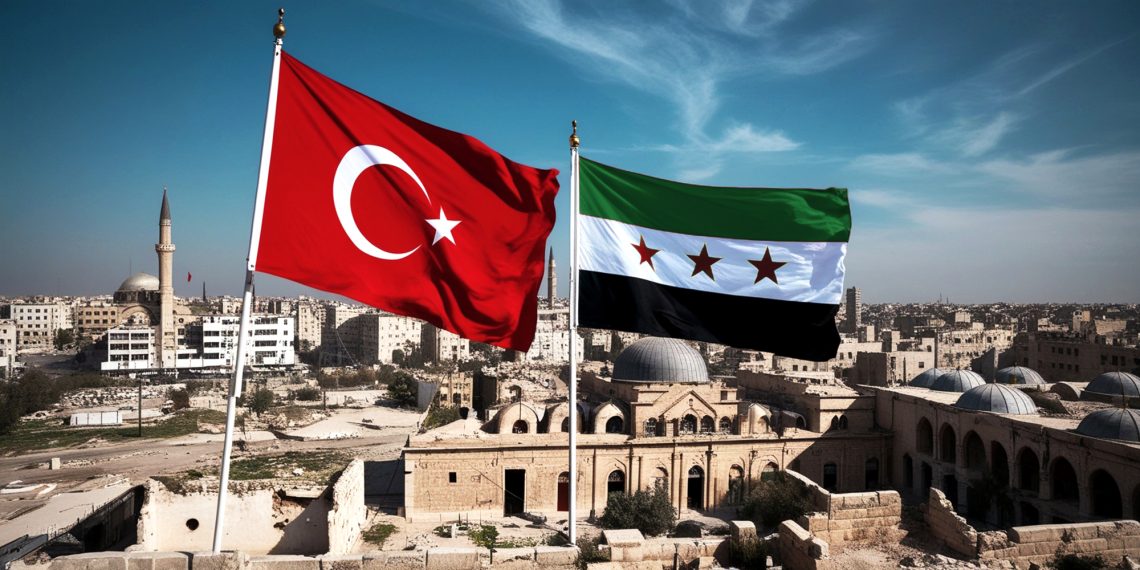
The claim to exist in Syria can provide a legitimate ground when it is realised with a historical vision. Because being the actual heir of history constitutes the basis of current movements. The Turkish community, which developed within the framework of the Islamic civilisation that started in Syria with the Seljuks, the entry of our culture here and the landscape that emerged with political organisations make us relevant to the current realities today. It will be enough to take a look at history to see that the struggle with the Crusaders, Mongols and Armenians in the region in the past, as we are progressing in al-Bab in Syria continues by changing its content.
Information is essential for those who pursue thought, not rhetoric. Since Syrian Turkmens did not attract our attention until recently, our knowledge is limited. With this small article, a glance at the formation of the Turkmen presence in Syria during the Mamluk period and an attempt to understand the movements in the region with a special focus on Sultan Baybars will be useful for future perspectives. It will be useful in developing a vision of what will happen as much as it is to trace the situations that are still of actual value for us today.
A Brief Overview of Syria and Turks from Past to Present
Syria has undoubtedly been an extremely important centre in the history of Turks throughout the Middle Ages. The Turkish presence in Syria, which started with Hanoğlu Harun, Afşin and Sunduk bey, the existence of a principality established in the region by Kurlu Bey and the existence of a political structure centred on Aleppo and Damascus, which continued as the Syrian Seljuk state, based on a history of Turks in Syria starting from 1065s, forces us to rely on a long-term perspective. Especially the Mamluks and the Ottomans period mobilises our current interest in Syria beyond our historical and cultural interest in Syria. Because the traces of these two periods can still be found in Damascus. In addition to this, we see Turkish domination in Syria during the Tolunids and the Ikhshidids before the aforementioned periods.
Since the Ottoman period has been touched upon a lot, it will be sufficient to mention the Mamluk period for the understanding of the situation. It is important to look at the administrative division of the Mamlūk State in the region that forms the northern border of the Mamlūk State in order to understand the position of these cities. In the Mamlūk period, the regencies in the niyabet of Halab were divided into two parts. One part was the regencies within the borders of the Damascus region.
Their number was 11. These regencies consisted of Kal’at al-Rûm, Kahta, Gerger, Behesna, Ayintāb, al-Rawāndan, al-Derbsāq, Bagrās, al-Qusayr, al-Shugr and Baqās, and Shayzer regencies. The second part was the regencies outside the borders of the Damascus region. These were also divided into two parts: The first part was the regencies in the sugūr and avāsim regions. There were nine of them. They consisted of Malatya, Debreki, Darende, Ablusteyn (Elbistan), Ayâs, Adana, Tarsus, Sirfendikâr, Sis naibliks.
The second part was the regencies bordering the al-Jazīra region in the Eastern Euphrates. These regencies consisted of al-Bîra, Kal’at al-J’aber, and al-Ruha (Urfa). Apart from all these naibliks, there were vāliks in the administrative division of the Halab region. These were the governorships of Halab, Kafrṭāb, Sermīn, al-Jebbūl, Simrān, ‘Azāz, Tell Bāshir, Manbij, Tīzīn, Buza’â, Derkūs and Antioch.
Creating a buffer zone along the Syrian frontier was an important feature of Mamluk frontier policy. The Dulkadiroğulları and Ramazanoğulları, small Turkmen principalities living semi-independently in a significant part of the Mamlūk territory stretching from the Taurus Mountains to the Euphrates, should be considered within this policy. The regency of Halab, an important centre in this region, was at the northern border of the Mamlūk State and was the centre of many events in the Mamlūks’ external relations with the Mongols, Turkmens and later the Ottomans. In this regency, of which Halab was the centre, there were about forty small and large regencies. Although some of these were outside the borders of Syria, they were considered to be part of Mamlūk territory.
Adana, Ayas, Darende, Divriği, Elbistan, Malatya, Malatya, Maraş, Sirfendikâr, Sis and Tarsus were the frontier fortresses and their protection was given great importance. Throughout history, Syria has been the dominance or transit area of the Turks. Syria has always been at the centre of the movements from Central Asia to Africa and vice versa. During the Mamlūk period, Syria attracts attention as a place where Turkmen population was settled as well as its strategic location. The influence of the Mamluks on the ethnic structure of the region goes back to the early times when the Turkish Seljuks were weakened during the Mongol invasion and the state was established. The Seljuk Empire of Turkey, which dominated Anatolia, was under heavy Mongol pressure after losing the Kösedağ War with the Mongols in 1243.
As a result of this pressure, Turkmens living especially in Kayseri and Sivas settled in Syria during the reign of Sultan Baybars of Mamluk. The Turkmens, who came to Syria and settled in Damascus during this period took advantage of the political turmoil after the death of the Ilkhanid ruler Abu Said Bahadır Khan and established the Dulkadiroğulları principality around Elbistan in 1337. Yavuz Sultan Selim defeated the Mamluks at Mercidabık in 1516 and annexed the Syrian lands of today to the Ottomans.
The first stage of the Syrian policy implemented by Baybars, who ensured the settlement of Turkmens in the region, was to ensure internal unity and to completely solve the internal problems related to Syria before starting to fight against the Mongols, Armenians and Crusaders. After the suppression of the rebellions in Syria, this astute sultan gathered the scattered Bahrī Mamlūks around him, took various measures to strengthen his influence in the army and to bind the soldiers to his person, and won the favour of the people and farmers by easing taxes. He also re-established the Abbasid Caliphate in Egypt, which had been terminated by Hülagü, in order to consolidate the Mamlūks’ dominance in Syria and Egypt.
He also took important steps in the process of Turkification of the region with his campaigns against the Armenians. Baybars’ attitude towards the Turkmens who were looking for a homeland in those years and his policies regarding the Turkmen issue are extremely important for our subject. As it is known, many Turkmens had come to Anatolia from Khorasan and Azerbaijan as a result of the Mongol invasion.
As a result of these migrations, the Turkish population of Anatolia became denser and every part of Anatolia was filled with Turkmen groups. These Turkmens, who had accumulated in Anatolia, did not obey the Seljuk Sultans who had lost their strength and did not want to be subject to the Mongols. For this reason, Mongol forces were sent against these Turkmens at various times during the reigns of Hulagu and Abaka, especially during Baybars’ Anatolian expedition in 1277.
After the withdrawal of the Mamluks, some of these Turkmens migrated to the Byzantine frontiers, while a significant part of them took refuge in the Mamluk State. Baybars welcomed these Turkmens, who numbered more than forty thousand houses and settled them in the whole coastal region from Gaza to the border of Antioch and Sis, and gave them lands, most of which had been taken from the Franks, as ikta. As a result of this practice, the Turkmens found a safe home for themselves, and the Mamluk State created a buffer zone of Turkmens on the borders of Syria with Baybars’ wise policy. These Turkmens, who were settled in the aforementioned region, mostly settled in Ayıntab, Aleppo, Antakya and Tripoli regions in the course of time. These Turkmens, generally known as the Damascus Turkmens in the XIII-15th centuries, were involved in very important political and settlement activities as an inexhaustible resource, especially during the Mamlūk State, while they lived in the western part of Southeastern Anatolia and northern Syria.
During this period, these Turkmens became the most reliable auxiliary forces of the Mamlūk State and for this reason, they almost always participated in large numbers in the campaigns against the Armenian Kingdom in Çukurova from the Baybars period onwards, established small principalities in these regions, and ensured the Turkification of this region.
The tribes belonging to the Three Arrows branch of Turkmens, namely Yüregir, Kınık, Bayındır and Salur tribes, mostly participated in the raids to Çukurova. As it can be seen, the Mamluks contributed to the change of the region and its population in favour of the Turks in a way that has not received attention until now.
They constitute one of the most important links of the historical process and tradition that started with the Tolunids, Ikhshidis and Seljuks. From 1250 until its collapse in 1517, it was one of the greatest powers in Hejaz, Egypt, Syria, Al-Jazira and Anatolia and had a significant share in the shaping of this geography. From the 13th century until the beginning of the 16th century, one of the most important aspects of this state, which was a dominant power in the region, is its share in the formation of the Turkish character in this region. At the time when the Mamluks were an important force in the region, the Ottomans were another important state and at the beginning of the 16th century they dominated the whole region and became the sustainer of the Turkmen presence here.
Although not discussed in this study, political organisations such as Dulkadiroğullan, Ramazanoğullan, Karakoyunlular and Akkoyunlular would be other important elements in the continuation of Turkmen presence in the region.
After losing the Kösedağ War with the Mongols in 1243, the Ottoman Empire was under heavy Mongol pressure. As a result of this pressure, Turkmens living especially in Kayseri and Sivas settled in Syria during the reign of Sultan Baybars of Mamluk. Sultan Baybars aimed to solve internal and external problems by making use of Turkmen elements in his struggle against Crusaders, Mongols and Armenians. With Baybars’ wise policy, the Mamluk State created a buffer zone consisting of Turkmens on the borders of Syria. Turkmens who were settled in the aforementioned region mostly settled in Ayıntab, Aleppo, Antakya and Tripoli regions in time.
The Mamluk historian al-‘Ayni gave the names and stamps of 22 tribes of Oghuz in his work: “Turkmens come out of Oghuzes. They are twenty-two tribes. Each tribe has a stamp (sign) on their animals and utensils that distinguishes them from each other.” Then he records the names and stamps of 22 Oghuz tribes. It is noteworthy that al- Ayni, as part of his information on the Oghuzes (Turkmens) records that there were settled tribes in Bilad al-Sham and al-Armenia and that they were divided into two main divisions, one of which was called Bozok and the other was called Uchok.
According to Khalil b. Sahin ez-Zahiri, the Turkmens in the Mamluk State resided in the area from Gaza to Diyarbakir. Among these Turkmen groups, Ibn Kutlubey, Ibn Dog, Ibn Sakalsiz, Ibn Dulqadir (Dulqadirids), Ibn Ramazan (Ramazanids), al-Ozerfyye, al-Bazatiyya/Doğancı Sons, al-Bayaziyya (Bayatlar), Bozcalular, Beğdili, al-Maraşlu, al-Arakiyya, Üçoklu/et-Türkman al-Uçokfyye; Among these tribes were such tribes as Beni Ozer and Beni Bernas, Bozoklu/al-Umara al-Bozokiyya/et-Turkmen al-Bozokiyya, al-Inaliyya, al-Harbendeliyya, al-Kanculiyya?(Kangli?), al-Baziyya/ Ibn Sahib al-Baz, ez-Zakariyya, Ibn Karaca, Avshariyya.
The Mamluk author al-Kalkashandi writes that Turkmens constituted the majority of the troops in Bilad al-Sharqiyya (approximately Southern and Eastern Anatolia). Whenever there was an expedition, an order to prepare for the expedition was written to them and the situation was notified by mentioning the names of the tribes separately.
Among them were Murad Khoja, Ahi Bozdogan, Zayn al-Malik Tozdogan, Ali b. Inal al-Turkmani, Yakub b. Ali Şiir from Bozok tribe. Al-Kalkashandi states that ‘there were Turkmens in Bilad al-Sham whose names were mentioned and who were summoned to the campaign’. Al-Bozokiyya, Ibn Inal, Awlad Ramadan al-Amiriyya, al-Özeriyya (Turkmens of Haleb), al-Döğeriyya (the community of Salim al-Döğeri), al-Harbendeliyya, Ağaçeriyya, al-Warsak (Turkmens of Tarsus), al-Kınıkiyya, al-Babenderiyya (al-Nakibiyya), al-Bekirliyya, al-Bayatiyya were among them.
The Armenian historian Vahram, speaking about Sultan Baybars’ 1275 Cilicia expedition, writes: “He gathered around him …… and the Turkmens, who had been engaged in shepherding since ancient times and had driven their flocks to these fields to spend the winter season. These tribesmen, who knew the country and the passes very well, united with the sultan.” Al-‘Ayni, Khalil b. Sahin and Vahram’s accounts are very important information about the Turkmen presence in the region. Turkmens had reached a strength of 180,000 horsemen by this time (15th century). There were people who were said to have been in Bilad al-Sham and Halab, who took care of the Turkmen tribes and commanded them.
In the process that started with the Seljuks, the Syrian Turkmen presence, which found its main shaping in the Mamluk period, has continued its existence in the Ottoman period, especially in Aleppo today. Refreshing our national memory will be valuable for looking at the present correctly. History is not for boasting but for thinking. The landscape we call Syrian Turkism today is like the current heritage of the Ottoman period. But it has undoubtedly affected the region in previous processes.
It is generally known that there are Turkmen settlements in Latakia, Hama, Homs, Damascus and Aleppo in Syria. The Ottomans, who dominated the region after the Mamluks, represent a process whose effects continue until today. This long perspective is a historical determination of why we are interested in Syria.
The Turks were undoubtedly the leading rulers of Syria in the agricultural age. However, a world that could not adapt to the passage of time, could not understand what the time brought and could not change, became the object of new developments in places where it was the subject.
In the 19th century, the role that Britain and France began to play in the region in the efforts to establish a new order represents the tragic process of post-Ottoman Syria that will continue to this day. Unable to keep up with the transformations in the economic and technological context, the Eastern Ottoman Empire was deprived of the vision of the world power it represented and was reduced to the status of small regional states.
While the tsunami of freedom and nationalism created by the French Revolution created a “spring” looking haze in the Arab world, the region began to live its hundred-year tragedy for the artificial borders drawn. The 19th and early 20th centuries were a time of turmoil in our ancient geography. India left the hands of the Mughals and was occupied by the British in 1857, Afghanistan became a geography that has been experiencing problems until today with the Durand border agreement of 1893, Egypt in 1882 and Cyprus in 1878 were occupied by the British, and Iran had its share of this turmoil. The only place where this power returned was Çanakkale. One by one, all obstacles on the energy routes were eliminated by a one-toothed monster fed first with coal and then with oil. As a result, a civilisation that anticipates benefit and calculation has started to execute its rule in our ancient geography.
If the establishment of Israel in the region is added to this, a multi-legged equation of transformations will begin to emerge. On the one hand, deprived of the spirit and knowledge of the age in which it lives, deprived of economic freedom and the ability to process its own resources, paralysed politically and militarily, it has become a hotbed of ideological and sectarian conflicts, On the one hand, on the other hand, the states of the region, which have a foreign-backed administration and regime understanding that sees living with ignorance and poverty, which has long chased knowledge, and on the other hand, the energy-oriented economic giants that pursue energy with an insatiable appetite, determine the rules and concepts of politics, philosophy, economy, history and have crossed technological boundaries. The encounter of these two worlds undoubtedly represents a process of mutual commitment of the East.
Previously, this geography, which was caught between the USSR and the USA during the cold war period of states such as England, France and Russia, experienced a complete historical misery. After the 40s, a geography of relative and relative “independence” moved from a period of direct dependence to a period of indirect dependence. Regimes were now elected “military” disguised regimes. The imperial power, which switched from direct rule to indirect rule, maintained its order until the 90s by adding Israel to the internal balances in the region.
While the age of nationalism and colonialism of the West represents the spirit of one era in the region, the period of indirect exploitation constitutes another era, and the period after the collapse of the USSR represents a new era of hegemony. Unfortunately, the bells in the region were drawn with Western changes and transformations that signalled the spirit of the age. The 90s represented a period of earthquakes in the region that started with the Gulf War. The neo-con approach was fuelled by the trauma of 11 September and the region reached the line it has reached today.
Despite everything, it should not be ignored that the haze called “Arab Spring” today is a project to adjust the next fifty or a century with the new discourses of the new time. In a showdown in which the balance of power is not well calculated, defeat is destined. At the beginning of the 20th century, the mentality that drenched the Balkans and the Arab Geography in blood with the cries of nationalism and freedom is now shouting the demands of the peoples, democracy and freedom.
In the midst of all these historical processes and contexts, in this balance of power, Syrian President Assad continues to spit at the wind blowing from the spirit of the times. What is the spirit of the time? It is the asabiyyah of that era. It is a set of structures affecting the individual, society and humanity. Individual, family and state are nourished, shaped and produce the will to act with this spirit. Sometimes an individual and sometimes a society creates this spirit. But the spirit overtly or covertly influences the material and spiritual orientations of that time. This is such a great force that it makes those who know how to manage it abad and those who cannot understand it berbad.
Can every right be demanded or is every right demanded legitimate; Is every demand of the people legitimate and realistic? What makes the demands of the people legitimate on the basis of action is its generalisability to the general public. Here, should the areas where the state is silent be an area of freedom or should there be a realistic definition and fulfilment of rights fed by the spirit of the time? Especially if a demand for a right victimises the general public, it is not called a demand for a right, it is called creating chaos.
Developments in Syria since the Arab Spring
In the face of sub-state actors waging a proxy war by turning territory, arming and creating state-like structures in the region. Making this a general principle and making it a principle that all foreign bases within the legitimate borders of the country should not be supported in a way that disrupts the unbalanced support and territorial integrity of an element can be a breathing space against the asymmetric balance we have established against the tugging east and west of the Euphrates.
The US should be criticised for enabling the violation of Syria’s territorial integrity east of the Euphrates as well as through the PYD. For Russia, on the contrary, there may be similar criticisms in the other direction.
The second issue that will support this first principle is to define the scope of the concept of terrorism and terrorists in Syria and how this leads to a violation in the context of territorial integrity, and to poke the issue through the issue of terrorism, which everyone talks about but defines the concept in their own way. All our interlocutors, including the regime, talk about terrorism and terrorists in the country, but everyone defines terrorism in their own way and according to their own interests. What is worse, no one sees terrorists east of the Euphrates except Turkey! The meaning of an element armed under the pretext of DAESH and jihadist terrorist discourse in terms of territorial integrity; the meaning of a terrorist organisation creating an internal country within Syria’s borders with its emblems, flags and armament by a foreign power should be questioned.
It is imperative to include all kinds of sociological, demographic and geographical transformation in Syria and the tyranny in this way within the concept of terrorism. In this respect, the contradiction of our interlocutors can be shown to them by examining the issue through the evaluation of the concept of terrorism in Syria.
The ethnic and sectarian proxy states to be substituted and the attempt to disrupt territorial integrity and sociological transformation is an act of terrorism in itself. Today, a similar sociological wall is wanted to be built on our borders through migration and migrants. In this way, the fire in Syria is poured into our country and the bill of the game in the east and west of the Euphrates is wanted to be cut within our borders.
Turkey may consider making attacks on the issue of migration and migrants to the region and the international community through the discourse of migrants who are victims of terrorism that undermines territorial integrity, especially in the east of the Euphrates, on the basis of terrorism and humanitarian grievances. Possible establishment of a safe zone? If it is in question, it should be filled with migrant asylum seekers in our country immediately and thus a sociological wall should be built against the demographic fascism and terror corridor plan. Otherwise, from whom and what will this zone separate or protect?
Throughout history, Western or Eastern invaders have tried to rule our region by establishing proxy states. The best example of this is the Armenian Barony established in Sis during the Crusader attacks. It should not be forgotten that the Crusaders and Mongols entered into support and alliance with this political structure, which would later be given the title of kingdom, against the regional forces. It should not be ignored that this past habit of using logistical opportunities and local elements, as well as the habit of realising their goals in the region and the globe based on an element that creates instability in the region, continues unchanged.
The developments in Iraq and northern Syria do not have a different mindset. In addition, the developments in the Eastern Mediterranean are not independent from these. The 14th century is the period when the Islamic world was subjected to a new Crusader wave in the direction of the Ottomans, the Western Mediterranean Principalities and the Mamluks.
In this process, the attacks on Syria and, in this context, the Eastern Mediterranean should be seen in this context and in its entirety. There are many projects and campaign plans regarding the spirit of these campaigns, which were to be led by King Philip VI of France. One of the most interesting of these is the one put forward by Marino Sanuto Torselleo.
“The capture of Acre, the Crusaders’ last stronghold in the eastern Mediterranean, by the Mameluke army in 1291 was not an unexpected result, but it caused great repercussions in the Christian West. In the period between the fall of Acre and the Crusade project of King Philippe VI of France in 1336, many plans, projects and proposals for the recapture of the Holy Land were written by different groups of writers, ranging from members of the royal family to merchants, diplomats, clergymen and military men. These projects, which initially aimed at the occupation of Egypt, the land of the “infidel Muslims”, and Istanbul, the capital of the “heretical Christians” and the subsequent conquest of the Holy Land, changed their target from the first quarter of the XIVth century onwards, when the threat posed by the seafaring Turkmen principalities in Western Anatolia against Latin interests in the Aegean rose to the top of the threat perception and turned into efforts to establish Crusader Naval Alliances against the Turks.
If we can look from today to yesterday and from yesterday to tomorrow for the construction of a consciousness and mind that thinks with history without the typical Crusader discursive simplicity, we can seek and find ways out of the problems we are stuck in. This emphasis on history was put forward on this path in order to understand and see an unchanging mind and movement practice. Today, there are efforts to organise the region with a similar mind through Syria and the Eastern Mediterranean.
In Syria, everyone defends territorial integrity and everyone is against terrorism, but within all these oppositions, it is as if everyone is an ally in all developments against Turkey. Iran’s latest Hamas move with Russia has begun to appear at the point of losing its effectiveness in Syria with the concern of protecting its territorial integrity in its own country.
In this context, elements such as HTS are advancing and PYD is again watching the developments on the sidelines. The most critical scenario that is likely to happen here is the realisation of a move that will suddenly transfer the places seized by HTS elements to PYD control with the support of foreign powers and the emergence of a Syria with at least 3 parts, similar to the operation carried out with ISIS before. The problem for Turkey here is that the PYD would take the autonomy envisaged in the Russian constitutional proposal and create a status quo beyond its borders to the detriment of Turkey. As allies, the US and Russia are endeavouring to preserve the structure in Syria through the “Kurdish” discourse. Just as the Armenian issue has continued as a global project with role sharing, the problem in Syria is managed in a similar way. We have become talking about the Buffer Zone and Adana Agreement instead of YPG and Ese/ad.
Of course, it is a priority to consider all peaceful and diplomatic possibilities and to act with caution in the context of the balance of power. However, when the main thing in terms of our national security is left behind and we linger with the chapter, the possible consequences of the formation of structures and problems that are difficult to compensate in the future are worrying for the future. In this respect, our determination at the operational level, the surprise of the US withdrawal, the buffer zone after Trump’s tweet “Do not touch the Kurds, we will ruin them”, and a stance that leans towards the Adana Consensus discourse as a result of Putin’s signal may confuse things in the field. The issue of the nature of the constitution that will determine the future of this country in Syria is as important and critical as Ese/ad and PYD.
At the time of this writing, the US-Russia agreement on the Iraqi model, which is imaginary for now but seen in the discourse, would be the legalisation of future risks, which could lead to serious problems in terms of our interests. The constitutionalisation of the developments in northern Syria may make many solutions more difficult.
The only thing that everyone agrees on is the territorial integrity of Syria, but beyond this, the actors give a concept to this integrity in their own way, so while Syria continues to bleed on our border with serious risks, the secret and stench of a PYD agreement continues to come to our noses.
This point should not be overlooked in order to understand the jostling in Syria today and to correctly determine the possible outcomes. In Syria, a divisive balance of power is taking place between regional actors such as Russia and the US, Iran and Turkey through elements such as ISIS and the PYD, which are produced alongside the regime and the opposition. It is obvious that there is a process beyond the usual war in Syria, but it is important for some countries, especially Turkey, to predict what the consequences of this process will be.
Just as the fire in burning Syria has crossed our borders, the stones of disintegrating Syria may fall on our country like meteorites.
When analysing a social event or process, it is necessary to consider transformations from a long-term perspective, in addition to analysing other influencing factors, understanding interdependencies and finally reviewing the balance of power. In this context, the differences between the Turkish and Russian approaches to Syria are related to the processes taking place against a historical background. Current transformations continue due to direct and indirect reasons.
Finally, our statesmen have started to make statements that will lead to a cut-off point. Relations between Syria and Russia during the Soviet and Russian Federation periods have always carried the potential for conflict with the network of relations Turkey established in another bloc in the same period. While the political economy of relations is decisive in terms of dependencies and enables us to be compartmentalist in relations, our NATO membership in power relations and Russia’s preferences for Crimea and Syria draw the general framework of the reactionary nature of relations.
In this context, in order to understand Russia in Syria, the hybrid warfare, which is an important part of its strategy, may need to be looked at in the context of our harassed and possibly downed aircraft. If a scenario of disintegration in Syria is to work, Russia will dominate the structure supported by itself, guided on the ground by Iran and sustained by organisations such as Hezbollah. This polarisation in the field will have one pillar of Russia and the other pillar will be another PYD-oriented polarisation on the US side under the pretext of ISIS. ISIS, on the other hand, will continue to be an actor in this process as a legitimate means for both powers to transgress international law and wage this hybrid war in the field until the negotiations are over and a result is obtained.
How will the Syrian deadlock be solved? Who will open the lock and how?
This question has been occupying the minds lately. More realistically, the sounds of the disaster here have begun to be heard in a wider area with the movements of migrants overflowing into large areas. Mr President’s recent statements suggest new developments focused on diplomacy despite the ongoing violence in the field.
There have been new developments regarding Syria in recent days. Some new approaches to the transition process are being voiced for the long-term solution of the issue. Obama and Putin will discuss the issue among themselves!!! Assad’s preservation of his place in the transition process is one of the expressions in this sentence. This situation brings to mind that the water of diplomacy will heat up again on the Syrian issue.
The question is whether the rules and principles of diplomacy and the rules protected by international law will work in the process and whether the institutions guaranteeing international representation and communication can be operated. In Syria, which has turned into a quagmire of strategic plans, the questions of whether the rules can work and whether diplomacy can be a tool to resolve this great conflict under the shadow of interests are thought-provoking for this country, which has been full of diplomatic disasters for five years. Can the disputes really be eliminated? If not, will the law of the wolf work in an environment where friends are exchanged?
What kind of reconciliation will be achieved between the regime, the opposition and the newly emerging elements in the field (PYD/PKK-ISISIS, etc.); how will the disputes be resolved; how will the communication between the elements be ensured in an environment where violence has become widespread; between whom and how will the negotiations take place; and under whose guarantees will the comprehensive programmes on this issue come to an end? Endless questions…
Will there be an imposition to stop the bloodshed and let the blood stop like in Bosnia, or will a new order be created out of the disintegrating Syria? In this chaotic environment at the foot of our borders, the PYD-PKK organisation will be strengthened and under the pretext of fighting against ISIS, de facto situations will turn into de jure situations, just like in Ayn al-Arab. The questions of how much these proxy elements will take part in the Syrian diplomacy traffic and how much they will affect the course of events are always among the questions that the chaos visible through the fog makes us think. Who will pay the price for the PYD, which the US does not recognise as a terrorist entity?
The Syrian incident describes a process in which enemies and friends are constantly negotiating among themselves while war and conflict continue on the one hand. In the process, interest groups continued to wait for the favourable season, which is the most important element of negotiations, with a series of Geneva-like conferences among themselves.
In addition to global actors such as the USA and Russia, Turkey, Qatar, Saudi Arabia and Iran are making efforts to change the course of events in Syria both in meetings and in the field. But in any case, ISIS and PYD structures continue to lead the developments against us. After this process, when the real diplomacy process starts, we will see where the final development leads us when the appropriate season comes. However, failed negotiation processes in the past have revealed some anomalies.
If the Syrian negotiations are to begin, the negative consequences and costs of ‘failed negotiations’ will be an incentive and even a threat for the parties to strive for a real result. The fact that the parties will lose prestige as these negotiations drag on, that this will have domestic political repercussions, and the disadvantages of prolonging the issue in the light of force majeure such as the problem of migrants will be important sources of motivation to reach a conclusion. As has been the case so far, if a solution is not achieved, the problems and the belief that the dispute cannot be resolved will be strengthened with protracted and deadlocked negotiations. Finally, as the parties fail to reach a solution, provocative reactions will emerge and the crisis will deepen. This will prolong the process in which weapons, not peace, will prevail. It should not be ignored that the powers that intervene in the field both directly and through proxies have the opportunity to direct this.
As for the desired agreement in Syria, in “reconciliation”, a third party or parties that can be trusted by the parties should provide an opportunity for informal and formal communication between the parties to the conflict in order to identify the main issues in the conflict that has been going on for five years, to reduce the tension on the ground, and to encourage the former citizens of a collapsed state to enter into direct negotiations with the aim of reducing this tension. The intermediary function, known in diplomacy as a “goodwill mission”, should be activated; these intermediary(s) should convey reciprocal messages without advising the parties. Finally, the third party(ies), acting as a “commission of enquiry”, should seriously and solution-orientated investigate the findings of the dispute and communicate the results to the parties. The nature of the activities at this stage will determine whether they will be shaped in the interests of Syria and its people or the hegemons, depending on the intentions of the parties that have the power to direct the issue.
So what kind of diplomacy approach can be foreseen in this process?
In the recent history of diplomacy, a new style called ‘transitional diplomacy’ or ‘post-conflict reconstruction’ diplomacy is used to solve the problems of states that have weakened or collapsed due to internal conflicts in Europe, the Middle East and African countries. Today, Syria has a failed state structure. According to this diplomacy method, organising security operations on the ground is seen as the first step. In this respect, in order to control the developments in Syria and to make the negotiations sustainable, security operations for the re-establishment of the collapsed structure can only be discussed as the second stage when the harmful structures of elements such as ISIS and PYD to the integrity of Syria and their efforts in this direction are limited or completely eliminated. Subsequently, it is necessary to carry out electoral reforms that can represent broad participation in the country – the situation in Iraq causes pessimism in this respect. In this way, normalisation and the restoration of a workable structure in the country can be achieved. As long as internal and external elements undermine this process, as in Iraq or Libya and if violence continues, there will be no real and final peace. The next step will be to identify and prosecute war crimes.
If all these diplomacy processes will be realised on healthy ground in Syria and with the fair attitude of the guarantors, one day we may start to hear the sound of order in Syria again instead of conflict. It is hoped that the migrant influx to Europe will lead to more sincere approaches to the solution of the problem. However, it is known that for the West, interests and calculation come first.
Will Syria rise from the ashes of the Middle East chaos, out of the swamp of strategies that emerged with the Arab Spring movements? Or is it at a new junction of the post-Ottoman disintegration process of the global actors a hundred years ago, the coming days will show this.