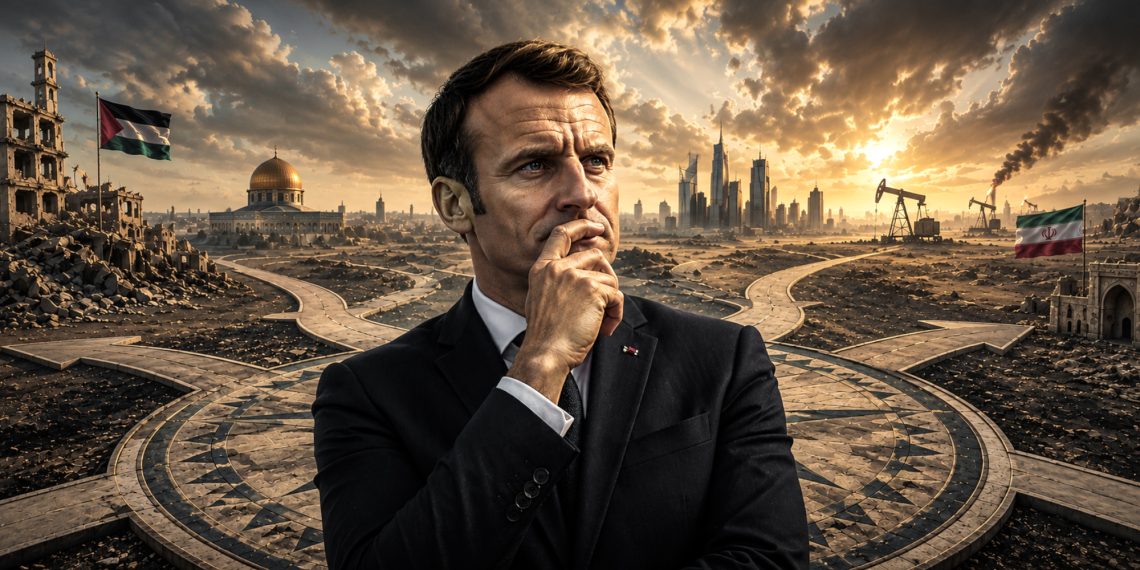
As the American saying goes, “all politics is local.” In France today, it might be said that all geopolitics is local. President Macron’s popularity has fallen to a record low ahead of France’s 2027 presidential election (President Macron is not running for another term), according to an IPSOS BVA-CESI poll, with only 16 percent expressing a favorable opinion of him.
France is also confronting persistent youth protesters since May 1968, multiple crisis, severe cost-of-living and energy crisis, aggravated by a global fuel-supply shock linked to the U.S-Israel war on Iran, and unconventional Saudi-Houthis (Ansar Allah) war in Yemen. The consequences of these wars are affecting energy prices, fertilizer and cereals supplies, shipping maritime routes and the wider European economy.
Recently, President Macron criticized the international response to the carnage in Gaza Strip, arguing that the failure to reopen humanitarian corridors in the Gaza Strip represents a shameful failure of collective action. At the same time, France has continued to position itself as a diplomatic and military actor in the Middle East undergoing a thoughtful strategic transfiguration.
What exactly is Macron’s strategy in the Middle East?
On October 24, 2023 President Macron called for an international military alliance against Hamas and for a decisive relaunch of the Middle East peace process. Paris last year did recognize symbolically the Palestinian state, last Summer Paris organized Paris Conference to revive the two state-solution and the future of Palestine. Yet France’s diplomatic posture has increasingly been accompanied by military and strategic commitments in the region. The controversy surrounding France’s relationship with Israel has further complicated Paris’s claim to an independent diplomatic role. France has authorized Israeli Prime Minister Benjamin Netanyahu’s plane to cross French airspace, while he was traveling to the United Nations General Assembly, despite the International Criminal Court arrest warrant against him.
Critics in the European Parliament and the left opposition in France have condemned the decision, arguing that it undermines France’s commitment to international law. At the same time, research by rights groups has raised questions about French military exports to Israel, reporting 35 new sales authorizations between May and September 2026. These developments expose the tension at the heart of French Middle East foreign policy: Paris seeks to present itself as a diplomatic power capable of speaking to all sides, while maintaining strategic, military and economic relationships that increasingly put it inside the regional balance of power, a policy that was lost under President Macron’s Administration.
Yanbu and the return of French military presence
President Macron has announced plans to deploy French military assets to Saudi Arabia to help protect the strategic oil terminal at Yanbu on the Red Sea. France would reportedly provide radars and air-defense systems to protect the site. The East-West Petro-line, stretching across Saudi Arabia from the kingdom’s oil-producing regions on the Arabian Gulf to Yanbu on the Red Sea, was constructed precisely in the 1980s to provide an alternative route in times of crisis. It allows Saudi crude to reach international markets without passing through the Strait of Hormuz.
Thus, the G7 countries agreed to release up to 100 million barrels of oil and diesel in an effort to ease supply pressures that have pushed fuel prices sharply higher. Diesel prices have reached record levels in parts of Europe, while the disruption to oil and fertilizer supplies threatens to deepen economic pressures ahead of the winter season.
President Macron has insisted that France’s objective is to protect critical infrastructure and energy routes. Last month in a prime-time interview on international affairs, he emphasized that France’s role would be defensive: military personnel, radars, and air-defense systems would be deployed to protect the Saudi energy facilities.
The war in Yemen has lasted for more than a decade, producing one of the world’s most severe humanitarian crises. The seizure or disruption of strategically important ports and supply routes threatens not only local populations but also global energy and food security. The Houthi movement (Ansar Allah), demonstrated its ability to threaten infrastructure and shipping far beyond Yemen’s West coast borders.
The Houthis strategy has repeatedly sought to increase pressure on Saudi Arabia and its international partners by exploiting the kingdom’s vulnerability to attacks on critical infrastructure. The Red Sea and the Gulf have effectively become interconnected strategic theaters. Any sustained disruption of shipping through the Bab al-Mandeb on the Red Sea or on the Strait of Hormuz could rapidly translate into higher energy costs in Europe and Asia.
Paris wants to avoid becoming directly involved in another Middle Eastern war, yet the security of European energy supplies increasingly requires some form of military protection. France’s overseas military presence, including its bases and facilities in Djibouti, Jordan, and the United Arab Emirates already gives it a strategic position along the principal maritime and energy corridors linking the Mediterranean, the Red Sea and the Gulf.
From Lebanon stake to the Gulf rake
During the Lebanese civil war (1975-1990), Paris attempted to combine diplomatic mediation with a military presence. The experience was traumatic. In October 1983, Hezbollah carried out near-simultaneous bombings of the U.S. and French Marine barracks in Beirut, killing 241 US Marines and 58 French soldiers. The episode remains a reminder of the dangers involved when France attempts to combine diplomacy, military presence and regional crisis management.
In 1990, France deployed forces to Saudi Arabia as part of Operation Desert Shield. The French ground component, known as Division Daguet, later participated in the 1991 Gulf War alongside the US-led coalition. France also deployed combat aircraft and naval units, with the operation commanded by General Michel Roquejeoffre. Three decades later, the strategic environment is different, but the underlying dilemma is remarkably familiar: how can France protect its interests without becoming a participant in a wider regional war?
A decade of strategic setbacks
France’s position in the Middle East cannot be separated from the broader difficulties it has encountered across the MENA region and in the African Africa. Macron’s policies toward the African Sahel have suffered major setbacks. France’s military withdrawal from several former areas of influence has been accompanied by a sharp decline in French diplomatic and military leverage.
Subsequently, under article 35 of the Constitution, the government must inform the Parliament within three days of a decision to deploy armed forces abroad. If the deployment continues beyond four months, its extension must be authorized by Parliament. In light of a divided lower-chamber and a weak government, the difficulty lies in determining what constitutes a military intervention falling within the scope of the provision.
Paris has also sought to maintain influence in the Horn of Africa, particularly around Ethiopia, Djibouti, and the Red Sea. Djibouti remains especially important because of its position near the Bab al-Mandeb Strait and its concentration of foreign military bases. The old French model, combining diplomatic influence, military presence, and economic partnerships is under pressure — across Africa and the Middle East, regional powers increasingly insist on greater strategic autonomy, while China, Russia, Türkiye and the Gulf monarchies have expanded their influence.
This is the paradox of Macron’s Middle East foreign policy. For much of his presidency, the guiding principle of en même temps doctrine doing two things simultaneously shaped France’s domestic and foreign policy. But the Middle East may be making that formula increasingly difficult to sustain Macron’s decision over Yanbu Port may reveal whether France is attempting to rebuild a distinctive strategic role in the Middle East or simply responding to a crisis that has exposed Europe’s dependence on regional energy security.
In sum, France cannot indefinitely separate diplomacy from military power, or European energy security from Middle Eastern geopolitics and economics imperatives. The Red Sea, the Gulf, and the wider Middle East are now part of a single strategic equation. “Macron of Arabia” a political metaphor for France’s attempt to recover a geopolitical role in a region where the balance of power is rapidly changing.