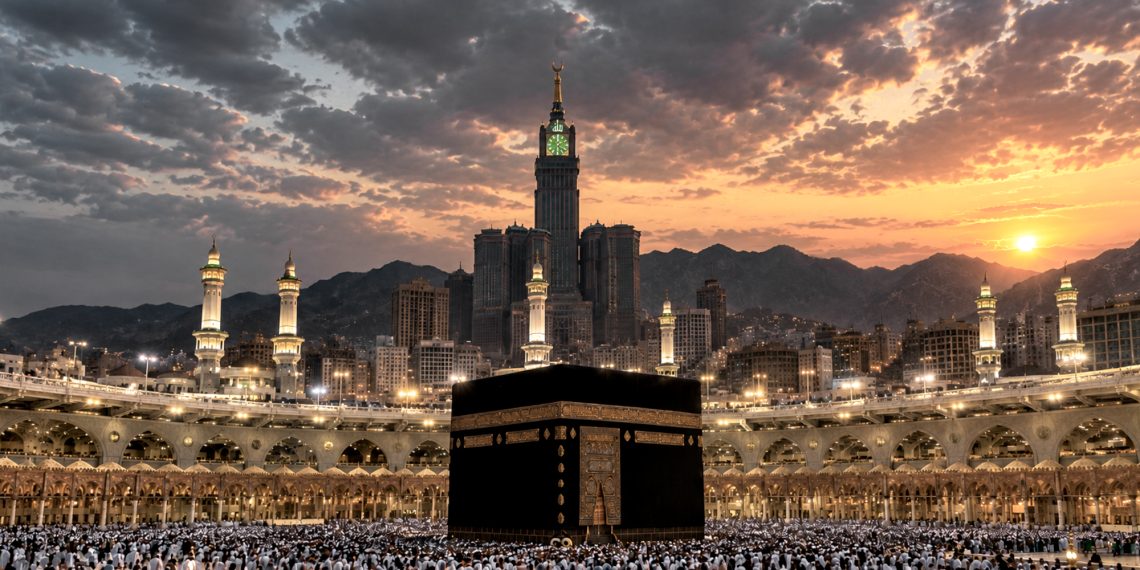
On 15 September 2026, warning sirens sounded over Makkah, Islam’s holiest city. The following day, Saudi Arabia declared its security a red line, and a nuclear-armed Pakistan pledged to answer for it. This article reads that moment as more than a Gulf crisis. It argues that the Middle East has now acquired, in one theatre and for the first time together, the three conditions that historically precede a systemic war, and that these conditions are being actively operated rather than left latent. What follows is an interpretation of a trajectory, not a forecast of an event. It does not predict a third world war on a calendar. It argues that the structural preconditions the discipline associates with systemic war are now in place, that the reassurance offered against this reading repeats the error of the 1930s, and that the frame of 1939 is analytical rather than rhetorical.
The Three Conditions for a Wider War
The argument rests on a structural account of how multipolar systems generate systemic war. Christensen and Snyder (1990) identify two alliance pathologies that recur when such systems come under strain. In chain-ganging, states bind themselves so tightly to an ally that any member’s war becomes general, the dynamic that globalised the local crisis of 1914. In buck-passing, states leave the burden of deterrence to others until no actor carries it, the dynamic that permitted German expansion through the 1930s. These are conventionally treated as alternatives. The claim here is that systemic war becomes most probable when the two operate at once, when part of the system appeases while another part contracts binding commitments, so that a local trigger meets a mechanism already built to transmit it outward. A prior condition governs both. Each pathology produces war only against a background of active revisionism, a power or powers testing the limits of the order and finding them unenforced. Where appeasement, an armed guarantee, and a live revisionist frontier coincide, escalation ceases to be contingent and becomes structural, because each unanswered move lowers the cost of the next and narrows the range within which any actor can still choose restraint. The sections that follow establish that these three conditions now hold at the same time in the Middle East, and that their concurrence, rather than any single event, is what warrants the comparison to 1939.
The 1930s are worth recalling precisely, because the parallel lives in the sequence rather than the slogan. The Rhineland was remilitarised in 1936, and the guarantor powers did not move (Bouverie 2019). Austria was absorbed, and the Sudetenland conceded at Munich in 1938, buck-passing dressed as prudence. Only in March 1939, once the trajectory was undeniable, did Britain and France guarantee Poland, a chain-ganging tripwire laid too late to deter and timed almost perfectly to globalise the war it failed to prevent. The invasion of September 1939 was the least surprising event of the decade. The error was never that the trigger could not be foreseen. It was that each crisis was judged in isolation, as a discrete problem to be managed, rather than as a stage in a direction of travel. That error is being repeated.
The First Condition, Two Expansionisms
The revisionist frontier this theatre presents is double. Two powers, not one, are testing the limits of the order at the same time, and their trajectories intersect on the same ground.
The first is Iran. Over two decades, it has built a regional hegemony through proxy rather than conquest, a network running from Hezbollah through the Iraqi and Syrian militias to the Houthis, engineered to reach Israel’s borders and the Gulf’s shipping lanes while keeping Iran itself insulated. The 2026 war dispersed this project rather than destroying it. The Houthis have since seized Mokha, taken Perim Island in the Bab al-Mandab, and launched missile and drone barrages into the kingdom (Times of Israel 2026; Al Jazeera 2026a). This is the strategy working as designed, imposing cost on the Gulf and on world trade from the chokepoint through which much of the planet’s energy moves, and doing so from behind a shield of deniability that keeps the sponsor formally absent.
The second is Israel, and it is the revisionism the region names least readily. The government now advancing towards its October election rests on a far right whose declared programme is territorial and maximalist. It has pressed annexation in the West Bank, legislated a death penalty for offences it frames as terrorism, and shown a readiness to strike across the whole theatre, into Iran, Lebanon, Syria and Yemen, treating the region as a single field of operations. The judgement rests on observable policy rather than on any claim of a concealed design. What matters is the strategic signature, a state persuaded that its security requires the continuous forward use of force and bounded by no line it is willing to respect.
The significance lies in the doubling. A single expansionist power can be balanced or contained. Two, advancing at once and each reading the other as the aggressor on the march, remove the slack a system needs to absorb a shock, because every move by one becomes a justification for the other. That is the first condition, and it is the ground on which the remaining two operate.
The Second Condition, the Guarantor Who Stepped Back
The second condition is a guarantor that declines to enforce the order it underwrites, and it is now on the record in detail. As the Houthis seized Mokha and pushed towards the Bab al-Mandab in September 2026, Mohammed bin Salman telephoned Donald Trump twice in a single day and asked directly for American strikes on the group. Trump declined both times (Axios 2026). The refusal was not a lapse in attention. It was a decision, restated over the following week even as the Houthis completed their seizure of an island in the middle of the strait and Brent and West Texas Intermediate crude pushed above one hundred dollars a barrel (Times of Israel 2026). Washington’s stated position is that it is already supplying what Riyadh needs, intelligence, targeting data, and more than two hundred personnel in a non-kinetic role, while reserving American force for Iran and the Strait of Hormuz (Axios 2026). The kingdom, rebuffed, has turned to Britain for operational support and to a wider circle of partners for air defence (The Hill 2026).
This posture is more revealing than a simple withdrawal, and it is the precise shape of the buck-pass. A guarantor that abandons an ally outright at least signals a clear limit. A guarantor that supplies everything short of the decisive act signals something more corrosive, that it will underwrite the war administratively but not own its outcome, leaving the exposed client to carry a fight the patron will not finish. Christensen and Snyder’s buck-passing is exactly this, the transfer of the burden of enforcement to another actor in the hope of conserving one’s own strength, and it was the pathology that let German expansion run through the 1930s while the guarantor powers husbanded theirs. Munich, too, was framed as prudence and support rather than surrender. The mechanism does not require a guarantor to leave. It requires only that the guarantor decline to be the one who fights, and that is now on the record twice in a single day.
The signal such a posture sends is read across the whole system, not only in Riyadh. When enforcement becomes selective, when a patron fights the war, it chooses against Iran and refers the war it does not choose back to the client, every actor recalculates. The Houthis learn that the ceiling on their advance is Saudi capacity alone, which a decade of inconclusive war has already shown to be limited. Tehran learns that the cost of operating through its most deniable proxy has fallen, because the proxy’s principal adversary now fights without its guarantor. And the Gulf monarchies learn that the American umbrella is conditional, which is the lesson that sends them to build an alternative. The guarantor’s half-step is therefore not a brake on the machinery. It is the permission that sets the third condition in motion, because a client who cannot rely on the patron will manufacture a guarantee of its own.
The Third Condition, the Tripwire and the Exposed States
The third condition, the tripwire, has just been laid. Unable to rely on the American umbrella, Saudi Arabia, Turkey and a nuclear-armed Pakistan have ratified the Makkah Joint Defence Agreement, whose central clause, modelled on NATO’s Article 5, treats an attack on one as an attack on all (Al Jazeera 2026a). This is the Polish guarantee reborn in the Gulf, and it carries the same globalising function. The danger is sharpened by what the pact withholds. Its text has never been published. Whether its guarantee extends to nuclear weapons remains deliberately unstated, and that ambiguity is itself the deterrent, since an undefined promise signals more than a defined one can bind. Pakistani forces are already deployed in the kingdom to protect it and the two holy sites, and the military has pledged to stand with Riyadh physically and to go to any extent (Al Jazeera 2026b). A local war in Yemen is now wired to the only nuclear arsenal in the Muslim world through a treaty almost no one has read.
The Gulf monarchies occupy the role that small, exposed states have always held on to the approach to a systemic war. Saudi Arabia is under direct and repeated attack. The United Arab Emirates and Qatar, exposed to the logic if not yet to the missiles, hedge through their own arrangements and court external protection while working to avoid becoming targets. These are not powers driving events. They are the objects of a contest between larger revisionisms, and their search for guarantees is precisely what threatens to draw the guarantors in. Belgium did not will 1914, and Poland did not will 1939. The states that trigger systemic wars are seldom those that want them. They are those whose vulnerability forces stronger powers to choose between abandonment and escalation. The Gulf has now manufactured that choice and handed it to a nuclear alliance.
The Trigger, Makkah as Sacred Referent
The trigger, when it comes, will be theological before it is territorial, and the region has already rehearsed it. On 16 September 2026 Saudi Arabia said it had intercepted a drone bound for Makkah and named the holy city’s security a red line (CNN 2026). The Houthis denied targeting it, as they denied comparable accusations in 2016 and 2017, insisting their aim was oil and military infrastructure far from the sacred sites (Al Jazeera 2016). Whether the drone was aimed at Makkah is unknowable, and for the mechanism it is beside the point.
What matters is the securitising power of the claim. Buzan, Wæver and de Wilde (1998) describe how an actor lifts an issue above ordinary politics by naming an existential threat to a cherished referent, and no referent in the Muslim world carries the charge of Islam’s holiest city. The claim converts a distant Yemeni war into a civilisational one. It drew condemnation from the Organisation of Islamic Cooperation and from Islamabad within hours, and it codes a Zaydi Shia movement as a violator of the Sunni sacred centre. It also activates Pakistan’s self-image as protector of the two holy sites, the theological identity that makes the only Islamic nuclear power the natural respondent. The narrative is the weapon, and its object is the threshold of mobilisation.
Against the Reassuring Reading
The reassuring reading holds that none of this will run. Middle Eastern crises contain themselves. Deterrence and exhaustion cap escalation. The Makkah pact is theatre, and its secret text and legal delays, with Turkey unable to activate it until a parliamentary vote that may not come before October, are taken as proof that it will never be used. This confidence is comfortable, and it is mistaken, for the same reason the equivalent confidence was mistaken in 1938. Each reassurance is an argument of about one crisis in isolation. The danger is not any single crisis. It is that the three conditions are present together, that the buck-passing has already begun rather than merely looming, and that the tripwire is already laid rather than hypothetical. Containment has held so far because the guarantee has been performed rather than executed, and performance is the condition of the interval before a war, not evidence against one.
The Warning
The finding is therefore precise, and it is not a prophecy. The Middle East has not entered a general war. It has finished assembling the mechanism by which one would form, and it has begun to operate that mechanism. When the theatre enters fully, when an Israeli campaign, an Iranian counter, a Gulf tripwire and an external patron are engaged at once, the war will not be declared, because wars of this kind are no longer declared. They accrete through commitments that cannot be withdrawn, and they are named only once they are already underway. The lesson of 1939 was never that Poland was a surprise. It was that the invasion was foreseeable for years, and that the people who mattered spent those years explaining why the trajectory would resolve into something more manageable instead. The trajectory in the Middle East is now visible in the same way. The siren over Makkah is not the war. It is the rehearsal, and the machinery around it is already real.
References
Al Jazeera (2016) Saudi Arabia intercepts Houthi missile near Mecca, 28 October. Available at: https://www.aljazeera.com/news/2016/10/28/saudi-arabia-intercepts-houthi-missile-near-mecca (Accessed: 20 September 2026).
Al Jazeera (2026a) Houthi attacks on Saudi Arabia could activate defence pact, Pakistan says, 9 September. Available at: https://www.aljazeera.com/news/2026/9/9/pakistan-warns-mecca-defense-pact-will-activate-after-houthi-attacks (Accessed: 20 September 2026).
Al Jazeera (2026b) Pakistan pledges full commitment to defence of Saudi Arabia, 18 September. Available at: https://www.aljazeera.com/news/2026/9/18/pakistan-pledges-full-committment-to-defence-of-saudi-arabia (Accessed: 20 September 2026).
Axios (2026) Saudi crown prince urged Trump to strike Houthis amid Red Sea threat, 11 September. Available at: https://www.axios.com/2026/09/11/houthis-yemen-saudi-trump-mbs-strikes (Accessed: 20 September 2026).
Bouverie, T. (2019) Appeasing Hitler: Chamberlain, Churchill and the Road to War. London: The Bodley Head.
Buzan, B., Wæver, O. and de Wilde, J. (1998) Security: A New Framework for Analysis. Boulder, CO: Lynne Rienner.
Christensen, T.J. and Snyder, J. (1990) ‘Chain Gangs and Passed Bucks: Predicting Alliance Patterns in Multipolarity’, International Organization, 44(2), pp. 137–168.
CNN (2026) Saudi Arabia accuses Houthis of ‘red line’ attack on Mecca as rebels face outrage from Muslim world, 16 September. Available at: https://www.cnn.com/2026/09/16/middleeast/saudi-arabia-houthis-mecca-attack-intl-hnk (Accessed: 20 September 2026).
The Hill (2026) Trump leaves Saudis in the lurch with hands-off response to Houthi advances, 17 September. Available at: https://thehill.com/policy/defense/6092199-trump-saudis-houthis-fight-red-sea/ (Accessed: 20 September 2026).
Times of Israel (2026) Trump said to reject Saudi request for strikes on Houthis, as they complete Bab el-Mandeb takeover, 12 September. Available at: https://www.timesofisrael.com/trump-said-to-reject-saudi-request-for-strikes-on-houthis-as-they-seize-red-sea-island/ (Accessed: 20 September 2026).