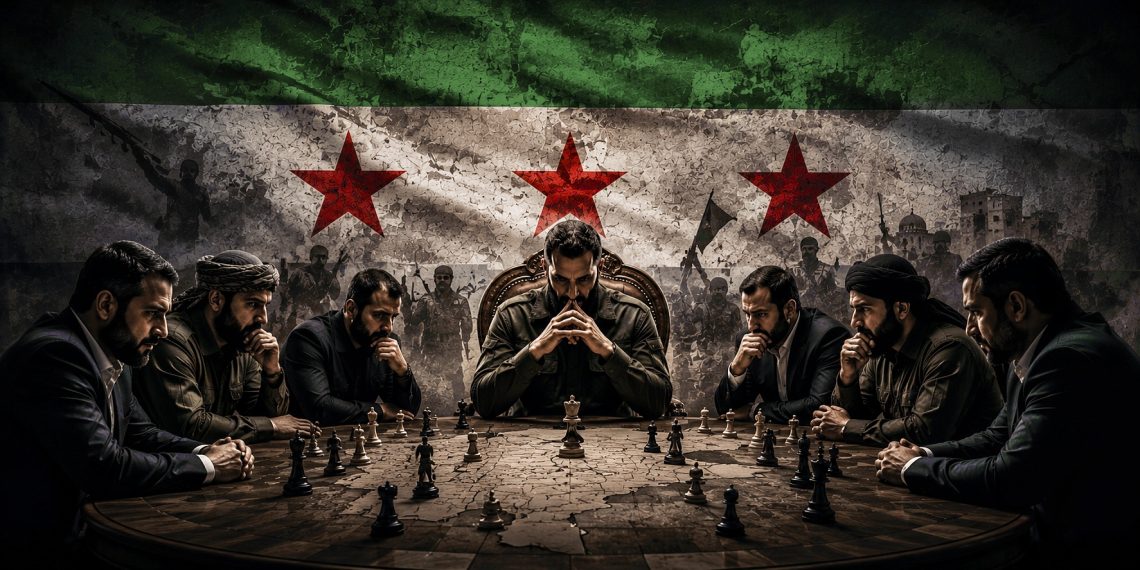
Genuine disagreements and rivalries appear to be developing within Syria’s new ruling establishment over the distribution of authority, access to resources, senior appointments, and control of the country’s security, military, and economic institutions. Yet the information currently available is not sufficient to verify the detailed narrative circulated by the social media account known as “The Root of the Conflict in Syria,” particularly its allegations concerning political assassinations, links to foreign intelligence services, the deliberate facilitation of bombings, and the purported presence of a British team directing Syrian officials from inside the Presidential Palace.
These are exceptionally serious claims, and no publicly available, independently verified evidence has so far emerged to substantiate them. They should therefore be treated as allegations reflecting an internal political dispute rather than as established facts.
Nevertheless, the publication remains politically significant because it offers insight into an opposition discourse emerging from within Syria’s former jihadist milieu. Its value lies less in proving specific events than in revealing how former insiders interpret the changing balance of power around President Ahmed al-Sharaa.
The account is widely believed to be associated with Saleh al-Hamawi, a former senior figure in Jabhat al-Nusra who later became a vocal opponent of al-Sharaa. His familiarity with the internal structure of Jabhat al-Nusra and Hayat Tahrir al-Sham, as well as with the relationships and rivalries among their leading figures, gives his claims a degree of contextual relevance. At the same time, his long-standing personal and political confrontation with al-Sharaa raises legitimate questions about the neutrality of his account and the extent to which it may be shaped by factional grievances.
Security appointments announced on July 19, 2026, suggest that these tensions have not, at least publicly, developed into violent purges or institutional collapse. Interior Minister Anas Khattab was appointed head of the National Security Bureau while retaining his ministerial portfolio. Hussein Salameh was named his deputy, while Abdul Qader Tahan was appointed head of the General Intelligence Directorate.
The appointments point to an effort to recentralize the security establishment under Khattab’s authority. They may also indicate an attempt to contain Salameh within a more subordinate institutional position rather than remove him entirely from the power structure. Such arrangements are consistent with a strategy of balancing rival centers of influence while preserving the cohesion of the ruling circle.
The most plausible assessment, therefore, is that Syria is currently witnessing a controlled rivalry within the upper levels of the new leadership rather than an open confrontation. Competition appears to revolve around institutional jurisdiction, control of security files, access to political influence, and proximity to the presidency.
The underlying risk is that the new state is being constructed through networks of personal trust and wartime loyalty rather than through clearly defined institutions, transparent chains of command, and independent oversight. This process is taking place amid concentrated presidential authority, weak accountability mechanisms, the persistence of a war economy, and widespread allegations of local corruption.
The overlap between emerging state institutions and the informal networks inherited from the former armed movement could eventually transform bureaucratic disputes into broader political or security confrontations. Such escalation could take the form of dismissals, marginalization, factional restructuring, selective anti-corruption campaigns, or the exclusion of figures seen as developing independent power bases.
For the time being, however, a managed redistribution of authority remains more likely than an immediate rupture within the leadership. The future stability of the new Syrian order will depend largely on whether its leaders succeed in transforming personal and factional loyalties into functioning state institutions governed by law, accountability, and clearly defined responsibilities.
The Transitional Phase and the Struggle over Power Distribution
The fall of Bashar al-Assad’s regime on December 8, 2014, led to a transfer of power to Ahmed al-Sharaa and the military forces that spearheaded the offensive on Damascus, most notably Hayat Tahrir al-Sham. On January 29, 2015, al-Sharaa was appointed head of the transitional government, and a new government was formed in March of the same year. Although the government included technocrats and representatives from various political groups, the key ministries—Interior, Foreign Affairs, and Defense—remained under the control of individuals trusted by al-Sharaa or belonging to his political and organizational circle.
The structural problem lies in the fact that the Syrian transition did not stem from a comprehensive political settlement or a constitutional balance of power, but rather from a swift military victory followed by the transfer of the administrative and security model established in Idlib to a larger, more diverse, and more complex state. The constitutional declaration granted the president broad powers to appoint ministers, members of the legislative branch, and judicial and security officials, within a presidential system that lacks a prime minister and fails to provide a robust institutional check on power. In July 2026, a transitional legislative council of 210 members was formed, 70 of whom were directly appointed by the president, while the remainder were chosen from regional electoral bodies. However, the council operates within a presidential system in which its power remains relatively limited, reinforcing the belief that the real decision-making center remains confined to the presidency, the security apparatus, and their inner circles.
Therefore, internal power struggles are neither unexpected nor exceptional, but rather a near-natural consequence of the transformation of military and organizational leadership into state authority. Commanders who had managed separate security and military sectors during the war were now required to operate within ministerial and legal structures, while the boundaries between the powers of the presidency, the Ministry of the Interior, the General Intelligence Directorate, National Security, the army, and local leaderships remained largely undefined.
How should the publication “The Root of the Conflict in Syria” be interpreted?
The publication can be broken down into three distinct layers. The first layer comprises a general political conclusion: that the regime monopolized power, relied on a narrow circle of close associates, and that disagreements arose between security agencies and figures. This conclusion partially coincides with independent reports that addressed the concentration of powers in the presidency, the continued control of sovereign positions by those close to Hayat Tahrir al-Sham, and the emergence of a pattern of personal rule or “new political paternalism” in managing the transitional phase. (The second layer includes potential information about jurisdictional disputes between the Ministry of Interior, intelligence, and national security, and about competition between security networks with different local and organizational backgrounds. This information seems structurally plausible; the multiplicity of agencies, the ambiguity of command lines, and the transfer of fighters and leaders from an armed organization to the state all contribute to competition over arrests, investigations, intelligence gathering, contact with foreign agencies, and control of resources and headquarters.
The third layer comprises unsubstantiated accusations, including that al-Sharaa ordered the assassination of Abu Maria al-Qahtani, that Syrian leaders report to a British team inside the Presidential Palace, that Hussein al-Salama deliberately allowed bombings to occur, and that certain individuals are linked to Mossad or foreign agencies as operatives. There is insufficient evidence in reliable open sources to substantiate these claims, and it is unprofessional to treat them as factual reports. The publication is also weakened by its categorical language; it does not present verifiable evidence, fails to distinguish between direct information, inference, and hearsay, and conflates political rivalry with criminal accusations. Therefore, it should be treated as part of a larger document.) This stems from a war of narratives within the former jihadist elite, perhaps a means of exerting pressure, issuing warnings, or settling scores, rather than being a definitively confirmed leak in all its details.
The case of Abu Maria al-Qahtani and the limits of the accusation
Abu Maria al-Qahtani, whose real name was Maysar Ali Musa al-Jabouri, was killed in April 2024 in the Sarmada area of Idlib, in an explosion that targeted his location. Al-Qahtani was a prominent leader in Jabhat al-Nusra and later Hayat Tahrir al-Sham. He was also involved in internal disputes with circles close to the group’s leadership, leading to his arrest on charges of collaborating with foreign intelligence agencies. He was later released and gradually returned to his activities.
Accordings at the time suggested that the attack was carried out by a suicide bomber or an improvised explosive device (IED), and various analyses were offered regarding who might have benefited, ranging from ISIS to internal rivals and other networks. However, the debate about the potential beneficiary does not constitute proof of Sharia responsibility for the operation. No public judicial investigation or independent physical evidence has emerged to prove that the assassination was ordered by the Hayat Tahrir al-Sham leadership. The use of al-Qahtani’s killing in the publication serves a clear political purpose; it presents the incident as a precedent for a supposed pattern of eliminating leaders when their influence or connections expand beyond central control. This is a hypothesis worth monitoring, but it only becomes a reality with a series of repeated pieces of evidence or incidents that prove the existence of a systematic pattern of purges.
The Significance of the Security Apparatus Restructuring
The decisions issued on July 19, 2026, acquire exceptional significance in assessing these allegations. Anas Khattab, the Minister of the Interior, also became the Director of the National Security Bureau, while Hussein Salameh moved to the position of Deputy Director of the Bureau, and Abdelkader Tahan was appointed head of the General Intelligence Directorate.
These decisions can be interpreted in four interconnected ways: First, there is a trend toward unifying the security leadership and reducing duplication between the Ministry of the Interior, the National Security Bureau, and the General Intelligence Directorate. Combining the Interior and National Security portfolios in Anas Khattab’s hands grants him broad authority over internal security and the coordination of agencies, making him one of the most powerful figures in the state after the president.
Second, Hussein Salameh’s transfer from heading a senior security agency or position to the deputy directorship of the National Security Bureau indicates a relative demotion, but it does not prove his complete removal or his transformation into an opponent of the regime. The decision may be a compromise to preserve his position, while transferring day-to-day executive decision-making to Anas Khattab and Abdelkader Tahan. Third, the appointments reveal a need to redefine the boundaries between agencies, which partially reinforces the hypothesis of prior power struggles. If relations had been completely stable and structures clear, the need for such a redistribution of positions would not have arisen.
Fourth, the appointments contradict the more extreme part of the report, which anticipates al-Shara’s swift removal of Anas Khattab. The current decision does not indicate his dismissal, but rather his rise and the expansion of his powers. This could be an expression of al-Shara’s confidence in him, an attempt to co-opt him within the power structure and prevent him from building an independent apparatus, or both.
The most likely interpretation is that al-Shara’ is employing a policy of balancing and consolidating power; granting a powerful figure additional authority while keeping the rest of the leadership within a cohesive structure that ultimately depends on the presidency. This is a common tactic in transitional regimes that fear defection as much as the emergence of an independent power center.
Anas Khattab: Security Partner or Potential Rival?
Anas Khattab’s importance stems from his extensive experience in security work within Jabhat al-Nusra and Hayat Tahrir al-Sham, and from his move, after the fall of the regime, to a highly sensitive official position. As Minister of the Interior and Director of the National Security Bureau, he became directly or indirectly responsible for a broad range of security, policing, intelligence, disarming armed groups, and pursuing networks of the former regime and organized crime.
The expansion of his powers does not necessarily mean he has become a rival to al-Sharaa. His rise may be a result of the president’s reliance on him to rebuild the security state. However, historical experience with armed movements suggests that a security leader who gathers information, files, and networks of officers can transform into a political power center, even unintentionally.
Therefore, the relationship between al-Sharaa and Khattab will remain governed by a delicate equation: al-Sharaa needs him to maintain internal control, and Khattab needs presidential cover to preserve his influence and the legitimacy of his apparatus. Any attempt by either side to circumvent this equation could create a crisis, but at present, the interests of both parties still lean towards cooperation.
As for the claim that Khattab possesses audio recordings of al-Sharaa’s meetings since 2017, this cannot be verified. This may be partially true in a security environment accustomed to recording meetings, but it could also be a form of political deterrence and a message that any attempt at exclusion will be costly. Therefore, the claim’s value is analytical, as an indication of distrust, not as proof of the existence of a specific archive.
The dispute over state identity
The publication includes a reference to Hussein Al-Salama’s demand that the state’s religious identity be defined and not remain between the Islamic and civil forms. Even in the absence of evidence that he issued this position, the issue he raises is realistic and central, as Al-Sharaa is trying to move from the leader of an organization with a jihadist background to a head of state who seeks international recognition, lifting sanctions, attracting investments, and managing a diverse religious and ethnic society. Therefore, his official discourse tends to be flexible, and to avoid formulating an explicit ideological state, despite the continued presence of the Islamic authority within the new regime.
On the other hand, there are currents within the former military and security base that consider that victory must be translated into a regime with a clearer Islamic identity, and they may see political and diplomatic concessions as a departure from their original goals. The transformation process of Hay’at Tahrir al-Sham was described as a process of de-radicalization that took place from the top of the leadership, without necessarily being accompanied by a similar intellectual transformation at all organizational levels.
Here one of the most important potential lines of division within the authority appears: not only who is in charge of the agency or the ministry, but also what is the nature of the state that the agency is built to protect? Is it a central national state with civil legal authority? Or a country that adopts a clearer Islamic identity? Or a hybrid formula that keeps the issue on hold to maintain the cohesion of the ruling coalition?
Sharaa is likely to continue adopting the hybrid formula, because it gives him flexibility vis-à-vis the outside, while at the same time allowing him not to lose his conservative base. However, if the ambiguity persists for a long time, the theoretical dispute may turn into a conflict over educational curricula, the judiciary, social freedoms, and the composition of the army and security.
Corruption and the economy of influence
Corruption accusations cannot be evaluated in isolation from the Syrian war economy. The new authority inherited collapsed institutions, smuggling networks, a black market, ghost employees, and a class of businessmen linked to the previous regime, as well as factions and local leaders who used to finance themselves from crossings, collections, and confiscations.
Initial government reviews showed the presence of hundreds of thousands of names receiving salaries from the state without actual attendance, and officials also spoke of a large amount of corruption accumulated within the institutions of the former regime.
But combating the corruption of the previous regime does not automatically mean that the new authority is immune from it. Independent press reports documented the continued payment of bribes to restore homes, cars, and property, or to release detainees, and pointed to violations committed by individuals or networks linked to the new regime.
The management of companies and properties belonging to businessmen linked to Assad also raised questions about transparency. Press investigations revealed the role of an undeclared economic committee and figures close to the president’s family in restructuring the assets and major companies. A fundamental problem arises here: secrecy may be justified by the need to dismantle the old regime’s economy, but at the same time it opens the door to the formation of a new, unsupervised network of interests.
As for the allegations related to local leaders in Aleppo collecting millions of dollars in royalties, it was not possible to verify them independently. But they correspond to an objective risk that some local leaders will become intermediaries between the state and the market, benefiting from security control, business licenses, settlements with former regime figures, and the restitution of property.
Therefore, it can be said that corruption in the new Syria is a real danger, but its map, dimensions, and individual responsibilities for it have not yet been proven in a way that allows the accusations contained in the circular to be adopted. The problem is not only an individual moral, but an institutional one related to the absence of financial disclosure, the weakness of the independent judiciary, the absence of a strong oversight parliament, and the failure to deploy mechanisms for managing confiscated assets and public contracts.
The external factor and the limits of intelligence influence
The new Syrian government is dealing with a wide network of external powers, including Turkey, the United States, European countries, and the Gulf states. It is natural for Syrian agencies to compete for control of these contacts, as this grants those in charge political influence, resources, and information.
However, the existence of security cooperation or communication channels with foreign countries does not prove that Syrian figures are being “controlled” by those countries. During transitional phases, multiple agencies coordinate efforts related to combating ISIS, foreign fighters, border security, drug trafficking, missing persons, sanctions, and the protection of diplomatic missions.
As for the claim that a British team within the Presidential Palace receives regular reports from five leaders and imposes dismissal orders, no credible sources have corroborated it. This claim requires concrete evidence or corroborating testimonies before it can be considered factual. The publication likely exaggerates the role of Western advisors and contacts to portray the regime as lacking independence, a recurring element in the rhetoric of al-Sharaa’s opponents from both jihadist and nationalist currents. It is certain, according to numerous press reports, that the team overseeing the Ministry of Interior and its relationship with Anas Khattab is American, not British, and that this team has no direct cooperative ties with the army leadership.
Nevertheless, external actors will have a real influence on the regime’s behavior, as Damascus needs recognition, investment, aid, security cooperation, and the lifting of economic sanctions. Western countries have exerted public pressure on the leadership to rein in the security apparatus, hold those responsible for abuses accountable, and prevent jihadist groups from operating outside the law.
Future Scenarios
Scenario One: Containment and Redistribution of Powers
Al-Sharaa continues to manage the power struggle by rotating positions, merging agencies, and promoting some leaders while demoting others without completely removing them. Anas Khattab serves as the most powerful security coordinator, while Hussein al-Salama and others retain roles within the regime to prevent them from joining the opposition.
This scenario supports the July 19 decision, which redistributed positions rather than creating a complete break. It also serves the interests of all leaders who understand that open conflict could threaten the survival of the new regime in the face of domestic and regional challenges.
Scenario Two: Escalation of Bureaucratic and Security Conflict
Disagreements over arrests, investigations, appointments, resources, and foreign contacts persist, manifesting as leaks, media campaigns, dismissals, officer transfers, and the opening of corruption cases against rival networks.
This scenario does not necessarily lead to widespread clashes, but it weakens the state’s efficiency and increases each official’s reliance on their personal circle. The phenomenon of using anti-corruption as a tool for redistributing power, rather than as a comprehensive institutional policy, may expand.
Scenario Three: Political Removal of a Power Center
If Anas Khattab or any security leader becomes an independent power center, makes sensitive contacts without presidential approval, or publicly disagrees with major policies, the regime may resort to gradually stripping them of their powers, not necessarily through physical elimination. This might begin with appointing deputies and assistants who would challenge his authority, then transferring units of his power, and finally relegating him to an advisory or diplomatic post. This course of action is less costly than assassination and more consistent with the regime’s need to present itself as a head of state, not the leader of an organization that manages conflicts through violence.
Fourth Scenario: Security Division or Internal Armed Clashes
This scenario could unfold if several factors converge: a severe economic crisis, declining external support, disagreements over the state’s identity, attempts to remove a leader with an independent armed force, and local networks rebelling in Aleppo, Idlib, or other areas.
In this case, the conflict might not begin with a centralized coup, but rather with clashes between security units, refusals to obey orders, the protection of wanted leaders, or an alliance of groups affected by restructuring. However, the leadership appears aware of this risk and therefore prefers, thus far, integration and balance, preventing the formations from remaining independent.
The direction of relations within the Syrian leadership can be gauged by monitoring a number of indicators over the coming months.
The most important of these are the transfer of arrest and investigation units between the Ministry of Interior and the intelligence services, changes in security chiefs in Aleppo, Idlib, and Damascus, the release or suppression of news related to Anas Khattab and Hussein al-Salama, the formation of committees to investigate corruption among local leaders, the emergence of leaked audio recordings or security documents, and the expansion of the Presidential Guard or agencies directly affiliated with the palace. The nature of the relationship between the Ministry of Defense and the Ministry of the Interior should also be monitored, as should the fate of military groups with a history of jihad, the establishment of a clear system for ranks, appointments, and accountability, the management of confiscated assets, and the extent to which security agencies are subject to effective judicial and legislative oversight.
The most dangerous indicator, however, would be the shift in discourse from administrative competition to accusations of ideological treason or the labeling of leaders within the regime as apostates or agents of foreign powers. This type of discourse creates an environment conducive to justifying violence and is difficult to contain through bureaucratic compromises.
Therefore, disagreements within the new Syrian regime are likely present and cannot be ruled out, but they are not substantiated with the level of detail provided in the publication “The Root of the Conflict in Syria.” The publication reflects its author’s familiarity with the old organizational structure, but it also reveals his deep animosity toward Ahmed al-Sharaa and employs categorical accusations without providing verifiable evidence.
The most reliable data points to three levels of competition: institutional competition between security agencies over powers, personal competition between networks of leaders, and ideological differences regarding the identity of the state and its foreign policy. Added to this is a struggle for resources stemming from the war economy, the management of the former regime’s assets, and local tax collection and settlements.
The decision to appoint Anas Khattab as head of the National Security Bureau, while retaining him as Minister of the Interior, does not currently support the expectation of his removal; rather, it confirms his rise. Conversely, the appointment of Hussein al-Salama as his deputy indicates a relative reduction and containment of al-Salama’s position, suggesting that al-Shara’ is restructuring power centers instead of dismantling them through violence.
The fundamental danger does not lie in a single personal conflict between al-Shara’ and either Khattab or al-Salama, but rather in the continued construction of the state on a foundation of loyalty and personal trust, instead of legal authority and independent oversight. The longer the transition from “rule by the victorious group” to “rule by institutions” is delayed, the greater the potential for corruption, leaks, defections, and the use of security apparatuses to settle scores. The most likely scenario in the near term is continued cohesion with a redistribution of roles, followed by the possibility of a containable bureaucratic and security conflict. As for assassinations or open confrontations between the leaders, they remain a low possibility that cannot be ruled out, but it should not be considered an inevitable or imminent outcome based on a single post, regardless of its author’s previous relationship with the leaders concerned, especially since Syrian President Ahmed al-Sharaa is still the strongest and most prominent figure and holds the reins of leadership and control among all the leaders.