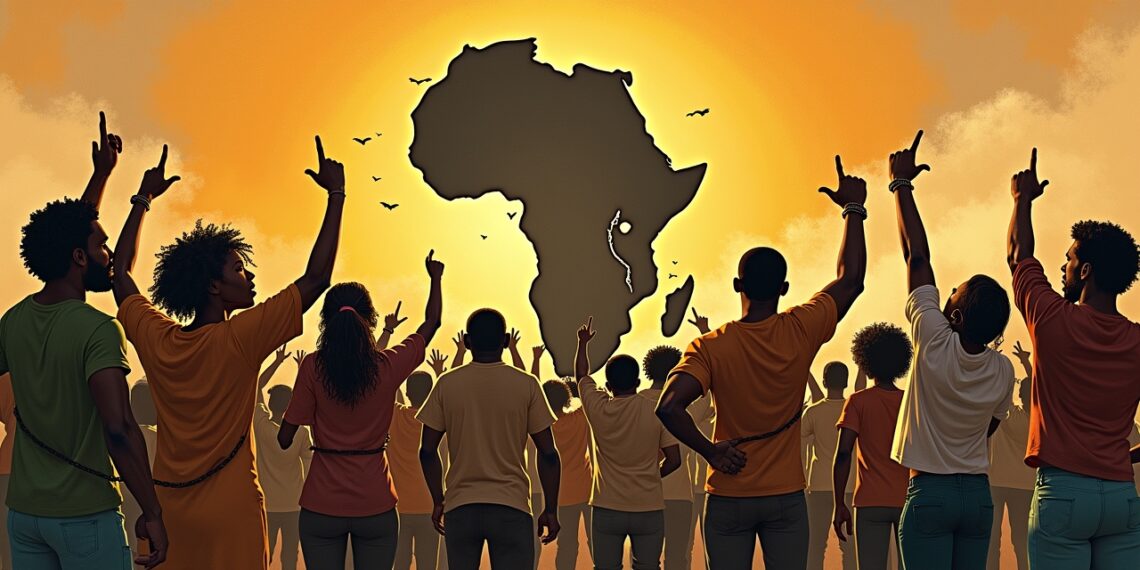
Last week White House meeting in the Oval Office was attended by five West African leaders of Gabon, Guinea-Bissau, Liberia, Mauritania, and Senegal. What mattered to the U.S. president was the gold, oil, and minerals buried beneath their soil. President Donald Trump said in his opening speech at the lunch that the leaders at the splendid table came from “very vibrant places with very valuable land, great minerals, great oil deposits and wonderful people.” Asking the Liberian president about his language skills, where did he learn English. “Such good English, it’s beautiful. Where did you learn to speak so beautifully?”
Permanent state of denial
Liberia was founded in 1822 by the American Colonization Society, whose goal was to resettle freed slaves in Africa. The country declared independence from the American Colonization Society in 1847, and a variety of languages are spoken in the country today.
Another white president did try to humiliate his former colonized society, President Emmanuel Macron’s appeasement in 2017 speech from the podium of Ouagadougou University was highly anticipated, in particular by the African youth, leaders and the progressive elite across the region.
His meeting with the Sahalian leaders in a mini-summit in the Élysée Palace was unusual because of his skepticism toward the African leaders on the thorny question of the “War on Terror” in the Sahel and West Africa. Though the expectation of President Emmanuel Macron’s address to Africans was significant due in particular to the high tension between French administrations both past and present, and the African public opinion and the love-hate relations because of colonization.
For the Burkinabe elite and public opinion in general, it is believed that France’s Intelligence Service had a hand in the tragic disappearance of President Thomas Sankara in 1987, followed by the conditional support to corrupted regimes across the francophone States.
Past French presidents in the Élysée Palace and the Quai-d’Orsay (Foreign Affairs Building) put their utopian agenda in the perspective of a continuity of neo-colonialism imperatives. However, this is the first time that a French president, born two decades later post-independence of African States, doesn’t have personal relations with African leaders (fathers and sons) and intellectually understands the continent’s development and security challenges.
President Emmanuel Macron has participated in the A.U.-U.E. Summit in Abidjan; his speech at Ouagadougou University was aimed to change the historical trajectory in the region, and assure that things will not continue “business as usual” for the African skeptics. A speech that would re-polish the image of France in the region is critical at this point, and this was the president’s strongest point.
A weakening time
But the elite and the political opposition were already manifesting their disappointment, the choice of Ouagadougou University as a tribune to address the Africans was not a consensual pick. The Sahel was then, and is still now in tumultuous deadly sandstorms from dystopian transnational Jihadist groups across the Sahel, suffering attacks on civilians and French and African Union troops on the ground, and further south by the Boko Haram Group, which has created further national security concern for the entire sub-region.
Yet this rhetorical speech was an implicit endorsement of the continuity of the corrupted regimes. Dr. Fatimatou Sheikh bey, a local community organizer with the African Women’s Association in Tremblay (Seine-st-Denis Department), France said in consequence, “the locals did not expect too much from the professorial speech that is undoubtedly Obamanian, eloquent, well-delivered, and not challenging the regimes for real ‘Change,’ just embarrassing the Burkinabe president.” Plus, “it is his job to bring electricity to poor people’s homes, not me,” President Macron said in an interaction style with a local student, in the same rhetorical angle of where did you learn English?
As an aside, Ouagadougou University is named after President Thomas Sankara, (the African Ché), how full of symbol and irony that a French president lectured an entire generation, who still mourn their anti-colonialist leader, who wanted to end France’s patriotism and wanted Africa for the Africans like Patrice Lumumba in the ’60’s.
Today most of the African universities are creating thousands of unemployed, not because of poor academic programs being pursued, but because of the lack of opportunities after graduation, creating general feelings of despondency and hopelessness. This is attributable to the unwise public policy in terms of education and employment in the region, whether in Burkina Faso, Liberia or elsewhere in Africa.
The choice of Ouagadougou University is a geopolitical one, and mainly due to the need of the then-Burkinabe regime to play a major role in the exhausting fight of “terrorism” in the African Sahel and West Africa. This was the case with Mali and Niger, until the young military leaders in these countries did overthrow the old regimes and imposed new relations with the former colonizer such as Burkina Faso. President Emmanuel Macron did not convince the youth in the sub-region to divorce themselves from the colonialist “fault” mentality, and in this stance he mentioned in his speech to “stop blaming us.”
African dream vs. West delusionism
The popularity of this political selling point in Africa in general is still an attractive brand. The leaders are disconnected from the majority of the conventional African elite, media, and the youth, who are dealing with an existential problem based on their marginalization and exclusion from the debate and the decision-making process at home, and the scornful and colonial mentality of the western leaders.
As a result they are dying in the harsh Sahara desert and the Mediterranean Sea, and worst have been exposed publicly to human trafficking and slavery auctions, when fleeing, corruption, poverty and wars. They are left alone without any protection from the Western Humanitarian INGOs, UNHCR, and ECHO, and are the victims of the bold militarized foreign policy of the West. Nonetheless, the point of President Macron’s speech and President Trump’s arrogant remarks are not to bridge a new dynamic based on responsibility and understanding between those of former colonization and a new generation that hopes for a better life at home.
The speech at Ouagadougou University like the White House meeting with the five West African leaders sounded and orchestrated like President Obama’s speech at Cairo University in 2009, when he eloquently lectured the Arab regimes, the elite, media, and the youth. As a result years later the region boasted ruined battlefields to the Al-Aqsa Flood Operation on October, 7, 2023 that changed the region’s geopolitics, unmasking the international system’s double standards policy when it comes to the southerners and the easterns.
President Emmanuel Macron did encourage the reading of intellectual pioneers of the sub-region, religious rapprochement, more rights for women and allowing the youth to have an analytical spirit in order to understand the real challenges facing the continent to become a land of opportunity, unlike President Trump who looks to Africa as a valuable land of rare minerries.
Making an end to USAID that has been helping millions to fight poverty and diseases, President Trump decided to punish millions because their leaders did not support U.S. resolutions in the UNGA on essential resolutions, according to Secretary of State Marco Rubio.
In sum, there is a new generation of politicians, elite, and media in Africa today, pledging to break with neo-colonialism comportment and restore African dignity, yet the West’s swaggering policy in Africa – is post-colonial imperatives based on struggle, as a result of the powerful colonizer has imposed a language and a culture, whereas those of the Oriental peoples have been ignored or distorted, like late Professor Edward Saïd put it.
By Abdennour Toumi
MENA & Africa Political Analyst