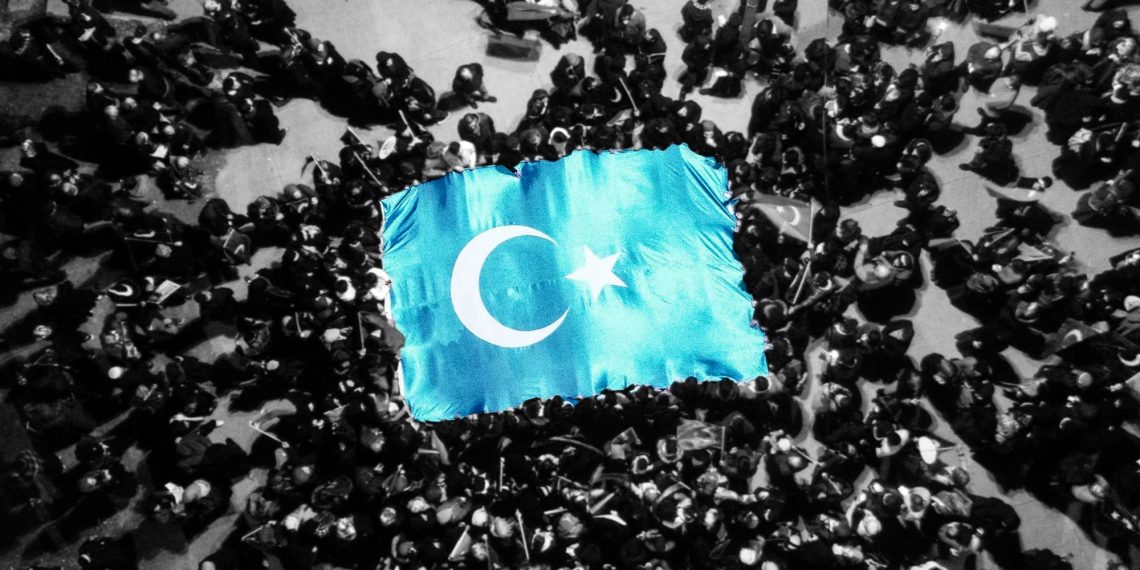
TURKESTANENESS, as a unifying umbrella concept, is a vision of strategic unity. In order to realise this, a general orientation at the individual, society and state levels is envisaged with the civilisationalist nationalist thought within the idea of the necessary operation. Nationalism’s mobilisation of history with a civilisationalist effect will be able to gather the fragments scattered in modern times.
But this alone is not enough. A movement that does not know its purpose is like water flowing in vain. This is where the framework we call the Arrow-Bow Theory of Civilisation comes into play. What will be the civilisational vision of civilisationalists?
Civilisation is to add a new page to a great composition that humanity has sung throughout history by combining the cultural ground of a nationality that sings its folk songs in the historical process with the essence of the great accumulation of humanity in its folk songs.
In view of this importance, the civilisation goal of our nationalism will be to present ourselves to the intellectuality and comprehension of humanity in the footsteps of our folk song.
The enthusiasm of purpose and effort with the practice filtered from the historical experience that the Turkish nationality will offer to humanity as a state and civilisation will be the basis of its civilisation. So, how will this happen?
General framework: Civilisation is the movement of the nationality as a subject/agent, the enthusiasm/romanticism of its material possibilities, which is driven by a specific purpose to offer common values to humanity by finding its form in the life of humanity in its own way within the framework of the state and the city, adorned with multiple merits. One of the biggest survival issues of our nationalism within the reflex of establishing, saving and protecting the homeland is the issue of civilisation.
Because if a culture that does not march towards civilisation cannot develop its state and establish a civilised structure, it begins to move away from its raison d’être like a fruitless tree. Inspired by Nevzat Kösoğlu, the combination of faith with action is of vital importance in this context.
Historical lodge: Civilisation is the ability to gather various nations around common values in one word. As the expected ones of a ruined hill of love in the middle of nowhere, Turks are obliged to carry the exuberant serene sounds of the past to the future with their folk songs. Turks, the nation of impossible love do not forget even if they do not meet.
Even in the most secluded place of loneliness, history and the horizon are light for them. The Turks, who are the tireless, tireless seekers of that inaccessible love of wisdom, the lost of the Ummah, are the valiant travellers of the blackest love.
Turks are the masters of transforming state and cultural systems with their own nationality at their core into multinational unions. Mete Khan, the ruler of our Hun State, expressed this when he said, “I united the tribes who can stretch the bow and arrow like a family and now they have become Huns”.
The presence of Tonyukuk in the Göktürks, Nizamülmülk’s place in the Seljuk State, and many statesmen of the Ottomans are a few examples of the Turks’ state experience of incorporating the environment into their state and civilisation ideal and making it a part of it. The Turk is a nation of the highest calibre that establishes a common value and transforms it into a common cause with its national, religious and humanitarian principles.
Today, this nation, which has been squeezed into Anatolia and is not wanted to see the daylight of this ability again by dealing with its own internal struggles, will reach the nooks and crannies of its memory by giving its nationalism the principles of the cause of civilisation.
In a nutshell, strength is born from unity and those who can unite even different people around the goal conquer the future. Today, a theory of civilisation based on the symbolism of the bow and arrow is a reading, an invitation, a call to those who connect their dreams and visions for the future to a civilisation centre.
Path and Development Framework: While ascending to the sky of civilisation, the next step of our culture after human beings should be umran. Umran, zoning and life are all words from the same root.
The story of our modern-day bedavet which has moved from the village to the city, continues, and we are still in limbo between the village and the city. The development and progress of our state will face difficulties without the establishment of our umran, that is, without the formation of a structure in which the city and the village represent our life with a common language. Here, it is necessary for our asabiyya to develop enthusiastically to support this change and transformation.
Without a driving force, the state and the city, i.e. the nation, cannot develop; in this sense the developments regarding the manifestation of civilisation expected to take place in the city will also have to be postponed. It should not be overlooked that the root of the umran tree is the villages, the badlands.
It would not be wrong to say that the migrations from the village to the city are movements that are correct in the direction of civilisation but cannot be managed correctly in our modern times. The trunk of this root will be the city and the state if the development is correct. While economic events, industry, crafts will take place on this trunk, sciences, educational institutions and art will be formed as fruits.
The lifeblood of this tree will be asabiye – nationality. As can be seen, this civilisation template corresponds to the sociological and social life of the Turks. As an alternative to the view that centralises the economic reality, this understanding that draws people to the centre is a template that our nationalism should take into account within the framework of civilisation.
This framework should be enriched with scientific studies without ignoring the situations and attitudes that each stage will need. Geography, climate and environmental factors and of course, the realities of economics should be considered in their proper place within this structure.
The Turkish University should be the incubator of the knowledge of this civilisation cause. While all these are being discussed, Cemil Meriç’s critical question welcomes us: Culture or Knowledge? Our intelligentsia, which wanders wherever evening or morning, must now identify what is to be appreciated.
Umran is waiting to be rediscovered as a concept of wisdom that combines civilisation and culture. Umran comes from the root amr.
When Cemil Meriç said amr: to sit in a place, to be in a relationship with someone, to cultivate the land, to organise a house, to make it prosperous, etc., he gave our nation an important message that it had never heard. Turks became the flagbearers of the world of order by living their civilisation with wisdom. TURKESTANENESS is a longing for the Red Crescent. Civilisationalist nationalism is the goal and tactical content of this and the Arrow-Bow theoirisi is the name of the method to work on this path.
ARROW-BOW THEORY OF CIVILISATION
While sitting in the shade of a plane tree with my ancestor Yusuf, son, I read your design about civilisation; civilisation is mentioned as the ultimate form/structure formed on the ground of culture, that is in life, within the framework of the triad of society-state and city. In your human-centred thought, you identify the society with the content of family and nation as the widest form of human life.
Thus, you try to explain the social order of man from a rational and factual point of view. Then, when you think about the epiphany called civilisation, you talk about the state, which is the state in which human beings organise their political and economic life as their own legal and moral order, as the order of justice and merit that they have established in order to be sure of their own evil.
In the context of civilisation, the city is the place/space where the social and political life of man is established. Here, you say that culture, the asabiyyah, which is the life of man, creates the umran in the political, social and cultural framework within these parts.
You endeavour to determine the reasonableness of your design by showing the facts and concepts from history. Of course, every design and thought becomes right or wrong by being criticised and open to falsification.
It is essential to add value to life, not to put a point, son said. He said, “Have you searched for a ground of fact by thinking about what you said through the world of facts in the past of Turkish culture?
Yusuf atam, I said; to be blessed is to be honourable and to carry merit. The social structure of the Turks is formed within the framework of their culture / life, starting with the person’s son, that is, the classification starting from the human being is formed as oğuş, urug, boy and the life of the nation is formed within a social structure and the budun is reached.
In this sense, the mind of the Turks creates the social order within a fact structure. Beyond this, the il or el, which I continue to design, represents the state in the life of the Turks. Thus, in an order, civilised life forms its own parts on the ground of Turkish culture. Beyond this, in the life of the nation that builds cities in yurts, wars and fish, their civilisation framework is completed. The cities in Maveraünnehir and the cities on the shores of Sir Derya and beyond are still witnesses to this. Nomads, villages and towns within this life exist as parts of the ground of this integrity.
I said, I think it would be possible to observe the concepts and structures of integrity or civilisation based on the phenomenon from within our culture. In short, in the design I mentioned, civilisation is formed within a structure that shows the parts / society / nation /state and city that have been put forward from the ancient times of history until now. What is technology there, he said? I said that technology is formed as a part of the education, art, economy life formed by the society-state in the city.
The existence of this cannot be excluded; however, I said that in my opinion, technique and technology are possible in civilisation around the more basic concepts I mentioned. I said that putting this at the centre seems to detach civilisation from its parts and crust it on a historical ground.
What makes civilisation international is the commonality of its parts/structures for humanity. Otherwise, culture gives colour to everything and those of it that can create concepts and ideas acceptable to humanity can become generally valid for humanity.
Religion is extremely effective in the formation of this. I said that the ideologies of modern times have also made this a matter of question within the framework of macus and limited. In short, I said atam, the fact that issues that are historical and subject to change/transformation are at the basis of the existence of a concept always carries that concept to a slippery ground. It makes it difficult to find frameworks to agree on.
I said it is dogmatic authoritarianism to absolutise ideology, to assume that the concretisation of culture in certain periods is the essence and essence, and to impose it as such. It dulls thought. It puts people in a dead end in history.
Furthermore, I said that the Turks represented this structure they had established with symbols within their culture. The conception of existence, knowledge and morality is an indispensable framework for a civilisation.
This view or philosophy gives civilisation the meaning of the content, that is to say the content. For without these, society, state and city remain as dry concepts. What is it in Turks, he said. I said, “Atam, it seems as if it is possible to determine this from the Oghuz Khan epic or from our mythological material.”
The symbolism of the bow and arrow is remarkable in these conceptions of the Turks. For the Root Turks, God is the earth and the bow is the element representing the state established with the blessing from the sky.
In this respect, the sky is represented by the bow. From this point of view, the place of God and the state are understood with the bow, so that one of its own civilisational parts establishes its own authentic world of knowledge within the conception of existence. In this sense, the arrow describes the nation and society, which form a whole subject to or together with the bow. Within the structure, state and society are considered together within the function and meaning of the bow and arrow.
I said that this symbolism and phenomenon have an important place in the formation of the foundations of my design. Here, while the bow puts the human and his life into the understanding of existence as a state and the arrow as a nation, geography, space and homeland take place as the beam, that is, the ground that unites these two.
Geography forms the basis of the city. It is the space that shapes the human and the state in life and ensures that they remain useful. Just as the bow and arrow lose their meaning when there is no bowstring, the existence of civilisation is null and void if there is no space/geography. The beam is also a reference to justice as a means of executing the state’s crime. If there is no law and morality, the existence of these three would be as meaningless as a bow and arrow without a bowstring.
I said, “I thought that this is how our knowledge of the view of the existence here gains its own content.” He smiled. Here, atam, I said, through these, my design finds its factual ground and concept world within our own culture. In this respect, I said my ancestor, with your permission, I would like to name this civilisation design of mine as ARROW-BOW THEORY/NAZARIETY.
I said, I would like to give this name to my civilisation design in this respect, since it is one of our most important issues to remain in the position of beautification and not to be able to justify the discourse of being rooted in the past in modern times, and not being able to create a specific epistemology by feeding on our own ontological sources.
However, this is not a point, it should be seen as a movement to think about ourselves in modern times, to pave the way for our consciousness, to look at existence, knowledge and morality with authentic concepts and theories at the point of reviving our culture, that is, to think civilisation on its philosophical foundations.
When Yusuf atam finished his tea, he kissed his hand and got up. As I travelled uphill in the night that smelled of bow flowers, Yahya Kemal’s poem “From Budin to Irâk to Egypt, From the conquered distant lands, The wind that blows free over the homeland, It has taken sound from all the bows. That genius has gathered us in such a way that he has listened to our story, which has lasted seven hundred years, from old sycamores. And I thought of my design with the sound of music descending from the heavens to the ground; weren’t folk songs and songs us in society, state and city?
As I was walking, religion flowed from one side and all life from the other in the music; from all sides, the Bosphorus, that city, the blue Tunca and the lush Euphrates flowed.
With many sounds, the sky and our places, our sadness, our enthusiasm, our victories, a universe similar to ours has flowed…If you have listened to the kemençe this summer in Kanlıca, listen to the tanbûru one night in the bow in Çamlıca.
Yahya Kemal entered my arm with the lines “The homeland is heard in every string of these instruments, the magic wind always blows from this land”. Yes, our music was our civilisation. That’s why its sounds were also about our civilisation.
While the bow and arrow were the common material cultural elements of humanity, they were transformed into a civilisation conception and design through Turkish culture and life, and turned into the theory of the bow and arrow in my mind.
On the road from culture to civilisation, hasn’t humanity experienced many developments in similar phenomena? And does it not continue to live? Can we not think that here the national and the international merge and diverge? Couldn’t the golden bow and silver arrows of Oghuz Khan be telling us a theory again?
Arrow-Bow Civilisation Theory and Our Civilisation as Seen from the Orkhon Monuments
The historical sources of a nation are undoubtedly its existence documents. One knows oneself, one’s identity and one’s personality in the mirror of this flowing water filtered from the roots through history and walks to the future by developing it in the conditions of the time.
No theories will benefit those who do not have a vision of the future. However, those who do not have theories cannot think about themselves on reasonable grounds by seeing the integrity in concepts, facts and life from the past to the future and cannot create solutions to their problems and new life topics.
The fact that thousands of people travelling abroad are subcontractors and cannot bring benefit is perhaps related to this. Those who cannot find mind, idea, concept and fact support for their own constants cannot go beyond imitation.
If we do not have a conception or theory that will transform the existence of the civilisation ground formed around the culture of our nation and nationality in our history from a hypothesis into a reality, we can read thousands of pages, but what we can find in integrity cannot be more than where coincidences drag us.
Here, in our approach to civilisation, which we dare to call the Arrow-Bow theorem (theory) that we put forward about civilisation, which we consider as the pieces of truth that make up civilisation in integrity and which we try to read through reality, we defend the argument that the whole of society-state and city/space/land are the integral parts of the structure that humanity calls civilisation and that when we look at the sources and works of any period of history, we are likely to see something about it.
In this framework, we wanted to think about the Orkhun Abideleri, one of the oldest relics of our culture in Turkish, from this point of view.
Society/Nation
Have we ever thought that some parts of the Orkhon Monuments, which are well-known and well-known, are the manifestations of a civilisation? For example, “When the blue sky above and the greasy earth below were created, the son of man was created between the two. My ancestor Bumın Khan, Istemi Khan sat on the son of man. Sitting down, he kept the Turkish nation’s province, ceremony, and put it in order.
All four sides were enemies. By sending an army, he took the nations on all four sides and made them all subject. He made the head bow to the head and the knee to the knee.” In the monuments, the trinity of heaven, earth and man is touched upon by starting to talk about creation, which has been included in our cultural values such as legends and epics since mythological times.
Since we have based our theory on the arrow, bow and bowstring, which symbolise the sky, earth and man, we can say that our theory is largely in agreement with the narrative here. It would not be wrong to say that our hypothesis of the existence/creation of man and then the formation of society and the state on it is seen in this great source of Turkish state philosophy as the factual equivalent of the phenomenon we are trying to theorise. However, in this sense, observations and falsifications are extremely important in terms of the truth or falsity of our argument in terms of scientific mentality.
In the continuation of the Orkhon monuments, in the context of society / nation and state, “Above, the Turkish God has arranged the sacred place and water in such a way. So that the Turkish nation would not perish, so that it would become a nation, he took my father Iltiriş Kagan and my mother Ilbilge Hatun from the top of the sky and lifted them up. My father kagan went out with seventeen soldiers.
Hearing the sound that he was walking out, those in the city went up the mountain, those in the mountain came down. They gathered and became seventy men. Because God gave strength, my father kagan’s soldiers were like wolves and his enemies were like sheep. He dispatched soldiers from east to west, gathered them and piled them up.
All of them became seven hundred soldiers. He created and educated the nation that had become a nation without a king, a nation that had become a concubine, a nation that had become a servant, a nation that had abandoned the Turkish tradition, according to the tradition of my ancestors.
He organised the Tölis, Tardush nation there.”, the issue is pointed out. Although it is not the subject of this section in the monuments, we should also state that the nation / society is warned by referring the subject to the section we have prepared by looking at the Orkhun monuments on the methods of colonialism. “Because the beys, because the nation is disharmonious, because it is deceptive, because the Chinese nation is deceitful and dishonest, because it pits younger brother and elder brother against each other, because it makes the bey and the nation pull against each other, the Turkish nation has lost the province it made a province and lost the kagan it made a kagan.
He made the sons of beys servants and the daughters concubines for the Chinese nation. Turkish beys left the Turkish name. Chinese beys kept the Chinese name and obeyed the Chinese kagan.” Here, the society is combined with the concept of nation and considered within the state structure, which is a phenomenon that corresponds to the organic integrity and logic of our theory. Isn’t it useful for those who see these monuments as naive tools of vulgarised nationalism to look at Ötüken and our roots within this framework? Where it is said that the name of the Turkish nation should not disappear, is not the name of the society and the centrality of its existence shown to us through life?
State/Nation
In the Orkhon monuments, as seen above, the life of nation and state are united. “Because God was favourable, and because I was fortunate, I sat on the throne as a sultan.”
“The Turkish God and the Turkish holy earth and water (spirits) above did as follows: “So that the Turkic people would not perish, so that they would become a people, my father Ilterish Khan and my mother Ilbilge Khatun were lifted from the top of the sky and raised them higher.”
“Because God so commanded, He left the sovereign without the sovereign, the sovereign without the sovereign, made the enemies dependent, made the kneelers kneel, “God, the state-giving God, who exalted my father, the Khan, and my mother, the khan, so that the name of the Turkic people would not perish, that God placed me on the throne as the Khan, no doubt, so that the name of the Turkic people would not perish” “May God forgive me, because it was my divine favour, because it was my destiny, I brought the dying people back to life and fed them” “(Eternal) heaven surely said: I gave you a khan, you left your khan and followed me. Because you were a follower, (eternal) heaven said ‘die'” As can be seen, the Turkish nation, state, land and waters are mentioned here, and the integrity of society-state and city-space, which is the basis of the Arrow-Bow theory, is mentioned here.
“The Turkish Wise Khan, who created God like God, is my word: My father, the Turkic Wise Khan … Sir, Nine Oghuz, Nine Oghuz, Two Ediz tented beys, nation … When I sat down, the Turkish lords, the nation, who thought they would die, were pleased and rejoiced, and looked up with their eyes fixed on the ground. Bu zamanda kendim oturup bunca ağır töreyi dört taraftaki … dim…Doğuda Kadırkan Ormanı’na kadar, batıda Demir Kapı’ya kadar kondurmuş. Between the two, he was just sitting there, organising the unorganised Gök Turk.
He was a knowledgeable kagan, a brave kagan. Of course his command was knowledgeable, of course he was brave. His gentlemen and nation were righteous. That’s why he kept the province like that.
He kept the province and organised the custom. He died in such a way…. My uncle kagan sat on that honour. Sitting down, he reorganised the Turkish nation, fed it again. He made the poor rich and the few many. When my uncle kagan sat down, I myself was a prince… At the age of fourteen, I sat as a shad on the Tardush nation because God commanded me to do so. With my uncle kagan, we sent an army as far as the Green River and the Shantung plain in the east. We sent an army as far as the Iron Gate in the west. We sent an army as far as the Kyrgyz country by crossing the Kogmen.
In total, we dispatched an army twenty-five times, we fought thirteen times. We made the illi without illi, the kagan without kaghan. We made the kneeler kneel down, the head bow down.”, the place of the state in this integrity is emphasised with these expressions. The perception of the state formed within the society and its order and order are emphasised.
“Turkish, Oghuz beys, hear the nation: If the sky above did not tread, the earth below did not pierce, Turkish nation, who would be able to disrupt the province, the ceremony? Turkish nation, give up, repent! Because of your lack of discipline, you have made a mistake against your kagan who had nourished you, against your free and independent good province, and you have brought it into a bad state.
Where did the armed men come from and scatter them? Where did the spearmen come from and send them away? Nation of the sacred forest of Ötüken, you have gone! Heading east, you have gone! To the west, you have gone! You must have done good wherever you went: Your blood ran like a river.
Your bone lay like a mountain. You have made your sons servants. You made your maiden daughter a concubine. Because of your ignorance, because of your evil, my uncle kagan flew away. I first erected the Kyrgyz kagan as a balbal. God, the God who raised my father kagan and my mother khan, the God who gave the province, made me sit on that God kagan, of course, so that the name of the Turkish nation would not perish.
I did not sit on a wealthy, rich nation, I sat on a poor, miserable nation, without food inside and without clothes outside. My younger brother Kül Tigin, two shad, we talked with my younger brother Kül Tigin.
I did not sleep at night, I did not sit day and night for the Turkish nation, so that the name of the nation won by our father and uncle would not perish. I won with my younger brother Kül Tigin, with two shad. I did not make the whole nation fire and water. Since I myself sat as a kagan, the nation that had gone everywhere came back on foot, naked, dead. In order to feed the nation, I sent an army twelve times towards Oghuz tribe in the north; towards Kıtay, Tatabı tribe in the east; towards China in the south … I fought. After that, because God commanded, because I had state and fortune, I resurrected and fed the dying nation. I made the naked nation clothed. I made the poor nation rich. I made the few nation many.” Here, with the emphasis that the name of the Turkish nation should not disappear, the expression of the state and the development of the nation within the traditions, the will and ideal of creating plenty of time in difficult times is put forward as a state duty as old as our history.
Place/Geography-City-Patriot
“I sat at this time, the Turkish Bilge Khan, who was in the sky like God” “When the blue sky above and the greasy earth below were made, a person was made between the two.” These lines, which express the existence of the nation represented by the sky and the bow, the earth/space and the beam and the arrow between them, establish a cosmology by introducing an understanding of space; beyond showing an understanding of space that the kagans were created in the sky and other people were created in the earth-water, it also describes the superiority of the kagans over other people, such as the superiority of the sky over the earth-water, or the social-state order in this sense.
In the Orkhon Monuments, it is written: “Above, the Turkish God has so arranged the Turkish sacred place and water. He will have raised my father Ilterish Khan and my mother Ilbilge Khatun on the top of the sky so that the Turkish nation will not be destroyed, so that it will be a nation” “If the sky above does not press, if the ground below is not pierced, who will be able to disrupt the Turkish nation, the Turkish nation, the province and the ceremony?” “The Turkish God above, the Turkish sacred place, the Turkish sacred place, the water has been so arranged” depictions emphasise the understanding of space and homeland consciousness.
The homeland of Turks is sacred because God created it. The relationship between society/nation, state and space is revealed with expressions such as “I have arranged and organised the Az nation so that the place and water held by our ancestors would not be ownerless”, “If the Turkish khan dwells in the forest of Ötüken, there is no trouble in the province”, “If you dwell in the forest of Ötüken, you will keep the province forever”, so that the homelands to be established here and the cities emerging on the banks of the Sirderya and other places can be read as manifestations of a civilisation.
This reading through our culture has an experiential value in terms of both thinking about our theory of civilisation through our own sources and seeing the power of our culture to create civilisation and our language to express it.
This theory, which we named based on the Oghuz Khan epic, is also important in our opinion in terms of showing that Turks are not deprived of philosophy and thought, and that if there is a problem, it is related to the shortcomings of today’s Turks between the past and the future. Is there not a message from our roots that says, “You made a mistake against your kagan who fed you, against your free and independent good province, because of your lack of discipline, and made it in a bad state”?
Arrow-Bow While Thinking the Theory of Civilisation with Farabi
While continuing our conversation with Yusuf Atam under the plane tree on the Arrow-Bow theory of civilisation, my son asked me if I had ever thought of testing or falsifying or trying to test the society-state and city issues that you claim constitute civilisation by looking at the factual world of history, Ibn Khaldun’s theoretical framework and the epic elements of Turkish mythology with our ancestor Farabi.
The determinations of the great Turkestanese that civilisation is formed through the state-city/spatial structure established in the centre of the human and social structure, which is formed on a cultural ground but emerges with more concrete facts than this, may also be useful in terms of understanding and explaining or justifying your theory.
Yusuf Atam, I said that what I understand and explain as civilisation is a form that can be applied to the general international reality. Each civilisation framework takes its place in history with the content of the culture in which it exists in its integrity. In this respect, Yusuf Atam, I said, first of all, let’s see whether Farabi had the three basic concepts that we claim to have created civilisation.
1-Society
When Yusuf Atam and I entered Farabi’s conceptual world, we saw the following: According to Farabi, man has certain/essential needs. Man cannot supply these needs alone. For this reason, he feels the need to live with other people in order to provide what he needs. This concrete motive reveals the formation of the structure called society beyond all super definitions.
As a result of this natural environment and creation, human beings come together on a common ground with other people in search of perfection / happiness / happiness / peace with a feeling explained by the concept of solidarity. This is almost a necessity. These gatherings of people also determine the form of the society they establish. Man’s ideal of happiness and perfection leads him to unity with other people with feelings such as coexistence and solidarity. Therefore, the human/society element, which is one of the concepts of the Arrow-Bow theory, takes place in Farabi’s concept world in this way, Yusuf Atam said.
Farabi classifies societies as “large”, “medium” and “small” in this social order: The great society is the structure formed by all other states and societies in the whole world.
Thus, al-Farabi gives us the consciousness of a great human society. Large societies are composed of nations that are related and helpful to each other in a virtuous dimension. Thus, the concept of nation formed by the cultural ground finds its place in this way.
A meaningless internationalism and a closed structure represent a departure from the organic/natural/intrinsic here. What al-Farabi calls the middle society is the society formed by a single nation living in a city.
The concept of nation, that is, the structure formed on a cultural ground, is presented in this way. The small society, on the other hand, represents the inhabitants of a city in the lands where a nation settles.
As can be seen, Yusuf Atam, our Farabi ancestor mentions the concept of nation and city in this way within the whole we have placed in our Arrow-Bow theory.
When Yusuf Atam said that this point carries the concept of city, which we consider as one of the pillars of civilisation, he looked at the city with heights in its silhouette and sipped his tea with a sigh.
2-City
According to al-Farabi, the city is a place of ignorance and corruption as well as virtue and happiness for man. It is not blessed. It takes the name of society, city and state according to its content. Farabi teaches us not to consecrate concepts, but to think with principles in content, Yusuf smiled when I told my ancestor.
In addition, al-Fārābī does not ignore the lower settlement units located next to the city, and states that the people of the village, neighbourhood, and house form a small unity; however, this structure is imperfect and incomplete. He is convinced that the highest goodness and perfection can be achieved in the city, and that it cannot be achieved with a more incomplete community.
This is why the city is centrally located in our theory. So, should the city be consecrated in the abstract? Or is it reasonable to consider the forms that emerged in a period of history as the essence of the city? In this way, al-Fārābī believes that happiness and virtue cannot be achieved in every city, and that happiness and virtue will be in question in cities where people help each other, especially in terms of intention and mentality (medina fādile/virtuous city).
In other words, even when it comes to society, state and city, this content must be in question if civilisation is to be formed. Cities, nations and humanity that help each other will only be able to realise a virtuous order and the goal of civilisation. Yusuf atam said that this approach is very important against unknown concept blessings.
3-State
Yusuf Atam cited al-Farabi as saying: “Just as the heart comes into existence first, then it is the cause of the existence of the other organs of the body, the cause of the emergence of their powers, the cause of their emergence in their own order of existence, and when one of these organs is corrupted, it is the heart itself that ensures the elimination of this corruption; in the same way, the ruler of the city must come into existence first, then it must be a cause of the emergence of the parts of the city, the volitional faculties of these parts, and their emergence in their own order of existence.
When any part of the city is corrupted, it is he who provides the means to eliminate this corruption.” He showed the justification of the place of the state in this structure. The ruler of the virtuous city and nation will be a ruler and order within this framework.
The son said that all concepts derive their value not from their words, but from the essence of their concepts, from the fact that they are close and distant to the truth they are based on. “One of the main attributes of the virtuous state, probably the most important one, is the harmony between the administration and the governed, the unity of work and purpose.
” By showing the information, the principles of the triple title in our theory were united in one sentence. Truth is static, reality is flowing in life.
This structure, which we call the Arrow-Bow theory of civilisation, takes its historical and intellectual foundations from a composition formed by humanity and the national rather than a utopian framework.
The readings to be made through the values of different periods of our nation, from the Orkhon Monuments to Farabi, not only try to overcome the confusion of definitions on the concept of civilisation, but also warn us about what we should look and concentrate on while searching for that lost continent called civilisation.
The river flowing from our mythology to the present and the future endeavours to identify and determine us in history. In this respect, this approach in the trilogy of society, state and city has been presented to the general public as a framework for our national life with tests, inaccuracies and additions within the framework of scientific mentality.
TURKESTANENESS is not a utopia. It is not a framework of empty dreams that will turn into a dystopia.
TURKESTANENESS is a geography and then a call for civilisation to all humanity. This call is the wish to regulate the nationalist feeling of humanity with a civilisationalist vision and to present a new meaning from the Turkestan geography to humanity in Turkish by re-establishing the society-state-city structuring within the framework set out in the theory of Arrow-bow civilisation.
TURKESTANENESS is the idea of reminding and re-establishing those who have forgotten themselves and their identity, which parts of civilisation are formed and what the value system within it consists of.
It is a call to walk the road with everyone whose goal is civilisation. Humanity is going through a great crisis of meaning; Turks are a nation capable of making a civilisation call to the future with what they have in the past. TURKESTANENESS is the aim and endeavour to carry the day to the future by remembering this accumulation with its essence again.