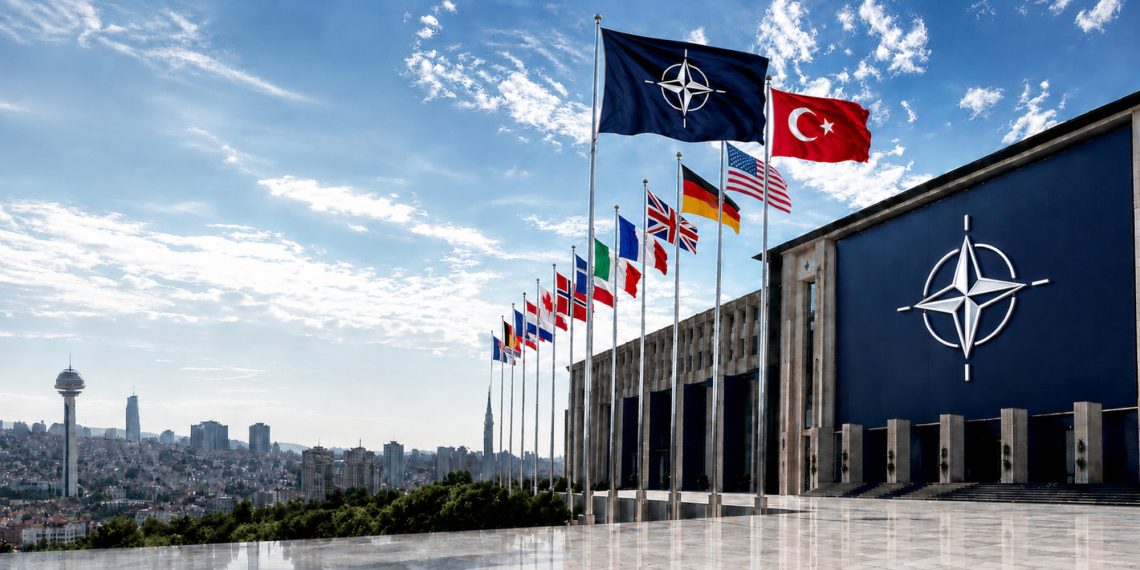
When NATO leaders gather at the Turkish presidency for the July 2026 Ankara Summit, the geographical shift of the Alliance’s centre of gravity will be tangible. For years, Brussels has operated on an East-centric axis, single-mindedly fixated on reinforcing the Eastern Flank against a revanchist Moscow. Yet, by stepping onto Turkish soil, the Alliance enters a theatre where threats cannot be viewed through a unidimensional lens. As the host country, Türkiye is uniquely positioned to disrupt this strategic myopia. Capitalising on its 74-year history as NATO’s southeastern anchor and its intricate regional balancing acts, Ankara is poised to leverage its host status to force a crucial recalibration.
By demanding an operational pivot toward the volatile Southern Flank, where Mediterranean maritime disputes, Middle Eastern instability, and Global South dynamics intersect, Türkiye will challenge the Alliance to operationalise its stated “360-degree threat approach”. This pivotal move proves that EuroAtlantic security can no longer be won by looking in only one direction. If NATO’s strategic framework is to remain relevant, it must understand that security is not a zero-sum game played solely on Europe’s eastern plains. A true 360-degree posture is an absolute prerequisite for comprehensive regional stability.
The Tyranny of the Eastern Axis
Since Russia’s full-scale invasion of Ukraine in 2022, NATO’s strategic attention has been consumed by a classic, continental deterrence model. Forward deployments in the Baltic states, Poland, and Romania have dominated troop allocations and budgetary planning. This East-centric bias was codified at the landmark June 2025 Hague Summit. There, allies signed the ambitious Hague Investment Plan, committing to a staggering 5% GDP defence spending target by 2035. The 5% target was split between a 3.5% core military requirement and a 1.5% wider security and infrastructure fund. It was born out of the raw panic of the Eastern Flank. However, its long-term implementation cannot be sustained through a purely continental mindset.
By hosting the 2026 summit in Ankara, Türkiye is subtly signalling that a massive strategic blind spot has developed. While NATO stares intently across the Suwalki Gap, the Mediterranean basin, North Africa, and the Levant are fracturing under the weight of civil conflicts, state fragility, and aggressive grey-zone manoeuvring by both Moscow and Beijing. For Ankara, the Southern Flank is not an abstract secondary theatre but an immediate front line.
The Southern Blind Spot and Hybrid Vulnerabilities
The strategic hazards defining NATO’s south are fundamentally different from the conventional threat landscape of Europe’s east. Instead of massed armoured formations, the Southern Flank is characterised by hybrid warfare, irregular migration flows weaponised by adversarial regimes, maritime choke-point vulnerabilities, and the proliferation of non-state actors armed with advanced drone technologies. Furthermore, Russia has successfully established a strategic footprint in the Mediterranean through its naval base in Tartus, Syria, and its mercenaries operating across Libya and the Sahel. This southern encirclement directly threatens NATO’s soft underbelly.
Should conflict erupt in the north, Russia possesses the asymmetric capabilities to disrupt sea lines of communication, conduct sabotage on underwater data cables, and squeeze Europe’s energy supplies originating from North Africa and the Eastern Mediterranean. By forcing these realities onto the Ankara agenda, Türkiye is reminding its allies that Article 5 solidarity must be multi-directional.
Ankara’s own defence posture serves as a blueprint for the multi-faceted approach NATO desperately needs. This posture balances the control of the Black Sea via the strict enforcement of the Montreux Convention, while simultaneously conducting counter-terrorism and power-projection operations in northern Syria and Iraq.
From a moral standpoint, addressing these hybrid vulnerabilities is vital for regional human security. When maritime routes are compromised or non-state actors are allowed to proliferate unchecked, it is civilian populations that bear the immediate brunt of the chaos. If the Alliance’s primary defensive strategy continues to focus exclusively on symmetric, state-on-state warfare in the east, it inadvertently abandons the Mediterranean and Middle Eastern neighbourhoods to the whims of warlords and proxy actors. For Türkiye, ensuring a stable south is not an exercise in imperial overreach or aggressive expansion. It is a defensive and humanitarian necessity aimed at creating a secure, predictable environment where regional populations can recover from a decade of compounding crises.
The Industrial Hinge: Integrating the Transatlantic Base
A sophisticated southern strategy requires more than just a reshuffle of troop deployments. It fundamentally requires the integration of the transatlantic defence industrial base, which is a key priority of NATO Secretary General Mark Rutte. Here, Türkiye offers a compelling case study. Over the last decade, Ankara has transitioned from a mere consumer of Western defence hardware to a powerhouse exporter of autonomous systems, naval platforms, and precision munitions. Turkish President Recep Tayyip Erdoğan has repeatedly stated his ambition to make his country’s defence sector even more autonomous. However, the realisation of the Hague Summit’s defence goals is being actively hindered by industrial protectionism and tech-leakage anxieties among Western allies.
National caveats and export controls continue to restrict the flow of critical components, creating artificial bottlenecks across the alliance. At the Ankara Summit, Türkiye is well-placed to argue that true alliance resilience requires dismantling these intra-alliance trade barriers. If NATO is to successfully build out the 1.5% GDP requirement dedicated to strengthening the defence-industrial base and safeguarding critical infrastructure, it must integrate tech-forward allies like Türkiye into its primary procurement supply chains. Leaving Türkiye’s booming defence sector on the periphery of NATO’s industrial plans is a self-inflicted wound.
To deepen this argument, industrial integration must be reframed away from “NATO expansionism” and toward equitable partnership. If the alliance expects regional anchors like Türkiye to shoulder the heavy burden of southern security, it cannot simultaneously treat them as secondary defence partners subject to political embargoes. True resilience rests on co-dependency and shared technological progress. By integrating indigenous defence capabilities, NATO moves away from a patron-client model toward an alliance of equals. This economic and industrial synergy is crucial to keeping defence manufacturing sustainable, cutting down on redundant supply lines, and ensuring that no single ally is left vulnerable due to protectionist political whims.
Policy Directions for the Post-Ankara Alliance
If the Ankara Summit is to be remembered as a transformational turning point rather than a routine diplomatic exercise, the North Atlantic Council must translate the host’s geographic realities into actionable, balanced policy. Instead of pursuing an expansionist agenda that seeks to push NATO’s borders further outward, the Alliance must optimise its current footprint. If NATO chooses to adopt a genuine 360degree approach, several structural shifts must follow:
- Establishment of a Southern Maritime Task Force: If NATO aims to secure its maritime borders, it must formally revise its Strategic Concept to establish a permanent, dedicated Southern Maritime Task Force. This entity should be explicitly tasked with countering Russian hybrid networks in the Mediterranean and protecting critical subsea energy and data infrastructure. This is a defensive imperative. It ensures that vital communication and energy links remain safe from sabotage.
- Defence Industrial Co-Development: If the 1.5% Hague infrastructure fund is to be utilised effectively, the Alliance must create a streamlined framework for defence industrial co-development. Rather than concentrating production in traditional Western hubs, NATO should establish joint defence-tech innovation hubs in southern European and Turkish cities. This strategy would directly link commercial AI and autonomous drone startups with rigid military procurement channels, fostering localised economic resilience and technological autonomy.
- Institutionalising Regional Diplomatic Dialogue: If lasting stability is to be achieved along the Southern Flank, NATO must move away from purely militaristic solutions and institutionalise a broader diplomatic dialogue with key regional partners in the Middle East and North Africa (MENA). Türkiye, leveraging its deep historical ties and contemporary diplomatic leverage in the region, should head this initiative. Rather than acting as an aggressive external force, the Alliance, via Turkish leadership, should act as a primary interlocutor to de-escalate tensions and stabilise the shared neighbourhood.
The security of the Euro-Atlantic area is indivisible. A chain is only as strong as its weakest link, and an alliance that focuses exclusively on its eastern border leaves its flank entirely exposed. The 2026 Ankara Summit offers an important window of opportunity. By stepping outside the comfortable institutional confines of Brussels and onto the geopolitical fault lines of the Anatolian peninsula, NATO leaders will be forced to confront the complex, multi-directional nature of modern conflict. If Ankara can successfully steer the Alliance toward a genuine 360-degree defence posture, the Ankara Summit will not just have redefined NATO’s geography. It will have secured its future by anchoring it in the moral and practical necessity of comprehensive regional peace.