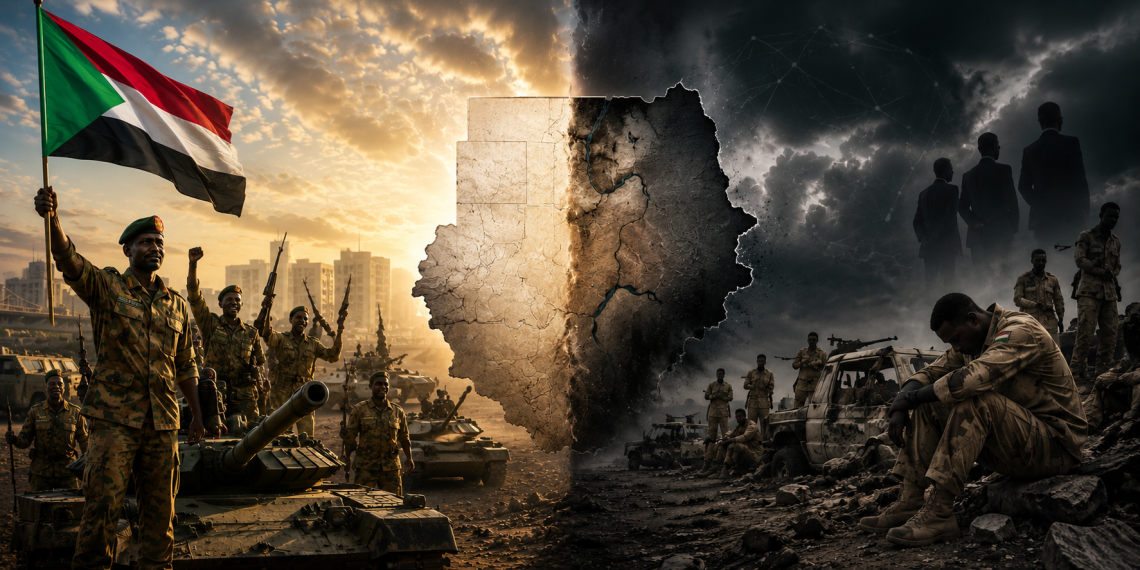
Political and military developments during the first half of 2026 indicate that the Rapid Support Forces (RSF) are facing one of the most critical phases since the outbreak of the Sudanese conflict in April 2023. After a prolonged period during which the RSF achieved significant territorial expansion, particularly in Darfur and parts of Kordofan and Khartoum, new indicators have emerged suggesting a gradual shift in the balance of power in favor of the Sudanese Armed Forces (SAF), accompanied by increasing international pressure on regional support networks linked to the RSF.
Factors Shaping the Future of the Rapid Support Forces
The Sudanese Army Regains the Initiative
Over recent months, the Sudanese Armed Forces have achieved a series of military gains across several fronts, benefiting from the reorganization of their forces and the expansion of alliances with armed factions and local actors. The army has succeeded in reclaiming strategic areas previously held in Khartoum and has made advances in Blue Nile and Kordofan states, limiting the RSF’s ability to maneuver and expand.
The army increasingly appears to rely on drones, air power, and long-term attritional warfare, weakening the traditional advantages that enabled the RSF to operate effectively through rapid mobility and tribal mobilization.
Rising Internal Divisions and Defections
One of the most significant negative indicators for the RSF has been the emergence of defections and the transfer of several field commanders to the side of the Sudanese army, particularly from tribal constituencies that formed the backbone of the RSF’s military structure.
Assessments by specialized monitoring centers suggest that these defections may mark the beginning of a gradual erosion of internal cohesion should the conflict continue without decisive gains by the RSF.
Pressure on External Support Networks
Despite ongoing debate regarding the nature and scale of external support received by the RSF, recent months have witnessed growing political, media, and human rights pressure on parties accused of supporting the force.
International reports and investigations have increasingly focused on financial and logistical networks linked to RSF leaders, raising the political and economic costs of maintaining direct or indirect external support.
At the same time, no conclusive publicly available evidence confirms a complete withdrawal of Emirati support for the RSF, while Abu Dhabi continues to deny allegations of providing military assistance to the force.
Possible Scenarios
Scenario One: Gradual Containment and Military Retreat (Most Likely)
This scenario assumes the continued advance of the Sudanese army and its recapture of additional territories, coupled with a decline in the RSF’s ability to conduct large-scale offensive operations.
Under such circumstances, RSF control could become confined to parts of Darfur and certain peripheral areas, gradually transforming the force from an actor seeking to dominate the Sudanese state into one focused on preserving limited zones of influence.
Scenario Two: Military Stalemate and Shared Influence
Despite the army’s recent gains, the RSF still possesses thousands of fighters, regional and local financing networks, and extensive tribal influence, particularly in Darfur.
As a result, the conflict could continue in the form of a prolonged war of attrition, producing a de facto division of areas of control without a decisive victory for either side.
Scenario Three: Organizational Collapse of the RSF
This scenario would require several factors to occur simultaneously, most notably a near-total disruption of external funding and support, the expansion of internal defections, and the loss of vital strongholds in Darfur.
Although some current indicators point in this direction, the RSF continues to possess military capabilities and economic networks that make rapid collapse unlikely in the foreseeable future.
It can be argued that the Rapid Support Forces have moved from the phase of “strategic expansion” that characterized 2023 and 2024 to a phase of “defending existing gains” during 2026.
Current indicators do not suggest the imminent disappearance of the RSF as a major military actor. However, they do point to a declining ability to impose its political and military project at the level of the Sudanese state.
The future of the RSF will continue to depend on three principal factors:
- The scale and sustainability of external financial and political support.
- The ability of the Sudanese army to maintain its current military momentum.
- The level of tribal and organizational cohesion within the RSF structure.
Based on the available indicators, the general trend over the coming months points toward a continued gradual erosion of the RSF’s military and political influence, without necessarily leading to a complete collapse or a decisive resolution of the conflict in the near term.