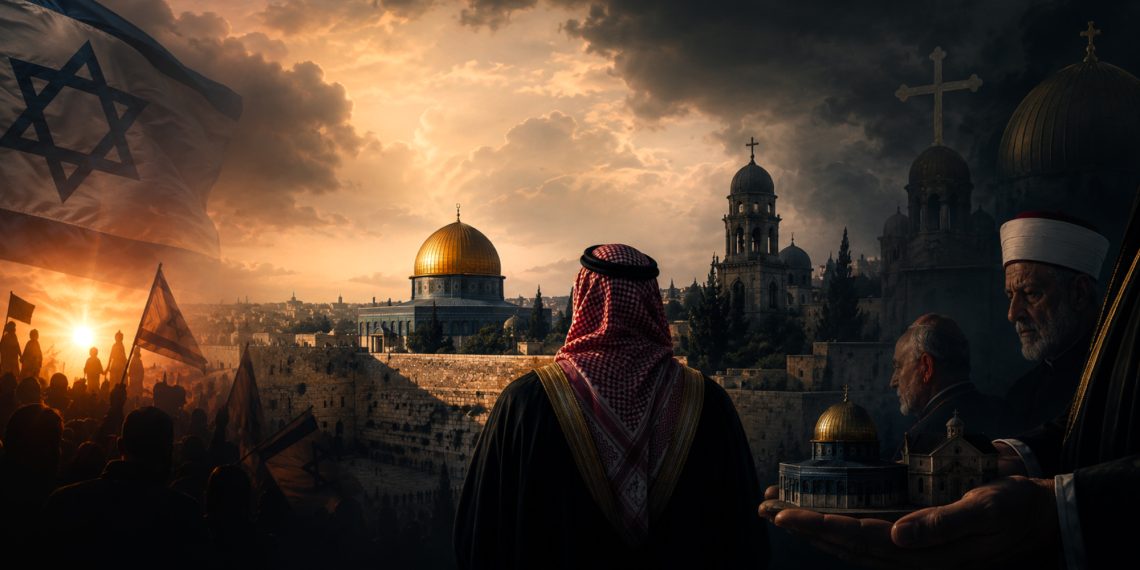
The issue of the Hashemite Custodianship over Islamic and Christian holy sites in Jerusalem is entering a sensitive and unprecedented phase amid ongoing political transformations within Israel and the growing influence of religious and nationalist far-right currents in decision-making circles. In this context, the positions of figures such as Bezalel Smotrich and Itamar Ben-Gvir, alongside Temple Mount activist groups, have become increasingly prominent. These groups view the current status quo at Al-Aqsa Mosque as a temporary arrangement that should gradually be altered in favor of broader Israeli sovereignty over the Haram al-Sharif.
The Hashemite Custodianship Between Historical and Legal Legitimacy
The Hashemite Custodianship is rooted in a series of historical, political, and legal foundations dating back to 1924. It was further reinforced following the Jordanian-Israeli Peace Treaty of 1994, under which Israel recognized Jordan’s special role in overseeing Islamic holy sites in Jerusalem. This role was reaffirmed in the 2013 agreement between King Abdullah II and Mahmoud Abbas concerning the protection and preservation of Jerusalem’s holy sites.
Although Israel does not recognize the concept of Jordanian sovereignty over Al-Aqsa Mosque, it has historically adhered to what is known as the “status quo,” which grants the Jordanian Waqf administration authority over the management and religious affairs of the mosque compound.
Is the Israeli Government Still Committed to the Status Quo?
Officially, successive Israeli governments continue to affirm their commitment to the status quo, recognizing the sensitivity of the issue and its regional and international implications. However, developments on the ground during recent years indicate a gradual erosion of that commitment.
The courtyards of Al-Aqsa Mosque have witnessed:
- An unprecedented increase in the number of incursions by Jewish religious groups.
- An expansion of Jewish religious rituals and prayers within the compound.
- A decline in restrictions that previously limited public displays of Jewish worship.
- Growing influence of movements advocating the construction of the Third Temple.
A number of ministers and lawmakers from the religious nationalist camp increasingly regard these developments as gradual steps toward redefining the status quo rather than preserving it.
At present, the immediate objective of the religious far right does not appear to be the complete and immediate takeover of Al-Aqsa Mosque, given the potentially explosive security and political consequences such a move would trigger. Rather, the more likely strategy consists of a gradual process that includes:
- Normalizing daily incursions into the compound.
- Expanding the scope of Jewish prayer activities within the site.
- Establishing a de facto temporal division of access and worship.
- Gradually moving toward arrangements resembling spatial division.
- Creating irreversible facts on the ground that make future reversals increasingly difficult.
This approach draws inspiration from the experience of the Ibrahimi Mosque following the events of 1994, when subsequent security and political measures resulted in the effective division of the site between Muslims and Jews.
The Ibrahimi Mosque as a Potential Model
The Ibrahimi Mosque in Hebron remains the most frequently cited example in Jordanian and Palestinian discourse concerning the future of Al-Aqsa Mosque. Many Palestinian and Jordanian political and religious elites believe that extremist religious groups seek to replicate the Hebron model in Jerusalem through a long series of incremental steps beginning with the expansion of Jewish religious presence and culminating in a redistribution of control over the site.
Nevertheless, implementing a similar model at Al-Aqsa Mosque faces significantly greater obstacles due to the global religious and political significance of Haram al-Sharif compared to the Ibrahimi Mosque.
Will the Israeli Government Yield to Far-Right Pressure?
The answer largely depends on the nature of governing coalitions within Israel. The more dependent a government becomes on religious and nationalist hardline parties for its political survival, the greater their influence on policies related to Jerusalem.
At the same time, any attempt to fundamentally alter the status of Al-Aqsa Mosque faces several constraints:
- The risk of widespread unrest in the West Bank and Jerusalem.
- Potential deterioration of relations with Jordan.
- American and European pressure.
- Negative repercussions for normalization efforts and regional relations.
- Security concerns regarding the expansion of violence across the region.
For these reasons, Israeli governments have generally favored a policy of gradual change rather than abrupt and decisive measures.
The American Factor: Supporting the Hashemite Custodianship or Reshaping Jerusalem’s Arrangements
The United States remains one of the most influential actors affecting the future of the Hashemite Custodianship over Islamic and Christian holy sites in Jerusalem. Since the signing of the Jordanian-Israeli Peace Treaty in 1994, successive U.S. administrations have viewed Jordan’s role as a cornerstone of religious and political stability in Jerusalem due to Jordan’s historical and religious legitimacy and its ability to manage a highly sensitive issue without triggering broader religious conflict.
However, recent years have witnessed new developments marked by the growing influence of Evangelical Christian and Zionist right-wing currents within the United States. These groups view Jerusalem through a religious and ideological lens that differs significantly from the traditional approach long adopted by American diplomatic and security institutions.
Their influence became particularly evident during the administration of President Donald Trump through the recognition of Jerusalem as Israel’s capital and the relocation of the U.S. Embassy. More recently, statements by U.S. Ambassador to Israel Mike Huckabee regarding the Jewish character of the Israeli state have generated considerable debate across the region. Huckabee is widely known for his strong support of Israel and settlement expansion, and his remarks concerning the concept of “Greater Israel” have attracted significant regional attention.
Conversely, American security, military, and diplomatic institutions continue to view Jordan as a key strategic ally in the Middle East. They generally believe that any substantial challenge to the Hashemite Custodianship could undermine stability in Jerusalem and the West Bank while weakening one of Washington’s most important regional partners in security and counterterrorism cooperation.
Regarding recurring discussions about a possible Saudi role in the administration of Jerusalem’s holy sites, the issue has remained present in political and media debates over recent years, particularly in the context of regional transformations and normalization agreements. Nevertheless, available indicators do not currently suggest the existence of an international, Israeli, or Palestinian consensus capable of fundamentally altering the existing custodianship framework.
Saudi Arabia also appears reluctant to enter into direct competition with Jordan over this highly sensitive issue, given its complex religious and political dimensions.
However, a future consolidation of alliances between the Israeli right and Zionist-Evangelical movements in the United States could revive proposals aimed at restructuring Jerusalem’s governance arrangements or broadening oversight of holy sites. Such proposals would continue to face major obstacles, including existing international commitments, Jordan’s position, and widespread Palestinian and Muslim opposition to any alteration of the historical and legal status of Al-Aqsa Mosque.
Looking Toward 2030
Looking ahead to 2030, the greatest threat to the Hashemite Custodianship is unlikely to come from a direct American or Israeli decision to abolish it. Rather, it lies in the possibility of a gradual erosion of its practical authority through the creation of new realities within Al-Aqsa Mosque, the expansion of Jewish religious groups’ influence, and the reduction of the operational role of the Islamic Waqf while maintaining formal recognition of Jordan’s role.
This scenario appears more realistic than outright abolition because it allows certain segments of the Israeli right to achieve incremental objectives without incurring the significant political and security costs that could result from direct confrontation with Jordan and the broader Arab and Muslim worlds.
Accordingly, the future of the Hashemite Custodianship will remain linked to three principal variables: The Jordan’s ability to maintain its diplomatic and legal presence in the issue, the position of future U.S. administrations regarding Jerusalem’s arrangements, and the success or failure of the Israeli right in transforming its ideological ambitions into official policies implemented on the ground.
It can therefore be argued that the Hashemite Custodianship is unlikely to face a direct legal challenge leading to its formal abolition in the foreseeable future due to its connection to international agreements and complex political arrangements. The real challenge lies in the continued erosion of its practical authority through the gradual policies pursued by religious and nationalist far-right movements.
Based on current indicators, the most likely scenario in the coming years is not the abolition of the Hashemite Custodianship but the continuation of the struggle over its actual authority and sphere of influence within Haram al-Sharif. This struggle will unfold amid gradual Israeli efforts to reshape realities on the ground and parallel Jordanian and Palestinian efforts to preserve the status quo and prevent any form of temporal or spatial division of Al-Aqsa Mosque.
Within this context, the Hashemite Custodianship will remain one of the most important pillars of stability in the Jerusalem file and one of the most sensitive issues in Jordanian-Israeli relations and in the broader future of the Arab-Israeli conflict.