A glimpse of Russian– Turkish relations in the last decade
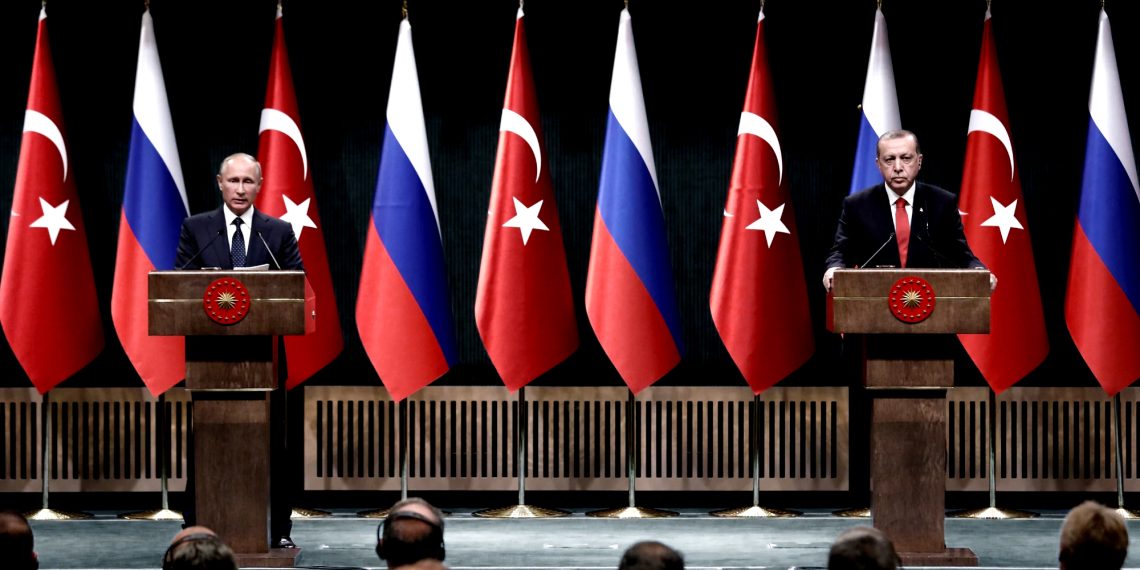
Russian-Turkish relations have been witnessing ups and downs for a decade. And after they were normal before the Arab Spring revolution in 2011, political relations became strained due to the situation in Syria. It reached the peak of its decline after the downing of the Russian warplane at the end of 2015, after the Russian military intervention in Syria to support the Assad regime on September 30, 2015. Russia froze relations with Turkey for almost a year, then reconciliation took place and relations returned to normal in 2016.
The failed coup attempt was in July 2016 in Turkey and President Putin was the first to inform President Erdogan of the existence of a coup attempt hours before the coup took place, noting that the coup, according to the Turkish government was planned by Fethullah Gulen with American support.
Russia and Turkey also have very broad cooperation relations that reach the level of strategic partnership: there are great commercial relations, as Turkey exports foodstuffs to Russia and thousands of Turkish companies work in the field of construction and contracting in the Russian market. Türkiye gets more than 5 billion dollars every year.
Turkey has previously purchased the Russian S-400 missile system and this is evidence of the depth of relations between Russia and Turkey, despite the fact that Turkey is a member of NATO. Experts believe that Russia wants to deepen the gap between Turkey and NATO.
Russia is building a nuclear power station in Kyoto, Turkey, and has extended two lines to transport Russian gas to Turkey, the first specifically for the Turkish market, and the second to transport gas to Europe. Then the two countries agreed to build huge reservoirs to collect Russian gas on Turkish territory to re-export it to the world.
There are Russian-Turkish understandings regarding the files of the Nagorno-Koropakh region in favor of Azerbaijan and its ally Turkey at the expense of Armenia, Russia’s ally, and in the Syrian crisis through the Astana platform.
But Turkey did not support Western sanctions against Russia. Today, Turkey has become Russia’s window to the world. Through it, Russia imports most of the industrial products and Western technology.
At the same time, there are clear differences related to the position on the Libyan crisis, as Turkey supported the government in Tripoli and signed an agreement with it regarding the Turkish presence in the Mediterranean, while Russia supported the other party to the conflict, which is Major General Khalifa Haftar.
Turkey provides Ukraine with Bayraktar drones, which have proven effective against Russian forces and reached the Russian depth in recent months. Turkey is currently building two factories for Bayraktar marches in Ukraine and Turkey has not recognized the annexation of Crimea to Russia, just as Turkey stands by the Muslim Crimean Tatars of Turkish origin.
A new Turkish position came that caused Russian concern, which is Turkey’s agreement to hand over the leaders of the Azov nationalist regiment to Ukrainian President Zelensky, noting that the agreement between Russia, Turkey and Ukraine to hand over the prisoners is that the leaders of the Azov nationalist regiment remain in Istanbul and do not return to Ukrain.
Developments in the Turkish position
Turkish President Recep Tayyip Erdogan said in a press conference with his Ukrainian counterpart, Volodymyr Zelensky, that he will support the reconstruction of Ukraine, adding that Turkey will continue its efforts to enter into negotiations to end the war President Erdogan supported Ukraine’s future accession to NATO..
Likewise, Turkey agreed to Sweden’s accession to NATO, which annoyed the Russians, and they took negative measures towards Sweden, as happened with Finland when it joined the alliance.
Another negative point in the relations between Turkey and Russia is related to Russia’s vote against the Western proposal to extend the UN mechanism for the entry of aid into northern Syria through several crossings for an additional year as the period expires on July 17, 2023.
There is a crisis regarding the issue of extending the grain deal because Russia complains that the West and the United Nations are not implementing the part related to the export of Russian grain and fertilizers and this constitutes a pressure factor on Turkey, as it is the main mediator in the deal.
Developments in the Russian position
On July 10, 2023, Chairman of the Security and Defense Committee of the Russian Federal Council (Senate) Victor Bondarev said that Turkey continues to gradually and steadily shift from a neutral country to an unfriendly country because it has taken a series of provocative decisions, and such behavior cannot be described as anything. Another but a stab in the back.
the Russian President’s envoy to Syria, Alexander Lavrentiev, confirmed on July 11, 2023 that intensive work is underway to normalize relations between Syria and Turkey, and we will inform heads of state upon completion to specify the details and date of the meeting between Turkish Presidents Recep Tayyip Erdogan and Syrian President Bashar al-Assad .
Lavrentiev added to Al Arabiya channel that there are specific difficulties in the way of normalizing relations between Ankara and Damascus, including the Turkish military presence in the Syrian territories, stressing that there is no slowdown in the normalization process.
On July 9, 2023, Russian Foreign Minister Sergey Lavrov and Turkish Minister Hakan Fidan discussed the return of the leaders of the “Azov” regiment ( which Russia considers a terrorist organization) to Ukraine .
The Russian Foreign Ministry stated that “Ankara’s attention was drawn to the devastating effect of the course of further deliveries of military equipment to the Kiev regime .” And that the two sides reaffirmed the need to preserve the existing nature of mutual trust in relations between Moscow and Ankara .
The American position
The US Department of Defense (the Pentagon) on July 11, 2023 That Minister Lloyd Austin discussed with his Turkish counterpart, Yasar Guler, in a phone call, support for Ankara’s efforts for military modernization, after Turkey agreed to support Sweden’s accession to NATO. And they “discussed… the positive talks between Turkey, Sweden and NATO Secretary General Stoltenberg, as well as the Ministry of Defense’s support for Turkey’s military modernization efforts .”
In October 2021, Turkey had previously demanded the purchase of US-made F-16 fighters and components to upgrade its current warplanes at a value of $20 billion from the American company Lockheed Martin.
The Kremlin’s reaction
The Kremlin declared on July 11, 2023 that none of the Europeans wanted to see Turkey in Europe, and that Ankara should not wear “rose-colored glasses”. And the Kremlin considered that the possibility of Ukraine joining NATO constitutes a great danger to European security, pointing to the need to realize this danger by those who take such decisions.
However, the Kremlin stressed that despite the differences between Russia and Turkey, Russia intends to develop relations with Ankara on conditions that are in the interest of both parties, noting that Russia is well aware of Turkey’s obligations within the framework of NATO.
On the consequences of Sweden’s accession to NATO on Russia’s security, the Kremlin said that Russia will take retaliatory measures in response to Sweden’s accession to NATO. It will be “definitely negative”.
Conclusion
It is unlikely that a breakdown in Russian-Turkish relations will occur because they are strategic, deep, and in the interest of both countries. Note that Russia, due to Western sanctions against it, needs this cooperation more than Turkey, as it does not recognize the sanctions, and benefits financially from its cooperation with Russia in the economy, trade, tourism, energy, and even in the military and security field.
This is not the first time that major differences have occurred between the two countries and then they have been overcome. For example, when the Russian fighter plane was shot down in 2015, Turkish-Russian relations froze for about a year, then returned to normal. Today, there is a serious difference regarding Turkey’s approval of Sweden, Ukraine joining NATO, and the Kremlin’s reaction was negative.
Russia also expressed its annoyance at President Erdogan’s handing over of the leaders of the Azov nationalist regiment to President Zelensky during his visit to Turkey 3 days ago. This was one of the reasons for the phone call between the foreign ministers of Russia and Turkey two days ago.
It seems that the reason for Turkey’s retreat from its position regarding Sweden’s accession to NATO and Turkey’s handing over of Azov national leaders to Ukraine, as well as Turkey’s support for Ukraine’s accession to NATO, are all emerging factors that will harm Russian-Turkish relations.
It is expected that Turkey will have concluded deals with the Americans, NATO and the European Union in its concession regarding Sweden and Ukraine, in exchange for resolving some outstanding issues such as: the file of Turkey’s accession to the European Union or the lifting of visas, as well as activating military cooperation with Washington such as the purchase of F-16 aircraft. And other things not announced.