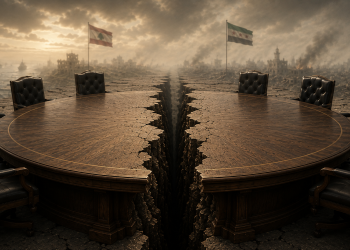
Every time it is announced that negotiations between Hamas and Israel have made progress, Benjamin Netanyahu quickly sets them back by two steps or more. Despite being one of the most important mediators, The United States does not make a genuine effort to deter him. On the contrary, it usually blames the other party for the failure to reach a deal. This is understandable if we consider the issue from the perspective of the balance of power.
The balance of power is the decisive factor…
The key factor in the course of negotiations is not the goodwill of the adversaries, nor that of the mediators, but rather the balance of power on the military and political fronts between the two sides of the conflict.
As of now, neither Israel nor the US administration feel a disruption that compels them to accept Hamas’s conditions, particularly a ceasefire, a complete withdrawal from Gaza and the unrestricted return of displaced persons to their homes.
On the contrary, Israeli forces face no major obstacles, neither internal nor external that prevent them from continuing their ongoing acts of extermination against the Palestinian people, without distinguishing between civilians and fighters.
Despite the Palestinians’ heroic resistance and the growing global support for them, we unfortunately do not believe that the human and political costs Israel has been paying over the past months for continuing the war have reached a point that forces its government to agree to a truce.
This truce is neither desired by them nor insisted upon by the US administration. It is true that the shock of the “Al-Aqsa Flood” will not fade from the minds of Israelis. However, the initial wave of panic is receding and so is the collective feeling of the disaster’s magnitude that befell them soon after Hamas’s attack on October 7, it has decreased over time as the authorities worked to absorb it through continuing retaliatory acts of extermination, which they do not intend to stop.
For its part, Washington uses negotiations as a political maneuver to cover up its involvement in acts of genocide and war crimes against the Palestinian people at the hands of the Zionist regime and its own hands.
In this case, it is inevitable that the maneuver continues so that their endorsement of the most heinous and egregious war witnessed by the world since 1948 remains concealed.
Under these circumstances, what can the Palestinians and others yearning for justice expect from what is called “negotiations between Hamas and Israel”?
Especially when the greatest role in these negotiations belongs to the main protector and supporter of Israel as the strongest and most influential mediator: the United States, with Egypt and Qatar also involved. Even if it is the only mediator having a genuinely influential weight on the negotiation process.
I dream, therefore I exist…
To answer the question and to avoid pessimism, let us mentally treat the following data as facts upon which analytical elements can be built:
- Hezbollah, Iranian forces, the Houthis and all Palestinian resistance factions successfully carried out a joint surprise and overwhelming three-dimensional (air-ground-sea) attack against Israel.
This was accompanied by an effective electronic and cyber campaign against the American naval and air forces deployed in the region, supporting Israel which significantly incapacitated their intelligence capabilities and communication systems globally and in space.
- The military situation in Ukraine against Russia significantly worsened, while North Korean armies invaded the South despite efforts by American forces deployed there along with reinforcements to counter Pyongyang’s attack on the US ally.
Near the Korea, another battlefront opened in Taiwan due to the occupation of the island by the People’s Republic of China, a situation that forced The United States to deploy additional forces in the region and provide what they call the “Taiwanese resistance” with large quantities of weapons and equipment.
However, traditional allies disappointed US expectations: most European countries failed to adequately support its war efforts against China; even Japan did not respond as expected to American requests on the Taiwan and South Korea frontlines.
This has left Washington fighting on multiple battlegrounds almost alone in a world war it cannot handle, preventing it from providing Israel with protection as it used to.
- The United Nations prioritized the deteriorating security situation in the Middle East. Its Secretary-General and the League of Arab States called for the inclusion of China and South Africa in the team of mediating countries in the negotiations between the conflicting parties in Palestine, now including Iran, Hezbollah, the Houthis, alongside Israel and all resistance factions in Palestine, Syria and Iraq.
The Gulf Cooperation Council strongly supported the request; OPEC also joined proposing to add Algeria to the mediators, threatening to cut oil supplies to Western powers supporting Israel if their request was not granted.
This proposal was enthusiastically supported by the Gulf Cooperation Council, which gave a 48-hour ultimatum to agree to it, threatening to use oil and gas as weapons in support of the Palestinians if the deadline passed without agreement.
- Simultaneously, as part of these impactful geopolitical shifts, there was a radical and constructive change in Arab-Arab relations and within the Organisation of Islamic Cooperation.
An unprecedented atmosphere of understanding and harmony prevails; bilateral conflicts, both military and political, within Arab and Islamic countries have all taken a path towards resolution, with the exception of my personal conflict with myself: my dreams strive to prevail over my rationality; they often succeed, as evidenced by these fantasies from which I find no escape to conclude this piece.