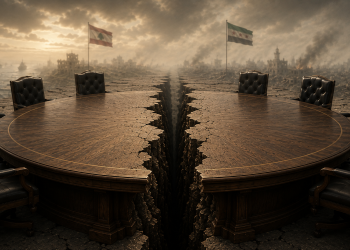
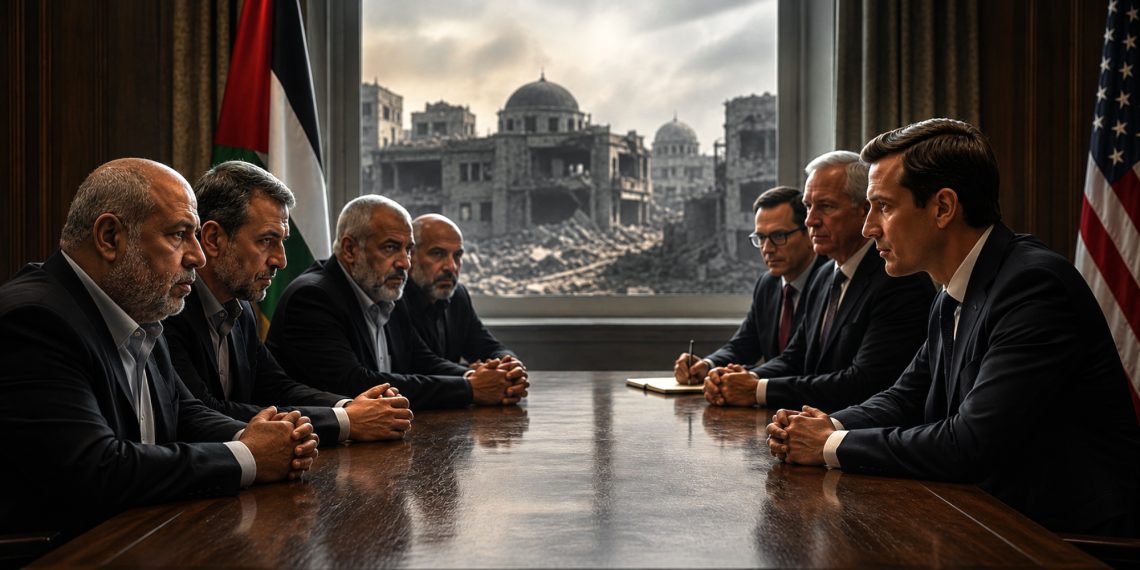
The meeting between the Hamas leadership and Jared Kushner represents a development that goes beyond negotiations over a ceasefire or the reconstruction of Gaza. Its strategic significance lies in the fact that the United States has shifted from dealing with Hamas solely as a security problem to be dismantled toward engaging with it, albeit temporarily and conditionally, as a party without whose involvement the new arrangements in Gaza cannot be implemented.
However, this functional recognition does not imply American acceptance of Hamas remaining in its current form. The apparent U.S. approach seeks to redefine the movement according to an equation that can be summarized as political survival in exchange for dismantling its military function. President Donald Trump’s declared plan is based on ending Hamas’s rule over Gaza, placing weapons under a single Palestinian civilian authority, and transferring administration to the National Committee for the Administration of Gaza, in parallel with a gradual Israeli withdrawal and reconstruction. The U.S. administration has officially confirmed that the second phase includes new governance arrangements, “demilitarization,” and the establishment of an international stabilization force.
The fundamental disagreement, however, concerns who should move first. Israel wants Hamas to disarm before withdrawal and reconstruction, while Hamas insists on reciprocal and phased implementation, demanding parallel Israeli steps involving an end to attacks and assassinations, withdrawal, the opening of crossings, the delivery of aid, and the transfer of civil administration. This is precisely the sticking point that could derail the plan even after Hamas has accepted its general framework.
What Changed at the Cairo Meeting?
In previous stages, the United States communicated with Hamas primarily through intermediaries. The direct meeting between Khalil al-Hayya and Kushner, in the presence of prominent American and international officials, indicates a shift from indirect diplomacy toward direct negotiations with the decision-making center within Hamas.
Reuters confirmed that al-Hayya met Kushner and U.S. officials in Egypt, while Axios reported that Tony Blair, Nikolay Mladenov, and other officials involved in the Middle East peace process also participated in the meeting.
This reinforces one of the most important observations in Oraib al-Rantawi’s analysis: Washington appears increasingly willing to negotiate directly with actors that possess the actual capacity to implement agreements on the ground, even when its political and legal relationship with them is highly complex.
However, this should not be interpreted as “American recognition of Hamas.” More accurately, it reflects recognition of the need to negotiate with the movement in order to dismantle its military structure and transfer authority in Gaza. The White House continues to advocate a model based on a Palestinian technocratic administration, an international stabilization force, and the complete demilitarization of the Gaza Strip.
The Heavy Weapons Dilemma
Weapons are at the heart of the next phase, but the debate is no longer confined to the slogan of “disarming Hamas.” Proposals whose details were published by Axios envisage a process lasting approximately 200–250 days and proceeding area by area. This would include transferring police weapons, placing heavy weapons out of service and in secure storage, dismantling tunnels and weapons-production facilities, and subsequently addressing small arms within a Palestinian legal framework. The process is also intended to include other armed factions in the Gaza Strip, not Hamas alone.
From Hamas’s perspective, accepting such an arrangement without simultaneous Israeli withdrawal and credible guarantees carries an existential risk. After surrendering its heavy weapons and dismantling its tunnels, the movement would lose its principal source of leverage, while rebuilding those capabilities would be difficult if Israel subsequently reneged on its commitments.
From the Israeli perspective, the equation is entirely reversed. Netanyahu wants to ensure that Hamas loses its military capabilities before Israel reduces its military control, because he believes that withdrawal before disarmament could allow the movement to rebuild its strength.
The core of the crisis, therefore, is not technical. It is a crisis of guarantees and trust.
Kushner’s real test now lies in Israel. Hamas’s position can be summarized in a politically precise formulation: “We agreed; now it is your turn with Netanyahu.” This is not merely a media maneuver, as independent American sources have confirmed that Hamas agreed to a roadmap for disarmament within arrangements that include withdrawal, reconstruction, and a new Palestinian government, while Israel has remained hesitant about implementation.
More importantly, Kushner’s subsequent meeting with Netanyahu did not produce a final Israeli commitment to the plan. The Associated Press reported that the lengthy U.S.-Israeli meeting ended on an optimistic note but without a decisive Israeli agreement, while Israel continued to insist on Hamas’s disarmament before progress on reconstruction and withdrawal.
Axios went further, reporting that Kushner asked Netanyahu to take incremental steps to test Hamas’s willingness to implement the disarmament arrangements. This suggests that Washington itself is beginning, at least partially, to favor a logic of reciprocal testing rather than demanding that one side implement all of its obligations first.
The strategic question, therefore, is no longer whether Washington can pressure Hamas. Egypt, Qatar, Turkey, and the United States have already exerted considerable pressure on the movement to reach the current agreement. The question is whether the Trump administration can impose a comparable degree of discipline on the Israeli government.
The Israeli Election Factor
American sources have confirmed that the upcoming Israeli elections have made Netanyahu more sensitive to any move that could be portrayed domestically as a concession to Hamas. Axios quoted a U.S. official as saying that the elections had made the issue extremely complex and that the White House did not want electoral calculations to freeze the next phase of the plan.
The problem, however, extends beyond Netanyahu himself. His departure would not necessarily produce a fundamental reversal in Israel’s position on Gaza. Within Israel, there is a relatively broad consensus on preventing Hamas from returning to power and rebuilding its military capabilities, even if political parties differ over the means and the political limits of the war. Palestinian expectations based solely on the outcome of Israeli elections would therefore be misplaced.
Four Possible Paths for Hamas
In my assessment, Hamas faces four possible paths.
- Transformation into a political actor stripped of its heavy weapons, the preferred American scenario. Hamas would relinquish direct control of Gaza, surrender or disable its heavy military capabilities, and remain a political and social movement capable of participating in the Palestinian political system in the future. This scenario would preserve the organization while fundamentally altering its nature.
- A hybrid weapons settlement, the most negotiable scenario. Part of the heavy arsenal, tunnel network, and weapons-production infrastructure would be dismantled, while weapons would be placed under phased Palestinian and international arrangements. Each phase would be linked to Israeli withdrawal, redeployment, and the transfer of authority. This scenario would allow both sides to present the agreement domestically at a lower political cost.
- Failure of implementation and a return to confrontation. If Israel insists on complete disarmament in advance, or continues assassinations and strikes in a manner that leads Hamas’s leadership to conclude that American guarantees are insufficient, the movement may return to viewing its weapons as its last remaining guarantee. Continued Israeli strikes in the days following Kushner’s visit have already demonstrated the fragility of the ceasefire.
- Fragmentation of military decision-making within the movement. Even if the political leadership accepts broad arrangements, questions would remain about its ability to ensure compliance by all armed units and groups in Gaza. The longer the process continues, the greater the possibility of dissenting groups, defections, or armed actors that are not fully subordinate to the central leadership.
The second scenario appears more likely, in my assessment, if Washington maintains its current approach, because it offers a middle ground between the Israeli demand for complete and prior disarmament and the Palestinian rejection of turning disarmament into unilateral surrender.
Is the Model of “Hamas in Government” Over?
To a large extent, yes. It is difficult to envisage Hamas returning to its pre-war model of simultaneously controlling government, security services, an armed wing, and the territory of Gaza. The current international and regional environment is moving toward separating these functions and transferring administration to a Palestinian technocratic committee, alongside a new police force and an international stabilization force. The White House has already announced that the National Committee for the Administration of Gaza will constitute the civilian pillar of the new phase.
But the end of Hamas’s rule does not necessarily mean the end of its political role.
Here lies perhaps the most important strategic implication of the Kushner meeting: the United States may be testing whether Hamas can be transformed from an organization combining governance, politics, and armed force into a Palestinian political actor with an enduring social and organizational base but without an independent military structure.
If achieved, this would constitute a structural transformation in the history of the movement, rather than merely another ceasefire agreement.
Where Does the Palestinian Authority Stand?
The absence of the Palestinian Authority from the center of this process presents a long-term political problem. Washington and the mediators are negotiating with Hamas because it retains executive power in Gaza, while simultaneously constructing a new technocratic administration.
This could inadvertently entrench a new Palestinian model in which the official authority in Ramallah becomes less influential than a network comprising the new technocratic administration, regional mediators, the United States, and Palestinian actors on the ground.
If this trend continues, the question that will inevitably emerge will not simply be, “Who governs Gaza?” but rather, “How will the Palestinian political system as a whole be rebuilt?”
The political integration of Hamas into the Palestine Liberation Organization or its participation in future Palestinian elections could become part of a broader arrangement, particularly if the movement relinquishes direct rule and much of its armed structure.
The Role of Egypt, Qatar, and Turkey
The presence of these three countries is not merely symbolic. Together, they constitute the regional guarantor mechanism necessary for implementing any agreement.
Egypt is indispensable because of geography, security, borders, and its relationship with the new Palestinian administration. Qatar possesses political and financial channels and the ability to communicate with the Hamas leadership, while Turkey provides additional political leverage with the movement. According to Axios, Turkey, Qatar, and Egypt exerted significant pressure on Hamas to reach the current understandings.
Any disarmament arrangement, therefore, cannot succeed if it is perceived essentially as an Israeli-American agreement imposed on Gaza. Hamas needs to present such an arrangement to its supporters as a Palestinian framework backed by Arab, regional, and international guarantees, in exchange for Israeli withdrawal, an end to the war, and the reconstruction of Gaza.
The New Factor: Washington Is Investing in the Post-War Phase
Another important development emerged immediately after the meeting. Reuters reported on August 19 that the U.S. government had allocated more than $206 million to support the international stabilization force in Gaza, including infrastructure, equipment, and operations.
This indicates that Washington is not treating the project merely as a bargaining instrument, but has begun constructing some of its operational mechanisms.
This increases pressure on both Hamas and Israel. If the components of the new administration, police force, stabilization force, and reconstruction financing begin to evolve into functioning institutions, rejecting the plan will become increasingly costly for either side.
Clearly, the meeting between the Hamas leadership and Kushner does not mean that the Gaza crisis has reached its conclusion. But it may mark the beginning of the end of an era in which Hamas simultaneously exercised governmental authority, maintained an armed structure, and wielded political influence.
The arrangement currently being tested essentially looks like this: Hamas would relinquish control of Gaza, gradually dismantle its heavy military infrastructure, and in return receive a permanent ceasefire, a phased Israeli withdrawal, and a guarantee of its continued existence as a Palestinian political movement. This would be accompanied by a transition to a technocratic Palestinian administration in Gaza and the beginning of reconstruction.
The principal obstacle is not the formulation of this equation; its components are already well known. The difficulty lies in the sequencing of steps and the credibility of guarantees.
If Washington demands that Hamas relinquish its most significant sources of power before receiving a verifiable Israeli concession, the process is likely to falter. If, however, Washington succeeds in imposing a simultaneous and verifiable model—for example, disabling a tranche of weapons in exchange for an Israeli withdrawal from a defined area, followed by the transfer of administration and the beginning of reconstruction—the agreement could develop into a viable political process.
At this meeting, Washington tested Hamas’s willingness to adapt to the post-war phase, and it appears to have received broad initial acceptance. The next test is not Hamas’s alone. It also concerns Kushner’s and Trump’s ability to persuade Netanyahu to accept a reciprocal approach in which disarmament becomes part of a negotiated settlement rather than a condition of surrender.
In my assessment, Hamas’s future will be determined in the coming months by the answers to two questions: Can the movement shift its organizational and social legitimacy from “armed resistance” toward political participation after the war? And can the United States provide guarantees that make such a transition less dangerous for the movement than retaining its weapons?
If the answer to both questions is yes, then we are witnessing a strategic transformation in the structure of Hamas and the Palestinian political system. If, however, Washington fails to restrain Israeli behavior and assassinations and strikes continue without corresponding political concessions, the argument within Hamas that disarmament leads not to a settlement but to the loss of deterrence will gain strength. In that case, the likelihood of renewed confrontation or the freezing of the plan will become significantly higher.