This analysis monitors the scale of military operations and the number of casualties resulting from attacks carried out by the Islamic State across several countries. The assessment is based primarily on statistical information published in the group’s weekly newspaper Al-Naba during the month of September. In some cases, data published by the organization beyond this time frame is also analyzed, as it provides insight into the scope of the group’s military and security activity across cities and provinces.
It is important to note that the accuracy of the group’s claims cannot always be independently verified. However, the statistical data regarding the number of operations and levels of human and material losses is, to a large extent, close to reality. At times, the group inflates figures related to material damage, which is a common practice among armed organizations. Nevertheless, these numbers can still serve as useful indicators to assess the effectiveness of the group and the extent of its global spread.
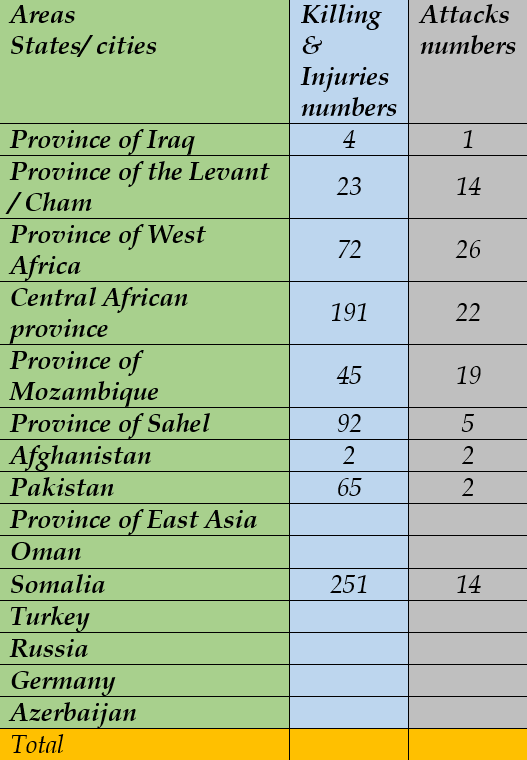
For this study, we relied on a sample of Al-Naba weekly issues covering September 2025, specifically issues No. 511 through 514. The following table and chart illustrate the distribution of attacks and their resulting casualties across the countries and cities where the group maintained operational and security activity during this period.
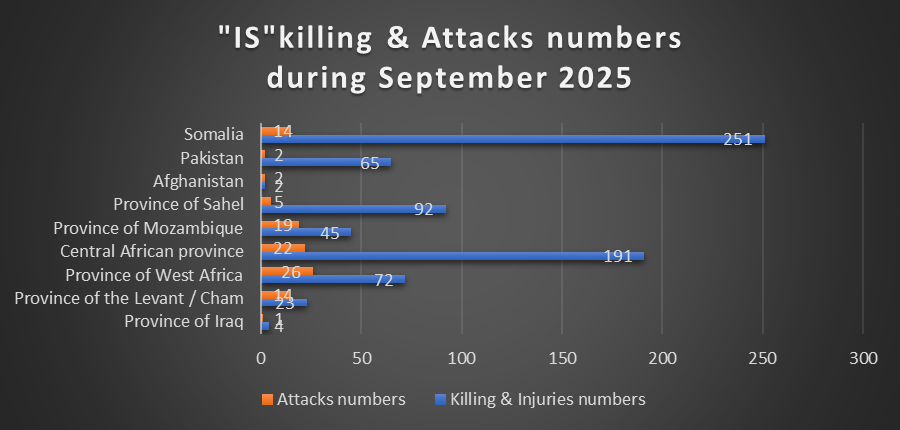
Analytical and Statistical Report on Attacks, Fatalities, and Injuries by Region
This report reviews data on attacks and the number of fatalities and injuries distributed across several regions and countries. The figures reflect geographic areas ranging from the Middle East to Africa, Central Asia, and the Indian subcontinent. Based on the accompanying table, the data will be analyzed by comparing different regions in terms of the number of attacks and human losses, followed by drawing key observations.
Countries that had previously experienced attacks by the organization—such as Turkey, Russia, Oman, East Asia, European states, the United States, Azerbaijan, and Iran—have not witnessed any such operations since the beginning of this year.
In Iraq, a single attack targeted an Iraqi army patrol with an improvised explosive device (IED) in Diyala Province, specifically in the Abbas Khudair area. The attack injured four soldiers and disabled their military vehicle.
In Syria, the organization continues to target the Syrian Democratic Forces (SDF), particularly in Deir ez-Zor and its surrounding countryside, as part of an ongoing campaign against these forces. During the reporting month, 23 individuals were killed in 14 separate attacks, most of which were concentrated in Deir ez-Zor and al-Hasakah.
The “Druze issue” in Suwayda has emerged as one of the most critical challenges facing the Syrian state after the collapse of the Assad regime, particularly following the rebellion led by Hikmat al-Hijri. The Israeli demand has centered on establishing a demilitarized zone in southern Syria without addressing the broader question of ending the occupation. In practice, this reflects a “fait accompli” policy in both Syrian and Lebanese territories, with the ultimate objective of partitioning Syria along sectarian lines. This would involve promoting a Druze federal entity alongside a Kurdish federal entity, thereby realizing the concept of the “David Corridor” stretching from the Golan Heights through Daraa, Suwayda, Deir ez-Zor, and Raqqa, and extending into Sulaymaniyah and Erbil.
This Israeli demand was reinforced by recent statements made by the U.S. President and Prime Minister Netanyahu on the sidelines of the United Nations General Assembly in New York.
In West Africa, “IS” carried out multiple attacks in the Nigerian states of Borno and Yobe, as well as in the Diffa region of Niger. These operations targeted government forces and allied militias, totaling around 26 attacks that left 72 people killed or injured, along with the destruction or disabling of several vehicles and motorbikes.
Parallel to its military activity, “IS” also conducted “dawah” (outreach) campaigns across 21 villages in northern Nigeria, aiming to spread its ideology and consolidate influence among local communities.
In Central Africa, the group carried out 22 attacks against Ugandan and Congolese forces. These operations resulted in approximately 191 casualties (killed and injured), marking the deadliest and most intense wave of violence in the past two months. Some of these attacks occurred between the villages of Bandolo and Mangorojiba in Lubero, where militants also burned two motorbikes during an assault.
In northern Mozambique, “IS” fighters launched 19 attacks targeting police forces, Mozambican soldiers, and pro-government militias. The most notable was the raid on the town of Mocímboa da Praia in Cabo Delgado province. Collectively, these attacks resulted in about 45 casualties (killed and injured).
In the Sahel, “IS” mounted several operations in Niger, Burkina Faso, and Mali. The group targeted armed militias allied with state forces and individuals accused of cooperating with intelligence services in areas such as Wulam in Tillabéri and near Ayoro in Niger. Additional attacks were directed at army bases in Mali and Burkina Faso.
The most violent incident in the Sahel was a confrontation between “IS” fighters and militants from Jama’at Nusrat al-Islam wal-Muslimin (JNIM) near the village of Boulani in the Sebba area.
In total, “IS” carried out around 5 attacks in the Sahel region during September, causing 92 casualties (killed and injured).
In Afghanistan, “IS” carried out a roadside bomb attack targeting a Taliban member in the Khar area of Bajaur. The individual, whom the group accused of involvement in the killing of one of its fighters, was killed in the explosion.
According to “IS” claims, another attack took place in the same district, in the village of Sadiqabad, also in Khar, Bajaur. The operation allegedly targeted a man described by “IS” as an agent of Pakistani intelligence. He was shot dead while riding his motorcycle with a handgun. “IS” noted that the victim was affiliated with local nationalist parties.
What stands out in these reports is that “IS” claimed two separate killings in the same area—one by an improvised explosive device, the other by a firearm. This raises questions about possible contradictions or duplications in the group’s narrative, casting doubt on the accuracy of its account.
In Pakistan, “IS” claimed responsibility for a major attack on a gathering of the Balochistan National Party in Quetta, the provincial capital. A suicide bomber identified as “Ali al-Muhajir” detonated an explosive vest inside the gathering, killing and injuring 76 people.
Among the wounded were two senior party leaders, including a former parliamentarian. Six vehicles were also damaged in the blast.
Additionally, “IS” carried out an attack targeting a Pakistani police officer on the Tora Shah road in the Pishin district. The officer was shot and killed with a handgun.
In Somalia, the group carried out several attacks targeting government forces in Puntland, in the northeastern part of the country, specifically in the Bari region, totaling 14 assaults, which resulted in approximately 251 casualties, both killed and wounded.
Government forces in Puntland continue to face intense attacks in areas where Islamic State operatives are active, particularly in the Al-Miskad mountains, despite the ongoing counteroffensive campaign against the group, which has lasted for over nine months.
In issue No. 511 of Al-Naba newspaper, the group published an illustrative poster detailing the scale of operations it carried out in northeastern Somalia, specifically in the Bari region of Puntland.
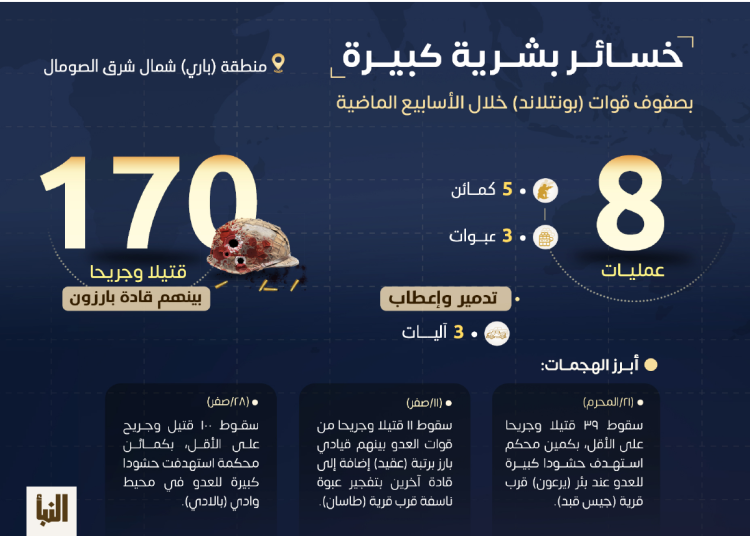
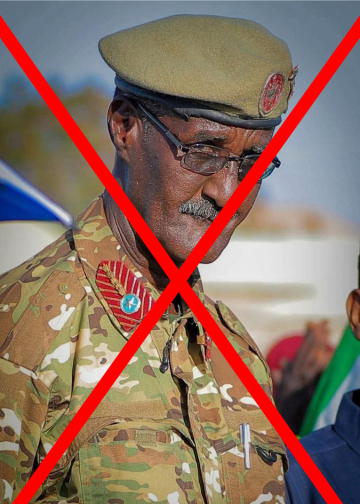
Last September was the deadliest in recent months in terms of clashes, during which General Ahmed Abdi Ali, the commander of the forces participating in the campaign against the group, was killed in an operation that took place between the villages of Tsan and Tadar in the Maiil Valley.
The confrontations occurred simultaneously across multiple areas, including the surroundings of Wadi Baladi near Bir Yara‘un, as well as Wadi Mirali, Wadi Arar, and Bir Murajadi, between the villages of Dri Mado and Hater Oden, and Shibab and Tadar.
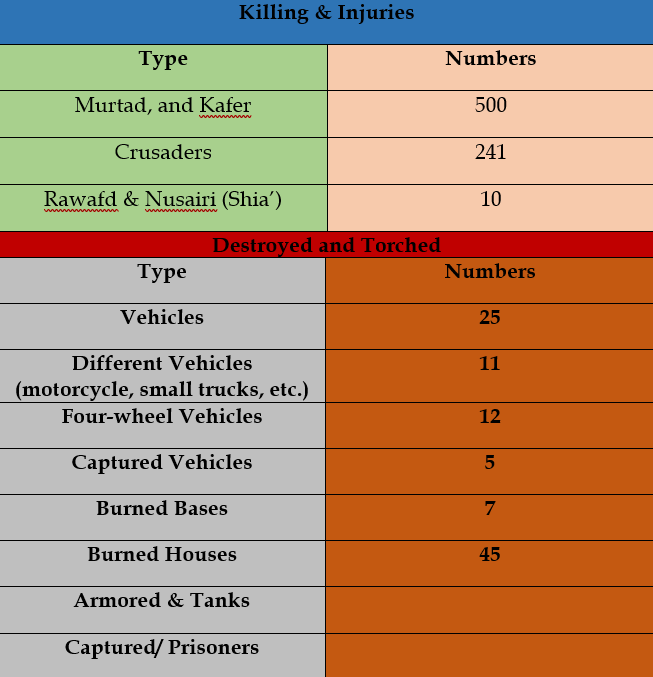
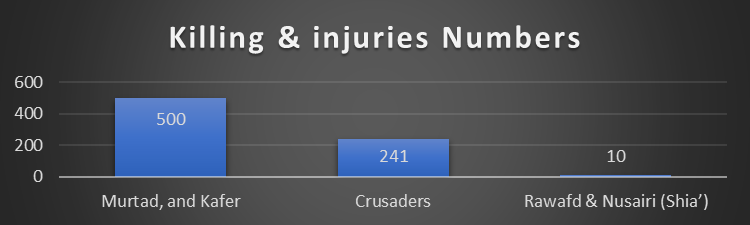
A statistical report on the human and material losses resulting from Islamic State operations worldwide:
The group claimed to have killed 500 people it described as apostates and infidels, 241 “Crusaders” (referring to non-Muslims), and 10 individuals from the Shiite community in Iraq.
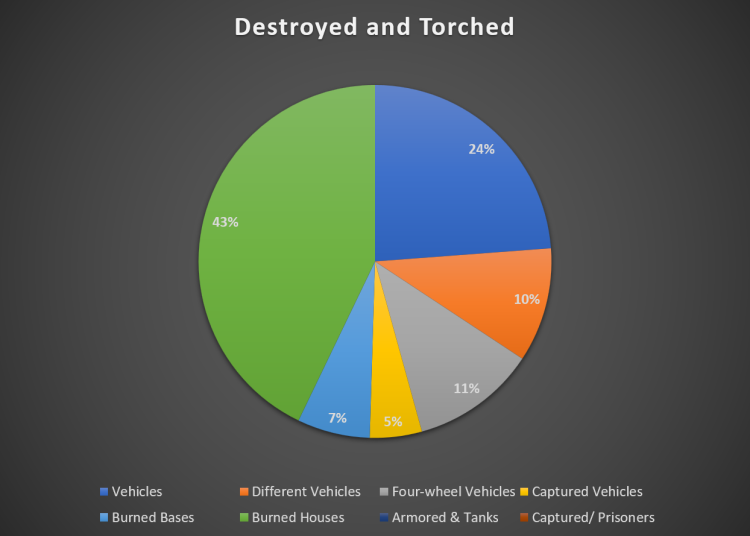
There was a noticeable increase in the number of killed and wounded, as well as the overall losses resulting from the group’s attacks in September, compared to previous months. During this period, the group destroyed or disabled 25 vehicles, 11 assorted vehicles, and 12 four-wheel-drive vehicles. Additionally, it set fire to 7 military bases and 45 homes, and captured 5 vehicles.