Algeria’s recent diplomatic engagement with Spain, Italy, and Germany reflects far more than a series of high-level visits. It signals a deliberate strategy to position Algeria as a lasting strategic partner for Europe in energy, industry, technology, and security cooperation. As Europe confronts growing geopolitical uncertainty and accelerates its energy transition, Algiers is seeking to transform its role from a traditional hydrocarbon supplier into a comprehensive economic and geopolitical partner.
At the heart of Algeria’s European strategy are several interconnected objectives: strengthening natural gas exports to support Europe’s medium-and-long-term energy security; attracting European investment in manufacturing, agriculture, and value-added industries; expanding industrial and technological partnerships; and developing renewable energy and green hydrogen projects that support both Algeria’s economic diversification and Europe’s decarbonisation agenda.
Diversification and a Long-Term Vision
Algeria’s broader ambition extends well beyond energy exports. Reducing dependence on hydrocarbons and promoting competitive industrial sectors, the country seeks to build a more diversified and resilient economy. Cooperation with Europe’s leading economies offers access to investment, technology, innovation, and industrial, while reinforcing Algeria’s diplomatic sovereignty.
Rather than relying on a single privileged European partner, Algeria is cultivating multiple strategic relationships. This approach reduces vulnerability to bilateral political crises while increasing its diplomatic leverage across Europe. If sustained through domestic reforms and continuing and fruitful investment, Algeria could emerge as a key actor in Europe’s future energy market, industrial transformation, and the evolving Euro-Mediterranean economic order.
Recent diplomatic initiatives also indicate that Algeria increasingly favours pragmatic bilateral partnerships with individual European states over a broader institutional approach through Brussels. This allows Algiers to negotiate according to national interests while preserving greater strategic flexibility.
The renewed rapprochement between Algiers and Madrid illustrates Algeria’s pragmatic foreign policy. Relations deteriorated sharply after Spain’s 2022 endorsement of Morocco’s autonomy proposal of the thorny dossier of Western Sahara, prompting Algiers to suspend the 2002 Treaty of Friendship, Good Neighbourliness and Cooperation; it has disrupted diplomatic and commercial ties between Algiers and Madrid.
The gradual normalisation that began in 2025 culminated in the restoration of the treaty in March 2026, followed by Spanish Prime Minister Pedro Sánchez’s recent visit to Algiers. The diplomatic reconciliation demonstrates that both governments have prioritised long-term strategic interests over previous political disagreements.
Energy, however, remains the cornerstone of this renewed partnership. Algeria continues to be Spain’s largest supplier of natural gas, providing approximately one-third of Spain’s imports through the Medgaz pipeline. As geopolitical instability persists — from the Russia-Ukraine war to disruptions affecting maritime trade through the Strait of Hormuz and the Bab el-Mandeb — Algerian pipeline gas has become increasingly important for Spain’s energy security. Spain therefore offers commercial recovery and development, and secure access to the western Mediterranean energy market.
Italy fills in a distinctive position within Algeria’s European strategy. Beyond being a major energy partner, Rome serves as the principal logistical gateway connecting North African renewable energy resources with continental Europe. Algeria’s participation in the SoutH2 Corridor represents the most ambitious component of its evolving energy diplomacy. The project envisages approximately 3,300 kilometres of hydrogen infrastructure linking Algeria with Germany through Tunisia, Italy, and Austria. Planned investments approaching $25 billion by 2035 demonstrate Europe’s growing commitment to renewable hydrogen and underline Algeria’s strategic importance in the continent’s energy transition.
Participation in this initiative offers Algeria an opportunity to reposition itself for the post-hydrocarbon era. Rather than remaining primarily a supplier of conventional natural gas, Algeria seeks to become an indispensable exporter of renewable hydrogen, ensuring its future relevance as European demand gradually shifts toward cleaner sources of energy.
President Abdelmadjid Tebboune’s recent state visit to Germany reflects Algeria’s parallel effort to strengthen relations with Europe’s largest industrial economy. Unlike the Spanish partnership, which has been driven largely by political and diplomatic reconciliation, Algeria’s relationship with Germany centres on industrial cooperation, technological innovation, and sustainable economic development.
The 32 agreements and (MoU) signed during the visit cover natural gas exports, renewable energy, methane-emission reduction, green hydrogen, industrial decarbonisation, scientific research, and technological cooperation. The first shipment of Algerian liquefied natural gas (LNG) to Germany, together with the agreement between Sonatrach (National Hydrocarbon Comagny) and the German energy company VNG to expand gas deliveries from 2027, illustrates Germany’s growing importance as a destination for Algerian energy exports.
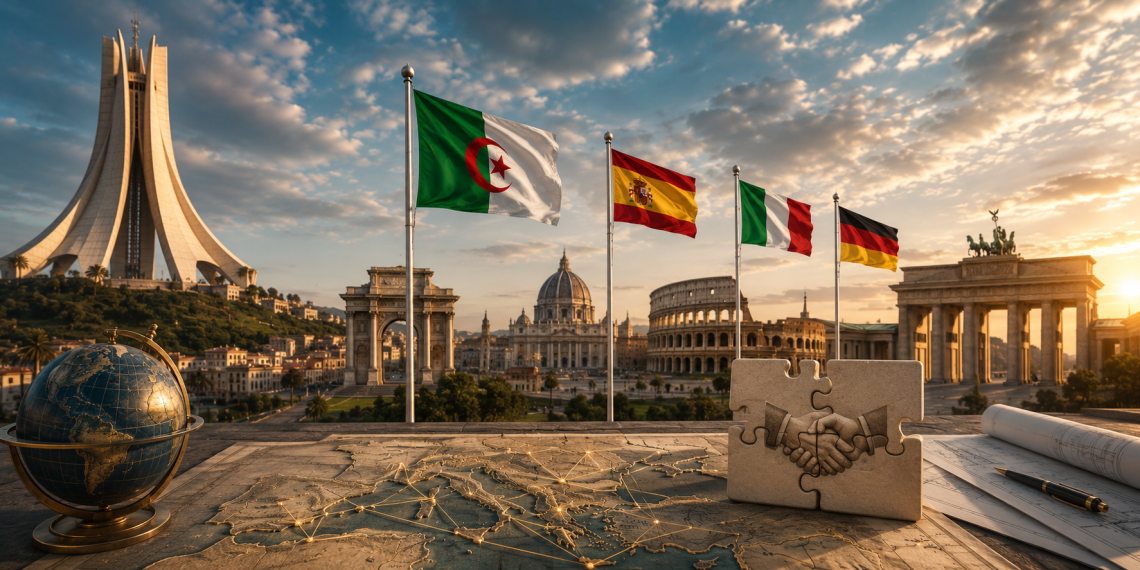
More significantly, the partnership extends beyond energy supply. Germany provides Algeria with opportunities for technology transfer, industrial upgrading, manufacturing cooperation, and integration into European value chains, supporting Algeria’s ambition to modernise its economy. Taken together, Algeria’s partnerships with Spain, Italy, and Germany demonstrate a coherent diversification strategy rather than a search for a single privileged ally.
Nonetheless, Spain contributes to enhancing diplomatic reconciliation and stable energy cooperation. Italy provides the infrastructure connecting Algerian renewable energy to European markets. Germany offers industrial expertise, technological innovation, and access to Europe’s largest manufacturing economy. Collectively, these relationships strengthen Algeria’s resilience while expanding its influence within Europe’s evolving energy and industrial landscape.
The Missing Partner: France
One notable absence from Algeria’s recent diplomatic momentum and mobility is France. Relations between Algiers and Paris remain strained following a series of political and diplomatic disagreements in recent years. France’s domestic political instability since 2024 has further complicated bilateral engagement, leaving relations largely frozen despite the strategic importance both countries attach to one another.
Nevertheless, structural interests continue to favor eventual rapprochement. Energy security, migration crisis management, counterterrorism, and stability across the Maghreb and the African Sahel remain shared priorities that neither country could ignore. Whatever the outcome of France’s 2027 presidential election, long-term geopolitical and economic interests are likely to encourage renewed dialogue between Paris and Algiers, much as strategic considerations have driven closer cooperation between Algeria and other major European partners.
Energy diplomacy remains the principal driver of Algeria’s European engagement, but security cooperation has become an equally important pillar. Spain, Italy, Germany, and France all share concerns over supra-national terrorist groups, organized crime, illegal migration, and instability across the African Sahel. These common challenges require closer intelligence sharing, security coordination, and political dialogue despite occasional diplomatic tensions. Consequently, Algeria’s European policy has become increasingly multidimensional, integrating energy cooperation with industrial development, technological modernisation, infrastructure investment, and regional security.
In sum, Algeria’s current diplomatic activism and pragmatism reflects a significant evolution in its foreign policy doctrine. Rather than positioning itself solely as a supplier of natural gas, Algiers seeks to become a comprehensive strategic partner contributing to Europe’s energy security, industrial competitiveness, technological innovation, and green transition.
The success of this strategy would ultimately depend on Algeria’s ability to institutionalize these partnerships through sustained investment, regulatory reforms, and genuine political dialogue based on mutual trust. If these conditions are met, Algeria could strengthen both its diplomatic sovereignty and its negotiating position while securing an influential role in the emerging Euro-Mediterranean geopolitical and economic order. This evolving strategy suggests that Algeria is no longer merely responding to changes in Europe; it is actively seeking to shape the future of Euro-Mediterranean cooperation.