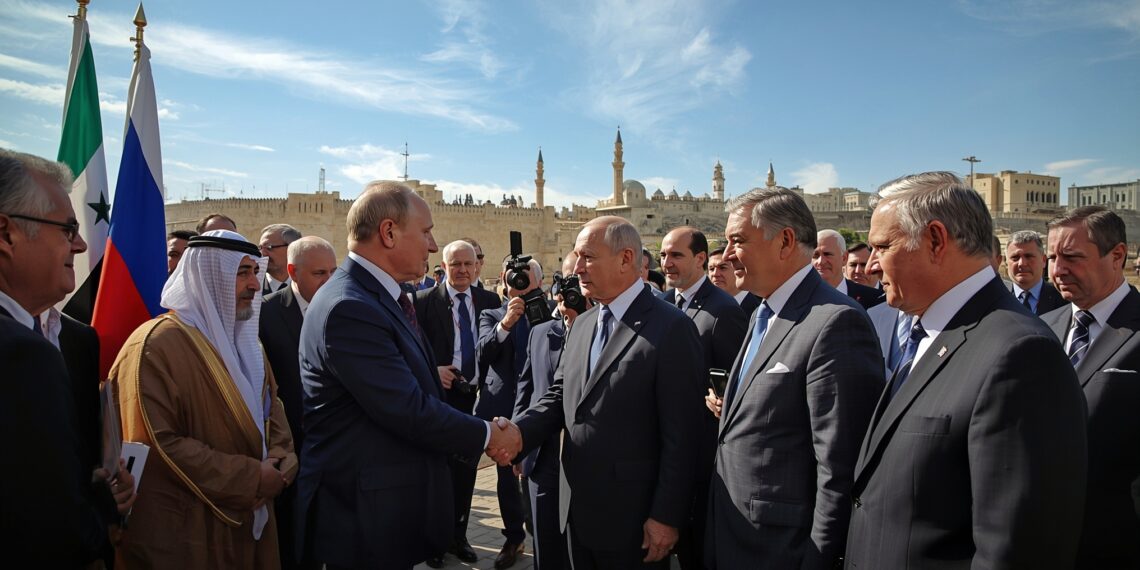
A large high-level Russian delegation of diplomats, politicians, military and economic figures arrived in Damascus on 9 September 2025. The head of the Russian delegation was Alexander Novak, Deputy Prime Minister of Russia responsible for the energy sector in Russia and head of the Russian side of the intergovernmental committee with the Kingdom of Saudi Arabia. The delegation also included the Minister of Construction, Housing and Communal Services Erik Vizolin (co‑chair of the joint Russian–Syrian intergovernmental committee); Deputy Minister of Defence Yunus‑bek Yevkurov, responsible for Russian defence affairs abroad (remnants of the Wagner forces); Deputy Foreign Minister Sergei Vershinin, responsible for the Middle East and North Africa (possibly a successor to Mikhail Bogdanov); the Russian President’s special envoy to Syria Alexander Lavrentiev; and representatives of other Russian departments at the deputy‑minister level.
The visit began without prior announcement. The Russian delegation was received on arrival by the Secretary‑General of the Presidency, Dr Maher Al‑Shar‘a, who studied medicine in Russia and is married to a Russian woman.
This Russian visit followed a visit by Syrian Foreign Minister Assad al‑Sheibani at the end of July, who led a high‑level Syrian delegation that included the Secretary‑General of the Presidency, the Minister of Defence and the head of Syrian intelligence. During that visit, President Vladimir Putin received al‑Sheibani in Moscow — the first visit by a senior Syrian official to Russia since the overthrow of Bashar al‑Assad on 8 December 2024. Meetings with Russian Foreign Minister Sergey Lavrov resulted in an understanding to “review” bilateral agreements, resume the work of the joint intergovernmental economic cooperation committee, and establish a committee to examine security and military cooperation.
At the time, the Syrian Foreign Ministry described the meeting between President Putin and Foreign Minister al‑Sheibani as historic and said it launched a new phase of political and military understanding between the two countries. It stated that President Putin had underlined Russia’s unequivocal rejection of any Israeli interventions or attempts to partition Syria, and confirmed Moscow’s commitment to support Syria in reconstruction and restoring stability.
Meetings of the Russian delegation:
– A broad meeting with Syrian Foreign Minister Assad al‑Sheibani and Dr Maher Al‑Shar‘a, Secretary‑General of the Presidency.
– The Russian delegation was received by the President of the Syrian Arab Republic, Mr Ahmed Al‑Shar‘a.
– A meeting with the Chief of the General Staff of the Syrian Armed Forces, Major‑General Ali Nassan (with emphasis on advancing mechanisms of military cooperation, including rehabilitating the Syrian army drawing on the long history of joint military cooperation).
Syrian positions:
– “Our relations with Russia are deep and have gone through periods of friendship and cooperation, but they have also known times when the balance was not present.”
– “We are opening a new page with Russia based on mutual respect.”
– “We want to see Russia as a positive partner standing by Syria’s unity.”
– “Explicit Russian support for Syria’s new course would be a step in Syria’s and the region’s interest.”
– A welcome of cooperation with Russia in reconstruction, energy, agriculture and health on a fair and transparent basis.
– “Any foreign presence on Syrian soil must aim to help the Syrian people build their future.”
– “Syria seeks sincere partners.”
– “Syria and Russia are capable of building relations based on sovereignty, justice and mutual interest. The more Syria stabilises, the more opportunities for cooperation open up; the weaker it becomes, the greater the chance of chaos and terrorism.”
– “Israeli attacks constitute a direct threat to regional stability.”
Political cooperation:
– Moscow is giving special attention to President Ahmed Al‑Shar‘a’s participation in the first “Russia–Arab” summit, scheduled for mid‑October.
– Novak stressed Syria’s sovereignty and territorial integrity.
– He said the new historic phase would see relations between the peoples built on mutual respect and expressed the hope that this relationship would continue to grow for the benefit of both peoples and countries.
– Russia supports the Syrian positions at the UN Security Council.
– President Ahmed Al‑Shar‘a accepted President Vladimir Putin’s invitation to participate in the Russia–Arab Summit on 15 October 2025, and Novak said Moscow was paying particular attention to the anticipated visit of President Al‑Shar‘a to Moscow.
– Novak proposed that the new Syrian authorities use Russia’s negotiating capacities to resolve issues with Israel and with the various Syrian groups and communities, on the basis that Moscow maintains contacts with all parties and can play a positive role.
– Novak told TASS that “we share Damascus’s concerns about Israeli sabotage actions. We also express concern about periodic outbreaks of violence against religious and ethnic minorities. In this regard I would like to draw attention to Russia’s unique negotiating capabilities, which maintain contacts with the Israeli leadership and representatives of all groups in Syria. We propose to use this factor to have a positive impact on stability in the Republic.”
Military and security cooperation:
– The two sides are working to set the foundations for re‑evaluating Russia’s military presence in Syria under new conditions that serve the interests of both parties and establish deeper cooperation without arousing the suspicions of regional or international actors.
– Russian media reports earlier spoke of Syrian interest in resuming Russian military police patrols in southern Syrian provinces to help curb Israeli incursions, interventions and attacks.
– Russia seeks to preserve the legal status of its bases at Hmeimim and Tartus in Syria.
– Leaks attributed to Syrian sources familiar with the discussions indicated that Damascus prioritised several items, including resuming supplies of Russian weapons to Syria, organising joint management of the Hmeimim and Tartus bases (including expanding Russian patrols in several areas), settling debt issues, developing economic relations, discussing the fate of Bashar al‑Assad and senior former regime officials currently in Russia, and launching a joint effort to avoid confrontation with Israel and develop coordination with Turkey.
– It is worth noting that Moscow recently conducted Russian patrols in Qamishli for the first time in coordination with Damascus and ignored the Syrian Democratic Forces (SDF). A Russian source did not rule out expanding this experience to patrols in some coastal and southern areas of Syria, noting the importance of reactivating understandings with Israel and the United Nations to conduct patrols in the buffer strip in the Golan.
– A source in Moscow said Moscow sees several obstacles to developing cooperation on armaments and re‑equipping the army, chiefly ongoing Israeli military activity. Nevertheless, the source said Moscow has concrete ideas for helping Syria train and re‑equip its army and supply it with weapons and equipment, based on the Syrian leadership’s wishes, in ways that meet the needs of the “new Syria” without pushing towards clashes with various parties, primarily Israel.
– Moscow is working to reach comprehensive understandings on a number of proposed files, such as mechanisms of cooperation given the Russian military presence in coastal and north‑eastern Syria.
– It appears too early to speak of joint management of the Russian bases; Moscow will not engage in internal activities in Syria, and its military presence in the bases is linked only to arranging logistical services for its fleet in the Mediterranean and beyond. At the same time, Moscow is prepared to discuss potential future mechanisms of military cooperation.
Economic cooperation:
– The two sides are discussing a review of the agreements signed between them (several dozen), especially those that are considered unfair to Syrians, such as the agreement on the port of Tartus, which affects Syrian sovereignty and was signed by the Russian government with the fugitive Bashar al‑Assad.
– The Russian Deputy Prime Minister proposed to the new Syrian authorities the resumption of the joint intergovernmental committee for commercial and economic cooperation. It appears that military negotiations also covered the formation of a committee for security and military cooperation between Moscow and Damascus.
– It is significant that the head of the delegation, Alexander Novak, is responsible for Russia’s energy sector and that Moscow is proposing joint work to rehabilitate infrastructure, including in the energy field.
– The official Russian government statement issued after the visit made clear that Russia’s highest priority is certain vital files in which the Russian side has important capabilities and expertise to develop cooperation. Chief among these was Russia’s readiness to help the Syrian government restore the energy sector and launch a number of projects to supply fuel and other vital necessities.
– Russian expert Igor Yushkov of the Financial University under the Russian government said Syrian authorities are very interested in petroleum products because of limited capacity and the poor condition of the country’s refineries; Syria needs diesel and fuel oil, and to a lesser extent petrol. It also needs new equipment for extracting and processing gas and oil and for pipelines. Russia has all of this. Supply questions relate to quantities, terms of delivery, priorities and guarantees in return.
– The Russian newspaper Vedomosti reported that the Russian delegation discussed in Damascus the participation of Russian experts in rebuilding the war‑torn economy. It added that while preserving the Russian bases in Latakia and Tartus remains fundamental and central, it is no longer the only issue for Moscow and Damascus. According to some experts interviewed by the paper, “the Syrian authorities expect, in return for guarantees for the Russian military bases and personnel, to receive fuel almost free of charge. There are also demands for the return of Russian technicians to restart gas and oil fields and to put them back into operation.”
Conclusion:
This is the second visit of its kind by a Russian delegation to Syria since the overthrow of the Assad regime; the first was on 29 January under Mikhail Bogdanov, Deputy Foreign Minister. It also follows the visit of Syrian Foreign Minister al‑Sheibani and his high‑level delegation to Moscow at the end of July.
The visit takes place in sensitive and complex circumstances related to worrying social, security and living conditions in Syria, and the challenges posed by foreign interventions, repeated Israeli attacks and the unstable international situation and shifting US policy.
Despite the dark period associated with the Russian military intervention in Syria in 2015 and the bombing and destruction it conducted — mostly of civilian targets — and the testing of more than 350 new types of weapons on Syrian soil in support of the Assad regime, it appears that Damascus and Moscow agree on the need to re‑establish bilateral relations on new foundations based on mutual respect and non‑interference in internal affairs and state sovereignty, as well as on shared interest, transparency, independence and frankness — a point particularly emphasised by the Syrian side.
Damascus continues to demand transitional justice, which is an indication of the need to hand over Bashar al‑Assad, his officers and the money they stole from the Central Bank of Syria to the Syrian government.
Regional, local and international circumstances are pushing Damascus to normalise relations with Moscow, which has leverage concerning Syria: voting in the UN Security Council, help in reaching an understanding with Israel, and the possibility of economic and military cooperation in areas such as energy, arming and training the Syrian army, and assistance on internal files.
Under the Assad regime, bilateral relations with Moscow served a single aim — the survival of Assad in power. Today the new Syrian government is working to safeguard the interests of the Syrian people and will not sacrifice national interests and Syrian sovereignty.
This rapprochement with Russia is happening against the backdrop of blatant Israeli aggression against a sovereign Arab state, Qatar, which plays a mediating role between Israel and Hamas and is an American ally that hosts the largest US military base in the region. How could Netanyahu’s extreme right‑wing government ignore American interests and those of its allies and bomb in broad daylight a country that is not at war with Israel? Therefore it is necessary for Arab countries in particular to diversify their international relations and not remain hostage to the West, which the piece asserts is united in policies hostile to Arabs and Muslims, and portrays Israel as a Western instrument to confront the Arab East and Islam.
In this context, Arab–Russian cooperation is generally useful and necessary to establish a geopolitical and geostrategic balance in the region.
It seems that Syrian‑Russian negotiations are pragmatic and realistic; they begin with the easier topics and then move on to tougher issues, especially since both sides want good bilateral relations.
There remain complex files still to be resolved between Damascus and Moscow, but time is likely to resolve them or at least reduce their salience, allowing focus on the urgent current matters.
Russia appears to have an opportunity to consolidate military cooperation with Damascus to curb Israeli attacks and thus retain its military bases, given that Israel does not want Turkish presence in Syria to replace a Russian presence.