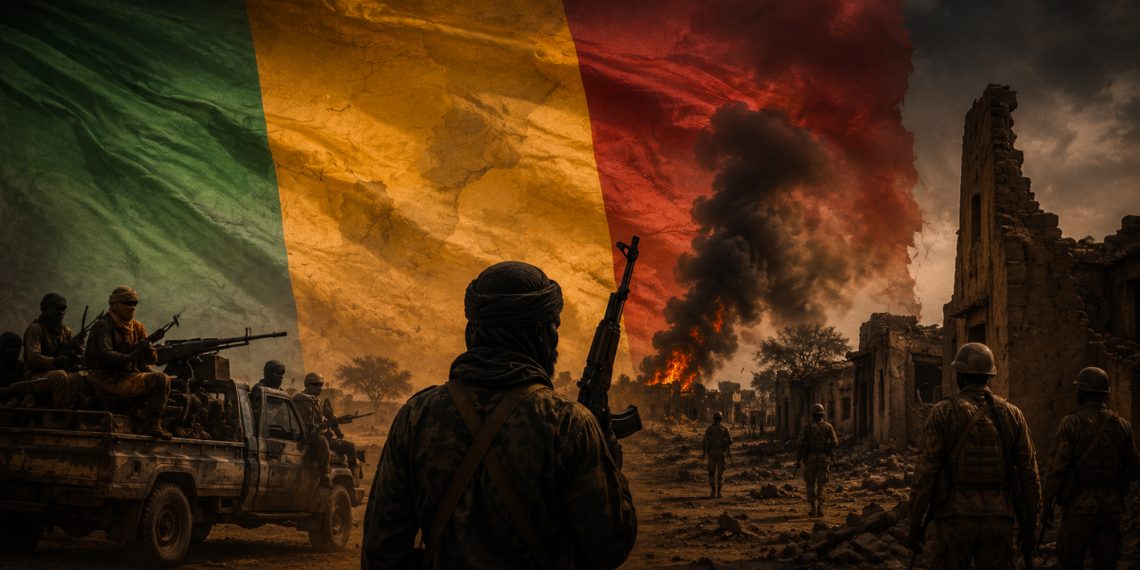
Human Rights Watch, the American human rights organisation, recently issued a report on violations committed by the warring parties in Mali and the Sahel, focusing on the targeting of civilians without accurate documentation or accountability for the perpetrators.1
The report included accusations against the Malian army and its affiliated armed militias (self-defence groups), as well as against opposition armed groups—most notably the Azawad Liberation Front (MNLA), which comprises the People’s Liberation Army (APL) and the Group for the Support of Islam and Muslims (JNIM). The report covered a period of large-scale military operations during April.
The Geopolitical Context
It is important to clarify that these mutual accusations of violations cannot be understood in isolation from the geopolitical shifts that Mali has witnessed since 2021. The French military presence has gradually diminished, giving way to an increasing presence of Russian forces and elements associated with the African Legion. This shift has added an international dimension to the conflict and further complicated efforts to independently verify violations.
The ongoing conflict in Mali is legally classified as a non-international armed conflict. Therefore, its parties are subject to the provisions of Common Article 3 of the four Geneva Conventions of 1949, in addition to the provisions of Additional Protocol II of 1977 and the customary rules of international humanitarian law.
Accordingly, the following actions constitute grave violations, regardless of the perpetrator:
- Targeting civilians
- Extrajudicial killings
- Torture and cruel treatment of prisoners
- The forced displacement of civilian populations
Because the warring parties largely disregard these laws, they currently remain beyond the reach of legal prosecution and penalties.
Methodological Challenges in Human Rights Reporting
Most human rights reports concerning the Sahel region are based on interviews with witnesses, survivors, and local sources. This makes verifying certain facts extremely complex, particularly in areas outside state control or under the influence of armed groups.
Historically, experiences involving a number of Islamic armed groups in Afghanistan, Iraq, Syria, Somalia, and the Sahel region have shown that the existence of internal instructions or fatwas prohibiting the targeting of civilians does not prevent violations on the ground. These routinely occur as a result of miscalculations, individual transgressions, or the expansion by local leaders of the interpretation of “participation in combat” or the suspicion of “cooperation with the enemy”.
The Position of the Azawad Liberation Front (FLA)
In this context, I contacted Mr Sid Ben Bella, a leader of the Azawad Liberation Front, to comment on the Human Rights Watch report.
He questioned the reports issued by international human rights organisations and their monitoring of violations in general, and specifically criticised Human Rights Watch’s report on violations targeting civilians in the battles of last April. He deemed the report inaccurate, biased, and unfair to the armed groups.
- Code of Conduct: He explained that their treatment of others during combat operations is based on their customs, traditions, and religion, which strictly forbid attacks on women, children, and civilians.
- Treatment of Prisoners: He added that they capture and treat well those soldiers who surrender or are wounded, stating that they currently hold approximately 200 Malian soldiers and two Russians as prisoners, along with a large number of bodies of those killed. He noted that an international human rights organisation has visited these prisoners to assess their conditions.2
- Denial of Abuse: He asserted that the Azawad Liberation Front (FLA) has never committed any acts of aggression against civilians, rape, forced entry into homes, or other violations typically associated with war. He attributed the accusations leveled against the FLA in the report to its alliance with the Group for the Support of Islam and Muslims (JNIM).
- Allegations of Ethnic Bias: He further explained that the testimonies and statements were collected exclusively in areas inhabited by Black Africans. He asserted that the report’s field and office representatives are driven by ethnic bias against the Tuareg, Arabs, and Fulani, arguing that a lack of ethnic diversity among the field representatives undermines the report’s objectivity.
- Accusations Against the Malian Army: He accused Malian forces of committing massacres, claiming they launch attacks on civilian gatherings under the pretext of fighting insurgents. He highlighted a massacre allegedly perpetrated by the Malian army and supported by the African Legion in Azawad, specifically in the rural Kidal region of Aghchar Sididen, accusing them of harvesting organs from civilians before killing them.
JNIM’s Responses to Human Rights Watch
The organisation published the answers provided by Jama’at Nusrat al-Islam wal-Muslimin (JNIM) regarding the violations they were accused of committing.
The group’s responses notably began with the phrase, “We wish for you what you wish for us.” This carries two implications: first, that they do not trust the organisation; and second, that when addressing non-Muslim groups, they bypass the traditional Islamic greeting (“Peace be upon you”) and proceed directly to the topic at hand.
The questions posed by Human Rights Watch, along with commentary on the responses, are outlined below:
- The Targeting of Civilians
Question: How do you justify considering civilians who obstruct your operations as legitimate targets?
- The Response: JNIM clarified that it does not consider targeting civilians generally permissible, except in specific cases with well-defined legal provisions in Islamic jurisprudence.
- The Issue of “Shielding”: The response addressed the controversial tactic of “shielding”, which some interpretations argue permits the killing of civilians if the enemy uses them as a shield to protect themselves from attacks. However, this remains subject to scholarly debate and should not be used as a pretext for expanding attacks on non-combatants.
- Direct Participation: The group stated that it avoids targeting civilians who obstruct its military operations unless they directly participate in combat by supporting government forces—either by providing intelligence or bearing arms. Those obstructing stability in areas under their control are deterred through advice, warnings, or, in some cases, imprisonment and hefty fines derived from Sharia law rather than human laws.
- The Siege of Bamako
Question: Won’t the siege of Bamako disproportionately affect the civilian population, potentially leading to dire consequences in terms of shortages of basic necessities? Have you considered potential mitigation measures?
- The Response: The group based its answer on the premise that every war has its costs. They argued that to fundamentally overthrow the ruling regime, military force and a protracted war of attrition are necessary.
- In Corporate Defence: In its defence, the group deflected by raising questions about the corruption practised by the authorities in Bamako—including the theft of the country’s resources and their transfer to foreign powers—which they claim is the true cause of widespread poverty and shortages.
- Political Regimes and Forced Displacement
Question: The military council has already announced an investigation and the arrest of some soldiers following the events of April 25th. Opposition politicians are being targeted, and there are reports of prominent figures disappearing. Won’t the siege you imposed on Bamako prevent those targeted by the military council from fleeing the city to safety?
- The Response: The group responded that the targeting of political opposition members in Mali, particularly in the capital, is not a recent phenomenon and is unrelated to the siege. They argued that the capital is no longer safe due to state-sponsored injustice and tyranny, which has driven residents to flee and ultimately contributed to their decision to impose the siege.
- Civilian Fear
Question: Do you believe that civilians in Mali fear you? If so, why? If not, why not?
- The Response: The group explained that their primary objective is to uphold the word of God, protect civilians regardless of religion or ethnicity, and spread justice. They extended an open invitation to anyone wishing to see the truth to visit the areas under their control.
Conclusion: A Shifting Discourse and Growing Crisis
The responses of Jama’at Nusrat al-Islam wal-Muslimin (JNIM) reveal a significant evolution in its political discourse. It no longer focuses solely on traditional jihadist rhetoric, but instead seeks to present itself as an alternative governing authority capable of providing security, justice, and services—a trend observed among several armed movements in Africa over the past decade.
Many African societies are plagued by widespread corruption, poverty, unemployment, insecurity, and a lack of basic healthcare, while a small group of politicians, military figures, and foreign powers monopolise national wealth. Testimonies from several local residents in northern Mali indicate that some armed groups have succeeded, at times, in curbing organised crime and drug trafficking. This has granted them a degree of social acceptance in certain communities, though this acceptance reflects the weakness of state institutions rather than full ideological alignment.
Ultimately, the number of civilian victims who are killed, wounded, or forced to become refugees remains devastatingly high. In the Mbera camp alone, the number of refugees has reached critical levels, with families living in harsh conditions without basic necessities due to the failure to reach political solutions.
The situation in Mali reveals a complex dilemma where ethnic, political, and ideological conflicts intertwine with foreign interventions. Because the state remains weak and violations continue unabated, civilians are left as the most vulnerable victims. Any sustainable approach to the Malian crisis cannot be limited to military solutions alone; it requires addressing the root causes of economic and ethnic marginalisation, promoting transitional justice, and ensuring that international humanitarian law is respected by all parties.
¹ https://www.hrw.org/news/2026/06/28/mali-grave-abuses-amid-renewed-fighting
² An interview with “Sayed Ben Bella” on Sahara 24 TV, regarding the “Aghchar Sididen” massacre in the Kidal countryside, https://www.facebook.com/share/v/1EXkgWxcCk/
³ Meetings with some opinion leaders in the local community in the city of Timbuktu during my visits to the city between 2016-2019.
⁴ The camp is located within Mauritanian territory in the Hodh Ech Chargui region, specifically about 50 kilometers from the Malian border and near the city of Bassikounou, and it hosts tens of thousands of refugees fleeing conflicts in northern Mali.