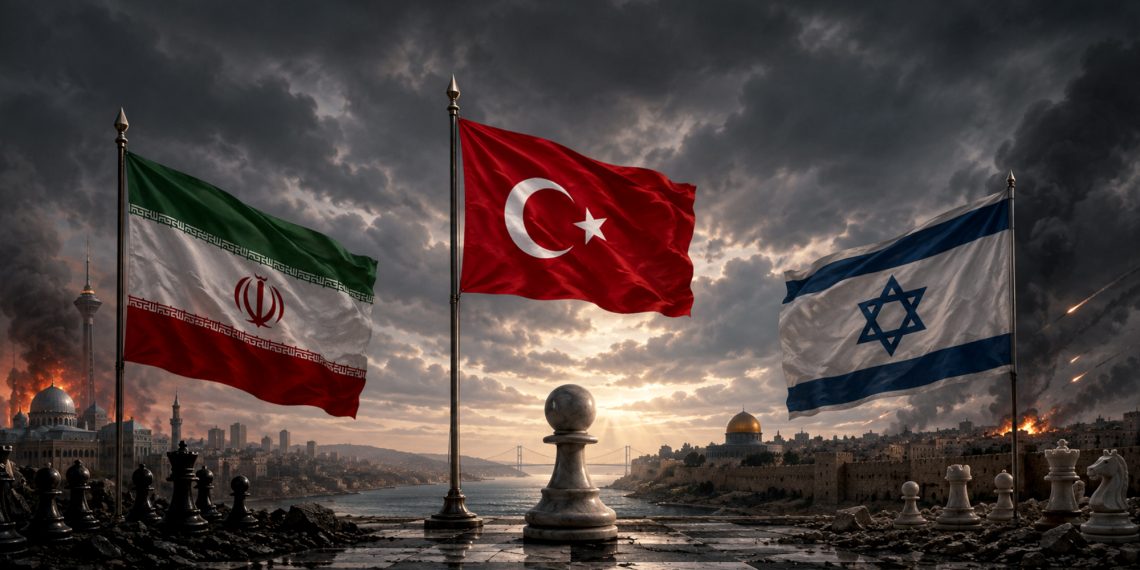
Türkiye is not merely an observer of the US–Israel confrontation with Iran. On the contrary, it is among the actors most directly affected by the political, security and economic consequences of such a conflict. For Ankara, the Iran file extends far beyond Tehran’s nuclear programme or missile capabilities. It touches simultaneously on Türkiye’s eastern and southern security belt, the balance of power in Iraq and Syria, energy prices, trade routes and relations with the West.
For this reason, reducing Ankara’s position to the question of “Which side is Türkiye on?” offers an incomplete reading. Türkiye’s primary concern is not to take an explicit side, but to manage the consequences of the conflict without becoming a direct party to it. Ankara is uneasy about Iran’s regional influence, yet it also views the collapse of the Iranian state as a major threat to its own security. It is precisely at this point that Türkiye’s search for balance in foreign policy begins.
Ankara’s Core Calculation
Relations between Türkiye and Iran are neither fully cooperative nor openly hostile. Historically, the two countries have often competed, yet have largely managed to keep this rivalry under control. Despite pursuing different objectives in Syria, Iraq and the South Caucasus, they have not completely severed channels of engagement in areas such as trade, energy and border security.
Today, Ankara continues to operate within this established pattern. It closely monitors Iran’s network of proxy forces, its missile capabilities and its influence across Iraq and Syria. At the same time, it recognises that a state crisis or uncontrolled disintegration in Iran could produce far more severe consequences. A weakened Iran may represent a manageable risk; a fragmented or chaotic Iran would pose a far greater security challenge.
Such a scenario could bring new waves of migration, armed groups, sectarian tensions and governance vacuums to Türkiye’s borders. Therefore, Ankara’s approach to the Iran conflict is not about defending Iran, but about preventing a broader regional collapse triggered by developments within Iran. Türkiye does not want Tehran to gain unchecked power, but neither does it want Tehran to disintegrate entirely.
Search for a Regional Mechanism
From Ankara’s perspective, the most realistic strategy is to remain outside the conflict while becoming one of the centres managing its consequences. Türkiye’s aim is not merely to keep its distance, but to help establish a diplomatic framework that prevents the crisis from spreading across the region.
To this end, Ankara may seek to construct a more institutionalised regional de-escalation mechanism that goes beyond bilateral contacts. A structure involving Türkiye, Pakistan, Egypt, Iraq and key Gulf actors could address ceasefire efforts, border security, the protection of energy and trade routes, and the management of humanitarian risks within a single framework.
The success of such a mechanism would depend on Ankara’s ability to engage simultaneously with Iran, the West and Gulf capitals. In doing so, Türkiye could position itself as a central diplomatic actor seeking to reduce the regional costs of the conflict without becoming a party to it.
Security and Economy in the Same Equation
One of the most immediate risks for Türkiye lies along the Iraq–Syria axis. Iran’s regional power is not limited to its conventional forces; it extends through a network of proxy groups and militias active across the region. Should the conflict expand, the mobilisation of these actors could directly affect Türkiye’s security environment.
This makes Ankara’s Iraq policy even more critical. Türkiye does not want Iraq to fall entirely under Iranian influence, but it also opposes the country’s fragmentation. Strengthening security coordination with Baghdad and Erbil, monitoring militia activity along the border, safeguarding logistical routes and securing projects such as the Development Road have all become strategic priorities.
The economic outlook is equally complex. Disruptions to trade with Iran, reduced exports to the Gulf, rising energy prices, and increased transport and insurance costs could all place pressure on the Turkish economy. Any escalation around the Strait of Hormuz affects not only Gulf states but also energy-importing countries such as Türkiye.
At the same time, the crisis may offer certain opportunities. If Türkiye can position itself as a secure trade and energy corridor, it could strengthen its role as a bridge between Asia and Europe. However, turning this potential into tangible gains requires more than geopolitical rhetoric. It demands robust logistics infrastructure, credible diplomacy, energy diversification and resilient economic planning.
Ultimately, Türkiye’s strategy in the Iran conflict rests on a simple yet difficult objective: to remain outside the war while being among those who shape its outcomes. Ankara seeks neither to align unconditionally with Iran nor to fully anchor itself to the US–Israel axis. Its core concern is to prevent the regional crisis from disrupting its strategic balance.
In this context, Türkiye’s success will depend less on loud declarations and more on quiet, multidimensional diplomacy. Keeping channels open while expressing objections, remaining influential without taking sides, and preserving its regional role without escalating security risks constitute Ankara’s central challenge. In such a conflict, being on the wrong side is costly — but so too is failing to be at the table at the right moment.