
The Alliance Between the “Azawad Liberation Front” and “Jama’at Nusrat al-Islam wal-Muslimin” in Mali
The security and political situation in Mali and the Sahel is witnessing significant developments amid an initiative launched by tribal elders and local judges in northern Mali. This initiative seeks to bridge the gap between the Azawad Liberation Front (FLN) and Jama’at Nusrat al-Islam wal-Muslimin (JNIM) . It comes against the backdrop of complex field and political dynamics facing both groups, particularly following the bloody confrontations between them in 2012, and the subsequent realignment of armed actors which led to the signing of what became known as the “Azawad Document”.

Drivers of Rapprochement
A common enemy: Both groups are engaged in fighting the Malian government, backed by international forces, as well as rival armed factions competing for influence in the region. This has prompted them to reconsider their internal conflicts in favor of coordination against their shared adversaries.

Avoiding past mistakes: The initiative stems from lessons learned from the bitter clashes of 2012, which weakened both parties and allowed for regional and international interventions that undermined their ambitions. This led to the signing of the “Azawad Document”, formally titled “General Guidelines on the Jihadi Islamic Project in Azawad”. The document stated: “…with the aim of removing the social, political, and intellectual isolation between the mujahideen and those constituencies as much as possible, particularly the major tribes, the principal rebel movements of various orientations, the notables and scholars of Azawad society and other respected entities and figures”.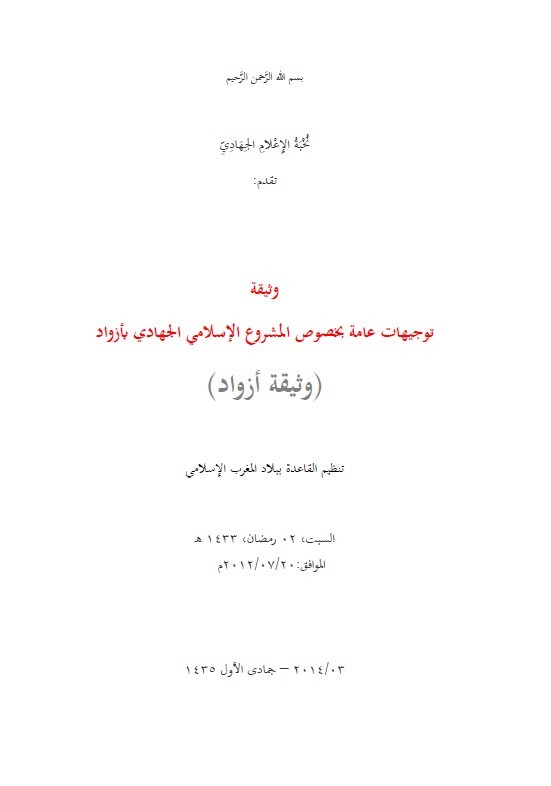
Local societal pressure: Local communities, through traditional and religious leaders, are pushing for an agreement that would ease the suffering of civilians trapped between the warring factions.
Parameters of a Potential Agreement
Guaranteeing non-recurrence of internal conflict: The agreement is expected to focus on mechanisms that prevent future clashes, with established channels for conflict resolution.
Division of territorial control: It may involve arrangements for dividing spheres of influence or establishing military coordination mechanisms.
Commitment to the Azawad Document: Any new understandings are likely to build upon previous agreements, adjusted to fit current realities.
Stance toward the Malian government: Their position vis-à-vis Bamako will remain a crucial factor in the success of any deal, given their ideological divergences.
Challenges Facing the Agreement
Ideological differences: The Azawad Liberation Front is a nationalist movement advocating autonomy for the Tuareg, comprising a coalition of four Azawadi factions. “JNIM”, by contrast, embraces a global Islamic vision aimed at establishing governance based on Sharia. However, JNIM has shown pragmatism in its legal-political dealings with rivals, drawing on the jurisprudential maxim *“securing benefits and warding off harms”. This implies prioritizing the removal of harm over the attainment of benefit when the two conflict.
The agreement should be seen as a tactical military and political alliance rather than a strategic one given the ideological rift between “Islamist” and “nationalist” orientations. The immediate aim is to set aside differences in order to withstand the new Malian government coalition and the African Corps mercenaries (formerly Wagner), who stepped in after France’s withdrawal. Neither the Front nor JNIM, individually, possesses sufficient power to face this coalition alone.
Another driver behind this alliance is the presence of the Islamic State (IS) which poses an additional challenge and a rival force to any emerging actors in Africa, especially as IS operations intensify in West Africa, the Sahel, and the Horn of Africa. Previously, IS harshly criticized al-Qaeda in the Islamic Maghreb for signing the Azawad Document with what it labeled as *“infidel democratic forces”.
Such alliances differ from those between states, as they are forged between armed groups with divergent ideological backgrounds.
External interventions: The rapprochement may not be welcomed by certain regional and international actors who see it as a threat to their interests, unless it serves their objectives in curbing the influence of rival powers.
The Malian government’s stance: Bamako is likely to view the deal as a threat to national unity, potentially prompting military action to foil it.
An internal factor that could affect the alliance’s future lies in the revolutionary nature of both parties: they are seeking to alter realities without possessing territorial control or formal political authority. However, the situation could change significantly if they succeed in consolidating power on the ground, potentially reshaping their priorities and alliances.
Possible Scenarios
Success and formation of a tactical alliance: If mediation succeeds, a limited tactical alliance may emerge, focusing on dividing spheres of influence and coordinating military operations.
Failure and renewed tensions: If negotiations falter, clashes may resume, especially amid competition over vital resources and territories.
Partial agreement leading to temporary calm: The most likely scenario involves limited understandings on halting hostilities and field coordination, without evolving into a long-term strategic alliance.
The initiative for rapprochement between the Azawad Liberation Front and JNIM marks an important development in Mali’s security landscape. It may reshape the armed balance of power in the Sahel. However, its success hinges on the two parties’ ability to overcome ideological rifts and navigate internal and external challenges. In any case, this initiative will remain under the close watch of regional and international powers, wary of shifts in Mali’s balance of power—especially as voices grow louder calling for secession and the establishment of self-rule in the region, following the new military government’s suspension of the Algiers peace accord with the opposition.