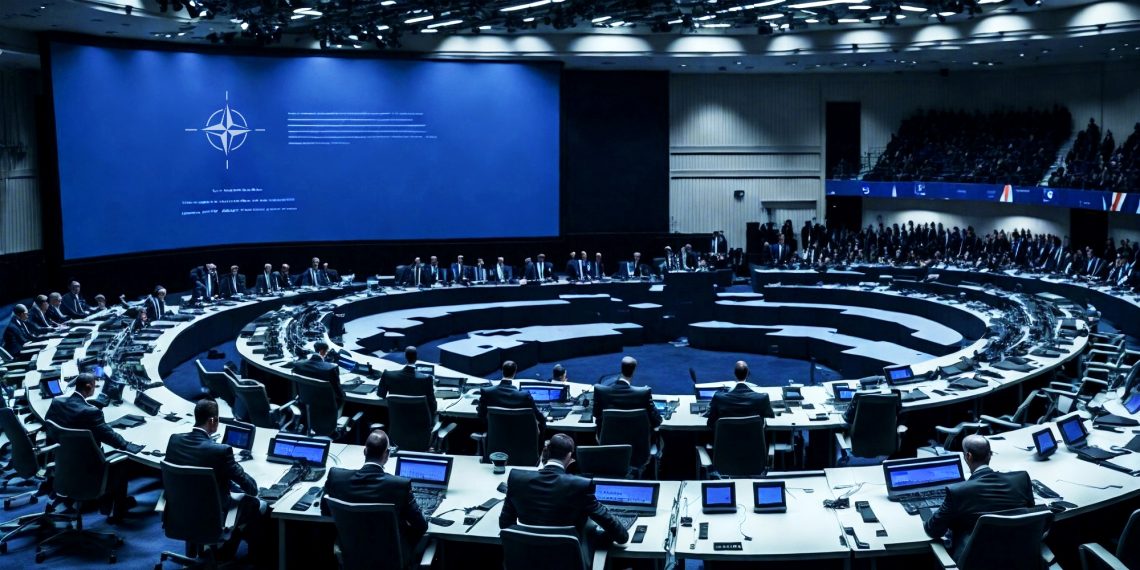
In recent years, the US has been trying to move the NATO alliance from a defence alliance to an “offensive” strategy. Or rather, the NATO alliance is being steered towards strategies beyond defence in line with the US security strategies developed one after the other in recent years. Of course, with the important support of the UK.
The NATO summit in Vilnius on July11-12, 2023 was in the words of NATO Secretary General Jens Stoltenberg, a historic summit. In the run-up to the summit in this former Soviet territory and very close to Russia, three important issues came to the fore:
Sweden’s NATO membership is conditional on Turkey’s “cessation of support for terrorism”.
Strong commitment to NATO membership for Ukraine and continued arms aid against Russia.
Discussion of NATO’s new defense plans.
Turkey’s Pre-Summit Moves
Turkey was at the centre of the pre-summit activity. NATO Secretary General and then US President Joe Biden called Turkish President Tayyip Erdoğan on the phone and intensified their diplomatic efforts to persuade Sweden’s membership. Although the topic was Sweden’s NATO membership,Turkey also brought different issues to the agenda. The procurement of F-16 aircraft and kits, which had been expected for two years, but still had not received the answer from the USA, was at the forefront. After this meeting, it is understood that the Biden administration promised to accelerate the bill on the subject, which is pending in the US Congress.
Biden also expressed his agreement with Erdoğan’s wish that “the leaders of the EU countries should send strong messages on Turkey’s EU membership”. However, how will the highly disorganised EU countries convince Greece and the Greek Cypriot Administration of Southern Cyprus (GASC) on this issue, which requires unanimity? As a matter of fact, the EU member states of NATO, which were sympathetic during the summit, listed their conditions for Turkey after the foreign ministers’ meeting.
The most important of these was the resumption of negotiations on the return to a “federated” structure in Cyprus. For 48 years, it was Turkey that brought solution proposals on federation to the table, while it was the Greek Cypriot side that objected.
In 2022, Turkey announced the “two-state” solution to the whole world and underlined that there could be no other solution. The fact that there have been no conflicts and massacres between the two sides since 1974 on the de facto divided island is the most important justification for a two-state solution. If stability and non-conflict are priorities for the international institutions, these have continued to be realised for 49 years.
Sweden’s request for Turkey to cease its support to PKK/YPG terrorism as a condition for its NATO membership is actually expected from other NATO members in line with the alliance’s spirit of “common defence”.
However, as Turkey has repeatedly emphasised, the US has been providing training, weapons and political support to the PYD/YPG, the Syrian affiliate of the PKK terrorist organisation, in eastern Syria since 2016.
Every year, millions of dollars from the US budget are allocated for this purpose. Turkey’s justified complaints are dismissed by the allied US as “It is being done for the joint fight against the ISIS terrorist organisation!”.
For this reason, the Turkish public is so angry about the US that they say, “When an ally country causes so much damage to Turkey’s internal stability and economy, how would an enemy country do so?”. However, despite the fact that Turkey has repeatedly told the US, “Cooperate with us instead of the YPG terrorist organisation!” in the fight against ISIS.
On the evening of July 10, President Erdoğan travelled to Vilnius and held a “trilateral meeting” with NATO Secretary General Stoltenberg and Swedish Prime Minister Ulf Kristersson, and the announcement that he had given the green light to Sweden’s NATO membership was the breaking news of the day, a result that came as a surprise at least in Turkey. In fact, according to Erdoğan’s and Foreign Minister Hakan Fidan’s previous statements, there was a heavy expectation that Sweden would wait a while longer at the NATO summit. As a result, Sweden’s membership decision was left to the meeting of the Turkish parliament in early October 2023.
Other Important Developments at the Vilnius Summit
The countries with the highest expectations before the summit were Sweden and Ukraine. Sweden had demanded that Turkey address its concerns about “support for terrorism”, while Ukraine’s President Volodymyr Zelenskyy had asked NATO for “accelerated membership”. While Sweden’s hopes were raised, Ukraine was told “Wait a little longer!”. It was clear from his body language in a photograph taken at the summit that the Ukrainian leader Zelenskyy, who had travelled to Vilnius for this purpose, was not given the hopes he had hoped for.
The European countries of NATO, which provided arms and equipment support in the Russia-Ukraine war under “neighbourhood pressure” from the USA and the UK, were forced to provide arms support again when they took refuge in the excuse that “there was no more ammunition to give”.
Although Zelenskyy was said during his visit to Istanbul before the summit that “Ukraine deserves NATO membership!” it was not possible for this to happen while the war was going on. Because according to Article 5 of the Atlantic Charter, if a member state comes under armed attack, the other members are obliged to stand by that country and defend it. Ukraine, which is still at war, cannot become a member of NATO in this situation.
As soon as the war ends and the situation in Russia calms down, it will be easier to talk about membership. By the way, it would be useful to give Ukraine the following warning: The West is famous for keeping even those who protect it waiting! The Turks are the nation that knows this best.
When Russia attacked Ukraine, almost everyone thought that Russia would bring Ukraine to its knees in a short period of time and that the Zelenski administration would change. The calculation at home did not fit the market.
Within a month and a half, it became clear that Russia was not prepared for this planned war in terms of the number of soldiers, equipment, logistics and intelligence. While Ukrainian soldiers were waging a “national struggle” for the defence of the country, Russian soldiers were in the belief that this struggle was not a “just war” as if to say “What are we doing in this war?”.
Nevertheless, Russia has captured almost all of the separatist region in eastern Ukraine within 6-7 months.
However, it has not been able to gain the military, psychological and political superiority to force Ukraine to give up its determination and will to fight. On top of that, in the last weeks of the war, which has been going on for more than 500 days, Ukraine started to gain new positions while retreating. There was also the Wagner crisis, which severely damaged Moscow’s reputation. “While Wagner was welcomed in Rostow with public demonstrations of love and sent off to Moscow, no Russian citizen appeared in Moscow to protect Putin!” the Ukrainian side says.
Ukraine’s Ambassador to Ankara Vasly Bodnar said that Ukraine, with its economy, population, number of soldiers, energy resources, weapons and national power elements, including weapons technology with its scarce capabilities and capabilities that cannot be compared with Russia, stopped Russia by showing a great example of heroism and started to regain the lost territories, and shared the following statement common in the Ukrainian army in recent weeks: “Don’t be afraid NATO, we will protect you!”
Bodnar said that Ukraine is defending its homeland against the Russians in a way similar to Turkey’s National Struggle after World War I. In his public speech at the Strategic Think Tank in Ankara on July13 2023, Bodnar likened Ukraine’s NATO membership to Turkey’s being kept waiting in front of the EU door, saying “Turkey understands us best!” and in a way, he also voiced Ukraine’s disappointment.
Strategy Changes in NATO and Possible New Regional Defence Plans
Since Russia’s unlawful invasion of Crimea in 2014, NATO has been working on changing its strategy, Russia was clearly perceived as a threat in 2018, finally Russia and global terrorism were included in NATO defence plans in the NATO military strategy renewed in 2019.
In this context, the NATO military strategy was revised to consider what could be done to deter and if necessary, defend against threats to the Euro-Atlantic region. In 2021, defence plans were developed taking into account the demographic structures of these regions and technological developments.
According to the new strategic concept adopted at NATO’s Madrid summit in June 2022, which took place after Russia’s attack on Ukraine, the Euro-Atlantic security architecture was undermined by “strategic competition and widespread instability”, Russia which attacked Ukraine became an open threat and could engage in strategic struggle in the Arctic and North Atlantic and the Russian presence in the Baltic Sea, Black Sea, Mediterranean and Belarus conflicted with the interests of the alliance.
The concept also claimed that China “undermines the security of the alliance by targeting allies with its malicious hybrid and cyber operations, confrontational rhetoric and disinformation”.
Following these developments, reminiscent of the Cold War era, it was widely reported in the media that NATO’s regional defence plans were being formulated, albeit with a “top secret” level of secrecy.
However, NATO’s new defence plans concerning Turkey and the role of the alliance in the future of the Black Sea in this context have not been fully understood. It is evaluated that NATO’s regional defence plans, which are determined by taking into account the press statements of the NATO Secretary General, especially after the NATO summit and the “Global Security Strategies” of the USA in recent years, may be as follows:
The first is the defence plans covering the Atlantic and northern Europe.
The second area is Central Europe, which extends from the adjacent Baltic region to the Alps.
The last one is the region that includes a wide geography from the Mediterranean to the Black Sea and is directly related to Turkey.
As in previous plans, these defence plans include details on the forces to be deployed and used in the land, sea and air areas as well as in space and cyber areas. Depending on the emerging threat, it will be decided how to act in terms of time and space.
With the Vilnius summit, the number of the “NATO Response Force” will be increased from 40,000 to approximately 300,000. This is far outnumbering even the Russian forces that attacked in February 2022 with a force of 175,000. The number of brigades in eastern Europe will also be increased in view of the attack on Ukraine, a development reminiscent of the “forward defence” strategy of the Cold War. According to these summaries, it is impossible to say “wrong!” to those who say that NATO is looking for new enemies in line with the wishes of the United States. It can even be seen that the alliance has evolved into a policy of aggression rather than defence.
Is a NATO Permanent Naval Force in the Black Sea Necessary?
In recent months, the demand for the establishment of a “Permanent Naval Force” in the Black Sea has been voiced in addition to NATO’s efforts to mass up to the Black Sea, which started in Eastern Europe before the Russia-Ukraine war and took shape by covering Bulgaria and Romania. In fact, the USA’s ambition to freely access the Black Sea by breaching the “Montreux Straits Convention” has been known for years.
With the free access of the USA to the Black Sea, Russia will attach more importance to armament in this geography and other Black Sea littoral countries, which will feel the threat the most, will allocate their resources to armament instead of economic development. Having recognised this danger for a long time, Turkey has tried to avoid these “dangerous” fait accompli within the alliance through diplomatic measures.
In contrast to this attitude of Turkey, the Black Sea littoral countries have a different approach. NATO countries Romania and to a lesser extent, Bulgaria and non-alliance countries Georgia and Ukraine want a Permanent Naval Force.
On the other hand, the risk of a Russia-NATO war is growing, given the increasing transfer of alliance weapons to Ukraine, the prolongation of the war and NATO defence plans for the region. In such a war, the risk of a nuclear conflict would also increase and the Black Sea littoral states would suffer the greatest damage.
If a naval force in the Black Sea is desired, it should be formed from the naval forces of NATO countries in the region. Turkey, which is capable of maintaining a strong naval force in the Black Sea, together with Bulgaria and Romania has the capability to deter Russian naval forces in the Black Sea.
If adequate reinforcements, especially air defence systems, are provided for this purpose, the countries in the region will feel less threatened and will be able to allocate their resources to their development. Moreover, the founding philosophy of NATO, which was based on “defence” principles at the time of its establishment, would be preserved.
In conclusion, according to NATO’s new military plan for the defence of the region from the Mediterranean to the Black Sea, Turkey is the most important power in the region. While these facts are obvious, how long can the EU continue to keep Turkey waiting at the door? How long will the US support the PKK/YPG terrorist organisation that threatens Turkey, the key country of the region and when will it turn back from this mistake? And how long will Turkey be able to tolerate this situation? I wonder which realistic and visionary “Western” leader/leaders will be able to see these realities and produce solutions?