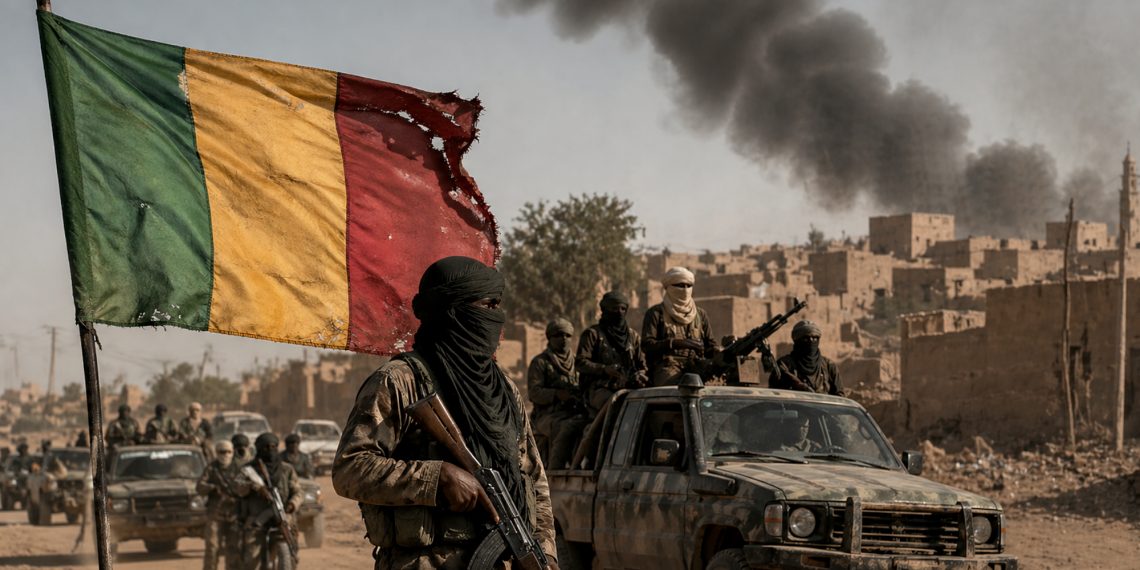
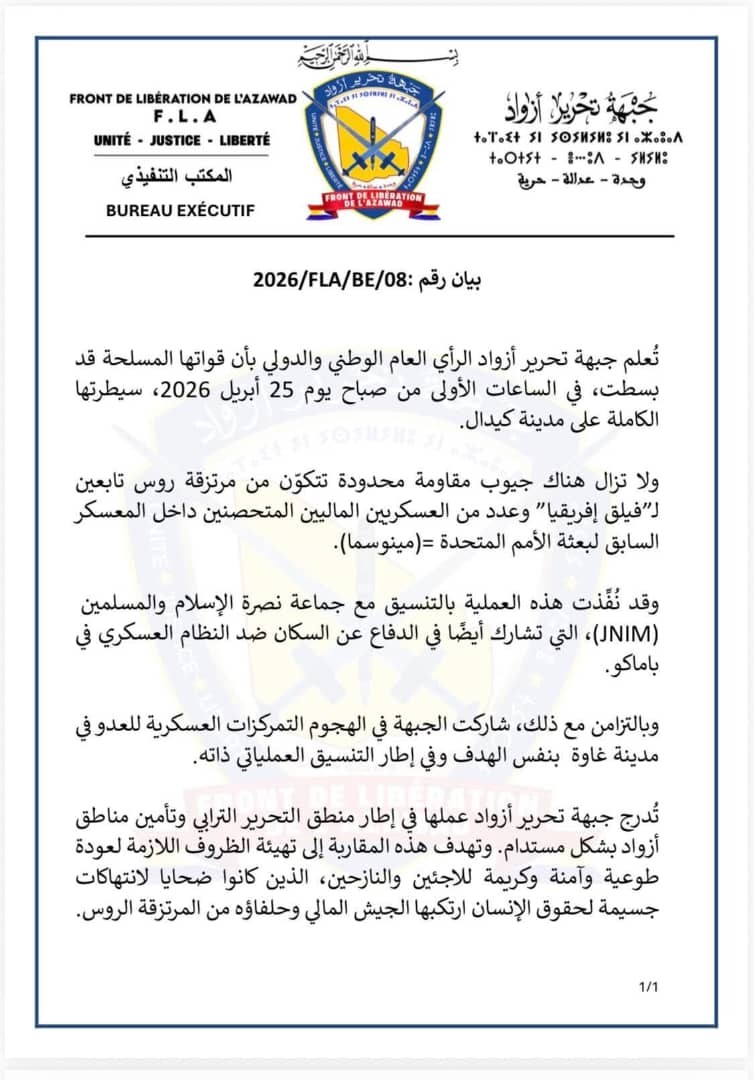
In a significant development, an alliance between Jamaat Nusrat al Islam wal Muslimeen and the Azawad Liberation Front announced, through two statements, a series of operations targeting major cities and military sites, including the residence of Malian President Assimi Goïta, the headquarters of Defence Minister Sadio Camara, Modibo Keïta International Airport in the capital, Bamako, and military positions in the city of Kati. This coincided with an announcement of full control over the city of Mopti and most army positions in Sévaré and Gao, in addition to the capture of Kidal, with only limited pockets remaining under government and Africa Corps control.
Several regions across Mali witnessed what amounted to a coordinated attempted military coup, involving attacks and clashes carried out by the alliance at dawn on Saturday, 26 April 2026, and resulting in its control of military bases and government institutions in those areas.
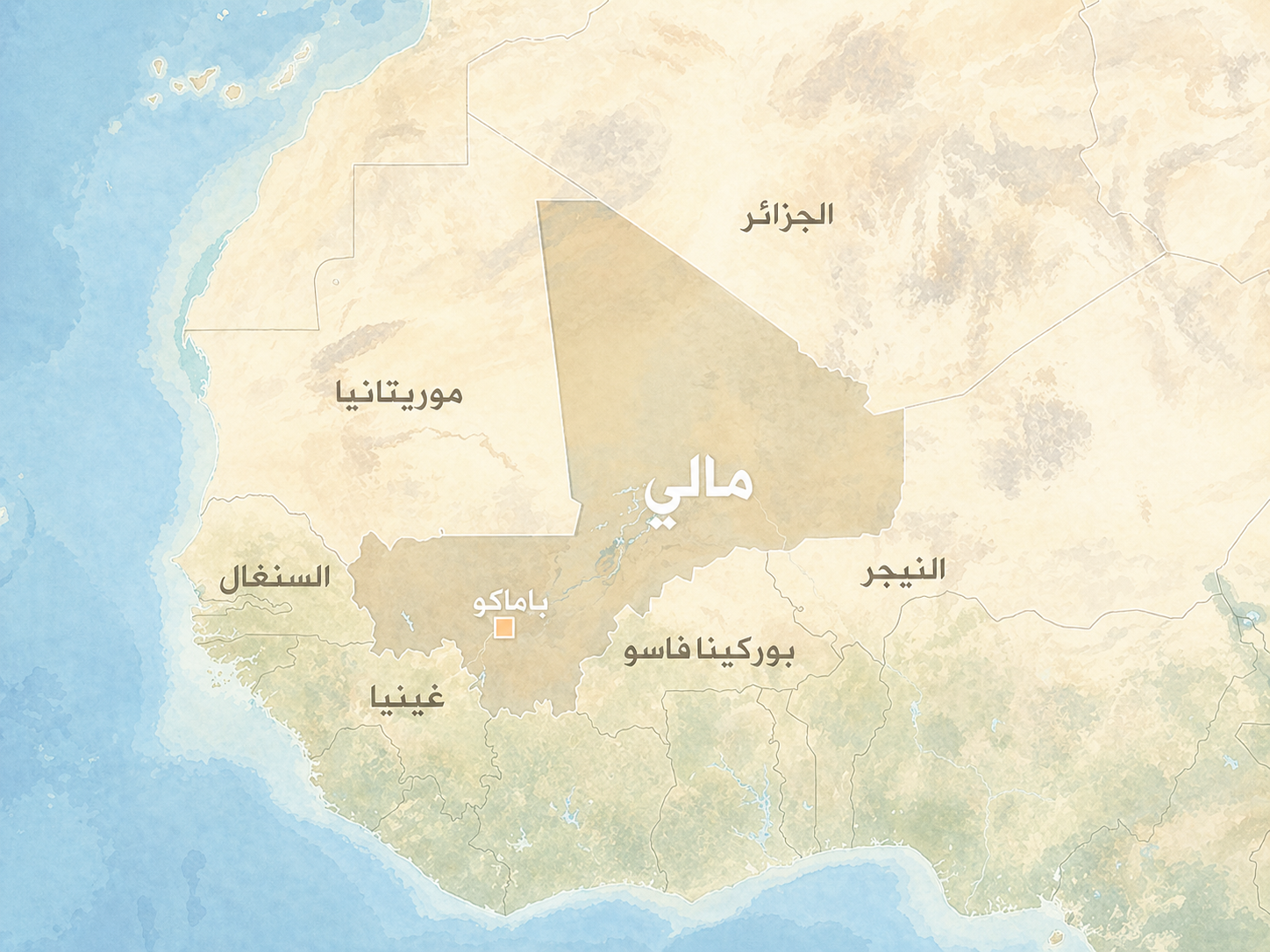
The two groups confirmed that their fighters had achieved full control over Mopti and tightened their grip on key army strongholds and Africa Corps positions in Sévaré and Gao. They also announced control of Kidal following a joint operation targeting Malian forces and Russian elements, conducted in coordination with their allies in the Azawad Liberation Front.
The alliance emphasised that these gains were not accidental, but the result of sustained effort, continuous coordination and active partnership, which contributed to a real shift in the course of the confrontation.
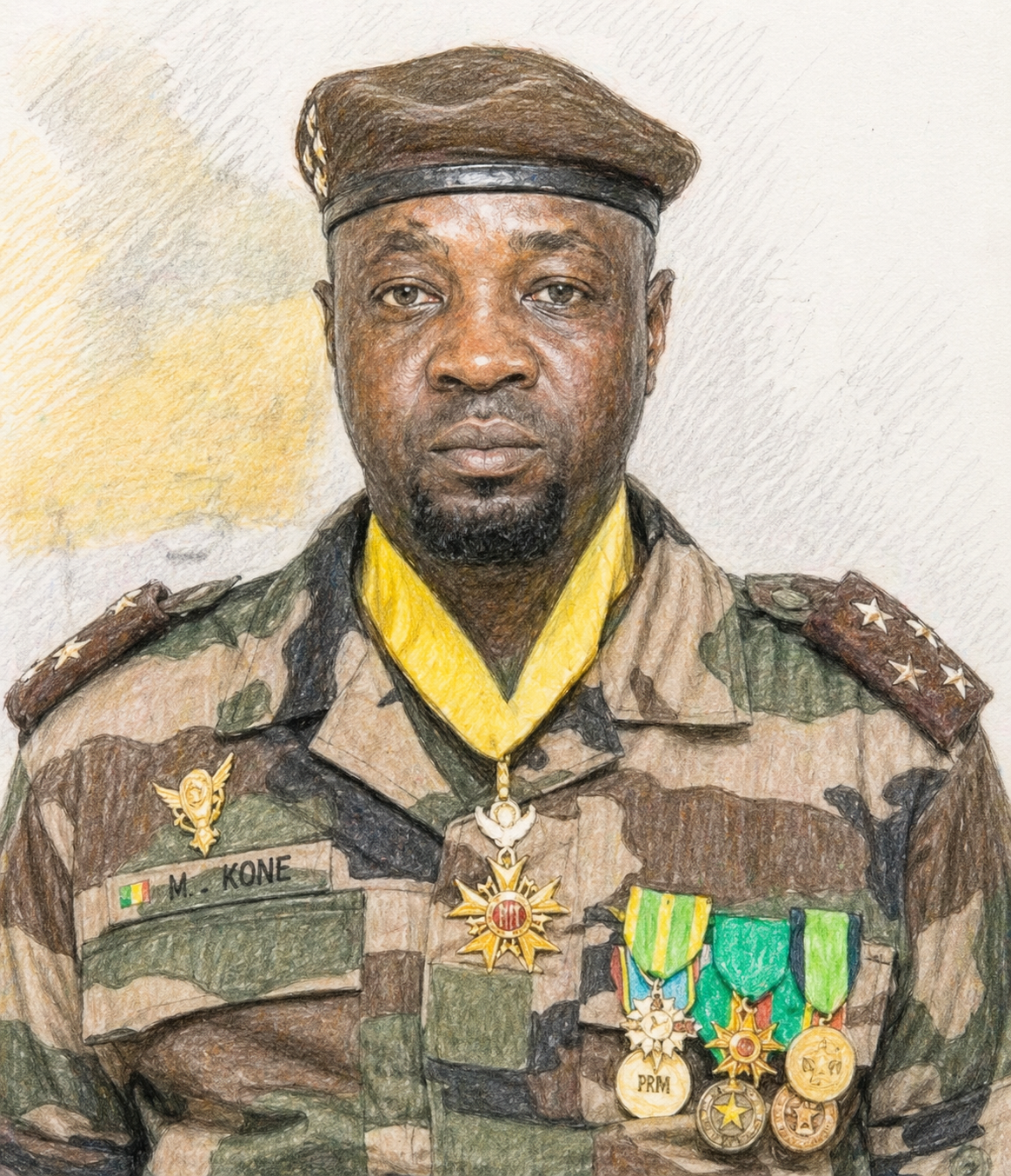
Heavy clashes were reported in Kidal, Gao, Mopti and the capital, Bamako, between the alliance on one side and the Malian army and Africa Corps on the other, leading to the alliance gaining control of large parts of these areas, while some pockets remained under government authority. The fighting reportedly resulted in the killing of Defence Minister General Sadio Camara and intelligence chief General Modibo Kone, while alliance fighters seized the passport and official uniform of Kidal governor General El Hadj Ag Gamou after he fled the city.
These attacks were preceded by a strategy aimed at near-full control over supply routes, besieging major cities, cutting fuel supplies to the capital and imposing restrictions on civilian transport companies.
The magazine Jeune Afrique confirmed the death of Defence Minister Sadio Camara following an attack by Jamaat Nusrat al Islam wal Muslimeen on his residence in Kati, using a car bomb that destroyed the compound.
Many African states, including Mali, continue to suffer from entrenched corruption, weak central authority and a lack of development due to decades of colonial rule that reinforced political dependency, empowered authoritarian systems and marginalised diverse ethnic communities while concentrating power in the centre and neglecting the periphery.
The attacks on military bases in Kona and Sévaré and the capture of Mopti place heavy pressure on the state, as they tighten the siege in the east and centre and expand the influence of Katibat Macina across the border with Burkina Faso. This movement effectively isolates Azawad from the rest of Mali and facilitates further advances towards cities such as Djenné and Ségou, where the same brigade operates as part of Jamaat Nusrat al Islam wal Muslimeen.
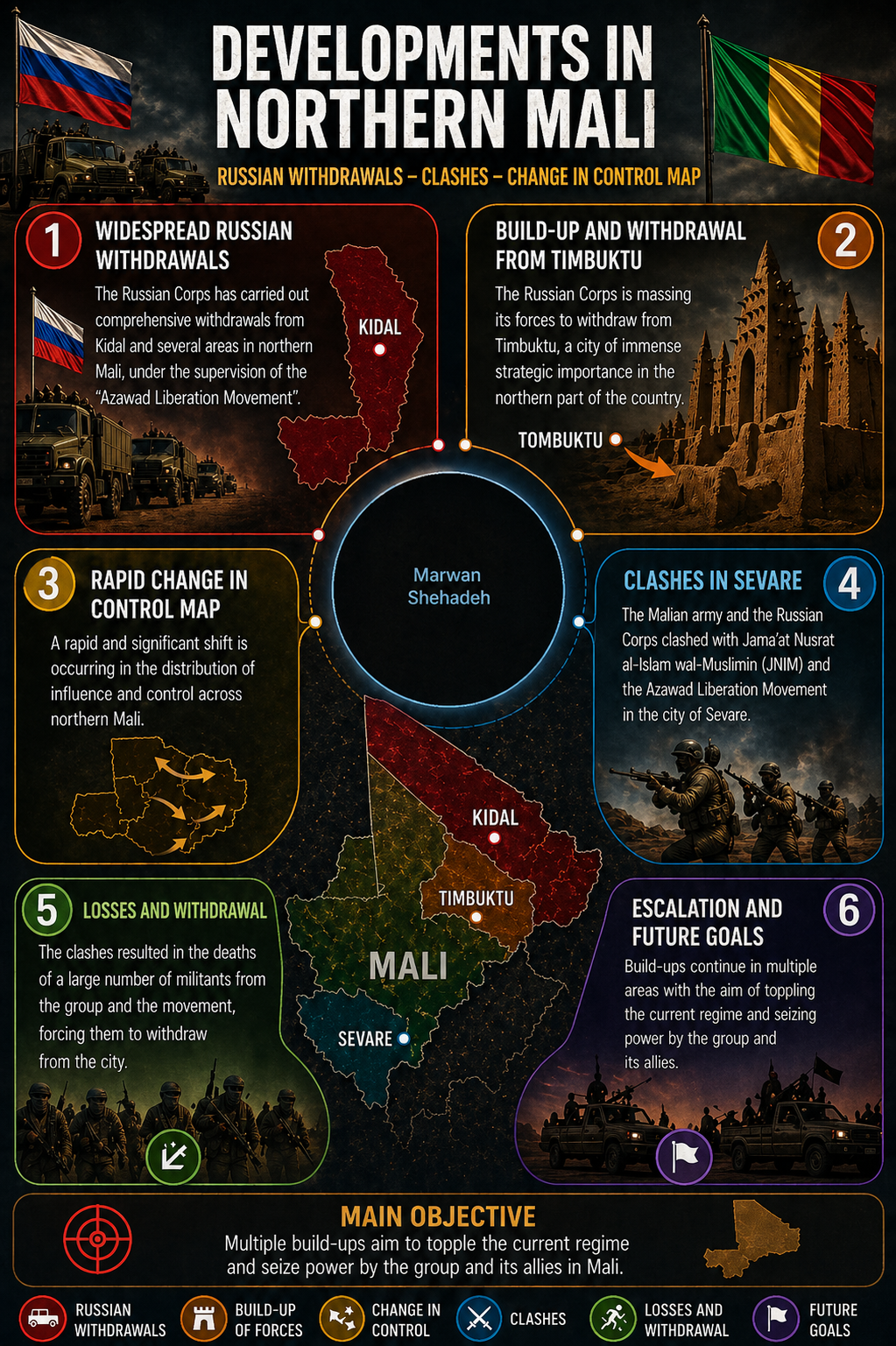
Targeting the city of Kati, adjacent to Bamako, opens a direct gateway to the capital and represents a strategy of encirclement, while continued expansion westwards following earlier control of Kayes, near the borders with Mauritania and Senegal, indicates a tightening grip around Bamako.
The expansion of the alliance also facilitates its operations against Islamic State elements in north-eastern Mali and strengthens its presence in the tri-border area between Niger, Burkina Faso and Mali, while at the same time Islamic State may exploit the situation to attempt to gain control of the besieged city of Ménaka.
Drawing on lessons from the Syrian experience, the alliance has begun limited political engagement, despite remaining an ideologically driven jihadist formation competing with Islamic State. This political track has emerged through condemning alleged massacres by the army and Russian Wagner elements, calling for an international investigation, urging protests in Bamako to establish an Islamic government, calling on Turkey to halt support to what it described as forces responsible for civilian killings, referring to drone supplies, and declaring a doctrine of conditional coexistence, while also entering negotiations with the government during the siege of the capital through mediation by opposition imam Mahmoud Dicko, based in Algeria, and formally expressing willingness to neutralise the Russian side and halt targeting them in exchange for future coordination.
Monitoring developments across Africa, the Sahel and the Horn reveals a major challenge for researchers and analysts due to the absence of reliable unified media sources. Government media is weak, slow and controlled, while French and Western coverage often reflects narratives tied to geopolitical interests, Russian media supports Malian military leaders, Arab media gives limited attention due to geopolitical priorities, and language barriers further complicate access to accurate information.
Most available information comes from official platforms of armed groups, state media and social media accounts that often lack professionalism, objectivity and comprehensive detail, reflecting individual agendas rather than a full picture of events.
The future trajectory of Mali points to two main scenarios: either the alliance consolidates control over the entire country, leading to the fall of the state, or the country moves towards de facto partition between a northern zone under alliance control, including Kidal, Gao, Mopti, Timbuktu and Macina, and a southern zone under military rule in Bamako, resulting in two competing authorities.
Regional stability will inevitably be affected, particularly in neighbouring states such as Mauritania, Algeria and Morocco, as well as Burkina Faso and Niger, where affiliated armed groups operate, placing a significant burden on these states to avoid escalation by managing relations and preventing spillover of military and security activities in the future.