
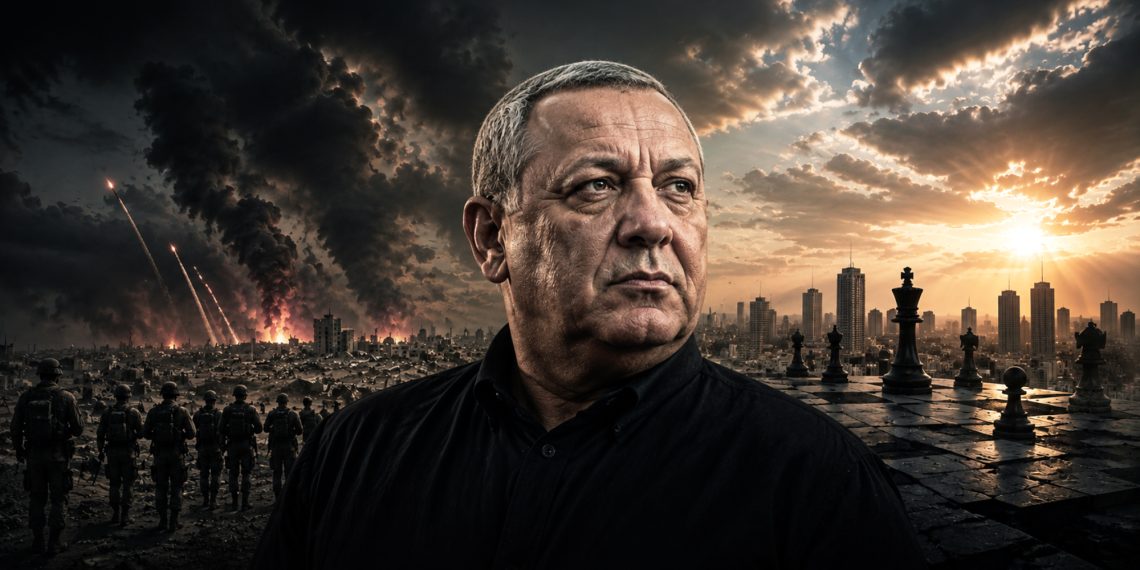
Gadi Eisenkot is not Benjamin Netanyahu’s opposite. He is the more credible face of Netanyahu’s policy. For Jewish Israelis, he offers institutional repair, accountability for 7 October and an end to the politics of personal survival. For Palestinians, he offers the same occupation, run more efficiently and presented as more acceptable to the world. In August 2026 he told Haaretz that “under the government we establish, there will be no Palestinian state” (quoted in Leber and Hassan, 2026).
Seen from outside Israel, and particularly from a Pakistani perspective with our own memory of colonial rule and partition, the question is not whether Eisenkot is better than Netanyahu. On most measures that matter inside Israel, he is. The question is whether a better Israeli prime minister produces a better outcome for Palestinians. On the evidence, he does not. His credibility may instead make the occupation harder to end, because the world will push less against a leader it respects.
Hermann’s (1990) work on foreign policy change helps separate real change from a change of manner. Governments can adjust the effort behind a policy, change its methods, replace its goals, or reorient a state’s entire place in the world. Eisenkot’s programme amounts to a substantial change in how Israel governs itself and a modest adjustment in how it manages the occupied territories. It brings no change in the goal of permanent Israeli control without Palestinian sovereignty. That is an old policy under a new face.
A Century Behind the Iron Wall
The goal has a long history. In 1923 Ze’ev Jabotinsky argued that Zionism could proceed only behind an “iron wall” of military power that the Arab population could not breach. Negotiation would become possible only once Arabs abandoned hope of defeating it. Shlaim (2000) traces this doctrine as the organising logic of Israeli strategy under governments of the left and the right. The wall was meant to bring the other side to negotiation from a position of weakness. In practice, successive governments maintained the wall and deferred the negotiation.
Palestinians have lived that history through five turning points. Between late 1947 and 1950, an estimated 600,000 to 760,000 Palestinian Arabs left or were driven from their homes, by Morris’s (2004) estimate. They were not allowed to return, and Palestinians remember those years as the Nakba, the catastrophe. In 1967 Israel captured the West Bank, East Jerusalem and Gaza, and settlement soon followed. The Oslo Accords of 1993 to 1995 created the Palestinian Authority but left Area C, about 60 per cent of the West Bank, under full Israeli control (Dekel, Cohen and Shalev, 2023). The final settlement that was supposed to follow never came. In 2005 Ariel Sharon, a former general, withdrew from Gaza without an agreement, and a blockade followed Hamas’s takeover in 2007.
The fifth turning point is the present. Hamas-led attacks on 7 October 2023 killed some 1,200 people in Israel, most of them civilians, and took 251 hostages. The war that followed has killed more than 74,000 Palestinians, according to Gaza’s Health Ministry (Associated Press, 2026). In the West Bank, the UN reported that settlement expansion and annexation had accelerated, displacing more than 36,000 Palestinians (OHCHR, 2026). October 2026 brought more settler attacks causing casualties or damage than any month since records began in 2006 (OCHA, 2026). In 2024, the International Court of Justice found Israel’s continued presence in the occupied territory unlawful (International Court of Justice, 2024).
Scholars in the settler-colonial tradition read this history as a structure rather than a series of events, driven by the steady replacement of one population by another on the land (Said, 1979; Wolfe, 2006; Khalidi, 2020). Others, Morris among them, stress contingency and war rather than design. The reader does not have to settle that debate to see the pattern. Every Israeli government, whatever its politics, has expanded control over the land and deferred Palestinian sovereignty. Any claim that a new prime minister marks a break has to be measured against that pattern.
General Eisenkot’s Record
Eisenkot was born in 1960 to Jewish immigrants from Morocco and grew up in Eilat (Horowitz, 2026). He spent four decades in uniform. He commanded the Golani Brigade and served as military secretary to Prime Minister Ehud Barak. In 2003 he commanded the Judea and Samaria Division, the army’s command for the occupied West Bank, during the second intifada. After the 2006 Lebanon war, he took over Northern Command, and from 2015 to 2019 he served as chief of the general staff (Israel Ministry of Foreign Affairs, n.d.).
At Northern Command he gave public form to the doctrine he is best known for. In October 2008 he said that what happened to Beirut’s Dahiya quarter would happen to every village from which Israel was fired on, and that Israel would use disproportionate force. “From our standpoint,” he said, “these are not civilian villages, they are military bases” (Reuters, 2008). The UN fact-finding mission on the 2008 to 2009 Gaza war quoted his remarks. It concluded that the strategy applied in Gaza was designed to punish, humiliate and terrorise a civilian population (UN Human Rights Council, 2009). Its chair, Richard Goldstone, later qualified some of his own conclusions (Goldstone, 2011). His three co-authors stood by the report (The Guardian, 2011).
After 7 October, Eisenkot joined the wartime government as a minister without portfolio. In December 2023 his son Gal was killed in northern Gaza during an operation to recover the bodies of hostages (Perets, 2026). The International Criminal Court’s warrants name Netanyahu and the former defence minister Yoav Gallant, not Eisenkot (International Criminal Court, 2024). What matters for this argument is his public doctrine and the offices he has held.
Measured against Netanyahu, his programme looks very different depending on the subject. For Israeli democracy, the change is real. He has pledged to establish a state commission of inquiry into 7 October and to repeal the judicial overhaul (Ynet, 2026). For Palestinians, it is not. On annexation, the change is only an adjustment. He opposes the E1 settlement plan, which would cut the West Bank in two (Reuters, 2026). A Jerusalem Post column records his opposition to full annexation and his pledge to enforce the law against violent settlers (Kukali, 2026). Yet he supports settlements authorised under Israeli law (Reuters, 2026), although the International Court of Justice has found settlement activity contrary to international law (International Court of Justice, 2024). He also rejects large-scale evacuation and insists on overriding Israeli security control (Kukali, 2026). The direction of policy would stay the same. Only the pace would change.
On statehood, nothing changes. Eisenkot calls the two-state formula “a mistake” (Reuters, 2026). His alternative is a “minus state”, self-government without an army or sovereignty (Kukali, 2026). That is administration without independence, much like what Oslo produced, and Netanyahu maintained. His coalition makes the point sharper. It would depend on the votes or abstentions of Arab-led parties representing Palestinian citizens of Israel. At the same time, his condition that partners commit to destroying Hamas keeps those parties out of the cabinet (Ynet, 2026). Palestinian citizens would sustain the government without any voice in its Palestinian policy.
The Price of Respectability
If Eisenkot changes so little for Palestinians, why might he matter more than Netanyahu? The answer is legitimacy. Hurd (1999) shows that rules sustained by legitimacy cost far less to uphold than rules sustained by coercion or self-interest. Cukierman and Tommasi (1998) show that whether a policy is believed depends on who proposes it, which is why hawks can sometimes make a peace that doves cannot. The same logic works in reverse. A former general whom foreign governments respect can sell continuity abroad, because outside audiences assume he would change course if change were possible.
The effect will differ from one actor to another. The Gulf is the least likely to move. Saudi Arabia will normalise relations only based on an “irreversible pathway” to Palestinian statehood (Freiberg, 2026). Eisenkot does not offer one. Europe is the most likely to move, because its pressure has been aimed largely at individuals. In June 2025, Britain and four partners sanctioned Bezalel Smotrich and Itamar Ben Gvir personally for inciting violence against Palestinians (UK Government, 2025). Measures aimed at named people lose their force when those people leave office, even if the occupation they oversaw remains. Donors are also likely to move. The Board of Peace for Gaza expects reconstruction to accelerate after the Israeli and American elections (Jerusalem Post Staff, 2026), and funding may flow without any conditions on the West Bank. Washington, which backed Netanyahu throughout, is unlikely to change course either way.
The result would be an occupation made respectable, respectable in appearance and unchanged in substance. Gaza would remain partitioned along the Yellow Line, with reconstruction stalled and confined to areas beyond Israeli control (PBS NewsHour, 2026). The West Bank would be governed as a “minus state”, with fewer settler attacks, easier movement and some economic relief, improvements that ease daily life while leaving Israeli control intact. This is what Goodman (2018) calls “shrinking the conflict”. Lustick (1993) explains why it is not a neutral pause. As incorporation of territory deepens, withdrawal passes from difficult to politically unthinkable. Slowing that process without reversing it does not keep options open. It closes them more quietly. With Palestinian elections postponed to September 2027 (Al Jazeera, 2026), Palestinians would have no elected voice to contest the arrangement.
Daily life in the West Bank may well improve. The far right’s exit from government would bring real relief to a territory where settler attacks now account for 55 per cent of recorded injuries to Palestinians (UNICEF, 2026). Some point to Sharon’s withdrawal from Gaza as proof that generals can surprise. Eisenkot’s explicit pledges on statehood rule out that path. A better situation day to day may help secure a worse outcome in the long term.
Pakistan and the Test of Policy
Whether this occupation made respectable takes hold will depend more on the region than on Jerusalem, and Pakistan sits at the centre of that test. In August 2026 Pakistan, Saudi Arabia and Turkey signed the Mecca Joint Defence Agreement, a sign that regional powers are now shaping their own security order (Council on Foreign Relations, 2026). Pakistan brings to that order a position of unusual clarity. It refuses to recognise Israel without a Palestinian state on the 1967 lines. It restated that position in May 2026, when it rejected President Trump’s call to join the Abraham Accords (Arab News Pakistan, 2026). Riyadh’s leverage rests on a similar condition, a pathway to statehood. Both conditions concern policy, not personality. Together they are now the strongest remaining check on an occupation made respectable.
For Pakistan, the lesson connects to its own history. As a state born of partition, it knows that unresolved territorial questions outlast the leaders who manage them. The postcolonial world has seen many arrangements in which control was repackaged in a more acceptable form while the order beneath stayed intact. Pakistan’s standing on Palestine rests on applying the same test to Israel that it applies elsewhere. The test is whether the policy has changed, not merely the face presenting it. If Islamabad holds to that test while others relax, its refusal will count for more, not less.
Eisenkot may serve Israelis better than Netanyahu did. For Palestinians, he offers a new guard at the same wall. Israel can change its prime minister within weeks. Palestinians have waited 78 years for a change in the policy that governs them.
References
Al Jazeera (2026) ‘Abbas postpones Palestinian legislative elections to September 2027’, Al Jazeera, 10 October. Available at: https://www.aljazeera.com/news/2026/10/10/abbas-postpones-palestinian-legislative-elections-to-september-2027 (Accessed: 8 November 2026).
Arab News Pakistan (2026) ‘Pakistan rules out joining Abraham Accords after Trump call for wider Arab-Israel deal’, Arab News Pakistan, 26 May. Available at: https://www.arabnews.pk/node/2644957/pakistan (Accessed: 8 November 2026).
Associated Press (2026) ‘Palestinian death toll in Gaza war rises above 74,000 since the war began’, The Boston Globe, 27 September. Available at: https://www.bostonglobe.com/2026/09/27/world/palestinian-death-toll-in-gaza-war-rises-above-74000-since-the-war-began/ (Accessed: 8 November 2026).
Council on Foreign Relations (2026) ‘The U.S.-led Middle East order is over. The Mecca agreement proves it’, 13 August. Available at: https://www.cfr.org/articles/the-u-s-led-middle-east-order-is-over-the-mecca-agreement-proves-it (Accessed: 8 November 2026).
Cukierman, A. and Tommasi, M. (1998) ‘When does it take a Nixon to go to China?’, American Economic Review, 88(1), pp. 180-197.
Dekel, U., Cohen, R. and Shalev, N. (2023) The Struggle over Area C: Change Direction toward a Space for Understanding with the Palestinian Authority. Special Publication, 23 August. Tel Aviv: Institute for National Security Studies. Available at: https://www.inss.org.il/wp-content/uploads/2023/08/special-publication-230823-1.pdf (Accessed: 8 November 2026).
Freiberg, N. (2026) ‘After Trump call, Saudi source says no normalization with Israel without “irreversible pathway” to Palestinian state’, The Times of Israel, 25 May. Available at: https://www.timesofisrael.com/liveblog_entry/after-trump-call-saudi-source-says-no-normalization-with-israel-without-irreversible-pathway-to-palestinian-state/ (Accessed: 8 November 2026).
Goldstone, R. (2011) ‘Reconsidering the Goldstone Report on Israel and war crimes’, The Washington Post, 1 April.
Goodman, M. (2018) Catch-67: The Left, the Right, and the Legacy of the Six-Day War. New Haven: Yale University Press.
Hermann, C.F. (1990) ‘Changing course: when governments choose to redirect foreign policy’, International Studies Quarterly, 34(1), pp. 3-21.
Horowitz, M. (2026) ‘Is Gadi Eisenkot the general who knows how Israelis feel?’, Al Majalla, updated 2 August. Available at: https://en.majalla.com/node/332316 (Accessed: 8 November 2026).
Hurd, I. (1999) ‘Legitimacy and authority in international politics’, International Organization, 53(2), pp. 379-408.
International Court of Justice (2024) Legal Consequences arising from the Policies and Practices of Israel in the Occupied Palestinian Territory, including East Jerusalem, Advisory Opinion of 19 July 2024. The Hague: ICJ.
International Criminal Court (2024) ‘Situation in the State of Palestine: ICC Pre-Trial Chamber I rejects the State of Israel’s challenges to jurisdiction and issues warrants of arrest for Benjamin Netanyahu and Yoav Gallant’, press release, 21 November. Available at: https://www.icc-cpi.int/news/situation-state-palestine-icc-pre-trial-chamber-i-rejects-state-israels-challenges (Accessed: 8 November 2026).
Israel Ministry of Foreign Affairs (n.d.) ‘Lt.-Gen. Gadi Eisenkot’. Available at: https://embassies.gov.il/MFA/AboutIsrael/state/Personalities/Pages/Gadi-Eisenkot.aspx (Accessed: 8 November 2026).
Jerusalem Post Staff (2026) ‘Board of Peace expects Gaza reconstruction to ramp up after Israeli election, US midterms’, The Jerusalem Post, 12 October. Available at: https://www.jpost.com/middle-east/article-911389 (Accessed: 8 November 2026).
Khalidi, R. (2020) The Hundred Years’ War on Palestine: A History of Settler Colonial Conquest and Resistance, 1917-2017. New York: Metropolitan Books.
Kukali, N. (2026) ‘Eisenkot wants a new direction. His Palestinian policy has a problem’, opinion, The Jerusalem Post, 13 October. Available at: https://www.jpost.com/opinion/article-911542 (Accessed: 8 November 2026).
Leber, A. and Hassan, Z. (2026) ‘Time for Saudi clarity on normalization with Israel’, Carnegie Endowment for International Peace, 26 October. Available at: https://carnegieendowment.org/research/2026/10/time-for-saudi-clarity-on-normalization-with-israel (Accessed: 8 November 2026).
Lustick, I.S. (1993) Unsettled States, Disputed Lands: Britain and Ireland, France and Algeria, Israel and the West Bank-Gaza. Ithaca: Cornell University Press.
Morris, B. (2004) The Birth of the Palestinian Refugee Problem Revisited. Cambridge: Cambridge University Press.
OCHA (2026) Humanitarian Situation Report, 29 October 2026. UN Office for the Coordination of Humanitarian Affairs, occupied Palestinian territory. Available at: https://www.ochaopt.org/content/humanitarian-situation-report-29-october-2026 (Accessed: 8 November 2026).
OHCHR (2026) ‘West Bank: Israeli settlements’, press briefing, UN Human Rights Office, Geneva, 17 March. Available at: https://media.un.org/unifeed/en/asset/d354/d3545337 (Accessed: 8 November 2026).
PBS NewsHour (2026) ‘Trump’s Board of Peace proposes $2.45 billion blueprint to begin Gaza reconstruction’, PBS NewsHour, 23 September. Available at: https://www.pbs.org/newshour/world/trumps-board-of-peace-proposes-2-45-billion-blueprint-to-begin-gaza-reconstruction (Accessed: 8 November 2026).
Perets, S. (2026) ‘Gadi Eisenkot: how a military record and personal grief made Netanyahu’s biggest rival’, The Jerusalem Report, 31 August. Available at: https://www.jpost.com/jerusalem-report/article-907097 (Accessed: 8 November 2026).
Reuters (2008) ‘Israel warns Hizbullah war would invite destruction’, Ynet News, 3 October. Available at: https://www.ynetnews.com/articles/0,7340,L-3604893,00.html (Accessed: 8 November 2026).
Reuters (2026) ‘Eisenkot offers hawkish alternative to Netanyahu for Israeli PM’, by A. Cornwell and M. Lubell, republished by Al-Monitor, 23 October. Available at: https://www.al-monitor.com/originals/2026/10/eisenkot-offers-hawkish-alternative-netanyahu-israeli-pm (Accessed: 8 November 2026).
Said, E.W. (1979) The Question of Palestine. New York: Times Books.
Shlaim, A. (2000) The Iron Wall: Israel and the Arab World. London: Allen Lane.
The Guardian (2011) ‘UN Gaza report co-authors round on Goldstone’, The Guardian, 14 April.
UK Government (2025) ‘UK and partners unite to sanction ministers inciting West Bank violence’, press release, Foreign, Commonwealth and Development Office, 10 June. Available at: https://www.gov.uk/government/news/uk-and-partners-unite-to-sanction-ministers-inciting-west-bank-violence (Accessed: 8 November 2026).
UN Human Rights Council (2009) Report of the United Nations Fact-Finding Mission on the Gaza Conflict. A/HRC/12/48, 25 September. Geneva: United Nations.
UNICEF (2026) West Bank Situation Update and Humanitarian Response, October. Available at: https://www.unicef.org/sop/reports/west-bank-situation-update-and-humanitarian-response (Accessed: 8 November 2026).
Wolfe, P. (2006) ‘Settler colonialism and the elimination of the native’, Journal of Genocide Research, 8(4), pp. 387-409.
Ynet (2026) ‘Eisenkot sets conditions for coalition, vows to use Knesset majority to reverse Netanyahu policies’, Ynet News, 31 October. Available at: https://www.ynetnews.com/article/by6ffom6ml (Accessed: 8 November 2026).