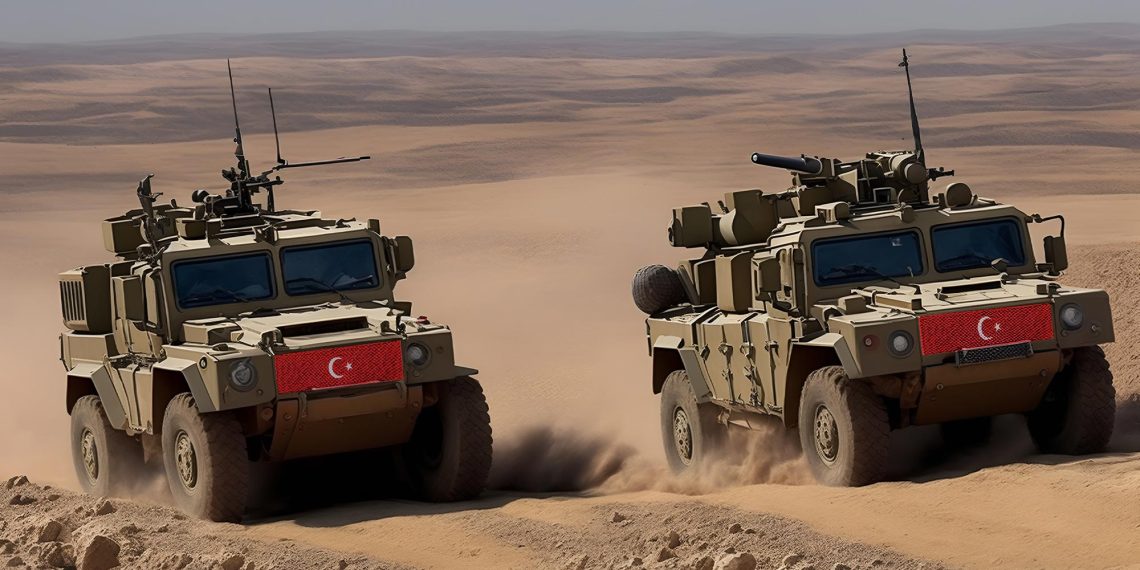
Key words: Turkey role in Syrian conflict, Turkey called upon the United Nations to impose a no fly-zone over northern Syria to protect civilians from the Syrian regime’s aerial bombardment and to establish a safe zone.
Turkey has been a major player in the political, military and humanitarian spheres ever since the Syrian conflict began in 2011. At first, Ankara demanded that Bashar al-Assad enact political and economic reforms and heed the peaceful protesters’ demands. As the conflict escalated, Turkey called upon the United Nations to impose a no-fly zone over northern Syria to protect civilians from the Syrian regime’s aerial bombardment and to establish a safe zone to stem the influx of Syrian refugees into Turkish territory. However, none of these Turkish appeals materialized due to the disagreements among the main actors in the Syrian conflict.
Several factors have contributed to Turkey’s military intervention in northern Syria, including the Syrian Democratic Forces (SDF) attempted to establish a Kurdish entity on the Turkish southern border, stretching from the far northeast of Syria to the Mediterranean Sea. Additionally, the breakdown of negotiations with the Kurdish Democratic Union Party (PYD) leader Salih Muslim in Ankara, the collapse of the peace process with the Kurdistan Workers’ Party (PKK) and the U.S.-led international coalition’s choice of the Kurdish People’s Protection Units (YPG) as a key partner in the fighting against ISIS and providing them with various heavy weapons.
In 2016, Ankara initiated “Operation Euphrates Shield,” a military operation in northern Syria in collaboration with the Syrian opposition factions. The operation was aimed at fighting against ISIS and the Syrian Democratic Forces. The latter group is primarily composed of the Kurdish People’s Protection Units, which Ankara perceives as an extension of the Kurdistan Workers’ Party (PKK). The PKK is categorized as a terrorist organization by Ankara.
Following talks held in Astana and Sochi, Turkey has continued to have a military presence in the area. This presence has been strengthened by an agreement among Turkey, Russia and Iran who are considered guarantor states, to station several Turkish military bases in order to carry out the Astana accords and preserve the de-escalation zones in northern Syria. Turkey subsequently launched two military operations, “Operation Olive Branch” in 2018 and “Operation Peace Spring” in 2019, which enabled the Turkish Armed Forces and Syrian opposition forces to gain control of several areas along the Syrian-Turkish border.
Over the last few years, Turkey has implemented measures to administer the territories that fall under its jurisdiction. These measures involve establishing a civilian police force to ensure security, consolidating the majority of Syrian armed opposition factions and designating them as the “Syrian National Army,” and establishing a judicial entity that encompasses multiple civilian courts, healthcare centres and educational facilities. Additionally, they have supplied essential amenities such as electricity, food and basic services to the region.
Turkey’s approach to the northern Syrian regions under its governance indicates that its military presence will continue until its security interests are no longer threatened and until a political resolution is achieved that addresses its security concerns, maintains the unity of Syria’s territory and prevents the formation of a Kurdish entity along its borders. Nevertheless, predicting when Turkey will withdraw its forces from the region is challenging.
There are two ways to consider the potential outcome of the Turkish military presence in northern Syria. The first perspective is the rapprochement between the Turkish government and the Syrian regime, which has been encouraged by Russia. A trilateral meeting between the defence and security ministers of Turkey and Syria was held in Moscow at the end of 2022 and plans are in place for a quadrilateral meeting in Moscow that will involve the deputy foreign ministers of Turkey, Russia, Iran and Syria. The second perspective pertains to the political developments that will occur in Turkey after the presidential elections on May 14th and the resulting of the government.
The future of Turkish military presence in northern Syria will be heavily influenced by the ongoing conflict between the Turkish government and the Syrian Democratic Forces. Turkey sees the Syrian Democratic Forces, which are primarily composed of Kurdish People’s Protection Units, as an extension of the banned Kurdistan Workers’ Party (PKK) within its own borders. As a result, the Turkish government has expressed its intention to continue fighting against the People’s Protection Units and the Syrian Democratic Forces to prevent them from posing a security threat. However, this has created tension with the United States, which supports the Syrian Democratic Forces both militarily and politically. It is unlikely that Turkish forces will withdraw from Syria until this issue is resolved.
At the trilateral meeting in Moscow on December 28th, the Syrian regime requested a timeline for the withdrawal of Turkish forces from Syrian territories as a prerequisite for normalizing relations between the two countries. Turkey expressed a willingness to withdraw in principle but emphasized that its presence in Syria is linked to combating terrorist organizations, specifically the Syrian Democratic Forces. Therefore, a solution to this issue will likely involve negotiations with the United States, who directly support the Syrian Democratic Forces. While a resolution is expected, the primary obstacle remains US military support for the Syrian Democratic Forces.
The future of Turkish military presence in northern Syria is also impacted by the broader geopolitical landscape of the region. With Iranian forces and Iranian-backed militias present in Syria and with Russia maintaining a direct military presence, it is unlikely that Turkey will withdraw its forces from the area. Turkey may link its military withdrawal to the withdrawal of all other foreign forces operating in Syria.
As a result, there are several potential scenarios that could unfold regarding the future of Turkish military presence in northern Syria. One possibility is that Turkey will negotiate a political settlement with active parties in the Syrian conflict, such as the United States and Russia that adequately addresses Turkey’s security concerns. However, such an outcome would require a significant shift in the dynamics of the conflict and a willingness on the part of all parties to make concessions.
The current situation in northern Syria could persist as another possibility for the future of the Turkish military presence. However, a comprehensive negotiated settlement that involves all parties to the conflict, including the Syrian government, Turkey and the Syrian Democratic Forces, is also possible. Such a settlement would address the root causes of the conflict, such as the Syrian refugee crisis, the future of the Kurdish issue in Syria and the establishment of a stable and inclusive political system in Syria.
To move towards a peaceful resolution of the Syrian conflict, it is crucial for all parties involved to prioritize dialogue and diplomacy. This will entail a willingness to compromise and address the underlying issues that sparked the conflict. Additionally, the international community must provide greater support to facilitate a peaceful resolution of the conflict.
Internally, the Turkish government and the main opposition parties, except for the Peoples’ Democratic Party (HDP) share a common view on the importance of safeguarding Turkish national security. As such, most Turkish parties advocate for the continuation of the Turkish military presence in northern Syria until a resolution that accounts for Turkish security interests is reached. Moreover, the Turkish opposition supports the recent rapprochement between the Turkish government and the Syrian regime, as well as the need to find a solution to the issue of the Syrian Democratic Forces. This indicates that even if there is a change in the Turkish government following the upcoming elections, it is unlikely that there will be significant alterations to Ankara’s stance on the military presence of its forces in Syria until Turkish concerns are addressed.
Conclusion: Keeping in view the said article, security and defence analysts say that to move forward towards a peaceful resolution of the Syrian conflict, it is important that all parties involved should take work from negotiation and diplomacy. International community should come forward to play a greater role for the peaceful resolution of the conflict.