

The concept of security is generally used to refer to the elimination of insecurity. “State of insecurity” can be defined as being exposed to violence, being in a state of poverty and being poor. In dictionaries, the concept of security meets a definition that focuses on society. As such, it is defined as “the execution of the legal order in practice in social life without any disruption in any way, the state of being able to live without fear, the state of being safe“, “the existence of a community that can be organised in the form of a state in a state of order and serenity, in a state of security“, “the security of all necessities and desires“. In international relations, the concept of security, which is generally understood to mean the survival and perpetual existence of the state, was first used by Cicero and Lucretius. This concept, known as “Securitas“, expresses the philosophical and psychological state of mind. The word became evident as a political concept when it was used within the scope of “Pax Romana” (Roman Peace) from the first century onwards. Therefore, when we consider the concept individually, we consider it as the state of being free from threats, and when we consider it in general, we consider it as the state of not being attacked or fear of attack against all the values one possesses.
* An expanded version of this article was published in Voprosy Istorii, 2022/ November3/3
The Early Positioning of Orthodoxy in Russian Security Perception
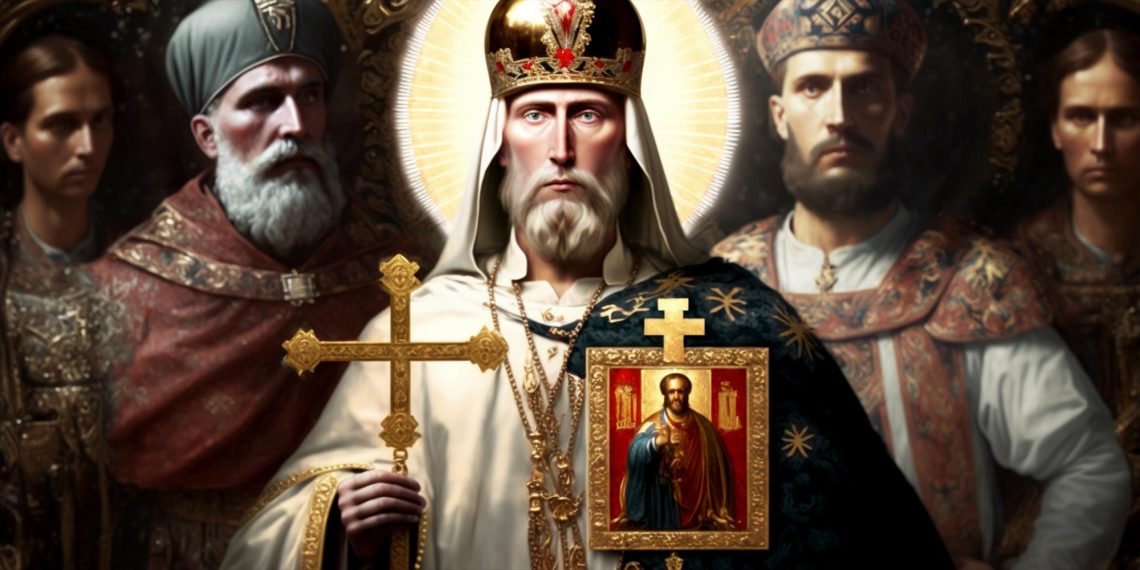
Ever since the Kievan prince Vladimir converted to Orthodox Christianity in 988 and brought his subjects with him, Russian religion and politics have been almost inextricably linked. Not only was Vladimir declared a saint equal to the apostles, starting a long tradition of political leaders and heroes, but the distinction between political power and religion was completely blurred.
In the late Middle Ages, especially in Russia, Ukraine and Serbia, there was a remarkable increase in the canonisation of Orthodox warrior princes. For example, St Alexander Nevsky, Grand Prince of Novgorod and Vladimir (1236-1263), St Dmitri Donskoi, Grand Prince of Moscow (1359-1389), St Stefan Lazar, Prince of Serbia (1371-1389) and St Stefan Lazarevich, Prince of Serbia (1389-1427). These cults of sainted princes and rulers were clearly aimed at developing a religio-political attachment to a national dynastic line. In Serbia, this resulted in a real genealogy of “holy kings”. The use of religious titles by state rulers was also an effective means of securing popular support.
Most of the security problems Russia faced in the early years of its history were of religious origin. The Northern Crusades of the XIIIth century were organised to convert Russians to Catholicism. Later on, the defence of Russia against Muslim attacks from the East was also regarded as a holy cause. One of the important reasons behind this acceptance is that after the fall of Byzantium in 1453, Moscow declared itself to be the Third Rome. Seeing political events through a biblical lens has been a strong tendency for many nations of the former Soviet Union (especially Russians and Ukrainians). These nations trace themselves to the descendants of Noah’s third son, Jafes. It is also recorded in Russian literature that St Andrew the Apostle visited Kiev and blessed the country and its inhabitants as early as the post-Catholic period. This has strengthened the basis for a belief that Russia is the chosen country and Russians are the chosen people. In the 1550s, the Russians took important steps towards increasing their regional power. Therefore, they were in a position to fight against the Muslims, who had influence over them and periodically took them under their rule. In these struggles, they naturally used the influence of Orthodoxy on the people. The first battle in which this claim became evident was the Battle of Kazan in 1552. Russian Orthodox rhetoric dominated the call for the conquest of the Kazan Khanate and became the public voice of Moscow’s decision to expand eastwards. Ivan’s army was consecrated on the grounds that it was engaged in a holy struggle against the Tatars. To commemorate the victory, an icon of the Archangel Michael, known as the “Church Militant”, adorned the walls of the Dormition Cathedral. In this icon, Ivan IV and his troops are not forgotten, and the Russian soldiers who died on their way back from Kazan, which was engulfed in flames, are depicted as bringing martyr’s crowns. The quality of the position given to those who died in the war was also an effective factor in gaining public support for the war. The effect of Orthodox rhetoric on the sanctification of war in this way was placed at the basis of Russia’s security perceptions. The development of the Orthodox concept of “holy war” in Russia, despite the seemingly favourable circumstances, nevertheless took root slowly. The hero Dmitry Pozharsky, who repulsed the Polish forces against the Polish invasion of Moscow in the XVII century, was regarded by the Orthodox Church as a holy patron, but wars were not sanctified in a religious sense in this period. However, this understanding has not continued in this form until today, and more importantly, the Union of Soviet Socialist Republics (USSR), which was established in the period after the Bolshevik Revolution of 1917, made peace with the church, so to speak, especially during the Second World War.
Church Support for the State; Security Co-operation
During the years of the Second World War, Germany’s aggression significantly increased the level of patriotism in Russia. Especially towards the end of the war, the Church’s “holy defence mission” to the people had to be heard throughout the territory of Mother Russia. During the German occupation in 1943, the Patriarch of Moscow and the Russian Orthodox bishops distributed letters addressed to the faithful in all lands, including those not conquered by the invaders. In these appeals, the Russian Orthodox Church emphasised the patriotism of the Church. Therefore, it supported the people’s defence of their lands against Germany and even tried to give this defence a sanctity. The priests preached to the Red Army by personally joining the army. The Soviet government not only encouraged but also directly supported the initiatives of the Moscow Patriarchate. The Church printed pamphlets supporting the government and state agencies organised their distribution in the occupied territories.
By 1945, a real alliance between the state and the Church had been formed, and for his statements at the National Church Council held in this year, Patriarch Alexy II was awarded the “Medal for the Defence of Leningrad” and the “Order of the Red Banner Worker”. and was honoured with a prize. In his speech, the Patriarch stated that the state has never sided with anti-religious activities, that Russian Orthodoxy has never faced systematic persecution, that there has never been a murder of religious Orthodox as in ancient Rome, and that it would be an act contrary to reality to say that there was intolerance towards religion in the Soviet Union.
At the end of the Second World War, Stalin found it expedient to channel the Church in a different direction, towards the aims of the state. He believed that the Church was the right actor to improve the image of the USSR abroad, especially in the international peace movement, and to emphasise non-proliferation. The realisation of this goal depended on the creation of an Ecumenical Orthodox Centre in Moscow, or, as Patriarch Alexy called it, a kind of “Moscow Vatican”. The Moscow Patriarchate’s claims to the role of the Third Rome provoked a negative reaction from the Eastern patriarchs. As a result, while no ecumenical council or preliminary conciliar council was convened, a conference of the leaders of the Orthodox churches was organised in 1948 to celebrate the 500th anniversary of Moscow’s autocephaly.
Conclusion
Samuel P. Huntington claimed that the conflicts predicted to be experienced after the Cold War will enter the terminology as “identity conflicts”, and that identity-based conflicts will replace the ideological-based conflicts experienced in the Cold War after the Cold War. He has made assertive discourses that the realism-based security dilemma in international relations will be replaced by the phenomenon of “being” as a result of identity-based political approaches, and as a result, a form of political relations based on “us” and “the other” will exist. In this assertion, he clearly emphasised that ethnic, religious affiliation and civilisational consciousness among the types of identities create deeper effects than other identities. However, in the mid-twentieth century, secularism was popularised and it was claimed that religion would never again play an important role in the decision-making processes of states. But indeed, in the late 1970s, fundamentalists began to rise up against this secular hegemony and began to bring religion out of its marginal position and back to the centre. At times they were defeated, and religion once again became a force to be reckoned with in domestic and international affairs that no government could easily ignore. Some authors have also argued that since the early 1970s there has been a broad return to religion in world affairs. Factors such as the fact that the secularisation and modernisation trends against religion in the nineteenth century were not as opposed as expected, religious demographics, both the higher birth rates of religious people and the increase in the population of religious converts, and the inheritance of land by religious people, have made religion once again a central instrument in international affairs. In addition to these factors, since the 1970s, Russia has seen its share of global changes, such as global pressures for democratisation, political participation, political change and religious freedom, opening up space for religious actors in civil society and political life; the declining political legitimacy of secular ideologies, paving the way for a modernising mythology and religious alternatives for first-generation elites in third world countries; and secular regimes and nationalist movements turning to religion to bolster their diminishing political legitimacy . Today, the impact of this share on Russian politics is manifested in the tendency to see the existence of the Orthodox Church as a means to contribute to the security of “Mother Russia”.


جهود مباركة اسأل الله لكم الإعانة والتوفيق
لقد اطلعت على مقترح المركز ولعل الاهتمام بالأمن يشكل اليوم وسيلة تفاعلية لكل الحادبين على المحافظة القيم الاجتماعية والأخلاقية والسلوكية