This is a detailed analysis of state failure. It asks why a counterterrorism victory that Pakistan secured at great cost did not last, and who bears responsibility for losing it. The article does not blame a single actor. It treats the collapse as a failure of governance shared by a prime minister, an army chief, successive federal governments and a provincial administration, and it weighs each against the documentary record. Attention falls on Khyber Pakhtunkhwa (KPK), the province that has borne the highest cost, and on the National Action Plan (NAP) of 2014, whose civilian commitments were never fully delivered. The argument unfolds in three parts. The first establishes what was achieved. The second traces how negotiation with the Tehreek-i-Taliban Pakistan (TTP) undid it. The third explains why the consequences fell on one province. Claims are sourced throughout, and partisan figures are identified as such.
The War Pakistan Won
In March 2026, the Global Terrorism Index ranked Pakistan the country most affected by terrorism in the world. It was the first time Pakistan had recorded the highest score on the index (Institute for Economics and Peace, 2026). Pakistan scored 8.574, ahead of Burkina Faso, and recorded 1,139 deaths and 1,045 incidents in 2025, the highest death toll since 2013 and the sixth consecutive annual rise. The index identified the TTP as the deadliest group in Pakistan, responsible for 56 percent of the country’s terrorism deaths, and the third deadliest in the world. The ranking came in a year when terrorism deaths worldwide fell by 28 percent, so Pakistan reached the top as most of the world grew safer (Institute for Economics and Peace, 2026). Measured more broadly, terrorism-related violence in Pakistan killed 4,001 people in 2025, the highest toll in eleven years (Congressional Research Service, 2026). By 1 October 2026, the provisional count for the current year had already passed that figure (SATP, 2026).
Figure 1. Pakistan’s Global Terrorism Index rank, 2018 to 2025
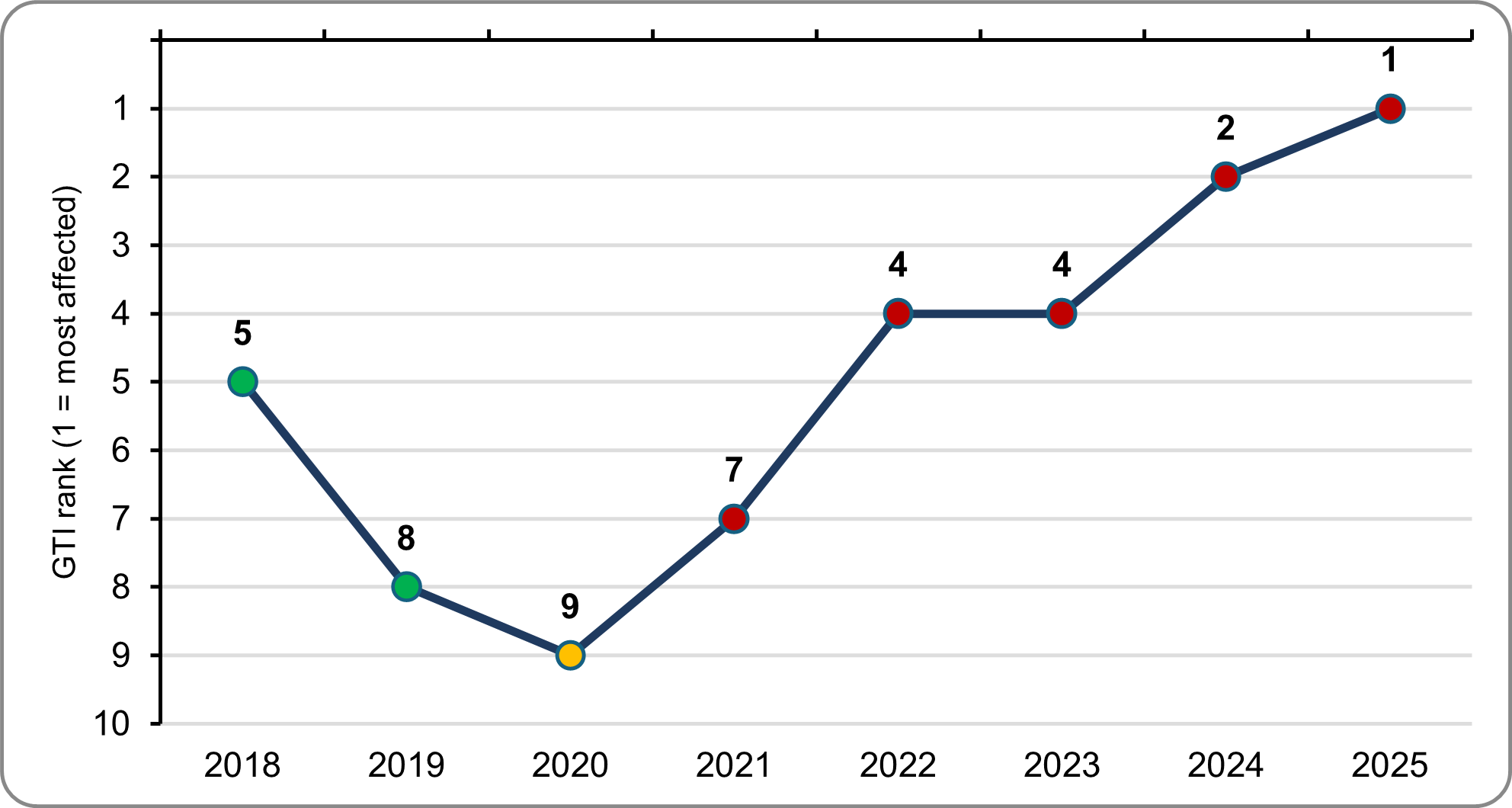
Ranks for 2018 to 2024 as recalculated in GTI 2025. Rank for 2025 from GTI 2026. Rank 1 is shown at the top. Sources: Institute for Economics and Peace (2025, 2026).
The ranking needs to be read correctly before it is used. The index measures the impact of terrorism on a country, scoring 163 states on incidents, deaths, injuries and hostages weighted over five years (Institute for Economics and Peace, 2026). It does not measure state sponsorship. Pakistan’s first place identifies a country under sustained attack, alongside Burkina Faso, Nigeria, Niger and the Democratic Republic of Congo. Different datasets also report very different totals, because they count different things (Table 1).
Table 1. Pakistan’s 2025 terrorism deaths by dataset
| Source | 2025 deaths | What is counted |
| SATP (2026), adopted by CRS | 4,001 | Civilians, security forces and militants, in attacks and operations |
| SATP (2026), excluding militants | 1,884 | Civilians and security forces only |
| Institute for Economics and Peace (2026) | 1,139 | Deaths caused by terrorist attacks |
| PIPS (2026) | 1,034 | Deaths in 699 terrorist attacks |
Sources as listed in the first column.
The levels differ because the definitions differ. The direction is the same in every series. National totals also combine two distinct insurgencies, the TTP’s jihadist campaign centred in Khyber Pakhtunkhwa and the Baloch separatist campaign in Balochistan. This article uses national figures to describe the overall trend and provincial figures wherever the argument concerns the TTP.
The ranking is more striking because Pakistan had already won this war once. That victory followed a failed experiment with talks. In January 2014, Prime Minister Nawaz Sharif announced a fresh dialogue with the Tehrik-i-Taliban Pakistan (TTP), and the first formal meeting took place in Islamabad in February (Dawn, 2021c). The TTP continued attacks in Pakistani cities while the talks proceeded (Jamestown Foundation, 2015). The talks collapsed in June 2014, and in the same month the army launched Operation Zarb-e-Azb in North Waziristan (Dawn, 2021c). The sequence matters for what follows. In 2014 the state tested negotiation, found it wanting and turned decisively to enforcement.
On 16 December 2014, TTP gunmen killed more than 140 people, most of them children, at the Army Public School in Peshawar. On 24 December, a special session of parliament approved the 20-point National Action Plan (NAP), drawn up by NACTA and the interior ministry in consultation with stakeholders (NACTA, n.d.a). Parliament passed the 21st Constitutional Amendment to create military courts for terrorism cases, and the moratorium on executions was lifted. Operation Radd-ul-Fasaad followed in February 2017 to dismantle networks beyond the tribal areas.
NAP was a comprehensive framework. It treated terrorism as a problem of state capacity, not of force alone. Its points ranged from executions and military courts to choking terrorist financing, a dedicated counterterrorism force, the registration of religious seminaries, administrative reform in the tribal areas and the revamping of the criminal justice system (ARY News, 2018). It also built an architecture to deliver them. A national committee chaired by the prime minister sat at the top, NACTA coordinated and monitored implementation, and from 2015 provincial Apex Committees joined each chief minister to the corps commander, the police, the intelligence agencies and the civil administration.
The results appear in every dataset. The South Asia Terrorism Portal (SATP), whose figures the US Congressional Research Service adopts, recorded 5,510 deaths in 2014, a total inflated by the 3,268 militants killed in operations that year. Deaths then fell to 3,685 in 2015, 1,797 in 2016, 1,269 in 2017, 688 in 2018 and 365 in 2019 (SATP, 2026). The Congressional Research Service (2026) describes five consecutive years of decline. The Pakistan Institute for Peace Studies (PIPS), which counts terrorist attacks rather than all conflict deaths, recorded 229 attacks and 357 deaths in 2019 (Dawn, 2020).
The chronology carries political weight. Pakistan Tehreek-e-Insaf (PTI) took federal office in August 2018, after most of that decline was complete. The campaign was conceived under a PML-N government and executed by the military leadership. PTI did, however, lead the provincial government of Khyber Pakhtunkhwa (KP) throughout those years, a fact Part Three addresses directly. At the federal level, PTI inherited an improving security environment. The rest of this article concerns what happened to that inheritance.
How the Peace Was Lost
Table 2 sets out the full record of terrorism-related deaths from 2013, the year before Zarb-e-Azb, to the present.
Table 2. Terrorism-related deaths in Pakistan by category, 2013 to 2026
| Year | Federal government | Civilians | Security forces | Militants | Total |
| 2013 | PML-N | 2,713 | 665 | 1,541 | 5,294 |
| 2014 | PML-N | 1,471 | 508 | 3,268 | 5,510 |
| 2015 | PML-N | 866 | 339 | 2,407 | 3,685 |
| 2016 | PML-N | 541 | 291 | 897 | 1,797 |
| 2017 | PML-N | 439 | 216 | 533 | 1,269 |
| 2018 | PML-N, caretaker, PTI | 358 | 158 | 162 | 688 |
| 2019 | PTI | 142 | 137 | 86 | 365 |
| 2020 | PTI | 169 | 178 | 159 | 506 |
| 2021 | PTI | 215 | 226 | 223 | 664 |
| 2022 | PTI, then PDM coalition | 229 | 379 | 363 | 971 |
| 2023 | PDM and caretaker | 398 | 532 | 583 | 1,513 |
| 2024 | Caretaker and PML-N coalition | 582 | 754 | 896 | 2,236 |
| 2025 | PML-N coalition | 655 | 1,229 | 2,116 | 4,001 |
| 2026, to 1 Oct | PML-N coalition | 690 | 1,048 | 2,295 | 4,034 |
Source, SATP (2026). National totals include Baloch separatist violence. Components exclude a small, unspecified category, so they may not sum to the total. 2026 figures are provisional to 1 October.
A common political claim holds that terrorism fell under Imran Khan and rose only after his removal in April 2022. The data do not support it, though the precise turning point depends on the dataset (Figure 2). SATP recorded a rise in deaths in 2020, from 365 to 506 (SATP, 2026). PIPS and CRSS recorded a further decline that year. PIPS counted 146 attacks in 2020, down 36 percent (PIPS, 2021), and CRSS counted a fall in fatalities of about 10 percent (CRSS, 2024). All three datasets agree that violence was rising by 2021, a full year of PTI government. CRSS records a 38 percent rise in fatalities in 2021 (CRSS, 2024), and PIPS a 42 percent rise in attacks (PIPS, 2022).
Figure 2. Annual change in violence, 2020 to 2025
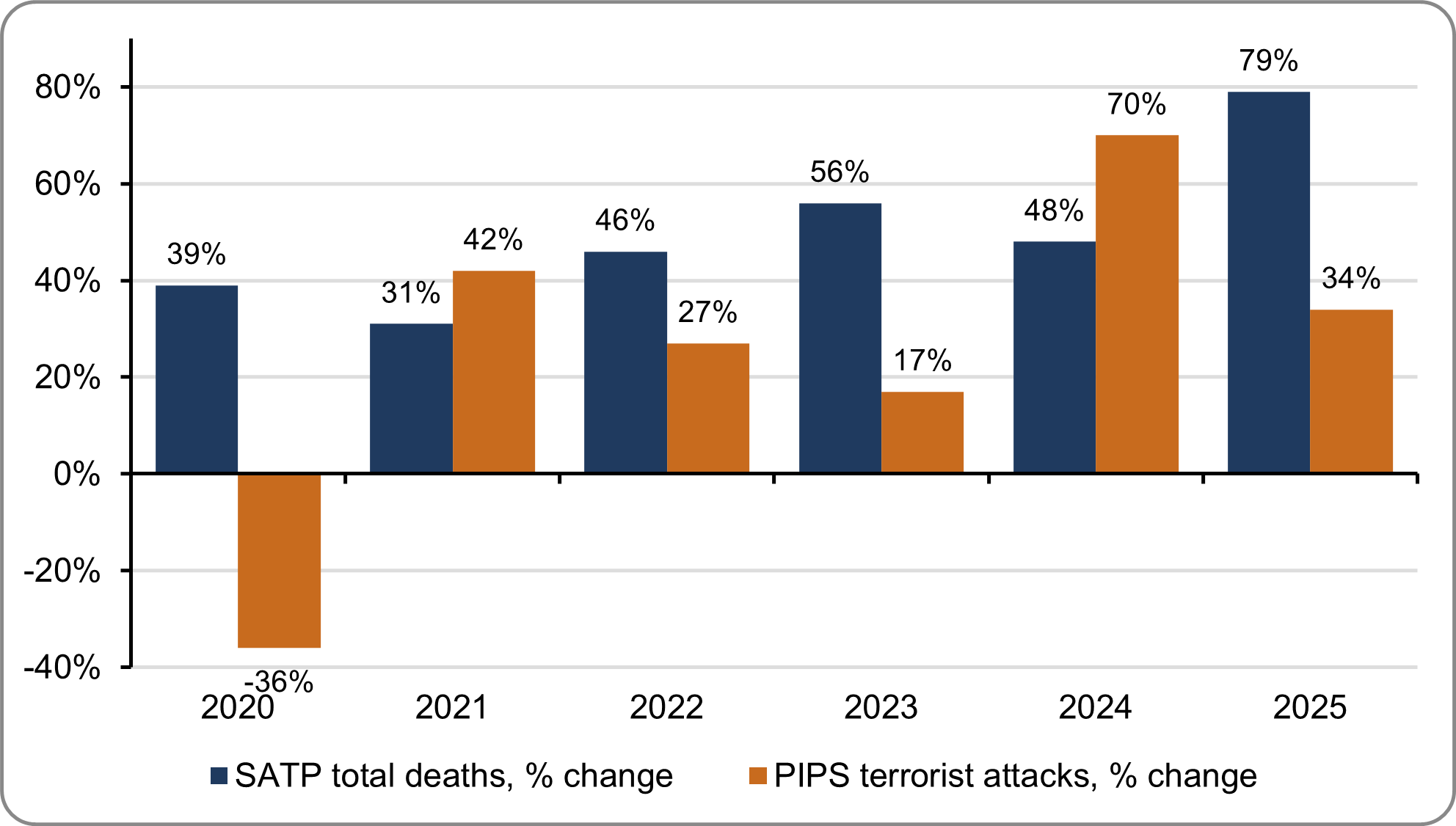
The datasets also agree on what was happening beneath the numbers in 2020. PIPS reported that year that the TTP and its affiliates were regrouping in the former tribal areas. Two breakaway factions, Hizbul Ahrar and Jamaatul Ahrar, declared their return to the parent group in August 2020 (PIPS, 2021). This point must be stated precisely, because the argument depends on it. The talks of 2021 did not start the TTP’s revival. They met a revival already under way and relieved pressure on it at the moment pressure should have increased.
The Taliban’s victory in August 2021 then gave the TTP what it had lacked since 2014, a secure rear base under a sympathetic government. PIPS later calculated that terrorist attacks in Pakistan rose by 73 percent in the 21 months after the takeover compared with the 21 months before it, and by 92 percent in KP (SATP, 2023).
Khan’s case for talks deserves a fair statement. He argued that two decades of operations had not ended militancy, that many TTP members were Pakistani tribesmen whose families wanted to come home, and that only a political settlement could last. “I am anti-military solutions,” he said (Geo News, 2021). The Afghan Taliban appeared to offer a channel that had not existed before, and many states have ended insurgencies through negotiated reintegration. The argument was not frivolous. The failure lay in how it was applied.
The signals began early. On 16 August 2021, the day after Kabul fell, Khan told the launch of the Single National Curriculum that Afghans had “broken the shackles of slavery” (Dawn, 2021a). On 1 October he confirmed on TRT World that his government was negotiating with TTP factions inside Afghanistan with the Afghan Taliban’s help. Asked whether fighters who disarmed would be pardoned, he replied, “Yes, we forgive them and they become normal citizens” (Geo News, 2021).
The talks were a civil and military enterprise from the start. Dawn’s national security correspondent later reported that the negotiations began in October 2021 at the Afghan Taliban’s request and had for a large part been run exclusively by the military in complete secrecy (Syed, 2022). Lieutenant General Faiz Hameed, then DG ISI and later Peshawar corps commander, spearheaded them (Syed, 2022). Parliament was informed but not asked to decide. On 8 November 2021 the military leadership gave an in-camera briefing to the Parliamentary Committee on National Security, at which Hameed presented the security picture and army chief General Qamar Javed Bajwa answered questions (Pakistan Observer, 2021). Opposition leaders Bilawal Bhutto Zardari, Ahsan Iqbal and Ameer Haider Khan Hoti opposed dialogue with any group that rejected the Constitution (Business Recorder, 2021).
The same day the government announced a one-month ceasefire mediated by Sirajuddin Haqqani, the Taliban’s interior minister (Al Jazeera, 2021). A government official in Peshawar told AFP that up to 100 TTP fighters had been released in the previous two weeks (Gulf News, 2021). Two days later, during the Army Public School proceedings, Justice Qazi Muhammad Amin Ahmed asked the prime minister whether the state was bringing the TTP back to the negotiating table instead of acting against it, and whether it was about to sign “a surrender document” once again (Dawn, 2021b). The question captured the central contradiction. The state was negotiating with the organisation whose massacre of schoolchildren had produced NAP.
The ceasefire lapsed in December 2021 and attacks resumed. Khan was removed by a parliamentary vote of no confidence on 10 April 2022. The process was revived that same month and continued under the Pakistan Democratic Movement (PDM) coalition. On 5 July 2022 the Parliamentary Committee on National Security, chaired by the new government, formally approved the negotiations and created a parliamentary oversight committee. Bajwa, the new DG ISI Lieutenant General Nadeem Anjum and Hameed attended. Political leaders were told that up to 30,000 TTP militants and family members were expected to return in the event of a deal. Dawn also reported that a general amnesty was planned once a deal was reached (Syed, 2022). PTI reportedly boycotted the meeting, and KP’s chief minister did not attend (Newsweek Pakistan, 2022). Parliamentary endorsement therefore came late, under Khan’s successors, and covered a process the military had run since October 2021.
The cost became visible in Swat, a valley the army had cleared at great cost in 2009. In August 2022 thousands of residents protested in Swat’s towns against reports of militants returning to the area. One protest leader said security had begun to deteriorate when the government resumed talks with the TTP (Arab News, 2022b). KP’s PTI government, led by Chief Minister Mahmood Khan, said it had taken notice and pledged to enforce the writ of the state (Arab News, 2022a). In the National Assembly, Defence Minister Khawaja Asif said the PTI leadership, including Khan, had once welcomed the Taliban in the province, and that PTI’s provincial government was now itself protesting their presence. He added that the assembly had been given two briefings on the talks (Dawn, 2022a). Khan also expressed concern about the TTP’s resurgence in Swat (Gulf News, 2022). On 28 November 2022 the TTP ended its ceasefire. On 8 December NACTA told the Senate Standing Committee on Interior that the group had “gained considerable ground” during the negotiations and that the talks had emboldened its fighters in Swat (Dawn, 2022b).
Khan did not distance himself from the policy after leaving office. In December 2022 he said his government “was already negotiating” to resettle about 40,000 people, including five to ten thousand fighters (Aaj News, 2022). In January 2023 he said the plan stalled because the provinces would not fund it (Dawn, 2023a). In February 2023 he said the process was still under way when he was removed (Dawn, 2023c). In a BBC interview in March 2023, he described amnesty as the only option for 30,000 to 40,000 militants and their families (BBC, cited in Sayed and Hamming, 2023). These statements settle a dispute that recurs in Pakistani politics. The resettlement policy existed; it began under Khan’s government, and he defended it as correct. Table 3 sets out the full sequence.
Table 3. The negotiation track, January 2014 to March 2023
| Date | Event | Actor | Source |
| Jan to Jun 2014 | PML-N talks fail, Zarb-e-Azb launched | PML-N government, military | Dawn (2021c) |
| Aug 2020 | Breakaway factions rejoin TTP | TTP | PIPS (2021) |
| 16 Aug 2021 | Khan praises Afghans for breaking “shackles of slavery” | PTI government | Dawn (2021a) |
| 1 Oct 2021 | Khan confirms talks, offers forgiveness to fighters who disarm | PTI government | Geo News (2021) |
| Oct 2021 | Military begins talks at Afghan Taliban’s request, led by Faiz Hameed | Military | Syed (2022) |
| 8 Nov 2021 | In-camera briefing to parliamentary leaders; opposition objects | Military, parliament | Pakistan Observer (2021), Business Recorder (2021) |
| 8 Nov 2021 | One-month ceasefire, mediated by Sirajuddin Haqqani | PTI government, TTP | Al Jazeera (2021) |
| Nov 2021 | Up to 100 fighters reportedly released | PTI government | Gulf News (2021) |
| 10 Nov 2021 | Supreme Court questions Khan over talks | Judiciary | Dawn (2021b) |
| 10 Apr 2022 | Khan removed by no-confidence vote | Parliament | Public record |
| 5 Jul 2022 | Parliamentary security committee formally approves talks | PDM coalition, military | Syed (2022) |
| Aug 2022 | Mass protests in Swat against militants’ return | KP public | Arab News (2022b) |
| 28 Nov 2022 | TTP ends ceasefire | TTP | Public record |
| 29 Nov 2022 | General Asim Munir becomes army chief | Military | Public record |
| 8 Dec 2022 | NACTA tells Senate the TTP “gained considerable ground” | NACTA | Dawn (2022b) |
| Dec 2022 to Mar 2023 | Khan defends resettlement on four occasions | Imran Khan | Aaj News (2022), Dawn (2023a, 2023c), Sayed and Hamming (2023) |
Actor cells are shaded to show shared ownership. Blue marks Khan and the PTI government, green the military, orange the PDM coalition, red the TTP and grey the 2014 PML-N government.
The talks failed on sequencing and verification. Negotiated reintegration can work when an armed group is militarily weakened, disarms before concessions and returns under credible state supervision. None of these conditions held. The TTP had just gained a sanctuary and a patron. Prisoners were reportedly released before disarmament (Gulf News, 2021). The TTP’s demands included reversal of the tribal merger and the withdrawal of security forces, terms no Pakistani state could accept (Syed, 2022). TTP fighters re-established a presence in Swat while the talks continued (Dawn, 2022b). The comparison with 2014 is instructive. Then, failed talks led to enforcement within months. In 2021 and 2022 failed talks led to further talks, and enforcement came only after the TTP had rebuilt.
Ownership of the policy was shared, and the record now allows it to be apportioned. The civilian government under Khan announced the talks, defined the amnesty in public and claimed resettlement as its own. The military leadership under Bajwa conducted the negotiations, largely in secret, through Hameed (Syed, 2022). Former human rights minister Shireen Mazari has claimed that resettlement was Bajwa’s idea (Dawn, 2023d). Khawaja Asif has said it was Khan’s strategy with the military’s backing (Aaj News, 2023). Both are interested parties offering opposite emphases. Read with Dawn’s reporting, they confirm a joint decision. The PDM coalition then revived the talks, secured parliamentary endorsement and failed to prevent the TTP’s return to Swat. Members of the National Assembly later distanced the House from the resettlement plan (Dawn, 2023b).
Accountability is nonetheless unequal. Bajwa and Hameed left office in late 2022. Khan is the only principal who publicly defended the policy after its collapse. His party’s chief minister in KP now campaigns against military operations and for a return to PTI’s approach (Dawn, 2026c). The courts have not settled the question. On 24 March 2025 the Peshawar High Court dismissed a petition by the Awami National Party’s Aimal Wali Khan seeking a judicial commission on resettlement (Express Tribune, 2025). The petition asserted that the PTI government had permitted resettlement as a goodwill gesture. The court made no finding on that assertion and held that the matter belonged to parliament (Dawn, 2025a). The judgment cannot fairly be cited as a ruling against PTI.
Why KPK Paid the Price
The resurgence fell overwhelmingly on one province. On 6 January 2026, the Director General of Inter-Services Public Relations (ISPR), Lieutenant General Ahmed Sharif Chaudhry, reported 5,397 terrorist incidents in 2025. Of these, 3,811, or 71 percent, occurred in KP, against 1,557 in Balochistan (Dawn, 2026a). Citing CRSS, he put KP’s fatalities at 1,620 in 2024 and 2,331 in 2025 (Dawn, 2026a). Independent data agree. The Congressional Research Service (2026) places 68 percent of 2025 deaths in KP. PIPS attack counts show the same pattern across the whole resurgence (Figure 3).
Figure 3. Terrorist attacks in KP and the rest of Pakistan, 2020 to 2025
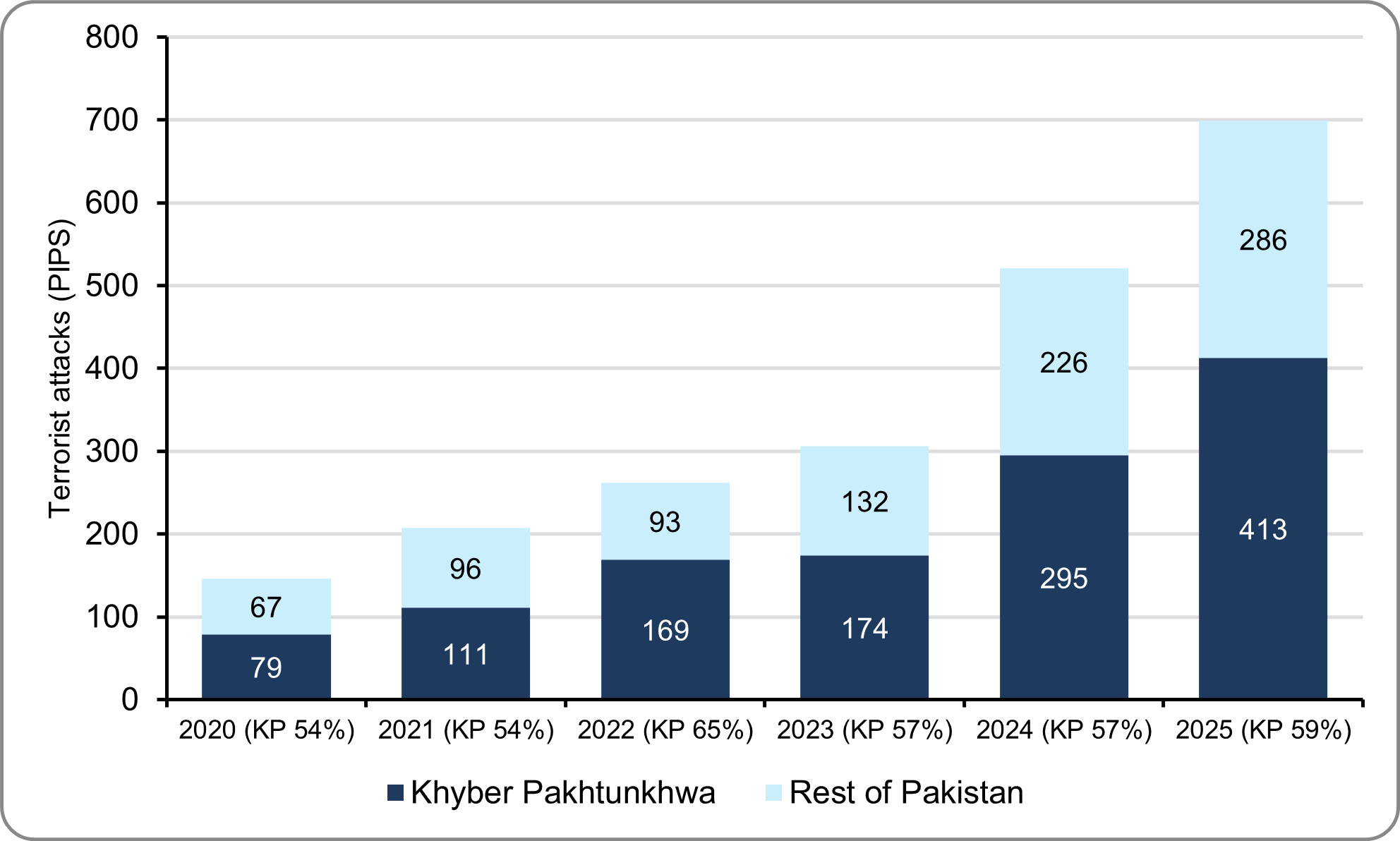
PIPS attack counts. KP figures include the former tribal districts, and KP’s share of national attacks is shown in each year label. The 2023 KP figure is reported from a PIPS policy review. Sources: PIPS (2021, 2022, 2023, 2025, 2026) and Sri Lanka Guardian (2026).
The figure shows two things. KP has carried out the majority of attacks in every year of the resurgence. What changed was volume. KP recorded 111 attacks in 2021 and 413 in 2025 (Sri Lanka Guardian, 2026), the TTP’s theatre growing in step with the national total.
A frequent misreading also needs correcting. Claims that Balochistan suffers more attacks than KP usually rest on the count of intelligence-based operations, where Balochistan’s figure is four times KP’s (Figure 4). More operations do not imply more attacks.
Figure 4. Terrorist incidents and intelligence-based operations by province, 2025
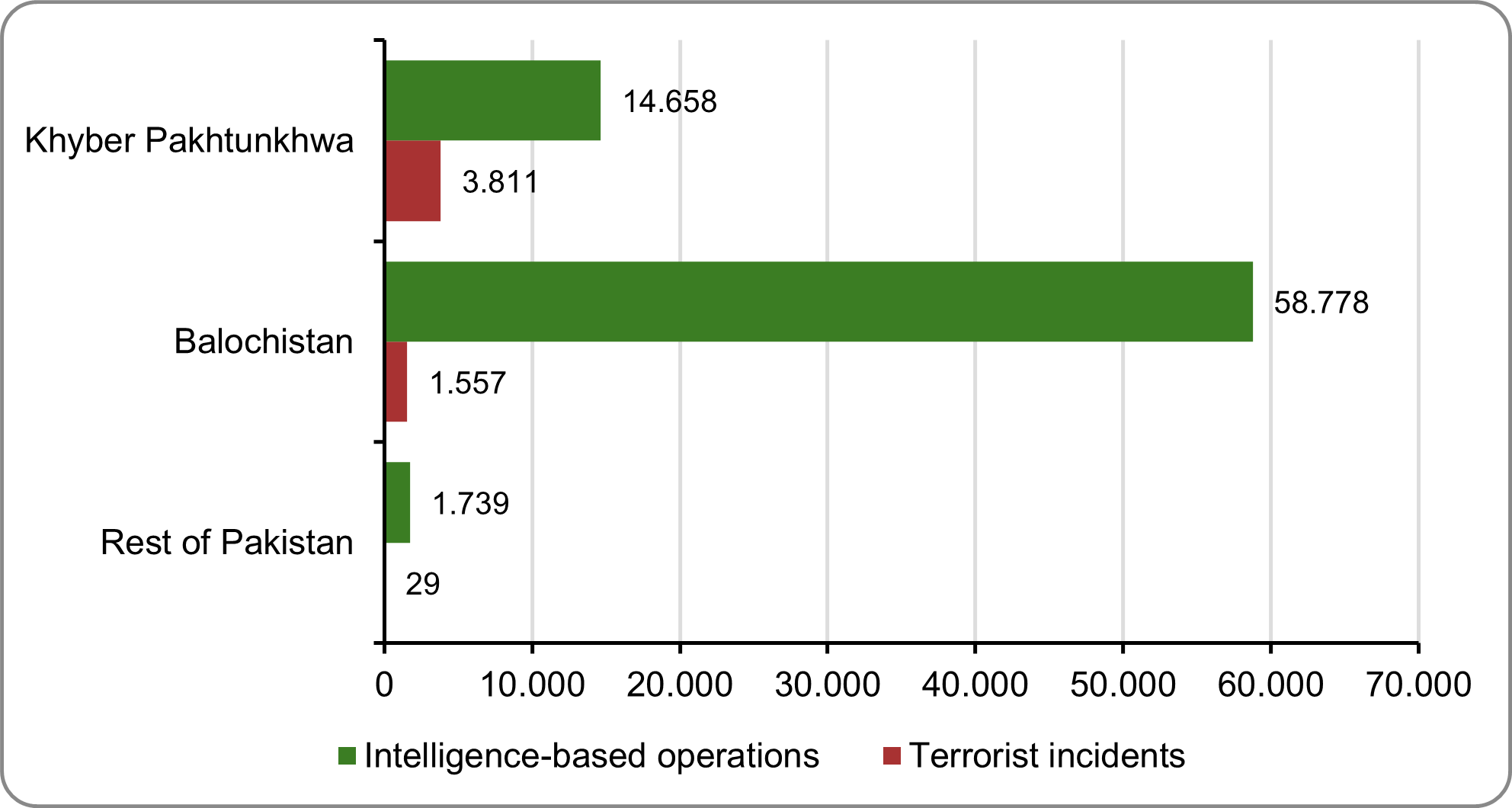
Source: Dawn (2026a), reporting the DG ISPR briefing of 6 January 2026. KP had 71 percent of incidents. Balochistan saw four times as many operations as KP but fewer than half as many incidents.
The two theatres also differ in kind. Most violence in Balochistan comes from ethnonationalist separatists, chiefly the Baloch Liberation Army. The TTP’s jihadist insurgency is centred in KP and the former tribal districts. Balochistan’s share has grown in 2026, and in September it recorded more attacks than KP and the former tribal districts combined (The Nation, 2026). That shift reflects an intensified separatist campaign. It does not alter the TTP’s centre of gravity. The military has attributed KP’s position to a “politically conducive environment” and accused the provincial government of obstructing operations (Business Recorder, 2026). These are political claims by an institution that is itself a party to Pakistan’s political conflict. The incident data on which they rest, however, match independent sources.
Why KP? The answer begins with NAP, whose architecture placed much of the work of consolidation on the provinces (Table 4).
Table 4. NAP points that depended on provincial delivery
| NAP point | Clause | Provincial role |
| 5 | Strict action against literature promoting hatred, extremism, sectarianism and intolerance | Enforcement and prosecution by provincial police and prosecutors |
| 8 | Establishing and deploying a dedicated counterterrorism force | Raised under provincial police, the basis of today’s CTDs |
| 10 | Registration and regulation of religious seminaries | Data collection and oversight through provincial departments |
| 12 | Administrative and development reforms in FATA, with repatriation of displaced people | A KP responsibility after the 2018 merger |
| 18 | Dealing firmly with sectarian terrorists | Provincial policing and intelligence |
| 20 | Revamping and reforming the criminal justice system | Police, prosecution, probation, prisons and lower courts |
Clause wording from ARY News (2018). Provincial roles from NACTA (n.d.a, n.d.b).
NACTA’s own record confirms the provincial dimension. Its implementation table lists the counterterrorism force as established under provincial police (NACTA, n.d.a). For criminal justice reform, NACTA convened the provinces’ chief secretaries and police chiefs in May 2016 and sent agreed recommendations to the provinces in August 2017 for implementation (NACTA, n.d.b). The Apex Committee in each province was the forum where the chief minister and the military were meant to coordinate this work. In KP, that committee has been chaired by a PTI chief minister since its creation in 2015, apart from a caretaker administration between January 2023 and March 2024.
Independent assessments reached a consistent verdict. The military and legal clauses advanced and the civilian clauses lagged. PILDAT (2017) found that provinces lacked the capacity, and in some areas the will, to deliver their share, and Ramay (2016) identified the same imbalance in an SDPI review. Madrassa reform illustrates the pattern. Thirteen months after NAP was adopted, NACTA’s national coordinator acknowledged that the government had not agreed even on how to collect madrassa data (The Friday Times, 2026b). By December 2018 Punjab and Sindh had completed their madrassa records, while KP and Balochistan had completed about 80 percent (The Nation, 2019). In its report on 2020, as the TTP regrouped, PIPS concluded there was little evidence that NAP had succeeded against extremism and related challenges (SATP, 2021). The federal level shares the failure. NACTA never became the coordinating centre NAP envisaged. In December 2018 the PTI federal government reportedly decided to overhaul the plan and asked provinces for implementation reports (ARY News, 2018), and a revised NAP was adopted in 2021 (NACTA, n.d.a). No province and no federal government delivered NAP’s civilian programme in full.
An obvious objection follows. If KP’s civilian institutions were weak, why did violence fall between 2014 and 2019 while PTI governed the province? The answer lies in what drove the decline and in what KP controlled. Military operations produced the decline by destroying the TTP’s infrastructure and pushing its fighters into Afghanistan. With the threat displaced across the border, weak provincial policing and prosecution were rarely tested, and their weakness was masked. The tribal areas, where the TTP was strongest, were federally administered until the 2018 merger, so the province became responsible for them only in that year. The capacity gap became decisive when the threat returned after 2020, through talks that brought armed men back into districts the provincial state was now responsible for holding. NAP’s provincial clauses were meant to be built during the quiet years for exactly that moment. They were not.
Reliable public data on KP’s counterterrorism capacity are scarce, and much of what circulates is partisan. On 5 October 2026, Khawaja Asif published a detailed critique of the provincial government, reported the same day by the state news agency (Tez Khabar, 2026). Table 5 sets out his claims against the available evidence.
Table 5. Defence Minister Khawaja Asif’s claims on KP, verification status
| Claim (Tez Khabar, 2026) | Independent check | Status |
| KP police about 125,000 strong | No public source located | Unverified |
| 13,000 police on VIP protection | No public source located | Unverified |
| 17,000 police posts vacant | No public source located | Unverified |
| CTD about 3,300 staff | PML-N white paper gives 3,113 of 3,844 sanctioned posts (Daily Times, 2026) | Broadly consistent, partisan source |
| 17 CTD bulletproof vehicles | PML-N white paper also gives 17, against 76 in Punjab (Daily Times, 2026) | Repeated by a second partisan source |
| Rs1.2 billion released of Rs42 billion requested for police posts | No budget document located | Unverified |
| More than 3,000 terrorism cases pending without conviction | No court or prosecution data located | Unverified |
Sources as listed in the table.
Most of these figures are best treated as the claims of a political opponent. The Friday Times (2026a) separately reported in July 2026 that KP police had sought a further Rs8 billion to complete security schemes in the merged districts after development funds ran out.
The provincial government has recently increased spending. Chief Minister Sohail Afridi’s 2026 to 2027 budget set the police budget at Rs191.4 billion, which he described as an 185 percent increase, and allocated Rs14.5 billion for weapons, bulletproof vehicles, armoured personnel carriers, drones and counter-drone systems (Arab News, 2026). The increase came thirteen years after PTI first took office in the province and five years into the resurgence. The most significant evidence, however, is an absence. The KP government publishes no regular data on terrorism prosecutions, conviction rates, CTD staffing or the functioning of police stations and courts in the merged districts. NAP point 20 called for the criminal justice reform such data would measure. A province that had delivered it would have every interest in publishing the results.
PTI’s strongest argument concerns money, and it is substantially correct. When the tribal areas merged with KP in 2018, the special commission led by Sartaj Aziz settled on 3 percent of the federal divisible pool and Rs100 billion a year for ten years to develop the merged districts (Geo News, 2025). That pledge has not been met (Figure 5).
Figure 5. Merged districts development funding, pledged and received
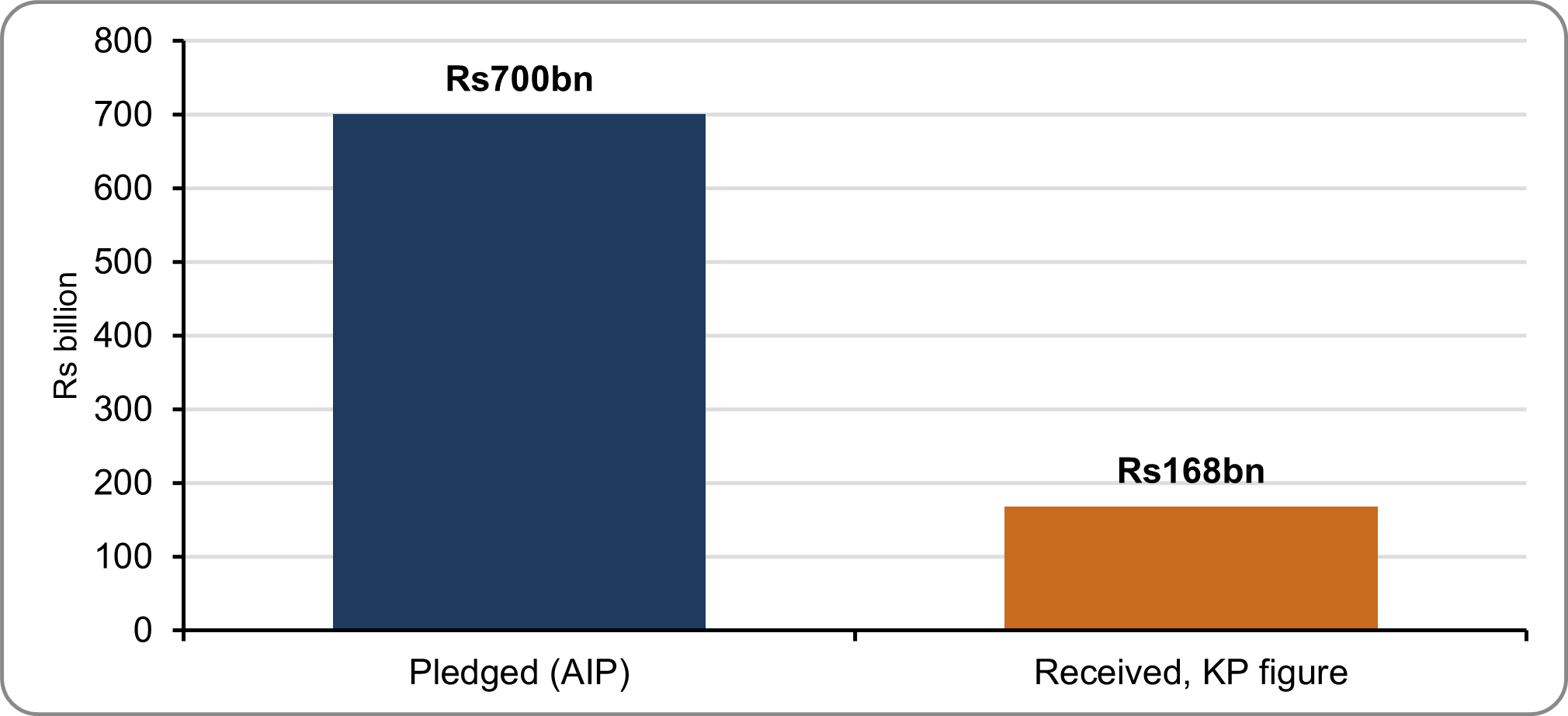
Pledge under the Accelerated Implementation Programme and the KP government’s figure for funds received, as stated by KP’s finance adviser in December 2025 (Dawn, 2025b). A KP Assembly resolution put receipts at Rs132.1 billion to 2024 (Geo News, 2025).
In May 2026, the KP government petitioned the Federal Constitutional Court, claiming Rs964 billion for the failure to revise its NFC share after the merger (Dawn, 2026b). The 7th NFC Award of 2010 remains in force and has never been adjusted for the merged districts’ population. The federal record is also considerable. The Finance Ministry states that between July 2010 and November 2025 it transferred Rs5.86 trillion to KP as its share of the divisible pool and Rs705 billion as the war on terror share, together with Rs704 billion for the merged districts since 2019 and Rs117.16 billion for displaced persons (The News, 2025). The federal shortfall has slowed institution building in the most violent districts in the country. It does not explain why the province’s counterterrorism force remained understaffed, why prosecution data are unavailable, or why police spending rose sharply only in 2026. Those outcomes reflect provincial priorities.
Political rhetoric has compounded the institutional deficit on every side. PTI’s provincial leadership has consistently opposed military operations while advocating dialogue. In June 2024, Asif said Chief Minister Ali Amin Gandapur raised no objection to Operation Azm-e-Istehkam in the Apex Committee while his party opposed it in public (Dunya News, 2024). On 5 October 2026, Chief Minister Afridi launched a PTI march on Islamabad from Lakki Marwat. He asked supporters to show whether they opposed military operations, said there had been peace under Khan, attributed the militants’ return to his removal, and promised that “if our policy is implemented, we will restore peace within 100 days” (Dawn, 2026c). That account conflicts with the record in Part Two. Violence was rising by 2021 under Khan (CRSS, 2024; PIPS, 2022). Khan has said resettlement began under his government (Aaj News, 2022). NACTA told the Senate that the negotiation track had allowed the TTP to gain ground (Dawn, 2022b).
The other side’s rhetoric has not helped. In October 2025, Minister of State for Interior Talal Chaudhry claimed that more than Rs600 billion had been released for KP’s police and CTD, a figure that remains unverified (The Nation, 2025). The military’s public statements on provincial politics have deepened polarisation (Business Recorder, 2026). Counterterrorism in KP has become an instrument of the wider conflict between PTI and the federal establishment. NAP succeeded in 2015 because it rested on consensus. Its civilian work cannot be completed without one.
Two remaining defences deserve a direct answer. The first holds that Afghanistan caused the crisis. The sanctuary is the principal external driver, and Sayed and Hamming (2023) show how the TTP used it to consolidate factions and centralise command. International Crisis Group (2026) documents the deepening dispute between Islamabad and Kabul over responsibility. A sanctuary, however, did not oblige Pakistan to declare a ceasefire, release prisoners and propose resettlement. A stronger external threat makes domestic capacity more important. The second holds that the current military leadership’s methods drove the violence. General Asim Munir took command on 29 November 2022, the day after the TTP ended its ceasefire, and violence had been rising since 2021 (CRSS, 2024). There is a legitimate debate about the state’s methods since then, and PIPS (2026) has warned against indiscriminate drone use. That debate concerns the effectiveness of the response. It does not explain the origins of the resurgence.
Conclusion
The evidence supports six findings. First, Pakistan’s 2014 to 2019 campaign succeeded, reducing deaths to 365 in 2019 under a comprehensive national framework backed by political consensus (SATP, 2026; Congressional Research Service, 2026). Second, the TTP began regrouping in 2020, and violence was rising across all major datasets by 2021, before Khan left office (PIPS, 2021; CRSS, 2024). Third, the negotiations of 2021 and 2022 strengthened the TTP. The state’s own counterterrorism authority reported that the group gained ground during the talks (Dawn, 2022b). Fourth, the policy was jointly owned by Khan’s government and Bajwa’s military leadership, and the PDM coalition continued it and secured its parliamentary endorsement. Khan is the only principal who defended it after its collapse (Syed, 2022; Aaj News, 2022; Dawn, 2023c). Fifth, the civilian half of NAP was never delivered, and the cost is concentrated in KP, where PTI has led the government for most of the period since 2013 and where 71 percent of incidents occurred in 2025 (Dawn, 2026a; PILDAT, 2017). Sixth, political rhetoric has displaced evidence. Most competing claims about KP’s police, spending and prosecutions are unverified, and neither federal nor provincial authorities publish the data that would resolve them.
The mechanism can be stated once. The Afghan sanctuary gave the TTP space, the negotiations gave it time and a route home, and a weak provincial state did not stop it from rebuilding. This article’s judgement is that without any one of these conditions the crisis of 2025 would have been substantially smaller.
Pakistan’s experience is instructive beyond its borders. A state defeated an entrenched insurgency through force and a well-designed national plan, then lost much of that gain through two failures of governance. The first was a decision, taken by a prime minister and an army chief and later endorsed by their successors, to negotiate with a regrouping enemy without verification, disarmament or early parliamentary sanction. The second was the decade-long neglect of the civilian institutions NAP had identified as essential, most damagingly in the province most exposed to the threat.
The remedy follows from the diagnosis. Any future engagement with the TTP requires parliamentary approval before talks begin, disarmament before release and a credible mechanism for enforcement, so that no prime minister and no army chief negotiate alone again. KP needs the institutions NAP called for in 2014. These include a permanent and properly equipped CTD, a specialised terrorism prosecution service with witness protection, published conviction data and a binding timetable for transferring the merged districts to functioning civilian authority. The federation must fund that transfer by honouring its 3 percent commitment. Above all, counterterrorism must be removed from partisan conflict, because the consensus of December 2014 was the plan’s most important ingredient.
PTI’s present proposal for KP is a return to dialogue in place of military operations. The record since 2020, drawn from official data, independent trackers and Khan’s own statements, shows where that approach led. The price of appeasement has been paid in Khyber Pakhtunkhwa, in lives, in lost ground and in a decade of unfinished work.
References
Aaj News (2022) ‘PTI govt was trying to resettle TTP in Pakistan, Imran Khan’, Aaj News, December. Available at https://english.aaj.tv/news/30308129/pti-govt-was-trying-to-resettle-ttp-in-pakistan-imran-khan (Accessed 6 October 2026).
Aaj News (2023) ‘Former establishment backed Imran Khan’s TTP resettlement plans, says Asif’, Aaj News. Available at https://english.aaj.tv/news/30317762 (Accessed 6 October 2026).
Al Jazeera (2021) ‘Pakistan government, banned TTP group reach ceasefire agreement’, Al Jazeera, 8 November. Available at https://www.aljazeera.com/news/2021/11/8/pakistan-government-banned-group-ttp-reach-ceasefire-agreement (Accessed 6 October 2026).
Arab News (2022a) ‘Government in Pakistan’s northwest takes note of Taliban resurgence, pledges to ensure writ of state’, Arab News Pakistan, 11 August. Available at https://arabnews.pk/node/2140811 (Accessed 6 October 2026).
Arab News (2022b) ‘Protests break out in northwestern Pakistan after reports of TTP presence in Swat Valley’, Arab News, 13 August. Available at https://www.arabnews.com/node/2141536 (Accessed 6 October 2026).
Arab News (2026) ‘Pakistan’s Khyber Pakhtunkhwa boosts police spending 185 percent in $7.8 billion budget’, Arab News Pakistan, 20 June. Available at https://www.arabnews.pk/pakistan/pakistans-khyber-pakhtunkhwa-boosts-police-spending-185-percent-in-78-billion-budget-2647900 (Accessed 6 October 2026).
ARY News (2018) ‘Federal government decides to amend National Action Plan’, ARY News, 3 December. Available at https://arynews.tv/federal-govt-amend-nap (Accessed 6 October 2026).
Business Recorder (2021) ‘Parliamentarians briefed, TTP peace talks held with only splinter groups’, Business Recorder, November. Available at https://www.brecorder.com/news/40132165 (Accessed 6 October 2026).
Business Recorder (2026) ’71pc terrorist incidents in 2025 occurred in Khyber Pakhtunkhwa, says DG ISPR’, Business Recorder, January. Available at https://www.brecorder.com/news/40400878 (Accessed 6 October 2026).
Congressional Research Service (2026) Terrorist and Other Militant Groups in Pakistan. In Focus IF11934, revised 25 March. Washington, DC, Congressional Research Service. Available at https://www.congress.gov/crs-product/IF11934 (Accessed 6 October 2026).
CRSS (2024) Annual Security Report 2023. Islamabad, Centre for Research and Security Studies. Available at https://crss.pk/wp-content/uploads/2024/02/CRSS-Annual-Security-Report-2023_Full-Version_MM-V5_SAP.pdf (Accessed 6 October 2026).
Daily Times (2026) ‘PML-N white paper flags rising attacks, police shortage in KP’, Daily Times, October. Available at https://dailytimes.com.pk/1560765/pml-n-white-paper-flags-rising-attacks-police-shortage-in-kp/ (Accessed 6 October 2026).
Dawn (2020) ’13pc decrease in terrorist attacks observed in 2019, think tank’, Dawn, January. Available at https://www.dawn.com/news/1526906 (Accessed 6 October 2026).
Dawn (2021a) ‘PM Imran talks about overpowering shackles of slavery at Single National Curriculum launch’, Dawn, 16 August. Available at https://www.dawn.com/news/1640988 (Accessed 6 October 2026).
Dawn (2021b) ‘APS carnage, SC grills PM Imran on talks with the TTP’, Dawn, 10 November. Available at https://www.dawn.com/news/1657164 (Accessed 6 October 2026).
Dawn (2021c) ‘On again, off again, a timeline of govt-TTP talks’, Dawn, November. Available at https://www.dawn.com/news/1660188 (Accessed 6 October 2026).
Dawn (2022a) ‘Protests against militants’ return echo in National Assembly’, Dawn, August. Reproduced at https://pk.vlex.com/vid/protests-against-militants-return-908566969 (Accessed 6 October 2026).
Dawn (2022b) ‘Peace talks emboldened TTP militants in Swat, Nacta tells Senate committee’, Dawn, 8 December. Available at https://www.dawn.com/news/1725310 (Accessed 6 October 2026).
Dawn (2023a) ‘Imran planned to settle TTP fighters in ex-Fata’, Dawn, 11 January. Available at https://www.dawn.com/news/1731063 (Accessed 6 October 2026).
Dawn (2023b) ‘National Assembly rues plan to resettle militants’, Dawn, 1 February. Available at https://www.dawn.com/news/1734676 (Accessed 6 October 2026).
Dawn (2023c) ‘Imran defends plan to resettle TTP, warns against poll delay’, Dawn, 2 February. Available at https://www.dawn.com/news/1734886 (Accessed 6 October 2026).
Dawn (2023d) ‘Gen Bajwa wanted TTP families resettled in Pakistan, claims Mazari’, Dawn, February. Available at https://www.dawn.com/news/1737816 (Accessed 6 October 2026).
Dawn (2025a) ‘Aimal Wali can probe militants’ resettlement through parliament, rules PHC’, Dawn, March. Available at https://www.dawn.com/news/1899887 (Accessed 6 October 2026).
Dawn (2025b) ‘KP claims trillions in dues amid 11th NFC talks’, Dawn, December. Available at https://www.dawn.com/news/1962412 (Accessed 6 October 2026).
Dawn (2026a) ‘DG ISPR says Afghans involved in major terrorist incidents in Pakistan in 2025’, Dawn, 6 January. Available at https://www.dawn.com/news/1965440 (Accessed 6 October 2026).
Dawn (2026b) ‘KP moves FCC over Rs964bn in NFC dues’, Dawn, May. Available at https://www.dawn.com/news/2017172 (Accessed 6 October 2026).
Dawn (2026c) ‘We are not yes-men, CM Afridi launches PTI long march to Islamabad’, Dawn, 5 October. Available at https://www.dawn.com/news/2034698 (Accessed 6 October 2026).
Dunya News (2024) ‘TTP resettlement led to Operation Azm-i-Istehkam, Khawaja Asif’, Dunya News, June. Available at https://dunyanews.tv/en/Pakistan/820300 (Accessed 6 October 2026).
Express Tribune (2025) ‘TTP resettlement plea dismissed’, The Express Tribune, 24 March. Available at https://tribune.com.pk/story/2536030/ttp-resettlement-plea-dismissed (Accessed 6 October 2026).
Geo News (2021) ‘Pakistan in talks with TTP factions for disarmament, PM Imran Khan’, Geo News, 1 October. Available at https://www.geo.tv/latest/373412-pakistan-in-talks-with-ttp-factions-for-disarmament-pm-imran-khan (Accessed 6 October 2026).
Geo News (2025) ‘KP CM urges president to convene NFC meeting over financial exclusion of merged districts’, Geo News. Available at https://www.geo.tv/latest/597610-kp-cm-urges-president-to-convene-nfc-meeting-over-financial-exclusion-of-merged-districts (Accessed 6 October 2026).
Gulf News (2021) ‘Dozens of Pakistani Taliban members freed as truce holds’, Gulf News, November. Available at https://gulfnews.com/world/asia/pakistan/dozens-of-pakistani-taliban-members-freed-as-truce-holds-1.84304494 (Accessed 6 October 2026).
Gulf News (2022) ‘Pakistan’s parliament debates resurgence of TTP militants in KP regions’, Gulf News, August. Available at https://gulfnews.com/world/asia/pakistan/pakistans-parliament-debates-resurgence-of-ttp-militants-in-regions-of-kp-1.89858008 (Accessed 6 October 2026).
Institute for Economics and Peace (2025) Global Terrorism Index 2025. Sydney, Institute for Economics and Peace. Available at https://www.visionofhumanity.org/wp-content/uploads/2025/03/Global-Terrorism-Index-2025.pdf (Accessed 6 October 2026).
Institute for Economics and Peace (2026) Global Terrorism Index 2026. Sydney, Institute for Economics and Peace. Available at https://reliefweb.int/report/world/global-terrorism-index-2026 (Accessed 6 October 2026).
International Crisis Group (2026) Pakistan, Responding to the Militant Surge on the Afghan Border. Asia Report No. 354. Brussels, International Crisis Group. Available at https://www.crisisgroup.org/rpt/asia-pacific/pakistan-afghanistan/354-pakistan-responding-militant-surge-afghan-border (Accessed 6 October 2026).
Jamestown Foundation (2015) ‘The Successes and Failures of Pakistan’s Operation Zarb-e-Azb’, Terrorism Monitor, July. Archived at https://www.refworld.org/docid/55a4cfa74.html (Accessed 6 October 2026).
NACTA (n.d.a) National Action Plan, 2014. Islamabad, National Counter Terrorism Authority. Available at https://nacta.gov.pk/?p=11281 (Accessed 6 October 2026).
NACTA (n.d.b) Criminal Justice System Reforms. Islamabad, National Counter Terrorism Authority. Available at https://nacta.gov.pk/?p=5556 (Accessed 6 October 2026).
Newsweek Pakistan (2022) ‘Parliamentary Panel to Monitor Military’s Talks with TTP’, Newsweek Pakistan, July. Available at https://www.newsweekpakistan.com/parliamentary-panel-to-monitor-militarys-talks-with-ttp/ (Accessed 6 October 2026).
Pakistan Observer (2021) ‘Security briefing’, Pakistan Observer, November. Available at https://pakobserver.net/security-briefing/ (Accessed 6 October 2026).
PILDAT (2017) Implementation and Monitoring of the National Action Plan. Background paper. Islamabad, Pakistan Institute of Legislative Development and Transparency. Available at https://www.pildat.org/events/17-05-24/pdf/ImplementationandMonitoringoftheNationalActionPlan_BackgroundPaper.pdf (Accessed 6 October 2026).
PIPS (2021) Pakistan Security Report 2020, press release. Islamabad, Pak Institute for Peace Studies. Available at https://www.pakpips.com/?p=6142 (Accessed 6 October 2026).
PIPS (2022) Pakistan Security Report 2021, overview. Islamabad, Pak Institute for Peace Studies. Available at https://www.pakpips.com/web/wp-content/uploads/2022/01/Overview_PIPS-SR_2021.pdf (Accessed 6 October 2026).
PIPS (2023) Pakistan Security Report 2022, press release. Islamabad, Pak Institute for Peace Studies. Available at https://www.pakpips.com/article/7315 (Accessed 6 October 2026).
PIPS (2025) Pakistan Security Report 2024, overview. Islamabad, Pak Institute for Peace Studies. Available at https://www.pakpips.com/web/wp-content/uploads/2025/01/Overview_PIPS-Security-Report-2024.pdf (Accessed 6 October 2026).
PIPS (2026) Pakistan Security Report 2025. Islamabad, Pak Institute for Peace Studies. Available at https://www.pakpips.com/article/8741 (Accessed 6 October 2026).
Ramay, S.A. (2016) National Action Plan, Implementation Gaps and Successes. Islamabad, Sustainable Development Policy Institute. Available at https://sdpi.org/publications/files/National-Action-Plan-Implementation-Gaps-and-Successes.pdf (Accessed 6 October 2026).
SATP (2021) ‘TTP and its affiliates continue to regroup in erstwhile FATA in 2020 according to PIPS reports’, South Asia Terrorism Portal, January. Available at https://satp.org/terrorism-update/ttp-and-its-affiliates-continue-to-regroup-in-erstwhile-fata-in-2020-according-to-pips-reports (Accessed 6 October 2026).
SATP (2023) ‘Terror attacks increased in Pakistan after Taliban takeover of Afghanistan, says PIPS report’, South Asia Terrorism Portal. Available at https://satp.org/terrorism-update/terror-attacks-increased-in-pakistan-after-taliban-takeover-of-afghanistan-says-pips-report (Accessed 6 October 2026).
SATP (2026) Terrorism in Pakistan, Yearly Fatalities. South Asia Terrorism Portal, data to 1 October 2026. Available at https://www.satp.org/datasheet-terrorist-attack/fatalities/pakistan (Accessed 6 October 2026).
Sayed, A. and Hamming, T. (2023) ‘The Tehrik-i-Taliban Pakistan After the Taliban’s Afghanistan Takeover’, CTC Sentinel, May. Available at https://ctc.westpoint.edu/the-tehrik-i-taliban-pakistan-after-the-talibans-afghanistan-takeover/ (Accessed 6 October 2026).
Sri Lanka Guardian (2026) ‘Pakistan’s Terrorism Crisis Is Deepening’, Sri Lanka Guardian, October. Available at https://slguardian.org/pakistans-terrorism-crisis-is-deepening/ (Accessed 6 October 2026).
Syed, B.S. (2022) ‘Parliamentary body to keep eye on talks with TTP’, Dawn, 6 July. Available at https://www.dawn.com/news/1698468 (Accessed 6 October 2026).
Tez Khabar (2026) ‘Terrorism main issue between Centre, KP government, Khawaja Asif’, Tez Khabar, reporting the Associated Press of Pakistan, 5 October. Available at https://en.tezkhabar.tv/terrorism-main-issue-between-centre-kp-government-khawaja-asif/ (Accessed 6 October 2026).
The Friday Times (2026a) ‘FATA Merger Brought Citizenship, Not Security’, The Friday Times, 8 July. Available at https://www.thefridaytimes.com/08-Jul-2026/fata-merger-brought-citizenship-security (Accessed 6 October 2026).
The Friday Times (2026b) ‘Where Minority Persecution Begins, Inside Pakistan’s Unregulated Madrassas’, The Friday Times, 15 September. Available at https://www.thefridaytimes.com/15-Sep-2026/minority-persecution-begins-inside-pakistan-s-unregulated-madrassas (Accessed 6 October 2026).
The Nation (2019) ‘National Action Plan, bigger responsibilities lie ahead’, The Nation, 3 June. Available at https://www.nation.com.pk/03-Jun-2019/national-action-plan-bigger-responsibilities-lie-ahead (Accessed 6 October 2026).
The Nation (2025) ‘No faulty bulletproof vehicles given to KP police, govt rejects Afridi’s claim’, The Nation, 21 October. Available at https://www.nation.com.pk/21-Oct-2025/faulty-bulletproof-vehicles-given-kp-police-govt-rejects-afridi-s-claim (Accessed 6 October 2026).
The Nation (2026) ‘Militant attacks surge to 12-year high in September as conflict toll rises’, The Nation, 2 October. Available at https://www.nation.com.pk/02-Oct-2026/militant-attacks-surge-12-year-high-september-conflict-toll-rises (Accessed 6 October 2026).
The News (2025) ‘Federal govt says Rs5.86tr paid to KP since 2010’, The News, December. Available at https://www.thenews.pk/print/1388089-federal-govt-says-rs5-86tr-paid-to-kp-since-2010 (Accessed 6 October 2026).