
With the outbreak of war in Gaza after October 7, 2023, a highly complex equation emerged, combining the moral legitimacy of the Palestinian cause with the actual balance of power that governs the course of the conflict. The war demonstrated that widespread human sympathy for the suffering of the Palestinian people runs parallel to an international, technological, and intelligence power structure that redefines the criteria for decisive action in confrontations. This gap between moral values and the balance of material power has become a fundamental element in understanding contemporary wars, where just causes operate within a strategic environment governed by equations of power, alliances, and technological superiority.
In this context, a delicate equilibrium is emerging today, pitting moral values against systems of actual hard power. Just causes possess a significant capacity to mobilize public opinion and stir the global conscience, yet the course of war is simultaneously determined within a strategic space controlled by elements of military, technological, and intelligence superiority, as well as networks of international political support. This paradox between moral legitimacy and the balance of power compels fragile states to adopt a more realistic understanding of the environment in which they operate, highlighting the complexity of the strategic landscape of modern warfare. The balance between values and power has become an integral part of the equation that determines the course of contemporary wars. In such a reality, fragile states need a high degree of ability to interpret this equation and assess their position within it, enabling them to manage their political and strategic options with a full awareness of the costs and consequences.
Lebanon: A Weary State at the Heart of a Regional Conflict
Lebanon today stands at the heart of this complex regional landscape at a historical juncture where the war raging around it intersects with a highly fragile internal reality. The Lebanese state is experiencing a profound institutional crisis, unprecedented economic difficulties, and accumulated political and sectarian tensions, making any involvement in the dynamics of regional war a costly decision with repercussions for the social, economic, and political fabric, as well as the cohesion of the Lebanese interior. In such a context, assessing the feasibility of engaging in war becomes a complex process involving an evaluation of society’s resilience and degree of internal cohesion, in addition to an assessment of the regional balance of power. Major powers operate within broad power structures capable of absorbing shocks and strategic repositioning. Fragile states, on the other hand, operate within a narrow space, forcing them to make delicate calculations related to their ability to maintain internal stability and prevent the spillover of conflict into society. In this sense, ignoring a state’s actual capabilities and its structural fragility can open a path where events accelerate beyond control.
Internal Polarization and the Shrinking of the Political Space
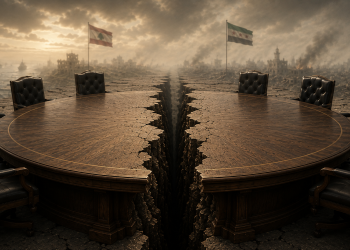
In this charged regional climate, Lebanon is rapidly becoming an arena of sharp political and social polarization. Regional tensions have been reflected in domestic political discourse, with a renewed surge in mobilization rhetoric and an escalation of dichotomies between opposing camps. This has rapidly narrowed the space for calm discussion of national options and paralyzed the ability to build common ground for political dialogue. This climate causes Lebanese politics to operate within a space of collective emotion rather than one of shared risk management, posing a real threat to internal cohesion at a time when regional pressure is increasing and political options are becoming more complex. The Wisdom of the Elite and the Third Way
In these complex circumstances, the need for what can be termed “the wisdom of the elite” becomes paramount as a fundamental element in managing this phase. This wisdom must be capable of interpreting regional shifts objectively, understanding the state’s position within the broader conflict, and assessing the costs before engaging in major decisions. Lebanon today, with its diverse composition and structural weaknesses, faces a genuine risk of the regional conflict spilling over into its society. Political and sectarian tensions could easily escalate into a protracted internal conflict, opening the door to years of attrition and collapse. Such a path serves the interests of the enemy above all others, as it transforms Lebanon into an open battleground, draining the resources of society and the state for decades. Lebanese history provides clear evidence of the consequences of this path. In the past, internal confrontations, after years of losses, ultimately led to everyone returning to the negotiating table, with the prospects for reform and state-building diminishing. This historical memory makes political wisdom today a national imperative to protect society from repeating the same trajectory. Hence, a third path emerges, one that transcends sharp dichotomies, as a more aligned option with Lebanon’s interests at this critical juncture. This path places the protection and cohesion of society at the heart of political thinking and redirects the debate toward managing risks rather than sliding into internal conflicts. Lebanon’s ability to maintain its internal stability amidst this regional conflict remains the decisive factor in its survival as a state capable of confronting future challenges.
The Decision to Go to War, State Responsibility, and National Consensus
In this context, the decision to go to war stands out as one of the most sovereign decisions in the life of a nation, because it is a decision that rearranges societal priorities and imposes a heavy human, economic, social, and security cost on fragile states. Therefore, this type of decision is linked to the nature of the state and its institutions, as well as the level of societal consensus on fateful choices. In contemporary political experiences, wars usually stem from a state decision made jointly by political and military institutions within a framework of broad national debate that balances the political stance with the state’s actual capabilities. In a pluralistic country like Lebanon, this consensus becomes a prerequisite for maintaining internal stability and social unity. The pluralism that constitutes part of Lebanon’s cultural and political strength requires, in times of major crisis, institutional management of dialogue and clear constitutional mechanisms that allow for the discussion of fateful choices within state institutions, not within the framework of narrow alignments or unilateral decisions. Given the geostrategic challenges surrounding Lebanon, active diplomacy and pragmatic politics can open multiple avenues for expressing political positions and defending just causes without turning the country into an open battleground. In such cases, strength stems from the ability to protect society and to manage the country’s geographic and political position with long-term wisdom that prioritizes Lebanon’s interests and stability.
Lebanese Diversity as a Historical Asset for Openness and Mediation
Lebanon possesses a rich political and cultural history, characterized by its social and cultural diversity and its geographic location at the crossroads of the Levant and the world. This diversity has not been merely a demographic characteristic; rather, over many decades, it has been an integral part of Lebanon’s cultural, economic, and diplomatic role in the region. Lebanese society has historically been shaped by a culture of openness and engagement with the world, and by the ability to build extensive networks of economic, cultural, and political relations with its Arab neighbors and the international community. This legacy has granted Lebanon a unique position as a meeting point for diverse cultures and as a bridge between different political and economic environments. In light of current regional transformations, this diversity can constitute a source of symbolic strength, enabling Lebanon to play political and diplomatic roles based on dialogue, mediation, and building channels between conflicting parties. Small states with cultural capital and extensive networks of relationships can sometimes play a role that transcends their military might, through diplomacy and the ability to bring parties together around negotiating tracks or political initiatives that mitigate conflicts.
This diversity becomes even more important when it is also invested in managing internal balances and fostering a culture of dialogue among the components of Lebanese society. This very diversity holds the potential to create common ground for national consensus and open a third political path that reduces the intensity of extremist polarization and liberates national decision-making from the logic of extreme dependencies. When diversity becomes a framework for convergence and dialogue, it becomes capable of protecting Lebanon, both its land and its society, and empowers the state to emerge from cycles of conflict and move towards proposing political and diplomatic approaches that enhance stability and open horizons for settlements that safeguard Lebanon’s interests in a highly turbulent regional period.