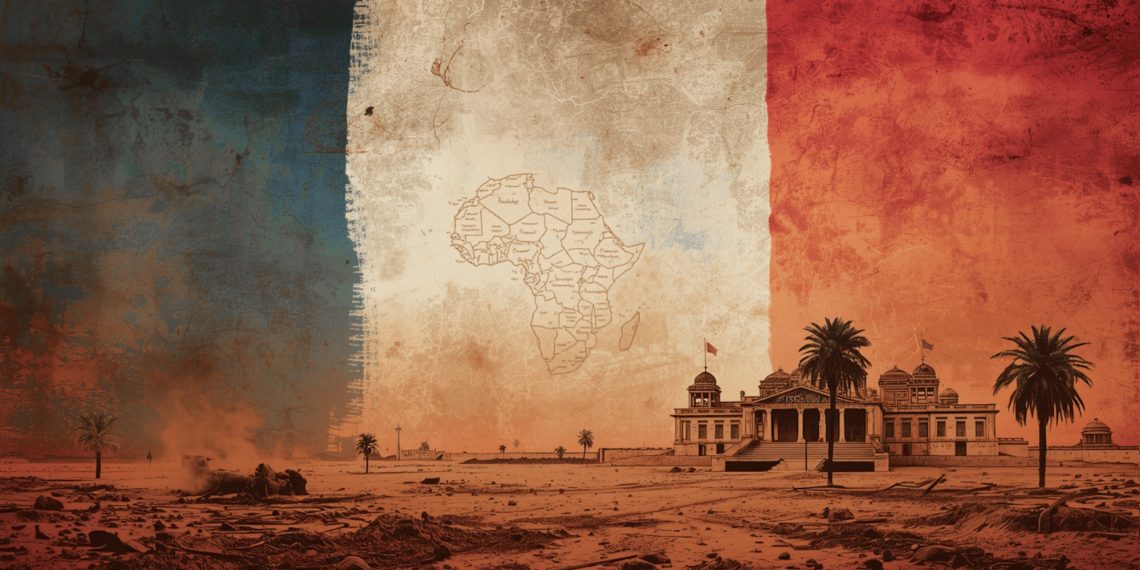
Over the past few years, Paris has been losing ground in Africa. It has been inching closer towards an end to its 66 years of military hegemony, political and economic influence in most West African countries. It was first decided by the young military authorities of the Sahel, West and Central African states: Niger, Mali, Burkina Faso, Senegal and the Central African Republic, to end French troop presence on their soil. Since his election in 2017, President Emmanuel Macron has been trying to polish France’s image in Africa, creating a narrative based on a détente posture toward the African Sahel and West Africa.
Stability pattern
In light of the fall of former Libyan leader Muammar Gaddafi in 2012, led by the NATO coalition, the African Sahel region fell into chaos. As a result of this invasion a security vacuum surfaced; Paris launched the Serval and Barkhane operations to counter a multi‑ethnic civil war and trans‑national Jihadist insurgency in a joint operation with the G5 countries (Mali, Burkina Faso, Chad, Mauritania and Niger). Paris sent more than 3,000 French soldiers, drones, armoured vehicles, transport aircraft, helicopters and fighter jets into the Sahel; the outcome was poor and led to further instability and insecurity. Since the two military operations the region has experienced six coups, thousands of people killed, thousands internally displaced and a humanitarian and food crisis in neighbouring countries, notably Algeria. These operations were a strategic failure in the African Sahel and caused a strategic shift, with direct national‑security and national‑interest consequences for Paris.
These military operations were accompanied in the Central African Republic by Operation Sangaris in December 2013, launched to restore order during the civil unrest between the pro‑government militia with Jihadist links known as Seleka and the Christian militia Anti‑Balaka. Like the Serval operation in Mali, the Sangaris operation managed to disarm the militias, control religious tension and conduct a peaceful transition to the UN peace‑keeping mission MINUSCA, in a similar manner to MINUSMA in Mali, a stabilising force mandated by the UN Security Council.
Geopolitical superpowers’ influence
Paris’s strategic failure left a military and political vacuum. Washington is actively positioning itself in the Sahel, West and Central Africa, while Beijing’s non‑interference policy in Africa and the MENA region remains a stabilising diplomatic approach. The region’s geopolitical and economic parameters have allowed another superpower—Russia—to rapidly fill the vacuum created by Paris’s departure. In 2019 Russia held the first Russia‑Africa Summit, attended by 43 African heads of state in Sochi under the motto “For Peace, Security and Development”. Its sphere of influence has since expanded. Insecurity caused by the escalation of trans‑national Jihadist groups inspired the overthrow of pro‑French regimes in Mali, Burkina Faso and Niger. Consequently those regimes requested military cooperation, and Moscow supplied equipment, personnel, trainers and advisers. In September 2024 Mali, Burkina Faso and Niger announced a deal with Russia to acquire telecommunications and surveillance satellites for use in their fight against Jihadist insurgency. In February 2024 Moscow’s new Africa strategy, based on humanitarian diplomacy, shipped 200,000 tonnes of free grain to six African countries, fulfilling a promise made by President Vladimir Putin at the 2023 Russia‑Africa Summit. The beneficiary countries were Somalia, Burkina Faso, Mali, Zimbabwe, Eritrea and the Central African Republic. Thus Moscow’s aid and cooperation enhanced an ongoing nuclear partnership with several African states, helping to establish nuclear power plants for electricity generation. Countries that have signed agreements include Algeria, Ghana, Ethiopia, the Republic of the Congo, Nigeria, Rwanda, South Africa, Sudan, Tunisia, Uganda, Tanzania, Zambia, Kenya, Morocco, Burkina Faso and Mali.
Is the African Sahel becoming the new Great Game?
Military coups in the troubled region of the African Sahel, Central and West Africa are often dismissed as routine, yet the entire region—and its non‑African actors, regional powers and superpowers—shows a great deal of interest in this complex local power struggle involving tribal, ethnic, religious and political actors. In this context France, the usual suspect for the region’s malaise and coup‑induced disease, is highly active and worried about the domino effect of coups and instability that challenge its military and diplomatic prestige, which has been in decline since the fiasco of the Serval and Barkhane operations in Mali under President Hollande. This decline is compounded by France’s Libya policy from President Sarkozy to President Macron, whose lack of experience with complex world affairs affected strategic decisions in Africa and the MENA region, fostering anti‑French sentiment across the continent and giving rise to Neo‑Pan‑Africanism led by a new generation of military and civilian elites and civil‑society leaders who oppose France’s patronage, hegemony and domination.
This patronage attitude is reflected in the role of the sub‑regional organisation ECOWAS, which brings together fifteen countries, was created in 1975 to promote economic cooperation in West Africa and is supported by Paris. Nonetheless, many people in the sub‑volatile region see ECOWAS as irrelevant and a minion of Paris. When the ECOWAS leader threatened the new military authorities in Niamey over a planned operation in 2023, the organisation was perceived as launching a proxy war that served colonial interests. After the July 2023 coup in Niger that ousted pro‑French president Mohamed Bazoum, Paris supported ECOWAS’s military intervention in Niamey. The last base standing, Paris knows, if it loses Africa it will mean the end of its influence and dictate in the region, as a result other regional and global powers will fill its long‑standing sphere of influence. Countries such as Russia and China are already gaining popular support; the United States has been keeping a low profile, maintaining its powerful military base in Niger and special‑forces deployments across the turbulence of the African Sahel. Turkey has been vocal and is positioning itself as a trustworthy partner and stabilising force in West and East Africa, extending to the Horn of Africa, another sphere of influence from which France is losing ground to China, Russia and other destabilising regional powers.
In sum, Algeria, as a pivotal emerging state in the region, adheres to the restoration of constitutional legitimacy in the African Sahel countries, boosting its presence through development‑ and stability‑oriented diplomacy, for instance with Niger, thereby ending a diplomatic rift with the Alliance of Sahel States (ASS). Algeria and Niger have confirmed work on the 4 100‑kilometre Trans‑Saharan Gas Pipeline project, designed to carry 30 billion cubic metres of natural gas annually from Nigeria, through Niger, to Algeria’s Mediterranean coast for export to Europe.
France appears to be playing a double game, sending the wrong message of endless misery in Africa, facing imminent national‑security threats, beginning with armed transnational terrorist groups, adding the migrant issue and diplomatic tensions with Algeria; the latter holds all the stability and security cards for France and Europe. This is why France’s and the EU’s leaders should review their Africa policy, despite their incoherence in international‑political strategic thinking, whether in Ukraine, Greenland or President Donald Trump’s “Board of Peace”, because the repercussions will be worse in this unstable world of affairs; the security and humanitarian ramifications of the war in Sudan, the fog of war in the Horn of Africa, and, in this insecure world, Paris and Brussels should look south.