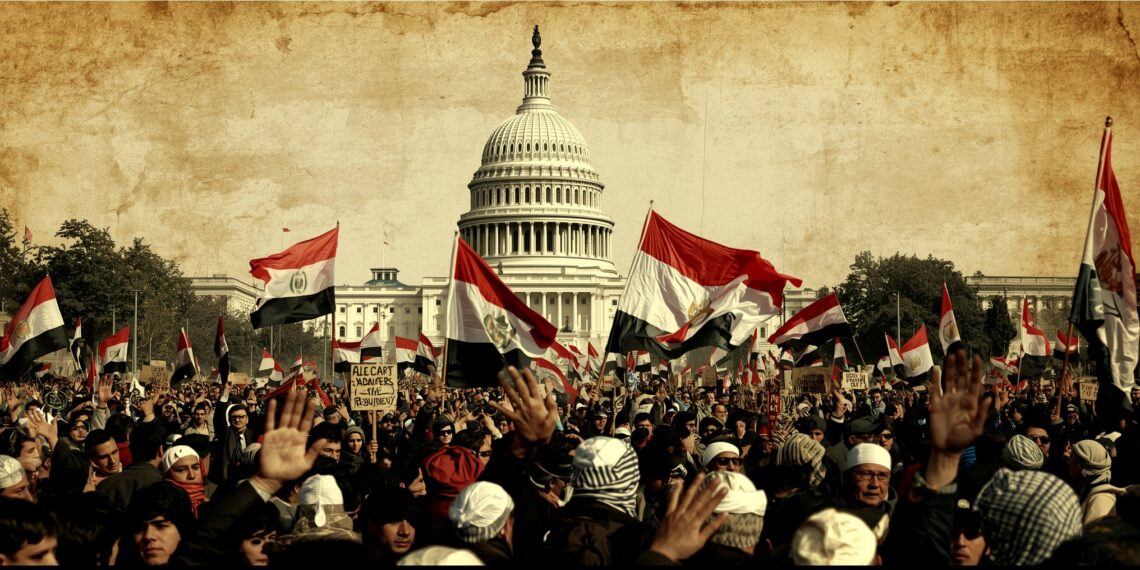
For years, debate has raged within US political and security institutions regarding how to deal with the Muslim Brotherhood, particularly given the divergent positions of the group’s branches around the world and the varying approaches it employs, including advocacy, political and armed activities.
Although the United States has not officially designated the group as a terrorist organization for decades, regional developments and pressure from regional allies (such as Egypt, the UAE and Saudi Arabia) prompted the decision to designate the group as a global terrorist entity, similar to organizations such as al-Qaeda and the Islamic State.
Direct Implications for the Group
Strict Financial Restrictions: The decision will freeze any financial assets or property belonging to the group or its members in the United States or that transit through the US financial system.
Legal Prosecution: The decision will open the way for legal prosecution of any member, collaborator, or financier of the group under US anti-terrorism laws.
Damaging the International Reputation: The designation provides legal cover for governments hostile to the group to exert further pressure on it domestically and internationally through smear campaigns and persecution.
Impact of the Decision on Arab and Islamic Countries
The decision will have varying repercussions on Arab and Islamic countries, determining the nature of their dealings with the group, in terms of classifying it as a banned or non-banned group. Therefore, if issued, this decision will enhance the state’s legitimacy in its war against the group and reinforce the official narrative of terrorism that links it to the group. Saudi Arabia and the UAE will exploit the decision to strengthen their political and security position against the Brotherhood, both domestically and internationally.
The impact of the decision on Jordan will vary, determining its position on the Brotherhood. It will present it with difficult choices and embarrassing legal and political problems, given the presence of political forces (parties) emanating from the Brotherhood that participate in the political process and have representation in parliament. Morocco’s position on the Brotherhood may be closer to that of the Jordanian government.
This decision may strengthen the Tunisian government’s position on the Brotherhood, particularly since it has classified the Tunisian Ennahda Party as a banned party and arrested most of its political leaders. The political and legal battle between the government on the one hand and the Ennahda Party and some other opposition parties remains open.
The two countries that are taking a soft approach to the Muslim Brotherhood in the region and may oppose the US decision and express reservations about it, given their historical relationship with the Brotherhood, are Turkey and Qatar. They may acquiesce to the US decision to a different degree than other countries. In Southeast Asian countries, the decision will gradually impact groups associated with the Muslim Brotherhood, such as Persis in Indonesia and the Pan-Malaysian Islamic Party (PAS) in Malaysia.
Due to the group’s deep involvement in political, social, and economic life in both countries, these countries may be forced to reject the decision and evade its implementation domestically. This is due to the group’s deep-rooted influence in the social fabric, placing them in a legal and political predicament that could threaten future political alliances and coalitions. The repercussions of the US decision on Pakistan will be disastrous, especially given the presence of political Islamist movements, some of which intersect ideologically and organizationally with the Muslim Brotherhood and participate in political and constitutional life there, particularly the Jamaat-e-Islami.
Pakistan has a long history of political participation by Islamist movements, operating within party and electoral frameworks, unlike many Arab countries. The Muslim Brotherhood has not been as organizationally active in Pakistan as it has been in the Arab world, but it has been intellectually and influentially represented in some parties and educational and advocacy institutions.
The decision could lead to further international pressure on Islamist parties, especially the Jamaat-e-Islami, if it is linked organizationally or financially to the Brotherhood.
The American decision will place Pakistan in a delicate balancing act. On the one hand, it is a country with a strategic alliance with the United States, while on the other, it is governed by a political life dominated by deeply rooted Islamist parties. Any excessive American escalation could upset this balance and lead to unforeseen internal political and societal repercussions, especially if steps are taken against the Jamaat-e-Islami, which is not classified as a violent organization but rather as a reformist intellectual movement. The resolution is not expected to become a unified international position for the following reasons:
The difference in definitions of terrorism among countries, and the presence of Muslim Brotherhood branches that legally participate in political life (such as in Morocco, Jordan, Kuwait, Malaysia, and Indonesia).
Some countries’ strategic interests with the group or its affiliates make the US decision subject to reservations.
However, some European countries that adopt a strict security approach may take partially similar steps (such as Germany and Austria), without a comprehensive designation as Washington has done.
From a legal standpoint, designating the group as a “terrorist organization” under US law means:
Designating any individual or entity proven to be affiliated with or financially supportive of the group on the terrorist lists;
Confiscating assets or any funds associated with the group in US banks or via dollar transfers;
Imposing travel and visa bans on individuals associated with the group;
Closing down associations and charitable organizations supervised by the group or proven to support it.
However, successful implementation depends on clear legal evidence, which could complicate or delay the widespread implementation of the decision. International divisions are expected over the legitimacy of the designation, reviving the debate over the definition of “terrorism.” It pushed the group toward greater secrecy and isolation, and perhaps even pushed some of its members toward extremism. This is what prompted authoritarian regimes to exploit the decision as a pretext to eliminate the (Islamist) political opposition.
The decision will also confuse moderate and centrist Islamist movements by lumping them together with groups designated by the United States as “terrorist” entities, especially in environments experiencing fragile political openness. This portends political, organizational, and ideological shifts toward extremism and radicalism, and a lack of faith in the effectiveness of approaches aimed at moderation and integration into society and the nation-state in the medium and long term.
The decision by the United States to designate the Muslim Brotherhood as a terrorist organization represents a dangerous strategic shift with repercussions that extend beyond the organization itself. It will undoubtedly negatively impact the organization, weaken its effectiveness and activities, and besiege its leaders, members, and institutions in all areas.
It will, in turn, impact the political landscape in the Middle East, international relations, and the future of political Islamist movements in general. Clearly, a comprehensive approach must balance security and rights, legal classification and political dialogue, to avoid creating intellectual vacuums that could be filled by more extremist groups. Should such decisions be issued, the turmoil in US foreign policy will have negative repercussions for the security and stability of societies and countries worldwide. This will lead to further repression, violations of public freedoms, and the rebuilding of weak regions that are unable to confront US decisions and those of its ally, Israel.