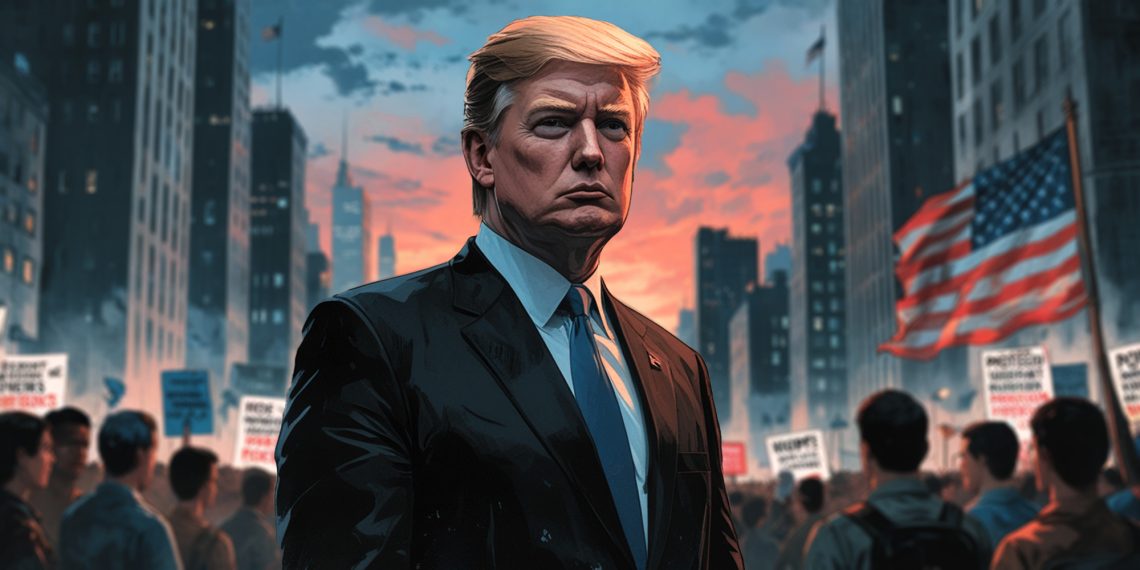
Foreign policy choices and practices in the United States are often dependent upon the political orientation and inclinations of the presidents who have significantly determinative roles within the political system. The renowned principle of checks and balances is referred to as a major constraint to curb potential transgressions of the president. However, this principle considers the role of the Congress and the relative independence of the judiciary and, thus, remains silent in cases where external supervision is actually needed and where the president and the Congress act in consensus that could be blatantly detrimental to the relative peace in international affairs. In rare instances, elements that fall outside the political and judicial establishment may play a restraining role. One of these elements is public opinion, which now seems to have gained relevance, given that President Trump acts in a way that he would not reasonably recognize some of the domestic or international boundaries.
Political scientists and historians have observed that American decision-makers do not pay close regard to public preferences, particularly during times of crisis. According to American presidents, there is no need to be concerned about public opinion, especially when national security is at stake. On the other hand, in some cases, the fear of an angry public reaction, even if indirect, discourages people from making extreme life decisions. The fundamental cause of this anxiety is that presidents are elected by popular vote. As a result, American citizens with the right to vote wield some influence over their elected officials. However, with rare exceptions, American foreign policymakers purposefully ignore public opinion when discussing how to respond to external challenges.
However, the lack of direct public influence in foreign policy does not mean that American foreign policy is completely undemocratic. In a broad sense, it is possible to say that national policies are determined in line with the wishes and expectations of the public. For example, during the Cold War period, the expectations and aspirations of the public regarding foreign policy were clear. In this period, the American public wanted foreign policy makers to protect American interests against the Communist threat, to avoid unnecessary wars and to pursue diplomacy in order to become a great democratic power. However, it should be noted that public expectations have changed over time. For example, in the immediate aftermath of the Second World War, the American public’s expectations in terms of participation in international politics were limited to membership in the United Nations. By 1948, however, a large number of Americans were in favor of a more interventionist foreign policy stance. The American public has sometimes been expansionist and sometimes isolationist; sometimes optimistic and sometimes pessimistic. Such general patterns of behavior or thought have not been so easy to manipulate through elites. For example, after the Vietnam War, the American public became opposed to the idea of intervention in Third World affairs. Without the strong opposition of the American public, it is highly unlikely that Ronald Reagan would have intervened in the unrest in El Salvador in 1981.
However, the direct influence and role of the people or public opinion in the foreign policy-making process is extremely limited and minimal. In the field of foreign policy, the president has a clear advantage over both Congress and the public. The president, who is almost the sole representative of the American people, is the most important actor in foreign affairs. This is facilitated by the fact that he can conduct diplomacy on his own terms without public pressure. For this reason, some issues that the public does not care much about can become major problems at times. While the president’s free hand in foreign policy making is largely due to the public’s apathy, their decision-making power in times of crisis can be attributed to the public’s lack of influence.
Nevertheless, as national leaders, American presidents have traditionally claimed that the public is a source of support and inspiration for them. For this reason, presidents have often felt the need to take public opinion into account. Traditionally, leaders have relied more on newspapers and mass media to determine what the public thinks. The US Congress, on the other hand, has served as the second most important source of public opinion trends for American decision-makers. Basically, American presidents have been more interested in the activities of the committees dealing with foreign affairs. However, from time to time, senators and representatives were also considered to reflect public opinion. Phones, letters, telegrams, faxes or e-mails received by the White House and other executive agencies are also important sources that give the president an idea of what the public thinks. Finally, presidents can get a sense of public opinion based on their own impressions. The attention or reaction they receive from the public, either at their rallies or during their travels, gives them an idea of how their policies are viewed by the public.
Public opinion is often more important after the implementation of a major policy. It is at this stage that criticism of the legitimacy of the policy and the authority of the president is more clearly expressed. However, even in such a situation, if the reaction is relatively small, the president may interpret this as silent support. For example, even when hundreds of thousands of people marched in protest in Washington in the 1960s, presidents drew attention to the 250 million people staying at home. The most important reason why American presidents are able to successfully fend off criticism is that they can portray themselves as representatives of the American nation. As a consequence, many people, for example, refrain from criticizing the president in public for fear of humiliating him. The fact that legitimacy is based on the approval of the nation pushes presidents to turn to the people when they face difficulties. For example, in the 1840s, President James K. Polk threatened to go to the people when Congress stood against him. The relevant departments of the executive branch assist presidents in reaching out to the public or making public appearances. In this framework, the Ministry of Foreign Affairs plays a particularly important role in foreign policy issues. Over the years, its role has shifted from field research to information gathering and lobbying.
Whatever the role and influence of the public, Americans still have certain views on foreign policy issues. The range of their behavior, knowledge and interest in these issues is quite broad. The most influential actors in shaping these views are businessmen, politicians, statesmen, broadcasters, journalists, intellectuals and spokespersons of organizations. There are four types of actors that play a role in shaping public opinion. These are national actors who form opinions on multiple issues (such as senators), national actors who form opinions on a single issue (such as the president of a company with a defense contract), local actors who form opinions on multiple issues (such as the president of a large bank) and local actors who form opinions on a single issue (such as a faculty member at a local university).
These actors convey their opinions to the public through the media and their policy preferences to the actors in power. These actors influence, express and represent the views of large masses of people. On low profile issues such as customs rates and trade policies, they can become the only interested parties. As a result, they can play a significant role in the policy-making process. Through lobbies, pressure groups and informal relationships with decision-makers, these actors can ensure that national policies serve their needs. In American history, such actors have mostly existed on the East Coast. Today, however, while New York has a prominent role as the national media and financial capital, such actors have also begun to have an influence in foreign policymaking in cities such as Atlanta and Los Angeles, as well as in regional power centers.
In between these actors, who have the power to influence public opinion and the preferences of the administration, and the ordinary public, there is another group of people who constitute at most 10 percent of the population. This group, which has a high level of knowledge on foreign policy issues, consists of middle or upper-middle class people and acts on behalf of organizations or groups with interests in the international arena. They play a carrier role in conveying the ideas and opinions of the actors who form foreign policy views to the public.
The remaining silent majority of the public has virtually no knowledge of diplomatic events and developments and the nature of the international system. They are excited by news about wars and crises on TV programs or in newspaper headlines, but they show no interest in the normal mechanisms of foreign policy. However, in certain circumstances, this apathetic and silent majority can become a powerful force in foreign policy. In such cases, large masses of people can be persuaded to put pressure on foreign policy decision-makers and their views can influence the outcome. For example, when Lyndon Johnson and Richard Nixon began to lose the support of the foreign policy establishment, they chose to appeal to the masses of the people to gain support for their Vietnam policy.
Compared to Europeans, Americans seem to have significantly less interest and knowledge on foreign policy issues. This surprises many observers, as the level of education of Americans today is more advanced than ever before. Today’s print and electronic media can also provide information to the masses much more quickly and easily, which in fact makes it easier for them to stay informed on foreign policy issues. Nevertheless, large masses of people are still uninformed about foreign policy issues. For example, a 1964 survey found that more than a quarter of respondents were unaware that there was a communist government in China.
Interestingly, however, some influential analysts believe that public apathy on political issues is not necessarily undesirable. As long as the uninformed public remains apathetic, leaders need not worry about irrational input into the foreign policy process. Some theorists also argue that mass apathy in a broad political space is preferable for democracy. If all Americans were interested in the political process, decision-makers would be under constant pressure, which would prevent them from carrying out their normal duties. The masses are not always capable of making the right decision on serious foreign policy issues, but they can nevertheless play an important role in controlling the behavior and preferences of decision-makers who choose a dangerous path.
Sources of Public Opinion
Although the overwhelming majority of Americans do not follow foreign policy closely, they do express opinions on, for example, the problems of peace and war and on foreign countries. These views are developed in different ways from different sources. A person’s attitude toward foreign policy issues is determined by his or her education, religious beliefs, age, place of residence, and even gender. University graduates are less nationalistic than high school graduates. Catholics are more hostile towards socialist states than non-Catholics. In the 1990s, young people had more friendly feelings toward the Japanese than those who remembered the Pearl Harbor raid. People living in the US Midwest are less isolationist than those living in the West or East because they live thousands of kilometers from the coast.
The nature of the group one belongs to is not the only determinant of foreign policy attitudes. Psychological and personal factors also play a role in the formation of political attitudes. Authoritarian and certain other strong personality types are influenced by patterns such as their relationship with their family, their sexual experiences and their career development. Interestingly, the more important a political issue is to an individual, the more that individual’s attitude towards it is influenced by psychological factors.
Regardless of the social or personal group to which one belongs, people all over the world are in fact more suspicious of foreigners. However, this suspicion can be exacerbated by a lack of information. Many Americans know very little about other nationalities and therefore develop negative prejudices against foreigners. For many Americans, Latinos are lazy and Arabs are terrorists. But not all prejudices are negative. If a state is small and non-threatening, Americans are more likely to admire the country and its people. Prejudices against larger and more powerful states are more complex. Depending on the particular historical experience, positive and negative elements of these prejudices may predominate. For example, Germans are loved for their hard work and cleanliness and hated for their ruthlessness and arrogance.
Although the American public’s opinion of foreign countries varies from generation to generation, those who form specific groups based on their ethnicity often lobby consistently for their homeland. Americans in this category have been extremely active throughout American diplomatic history. The mythical view of the United States as a melting pot has not created a new type of American. Fourth and even fifth generation Americans still remain loyal to their original nationality. In diplomatic and military disputes not directly involving the United States, German-Americans, Polish-Americans, Arab-Americans and others tend to support their homeland. Often, this support is independent of the national interest of their new country.
For example, during the First World War, German Americans strongly opposed Woodrow Wilson’s decision to go to war. In the post-World War II period, Jewish Americans have had a very strong influence on US policy in the Middle East. Cuban Americans had a similar influence on US policy towards Cuba under Fidel Castro.
Ideology also has the ability to mobilize people. In the 1930s, a significant number of American Catholics worked to prevent Franklin Roosevelt from selling arms to the Spanish government. In contrast, university students, who saw Spanish Republicans as heroes fighting against the fascists, pressured Roosevelt to soften the arms embargo. In the 1950s, the conservative Committee of One Million became an important actor in the debate over US policy towards China. A similar anti-communist organization, the Committee on the Present Danger, played an important role some twenty years later in reducing support for Nixon and Ford’s policy of détente towards the Soviet Union. However, the effectiveness of such groups in foreign policy was extremely limited compared to their effectiveness in domestic politics. In most cases, American diplomats were able to either ignore them or use them against each other.
As a result, there is no consensus on how the public should and does influence foreign policy. Many analysts argue that presidents are in some way constrained by the preferences and actions of a public that defines broad national goals and sets relevant parameters for action. Nevertheless, presidents have an extremely dominant role in foreign policy, with a more prominent and effective role in decision-making than even in less democratic countries. It should also be noted that it is not possible to speak of a single people and public opinion. The interest, influence and knowledge about politics of each mass of people varies. The socio-economic status and personality of individuals can also have an impact on foreign policy attitudes. All this means that measuring the influence of public opinion on American foreign policy is extremely difficult. Identifying societal influence on American foreign policy will be possible by identifying the relevant social groups and explaining their role in foreign policy.