With the announcement of the “Sahel Confederation of States” alliance on 6 July 2024, leaders of Niger, Burkina Faso, and Mali seek to arrange inter-state and regional relations by transforming the military leaders’ seizure of power into a state of political renewal, thereby reinvigorating the discourse of national liberation. This raises debates about the alliance’s role in modernising governance systems based on the legitimacy of the status quo, rather than through traditional political processes. Consequently, there is an urgent need to assess the alliance’s appeal compared to the performance of the Economic Community of West African States (ECOWAS) and its impact on the political situation in the Sahel region.
According to the joint statement, the three governments move towards the second phase of determining political legitimacy and international representation capability. Having overcome external pressures and blockades, the close alliance works on two fronts: supporting the governing legitimacy of each country and showing solidarity against threats of intervention and armed group risks. These developments are important for forming a structure capable of responding to Algeria and Libya’s concerns about internal instability, international intervention, and the rise of terrorist and separatist organisations.
Fundamentally, the alliance focuses on strengthening national sovereignty, removing French and American presence, and structural changes in foreign policy towards partnerships with Russia, Turkey, and Iran, while also addressing terrorism and extremism. In early March, it began forming a joint force to combat jihadists in the border triangle and to stop the depletion of raw materials.
Historically, this situation aligns with the evolution of governance systems during the post-independence phase when liberation leaders sought to fortify their position by investing in the shared experience of anti-colonial struggle, sparking the development of the “Rassemblement Démocratique d’Afrique de l’Ouest” initiated in 1946. This transformed revolutionary leaders into governors of West African nations, contributing to the African liberation movement and its continental and regional organisations. Early experiments in unity occurred as these governments responded to political change and sought mutual protection at the dawn of independence. As this experience grew amid the shifts accompanying World War II, the disruption of the international system and numerous emerging conflicts create opportunities to form regional entities built on common interests and collective security.
Nonetheless, the emergence of the alliance highlights the decline of regional alliances’ significance amidst the limited contributions of the “Community of Sahel-Saharan States” and ECOWAS in providing the necessary security umbrella to consolidate regional stability or enhance economic cooperation. For alliance members, the reduced benefits are partially tied to the modest performance of democratic programmes in institution-building or addressing the tribe-state dilemma, leading to political instability. The absence of a corrective model leaves governments distant from societal satisfaction.
Similarly, the collective efforts yielded disappointing results. Despite ECOWAS expanding its intervention powers, it failed to retain its appeal for members, often more preoccupied with upholding the status quo rather than alleviating problems and crises. During the governance crises in the three states, ECOWAS remained powerless to effect change, notably within Niger, where it was out of touch with both actual and symbolic influence, especially amid escalating security and social problems within almost every country. The organisation became unable to meet the growing regional stability needs, casting it as a tool for control rather than bringing benefits.
For the three countries, ECOWAS’s approach seems unsuitable for resolving internal power conflicts or activating inter-state trade. Amid recurrent crises, the organisation became confused. The withdrawal of three central Sahelian members could indicate the diminished feasibility of its existence, particularly given deficiencies in financial, security, and defence aspects, hindering its ability to counter terrorism and sustain the challenge of building a regional force.
Geographically, the alliance garners dual attention. Firstly, the central position of the alliance members within the Sahel enhances its attraction for others to join, potentially reviving Muammar Gaddafi’s project to connect the desert zone with the Mediterranean coast and overcoming Libya’s decline since 2011. Secondly, the alliance emerges amid Russia’s efforts to link Libya with the Sahel, yet it faces burdens from the Russian-American rivalry over regional security dominance and the spread of civil wars along the Sudanese people’s belt. In this context, Libya’s swift response to align with military developments in the Sahel raises the possibility of its joining, improving the alliance’s prospects for a positive alignment with the political entity’s new direction.
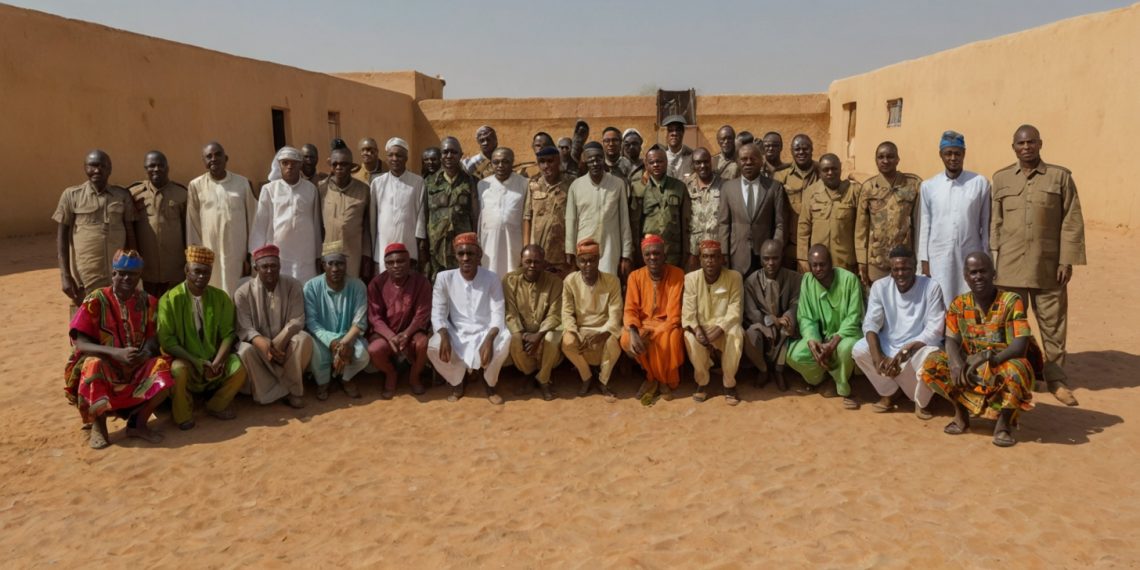
Ultimately, the alliance’s step forward represents a progression in defence coordination against ECOWAS’s intervention threat to reinstate Niger’s former President Mohamed Bazoum. It places new governments before the realisation of the importance of mutual support against regional isolation. Given the relative weakness of the three armies, this move signifies political solidarity focused on advancing collective inclusion. A year after Niger’s coup, consultations began to establish the alliance, following the foreign ministers’ approval of a draft agreement in May for the Sahara alliance, aimed towards political unity.
Overall, discussions on the alliance’s future hinge on structural and intellectual criteria, primarily leadership change, offering insight into the rising integration among Africa’s new leaders. Beyond similar ages, goal alignment ensures stable group relations. On one hand, the primary goal was to end the exploitation of sovereign resources and strive for true independence away from colonial legacies. This liberationist approach seeks to review foreign policy by pivoting away from Western countries and opening new alternatives. On the other hand, based on statements and public utterances, leaders express a desire to balance regional relations.
Shared military backgrounds enhance the alliance’s coherence, with similarities in political culture and institutional management experience. Here, the alliance emerges as a response to grievances and skewed interests with the colonial power (France) and the United States, and an emphasis on shifting eastwards. Though the foreign policy restructuring is pursued, achieving balance with Russia and China or other nations depends on advances in establishing the new system. If internal fragmentation and institutional stagnation persist, it will likely trigger a new cycle of resource depletion and shift in submission to dominance.
Contrary to traditional political transitions, leaders have not focused on transferring power to civilian governments and organising elections but rather on rebuilding regional relations and foreign policy, perceiving on-ground presence and social support as sources of legitimacy. In this case, the three rulers follow a different path, its roots tracing back to converting liberation movements into ruling authorities, laying the groundwork for similar systems not reliant on elections to solve legitimacy issues, while devising alternative state management frameworks.
The progress in political changes depends on leaders undertaking roles as pioneers in political system construction and Confederation development as an alternative or equivalent to existing assemblies, by presenting an alternative experience to the prevalent political transition processes since the late 20th century. The model would integrate regional and local factors in building a coherent political framework and enhancing self-capacities faced with external pressures.
Despite these advantages, the alliance lacks sufficient resources to tackle social peace and national integration challenges, and the absence of a modernisation model presents a challenge for political system development in countries amidst turbulent regional environments, structural imbalances, and capital accumulation constraints. Exiting these challenges involves improving the political and economic resource management and engaging in alliances based on mutual dependency, compensating for internal shortcomings and neutralising external pressures.