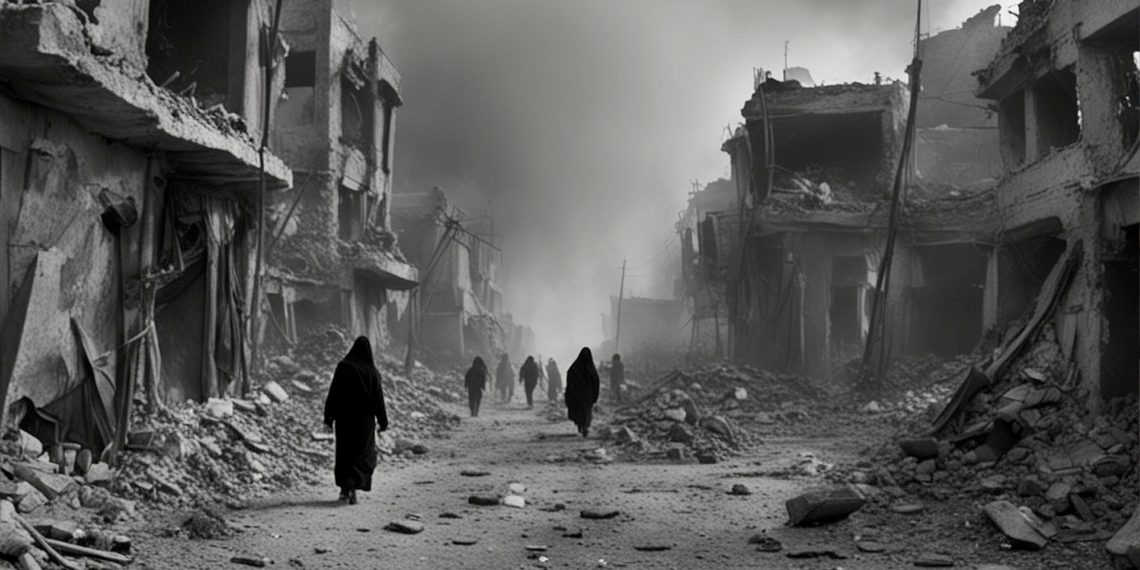
As we approach the July 11 anniversary of the Srebrenica genocide, today’s events in Gaza are a reminder to look back and think forward. The massacre and genocide seem to be both a part of what happened in the past and a consequence of the mindset that led to it. Gaza is the place where humanity has once again fallen silent and ended. Gaza is neither the first nor the last. It is important to see that the Gaza issue, which is the latest outcome of a world order and logic of disasters, massacres and genocides in Rwanda, Bosnia and Syria, as the latest great bloody event of a world order. By looking at the big picture, rather than considering Gaza solely in its own current internal conditions, we can evaluate the past more broadly, understand the present better and predict the future more accurately.
The Unchanging Mind from Rwanda to Gaza
What is happening in Syria is one of the largest-scale acts and violence of humanity has seen in recent times. A state and its coalition partners are trying to destroy an opposition by displaying the ugliest forms of warfare. A tragedy is unfolding in a country where compassion and conscience cannot even remain silent.
This process, which is taking place in front of the eyes of the free world and despite the so-called support of the opposition brings to mind the 1994 Rwandan Genocide. You know, what happened in the country in the middle of Africa while the genocide in Bosnia continued. Eight hundred thousand people were exterminated in 100 days.
When we think about Rwanda these days, interesting structural similarities with what is happening in Syria draw attention. I can almost hear those reading this article saying, “No way! If the Gaza genocide is somewhat like the Syrian tragedy, a bit like Afghanistan, a bit like Bosnia then on a structural level it is somewhat like Rwanda.”
Rwanda was given as a colony first to Germany at the Brussels Conference in 1890 and then to Belgium after the First World War. The first leg of our analogy starts right here. The structure that shared Africa with great appetite and with the same greed, piled into the region it called the Middle East after the Ottoman Empire.
Both Africa and the Middle East share a common fate in the colonial era. Although the Ottoman Empire’s shielding of both regions had repelled previous attempts, colonial structures were established in these regions after fate had delivered them to their destined end. This meant the beginning of chaos and instability within these structures. France in Syria and Belgium in Rwanda operated with a similar political mind and conscience. It would not be wrong to say that the roadstones of the massacres in 1994 and today were laid during these periods. The technological positivist mind of the West, tuned to calculation and utility shaped the region with the cold-blood of a machine.
While all this was happening, history stopped in Africa and the Middle East. Both geographies were left out of history and history flowed as an object in the river. This is also the time when the foundations were laid for polarization in these countries for breaking away from historical unifiers, for inventing others, for starting classifications and for looking at the other with hatred. History is no longer functional and constructive but destructive in these processes.
The human being loses its value, the will to be a nation and walk together into the future weakens and the homeland becomes relative to others. Security concerns take precedence over respect, compassion and service to one’s own country.
Africa and the Middle East in general and Syria and Rwanda in particular are now destined to be reduced to the status of sleeping countries, turning into fields of strategic and political economy. The inhabitants became meaningful or meaningless in line with the realization of goals rather than as human beings.
It is precisely here that another governing strategy of the Western mind comes into play. This is the choice to rule the majority with minority groups in the colonized country. This is both less costly and easier. Because the minority will be subject to the external ruler who controls the region.
This preference was formed with a theme and content that varied according to the situation at the ethnic, religious and tribal level. When we look at this point, in contrast to the French mind that preferred a Nusayri group in Syria, Tutsis were preferred by Belgium during the colonial period.
With these statements, neither the Alawites nor the Tutsis are criticized but the situation is determined in terms of identifying the mind at work. These preferences inevitably created exclusion from other segments of society and a structure that was open to provocation in the later stages. In Rwanda, the same mind that changed its preference with the changing balances of the Second World War started to prefer the majority Hutus this time. Because when it came to the ballot box, this was important and necessary to exist in that country. It was unthinkable that a conflict would not emerge from this structure polarized by years and it did.
A similar process took place in Syria in a different context, and the power of the minority lasted until the last uprising. The status quo here is not as simple and easy as in Africa. The importance and value of the region was also different. In any case, social division and polarization, another roadstone of conflict was laid in these two countries in their own autonomous processes. Poverty, ignorance and dissension seemed to be the common fate of these societies. While the global structures that recruited local elements were realizing their own strategies, a politics of tutelage was going on within the country.
Therefore, massacre, conflict and tension were inevitable. The massacres of the Hutus against the Tutsis in 1964 and 1974, the hundreds of thousands who fled the country and the 1994 massacre at the end of the civil war that continued between 1990-92 have all gone down in the country’s history as a dark page.
Today, a civil war continues in Syria, accompanied by exile and torture, and continues with full intensity during these days of the Geneva-2 conference. In short, as can be seen, these geographies, where the tactic of ruling the majority by polarizing and using the minority turns into violence are painful examples of the policies of the same mind with different nuances. The worst and cruelest thing is the time it will take to rehabilitate the walls of anger, hatred, and blood sown between brothers and sisters.
But for what it matters, former French President François Mitterrand’s statement to Le Figaro in 1998: “It is not that important that there was a genocide in those countries,” seems to summarize the story.
Another aspect of the issue is the approach of UN-based actors such as the US and France to the issue. While the massacre and genocide were going on in Rwanda, for some reason, the US withdrew its UN troops from the region. France, which remained silent until the intervention of the Rwanda Patriotic Union, suddenly intervened in the region and turned a blind eye to the butchering of 200,000 people under its own supervision.
In the Syrian conflict, the UN today is silent and is just hanging around the periphery of the issue. Direct or indirect interventions by the US, which could have ended the issue long ago, are not on the horizon. On the ground, forces like the PYD and ISIS have declared that they will not recognize any treaty and continue to fight alongside other Iranian-backed forces. The terrorist rhetoric that the trio of Russia, Iran and Syria stressed at Geneva-2 is a case of the hat falling off and the bald head appearing.
While labeling a group that strengthens their hands at the table with terrorism and presenting it in front of the world, on the other hand the terror of torture is not mentioned. With a complete eclipse of conscience, they go around the issue by making explanations about the timing or the authenticity of the photographs and they continue their reckless behavior in order to gain time and finally take advantage of the US’s stance, which is realized within the framework of the strategy they have reached with possible secret agreements.
Yes, it would be naïve to think that the conscience of humanity, which did not bleed yesterday in Bosnia and Rwanda, will bleed today in Syria. In Syria today, a massacre is going on with weapons coming from Russia, equivalent to the murders in Rwanda yesterday with cleavers coming from China. Syria going to the polls together and as one is the biggest concern of the regime and these forces.
The powers looking at Syria with the lessons they have learned from Egypt are trying to solve the issue in this parallel. The violence and blood that was reflected to the world from Bosnia, Khojaly and Rwanda yesterday is reflected from Iraq and Syria today.
However, as we have tried to show the founding beginning and continuation of these processes stem from dynamics and processes outside the dynamics of the region. There is no great central power that can intervene in the colonial and post-colonial experiences, the unstable emancipations of the post-World War II era and the post-Cold War jostling today. Polarized by forces that can be controlled from within and outside the region, the Middle East is far from reaching the strategic integration of the Seljuk-Ottoman line.
Akif said about the turmoil caused by the civilization that centralizes power and interest in our region: “The blood of politics: wealth, life: might, Cruel Europe recognizes a right: strength.” His words are an important testimony to what is happening. In Rwanda, these explanations, which are interpreted as the apparent cause of the massacres, which according to one interpretation are centered on the Rwandanness of the Tutsis and the struggle over fertile lands remain details in the final analysis, even if they are true when looking at the whole picture. In Syria, on the other hand, a sectarian and religious conflict is being portrayed. It is shown as a struggle between a regime that guarantees secularism in the region and the forces against it. All these are the theatrical parts of the issue and do nothing but fuel the fire on the ground. Yesterday in Rwanda, insects were being cleansed with cleavers, today in Gaza terrorists!!! are being tortured to death. This attempt to analyze Rwanda and Syria is certainly not an attempt at a one-to-one match.
However, historical events originating from similar origins may show similar processes with different nuances. What happened today is yesterday’s evidence of what will happen tomorrow. It is hoped that Syria will not become Bosnia, Afghanistan and Rwanda!!! But the nature of the international system and the dynamics in the region do not allow for a very optimistic outlook.
The Order of Massacre from Bosnia to Syria and Gaza
Genocide continues in Gaza. Similar events took place in different geographies before this. Bosnia was one of the most painful ones. The aftershocks of the collapse of the Soviet Union continued to be experienced in our region. The first serious echo of this event occurred in the Balkans. Between 1992 and 1995, Bosnia was shaken by a war marred by tragic crimes against humanity and genocide, and of course, Turkey had its share.
In the days of the Arab Spring, which we believe to be a continuation of these events, a similar drama was witnessed in Syria today. Syria’s geopolitical situation was reminiscent of Bosnia in that it was deprived of underground riches, just like Bosnia, but with its important strategic location. Even though the processes started with different dynamics and have changed in nature, one cannot help but look at events as close as yesterday when evaluating the modern world and its attitudes in the face of events.
What is happening in Gaza today and what will happen in the future in the same framework seems to be the results of the same logic and order. When we look at the fluctuations in Bosnia and the Balkans, they are events related to the post-Soviet period. When the developments in the Balkans and other regions are analyzed, Russia, representing the post-Soviet era continues to support local elements and exhibit attitudes reminiscent of its imperial claim in order not to lose power in the region. In his article written during the Bosnian War, Charles Krahuthammer took the matter a bit further and made a prediction, stating that the possibility of a new Balkan War involving Russia, Albania, Greece, Bulgaria and Turkey cannot be ruled out after the delay in the UN intervention in the war. Could it not be the result of a similar delay that today the positions and tense postures of Iran, Israel, and the United States create fears of such a regional struggle? More interestingly, the parties involved are positioned almost in a similar way. On May 27, 1992 an explosion on Vase Miskin Street in besieged Sarajevo killed 17 civilians and injured 108 others. Following the deaths of dozens of civilians, British Prime Minister John Major, US President George H. W. Bush, Turkish Foreign Minister Hikmet Çetin and other political leaders immediately blamed the Serbs for this terrible event.
As a result, three days later, on May 30, 1992, the UN Security Council agreed to impose a broad economic embargo on the Federal Republic of Yugoslavia, including a ban on oil sales and the cutting off of air links because of the “Serbian” attack on people waiting for bread. In response to the call by Bosnian-Herzegovinian Muslim leaders for UN intervention, UN Secretary-General Boutros Ghali told journalists in Paris that “the proposal to send UN Peacekeeping troops to Bosnia and Herzegovina on the initiative of France will be discussed shortly, but the UN will only send Peacekeeping troops if the international community provides financial and logistical support and the parties involved in the conflict agree to a stable ceasefire agreement.”
In a sense, they were still recognizing that Bosnia was a party on equal terms, despite the actions of the Serbs and thus basing their intervention perspectives on the norms of international law. As can be seen, at the beginning of the Bosnian conflict, the US, the UK and Turkey were against the Serbs and the UN’s famous condemnation and embargoes came into question. This ethnic conflict between Serbs, Bosniaks and Croats took place and ended under the support and shadow of global powers.
There, it was the Bosnians’ declaration of independence that sparked the war, while in Syria it was, in the crudest analysis, the current regime’s unwillingness to open itself to the people. In Gaza, we have a people being destroyed in their own legitimate territory. Instead of the ethnic contradiction in Bosnia, in Syria there was a sectarian and to some extent an ethnic contradiction.
However, while the Turkmens, who constitute the ethnic side of the conflict, are in the opposition ranks, the Kurds, for some reason, seem to be silently and deeply arming themselves and waiting for a possible and promised day. The intention here is never to marginalize the Kurdish ethnicity or to portray it as a fault line, but to reason on the figures that the imperial mind is likely to use. At the latest point, the feared sedition in northern Syria over the SDF issue seems to be continuing. Considering only diplomatic approaches to the blood that continues to flow in Syria, the failure of the reflex in Libya for some reason, the deep silence in the Bosnian War, the massacre of the disarmed Bosnians, and finally the peace that came to Bosnia in the context of the tripartite maps drawn, the developments in Syria and the possible western reflexes against it were causing concern. Of course, Israel’s security concerns in the region should not be ignored when considering the Syrian issue.
The main concern here is the emergence of surprise maps in Syria, as in Bosnia. There is a historical and current background that would allow this to happen. In Gaza, an attempt is being made to redesign a geography by destroying and dehumanizing it.
It is important to take a look at the French colonial period in post-Ottoman Syria in order to understand the historical background. Between 1920 and 1924, the French organized Aleppo, Damascus, Latakia and Jabal al-Druze into four separate provinces, each with its own government and French advisors. In addition, Iskenderun Sanjak was given a separate autonomous administrative structure. Thus, the Nusayris (Alawites) in Latakia in the north and the Druze in Jabal al-Druze in the south had a separate administration.
In 1925, France united Damascus and Aleppo into a single Syrian State. Sunni Muslims constituted the majority in these four provinces, whose borders were redefined by including Hama and Homs. The fact that the homogeneous structure of the Syrian State was disrupted by the inclusion of Druze and Alawites (Alawites) in the borders of the Syrian State in 1946 played an important role in the subsequent instability of Syria.
As can be seen, Syria was divided with sectarian considerations at the forefront during the colonial period. In order to understand the troubled side of this colonial structure, it is important to look at the political and administrative structure in the Mamluk and Ottoman periods in order to make a more consistent comparison and to evaluate the situation in a healthy way. During the Mamluk and Ottoman periods, Syria was administered according to regencies and provinces with cities being the main focus.
The administration of the lands in Syria was divided into regencies. The regencies of Dimashq, Hama, Halab, Tarabulus, and Safed represented the main administrative organization of the Mamluks in Syria. In addition, there were smaller administrative structures such as Sis, Kerek, Gaza, Jerusalem, Masyaf, Kal’at al-Muslimin, al-Rahba, al-Bire, Ruha, Shayzer, Ayintāb, Behesni, Malatya, Ayas, Elbistan, Ezene (Adana), Tarsus, Ayas, regencies under Dimashk and regencies under Haleb. Syria was a very important and valuable administrative center for the Mamluks on their northern borders. After the Sultan in Cairo, the highest ranking and most powerful emir was the regent of Damascus. It is still possible to see traces of this historical past in Damascus today.
The Ottoman provincial organization consisting of beylerbeyliks, sanjaks, kaza and nahiyas was applied in this region after the conquest of Damascus (Bilād al-Sham). Yavuz Sultan Selim “After the first victory against the Mamluks, Sultan Selim gave the administration of Halab to Ahmed Bey, known as Karaca Pasha, Hama to Güzelce Kasım Pasha, Hums to İhtimanoğlu, Tripoli to Mustafa Bey, son of İskender Paşa, and the governorship of Damascus to Ahmed Pasha, son of Yahşi. After that, he assigned Gaza to Mehmed Bey son of Isa Bey, Jerusalem to İskender Bey son of Evranos and Safed to Müstansır son.
However, soon after, on September 25, 1517, he gave the administration of Gaza, Jerusalem, and Safed to Canbirdi Ghazali, who entered the Ottoman service after the Battle of Ridaniya, and on February 16, 1518, in addition to these sanjaks, he also gave the Sanjak of Damascus to Ghazali. Thus, Ghazali became the beylerbeyi of Damascus province under Ottoman rule, as he had been under Mamluk rule.
The territory under al-Ghazali’s direct rule was quite extensive and included Safed, Nablus, Jerusalem, Gaza and Kerek-Shebbek in the area from Damascus to Arish. It seems that the Ottoman sultan thought that by appointing al-Ghazali to this position, he would gradually subjugate the Bedouins and make it easier for them to accept Ottoman rule in this region in a short time.
In fact, Sultan Selim must have had the same idea for Egypt, for on August 29, 1517, he appointed the Mamluk nāyib of Halab, Hayır Bey, who had entered the service of the Ottomans after the battle of Merc-i Dabık, as governor of the region.” The beylerbeydom of Damascus was divided into 18 sanjaks in its most general division after the region was taken from the Mamluks in the 16th century.
This division shows great similarities with the Mamlūk period. During the Ottoman period, the structure of the Mamluk period was maintained and Syria, which was administered on the basis of sanjaks under the Damascus beylerbeylik and later on the basis of provinces and provinces, experienced the colonial fragmentation mentioned after the Turkish period and became what it is today.
The division of Syria under Turkish rule, which included the Mamluks and Ottomans, was based on purely administrative considerations and reflects an understanding that, unlike in the later period, ethnic and sectarian emphases were not prominent and did not think of administering the region by taking advantage of the contradictions in this sense. Another aspect of the issue is that a similar international fragmentation as in the Bosnian War has also emerged in the Syrian conflict.
While Serbs and Croats, the parties of the Bosnian War were supported by some “big” states, Bosnian Muslims were supported by countries such as Turkey and the USA, as can be seen from the information given in the introduction.
Especially when the position of the Russians, who supported the Serbs, is compared to their position in Syria, there is an exemplary situation. Contrary to what was thought, the announcement of this atrocity policy of the Serbs in the world did not increase the hopes of the Bosniaks to be saved. On the contrary, an embargo was launched with the support of the UN and NATO, specifically targeting the Serbs.
However, the Bosnian Serbs were almost unaffected by this embargo, both because of the help of the Russians, former allies of the Serbs, and because they were geographically more advantageous than the Bosnian Muslims further inland. What happened to the Muslims, who were already very weak in terms of weapons and logistics.
Yugoslavia had one of the largest armies in the world and the Serbs used this power almost to the fullest. Today, the Syrian embargo is hitting the opposition. Reports of shortages of food and medicine have begun to circulate. Russia and more ironically but strategically, Iran are turning a blind eye to the humanitarian and moral drama in Syria today in order to preserve a status quo focused on their interests.
This attitude leads to a situation that raises concerns that it is contributing to the Bosnalization of Syria. The developments in the context of the Bosnian War and the Arab Spring in Syria are of course not repetitive events. However, some of the situations and figures within the events carry content that will enable a comparison and future evaluations. In addition, it is possible that some of Syria’s past events carry clues to potential developments for the future. Even if it remains purely hypothetical, this look from history to the present through this study should be seen as a well-intentioned attempt to understand the Syrian event and its future from our own perspective.
As a historical background, a comparison of the administrative structure of Syria during the Mamluk and Ottoman Turkish administrations and the division of Syria during the French colonization is meaningful for the analysis of the future.
In today’s unstable situation, there is no reason why similar projects should not be proposed at the UN for the sake of regional and national stability as a result of bringing the parties to a certain place in a struggle that neither kills nor dies, as in Bosnia. The emergence of new maps of Syria at an unexpected moment should not surprise anyone. Weren’t these borders already drawn by someone in the past?
The World Order from Jerusalem to Gaza in the Historical Process of Tracing Genocide
In his poem Jerusalem, Nizar Kabbani is looking for someone to save this city by returning it to its original meaning. It is obvious that the issue is not to dominate Jerusalem, but to make it belong to its original meaning:
“O Jerusalem, O Jerusalem,
O city of sorrows,
O city of tears flowing from your eyes,
who will stop the enemies who descend upon you?
O pearl of religions,
who will wipe the blood from your walls?
who will save the Bible, who will save the Qur’an,?
who will save the Messiah from those who killed him?
who will save humanity?
(Nizar Kabbani, Jerusalem)
Jerusalem is not ruled; it is served. It is a city whose meaning is to be served. This is where the question of where Muslims stand, what is their state on this path, what is their responsibility comes to mind. Let us first remember the ideas of Sezai Karakoç in his poem O Jew and then ask ourselves why us? Maybe an ember from the fire of Masjid-in will fall on us frozen like the dead and thaw our ice, O Jew…We will not be able to save you from it, even if we want to, O Jew…It is not you who has done this to us, we are suffering our own punishment. This is like a prayer and a call. It is an appeal to all the men of the cause who think they are the regent of Jerusalem. What is our own punishment?
What was the meaning that Hz. Omar, Saladin Ayyubi, and Yavuz Sultan Selim inherited from each other by mentioning each other in the Jerusalem Decree and we hope that the fourth one will mention Yavuz and one day, within the framework of an international power, put forward a new one as the document of the Restitution of Jerusalem to its Meaning? Have we thought about it? Do we know this continuity?
If the souls are refreshed only by pouring cola and raiding hamburger shops in response to Gaza, then there is still a long way to go before the ice thaws. What is our answer to the question that it is not the Jews who did this to us, it is us, we are suffering our own punishment? What is happening in Gaza today makes us think about Jerusalem and its future in retrospect. This is the time to remember and recall the words of our sage Aliya about Jerusalem: “Jerusalem is not an ordinary city.
It is a city with sanctities that the three great world religions cannot renounce. Who can ensure a free city of Jerusalem that will be completely open to everyone? Only Muslims can do it, both theoretically and practically. Theoretically because only Islam recognizes Moses, Jesus, the Bible,and the Torah, whereas neither Christians nor Jews recognize Muhammad pbuh or the Quran.
This is the element of Muslim superiority in this matter. Practically speaking, Jerusalem is in the Muslim world. Any non-Islamic domination of Jerusalem would be an abnormal situation that can only be sustained by force and a state of tension is never a state of freedom.” Aliya’s observations seem to describe the essence of our merit to be the servants of Jerusalem in theory and practice, even if we are frozen like the dead. Do today’s events in Gaza, the situation in Jerusalem, and the negative and pessimistic outlook shown by the balance of power, remove this reality? Let’s listen to Sezai Karakoç again here:
“You burnt the Al-Aqsa Mosque,
O Jew…Or rather you thought you burnt it,
O Jew…What you burnt is only the shadow of the Al-Aqsa Mosque in the sky,
O Jew…What you burnt is not the spirit of the Al-Aqsa Mosque, but the sign of stone, earth, and wood,
O Jew…The spirit of the Al-Aqsa Mosque is not burnt, it is only stone and earth that is burnt…You burnt yourself, O Jew.”
Can a shadow, a power that fights with stones, earth, and trees, the current representative of the global powers in fashionable terms, harm a spirit between heaven and earth? Can bombs destroy it? What is Jerusalem then? What is the city of this merit of servanthood that Muslims and in this sentence especially Turks, have proved their merit with their history? Let Karakoç tell us:
“And the city of Jerusalem. The city built in the sky and brought down to the ground. The city of God and the city of all humanity. The iron of the tombs has turned green with the poison of time blowing like the wind, and the tombs are running away at night They are evacuating like evacuating an occupied city They are fleeing, like fleeing the city of Lot With the wrath of God and the torment of the silent minarets so as not to turn into salt statues With the anguish of destroyed mosque domes and the look of martyrs’ bones is another look Not even a stone wants to stand here anymore…” (The Hour of Destiny, Sezai Karakoç)
Why does Israel continue this oppression? What is this unending harassment for? Is there something that is envied or not digested? Karakoç responds by saying, “You are jealous of its greatness and oppression, its bearer of truth, O Jew”. Here is a road map for those who dare to return Jerusalem to its meaning and aspire to be its servants. Jerusalem will surely open its doors with honor and dignity to those who will inherit the city of God and the city of all humanity with the morality and mentality Aliya talks about. Otherwise, we will continue to say that this is the order, the balance of power, let’s be realists, economic realities, etc. which is the desired status quo. Today, the current state of constant harassment in Gaza is playing its final act. Once again, the Zionist mind continues to hurt and betray. What is happening. Let Sezai Karakoç say:
“You hurt the soul of Prophet Suleiman,
O Jew You shook the soul of Prophet Davi,
O Jew You betrayed the Psalms,
O Jew The Torah and the Psalms Of Moses, David, Solomon,
And all the books and all the prophets,
Awaiting the arrival Of the Great Prophet Who was prophesied by all the books,
and all the prophets To be the light of the universe and humanity,
and the earth To be the Imam to all the prophets At the place where he led them in prayer You betrayed, insulted in your mind, O Jew.”
Gaza is under such fire right now. And those who will serve it have a responsibility that dates back to the Prophet Omar. Let the late Karakoç tell us what happened to this city that Turks have been the guardians and servants of since the Seljuks, Mamluks and Ottomans: “After you took Jerusalem, after you left no torture in Gaza, you burned the Al-Aqsa Mosque, O Jew, you took your shamelessness to the extreme.
Those who burned the pulpit prepared by Nureddin Mahmud Zengi and replaced by Saladin Ayyubi continue to destroy the lands of merit in the Seljuk-Ottoman line. However, those bombs will not harm a shadow and the stones and soil will be compensated. If it is our lives that are burned or their sighs, they will come out in the end…
Jerusalem is Turkish and Turkish is Jerusalem
Jerusalem is one of the three most important cities of Islam and a city that is blessed by the Word of Allah. For the Turks, Jerusalem is a homeland not only in terms of being Islamic but also in terms of being a land where they flew their banners and flags, except for some interruptions until the end of 1917, with the change of dynasties in their eternal state from the Tolunids to the Seljuks, the Mamluks and finally the Ottomans.
This place was so important that the Ikhshidi ruler Muhammad b. Tughj requested to be buried here. Again during the Seljuk period, Artuk Bey built a mosque here in 1089 and probably died here in 1091. According to Mateos of Urfa, Artuk Bey shot three arrows at the ceiling of the Church of Qiyamah/Kamamamah as a sign of Seljuk rule and left his mark of Seljuk sovereignty here.
According to the same author, he is buried on the road to the Temple of Solomon in Jerusalem. Mamlūk sultans from Baybars to Kaidbai gave importance to Jerusalem and the repair and reconstruction activities, especially the Al-Aqsa Mosque, continued continuously. Jerusalem, like Mecca, Medina, Kashgar, Bosnia and the like, is one of the parts of our concept of world domination.
When the British entered the city, this place, which was Ottoman territory, ended a period of nearly a thousand years as part of the Turkish homeland. In terms of tracing Turkish traces in Jerusalem, the works left behind and the foundations, which are one of the main elements of the civilization that keeps them alive, have an important place. Especially foundations related to education stand out at this point.
Turks had been allocating foundations for education since the 1066 madrasah of Tamgaç Ibrahim Khan during the Qarakhanid period. During the Seljuk period, Nizam al-Mulk’s foundation-based madrasa model continued in Anatolia, Syria and Egypt, where Seljuk influence was felt after the Qarakhanid period. It would not be wrong to say that the Syrian region served as a bridge for the transition of Seljuk influence to Egypt.
Here, it is necessary to present the Zangids and Ayyubids as the structure that enabled this transition and to state that Nureddin Mahmud Zangid continued the tradition of foundation-based madrasas. During the Zengid period, the method of covering the expenses of education through foundations continued as in the Seljuk period. Nūr al-Dīn Mahmud was also the statesman who opened a large number of madrasas after Nizām al-Mulk.
The madrasas in Damascus, Homs, Hama, Ba’lebek, Aleppo and Urfa had rich foundations. The expenses of the madrasas were met from the foundations assigned for each madrasah. While the foundations were attached to Kemāl al-Dīn al-Shahrazūrī, who assumed the post of Kād al-Kādlküdat after the capitalization of Damascus, Nūr al-Dīn Mahmud himself administered some of the foundations in the last years of his life. Jerusalem is also seen as one of the places where this tradition of building madrasas continued. One study states that 74 madrasas were established in Jerusalem between 1174 and 1516.
It is not surprising that the first madrasah built in Syria was the al-Zajjajiyya in Aleppo, modeled after the Nizamiyya madrasah in Baghdad. Sheref al-Dīn Abdurrahman ibn al-Hasan al-Ajami (d. 561/1165) who completed his education at the Nizamiyya in Baghdad, built the al-Zajjajiyya madrasa in 1123 on the model of the famous madrasa in Baghdad on the advice of the governor of Aleppo, Bedreddin (Badr al-Dawla) Suleiman.
The same tradition continued in the Mamlūk period, which was an extension of this tradition. Foundations played a major role in the establishment or reorganization of various villages and cities in the Islamic world. In the Mamluk period, Jerusalem’s stable environment away from political strife, combined with the great support given by the administration to the scholars through madrasas and foundations, brought many famous scholars to Jerusalem in order to study, work as muderris or settle down.
In Egypt, the Mamluk sultans used foundations in all areas, especially in urbanization projects to transform the old city of Cairo. The maintenance of holy cities such as Mecca, Medina, Jerusalem, and al-Khalil, education, religious and municipal services and some military institutions such as arms factories were financed by foundations. It is not possible to estimate the exact number of the hundreds of charities established all over the Islamic world. However, some figures are mentioned in sources and studies.
It is a fact that madrasas in the Mamlūk period were established and organized on the basis of foundations (awqaf and ahbas) and operated on the basis of these revenues. During the reign of An-Nāṣir Muhammad b. Qalāwun, waqf lands amounted to 130 thousand feddans. Houses, bazaars, and lands were endowed as waqf (Said. A. Ashūr, al-Mujtema’ al-Misrī fī ‘Asr Salātīn al-Mamālīq, Cairo: Dar al-Nahda al-Arabiyya, 1987, pp. 147-148) According to al-Maqrīzī, the number of endowed madrasas and mosques in Cairo in 1436 was 158. While the number of mosques in this city was 130 at the time of the fall of the Mamluk State, the total number of mosques and madrasas reached 264 at the end of the nineteenth century.
Uleymî’s records show that 39 madrasas were endowed in Jerusalem and studies on the Ottoman period show that some of these foundations continued to function. As a civilizationalist nation, the Turks established a structure that combines good with the creation of umran in all areas of life. While the material world was shaped within a civilized framework, the material world entered the command of life through charity and the view of life that sought a balance between the two worlds also institutionalized itself.
As a civilizing society, the Turks ensured that various religions and nations lived in Jerusalem in peace and order and left meaningful traces here in different periods as children of the same vision, as can be seen in the example of foundations. Jerusalem was an Islamic homeland and a Turkish homeland, a homeland where the Turkish flag was waving a hundred years ago in our memories. All of our Islamic, Turkish and human identities are responsible for us to be a party to the humanitarian issues of today, and every life lost in Gaza is ours like every oppressed life.
From Today’s Gaza to the Future
What Israel is able to do in Palestine today is in some ways closely related to the disintegration of the Turkish shield in the First World War. Strategically, for the Zionists, a possible British victory meant that Palestine would break away from the Ottoman Empire and come under British control. Thus, the building blocks of the state of Israel could be laid in the region. With British sovereignty, the bans on Palestine would be lifted and the region could be opened for Jewish settlement.
As can be seen today, the settlement policy, which violates all international laws, is one of the motives behind the strategic support given to the British by the Zionists of that period. In this respect, the general tactic and effort of the Zionists was to support the British to win the war. In this respect, the answer to the question of what the Anglo-American ships in the Eastern Mediterranean are looking for today is fundamentally related to the developments of this period. Aaron Aaronsohn, who founded the NILI espionage organization among the Zionists working in this direction, is seen to have begun to negotiate closely with British officials such as Fitzmaurice and Sykes over Palestine. This person is actually one of the symbolic characters of today’s story.
The aforementioned Aaron promised the British intelligence support in the war on the condition that the British would accept Jewish sovereignty in Palestine at the end of the war. In the end, Aaron convinced the British and was assigned to the British base in Cairo to carry out the aforementioned intelligence activities. As can be seen, what happened on the Palestinian front during World War I seems to have also meant the execution of the project of a Jewish state in Palestine.
The Loss of Palestine and Syria or Towards the State of Israel
When the First and Second Canal Operations, the First, Second, and Third Battles of Gaza, the First, Second, and Third Battles of Gaza, the First and Second Battle of the Bank, and the Battle of Nablus on the Southern Front in World War I were lost by the Armies of the Lightning Armies Group, the armies would have to evacuate Palestine, Jordan and Syria, respectively, and at the end of the defensive battles within the framework of Gaza-Jerusalem-Nablus-Daraa-Damascus-Aleppo, first north of Aleppo and then the armies would have to withdraw until Adana. In other words, the conditions mentioned above were unfortunately realized and the Ottoman rule was removed from the region.
While these plans of the Jews were being carried out, Sharif Hussein and his sons would also support the loss of this war. On September 19, 1918, the British Army under General Allenby, together with the Arab Army under the command of Faisal, the son of Sharif Hussein, the Emir of Mecca, defeated Field Marshal Liman von Sanders’ Lightning Armies Group in its operation against the 8th, 7th, and 4th Armies south of Nablus. After this, the enemy advance continued in the direction of Syria. On September 29, 1918, Faisal’s Arab Army invaded Damascus. Our troops evacuated Damascus in the afternoon of September 30, 1918 and the Arab and British armies captured Damascus on October 1, 1918. Thus, the retreat would continue until Adana.
A Zionist Espionage Network: NILI
This network, called NILI (the name of the organization comes from NILI, an acronym for the Hebrew motto “Netzach Israel Lo Ishakare”, meaning “Israel will not lie forever”)was founded by the aforementioned Jewish botany expert Aaron Aaronsohn. Aaron was born in Romania, but as fate would have it, he and his family sought refuge in the Ottoman Empire in 1882 due to the anti-Semitism that had flared up in Eastern Europe.
It is hard to understand why some political Jews never stop responding to the Turkish attitude of protecting Jews against anti-Semitic movements around the world by cruelly persecuting Turks and their beliefs. However, all Jews should be sure that if they are oppressed tomorrow, Turks will look after them with the same kindness. Because this is their character. Anyway, the refugee family is settled in Palestine. Interestingly, this Aaron was sent to an agricultural school in France with a scholarship from Rotschild.
It was during his school years that Aaron was drawn to the Zionist ideas of expanding Jewish colonization in Palestine and establishing a Jewish homeland there. As will be seen in the process, the expulsion of the Ottomans from the region, the seduction and revolts of some of the Arabs by Lawrence and his ilk, the events of World War I, the expansion of colonization and the establishment of Jewish settlements and occupation today, and the lawless activities for the establishment of Israel have their foundations in these times.
Oddly enough, or in one of those endless twists of fate, Aaron was made an advisor to Cemal Pasha in Army IV at the beginning of the war and assigned to the locust control office. What an innocent and reasonable justification, right?
The man is with Cemal Pasha to fight locusts. Thanks to this assignment, the Ottoman police also gave him a “travel document” to carry out scientific studies. Here is one of the examples of the wave of heedlessness in our Middle Easternized region that gave birth to Israel today. What is this document good for?
Aaron established contacts with high-ranking military and other leaders in Syria, Palestine, and Lebanon, and traveled to Berlin, Vienna, and Switzerland. An interesting example of how a Zionist who dreamed of Israel in agricultural school became a dagger in our own hands. And did it end with this? No, it did not.
Taking advantage of his closeness to Cemal Pasha, Aaron unfortunately obtained the defense plans of the Arab provinces of the Ottoman Empire in June 1916 and delivered this very critical information to the British intelligence service in London. In short, he kept his promise and became the picture of Zionist treachery in the Ottoman homeland against the Ottoman state in which he had sought refuge from anti-Semitism for the sake of his own dreams.
Aaron’s NILI gathered information about our troops in Palestine and Syria and used Jewish girls, motivated by the desire for an independent Israel, to reach allied officers. There was not only betrayal from outside and using women, but there were also traitors from within. They always have and always will. A so-called Turkish officer named Mülazim Bahaaddin Efendi acted in concert with Belkind and Lishansky.
Bahaaddin Efendi later defected abroad under the pseudonym Şabetay. Some non-Turkish officers in the Ottoman army exchanged information with NILI in exchange for bribes. The NILI used information produced by the propaganda team of the famous Arnold Toynbee while working for the US to enter the war on the side of Britain. In the end, the NILI was identified and crushed and the Damascus and Jerusalem Divan-ı Harbiyahs imposed various punishments on the NILI spies, including execution. Naaman Belkind and Yossef Lishansky, two of the leaders of the organization, were executed by hanging in accordance with the decision of the Damascus Court MartialIn sum, the Ottoman Empire crushed this gang that wanted to perform engineering and surgery on its territory, but at great cost.
In 1919, Aaron, Weizman’s assistant, traveled to London to present a report on the borders of Palestine after the Paris Conference. On his return, his plane crashed into the English Channel and Aaron and his NILI drowned there, but the ideals he worked for were realized in Palestine.
What is happening in Gaza today is the current result of the brief information given here in a nutshell and the current results of the work of the NILI example. “Let us end by recalling Lawrence’s words: The government has roused the Arabs to fight on our side by promising them absolute self-government. Arabs believe in individuals, not institutions. They saw me as a free agent of the British administration and asked me for a confirmation of the government’s written promises.
So I had to enter into a secret agreement and assure the men of their reward, whatever the value of my words. During our two years of partnership under fire they got into the habit of believing in me and, like me, sincerely thinking of our government. In this hope they did some good things, but I, of course, instead of being proud of what we did together was constantly and bitterly ashamed. It was clear from the beginning that these promises would be a dead document if we won the war, and if I had been an honest adviser to the Arabs I would have advised them to go home and not risk their lives fighting for such things… I risked dishonesty, in my opinion Arab help was necessary for our cheap and quick victory in the East and it was better to win and break our word than to lose.” For those who dream of self-government without recognizing that there is a proxy element in the region, we recommend that you take a look at the history in this article. The Turkish state should look at those it has chosen to fight locusts, the Arabs should look at their friends, and all the Muslims of the region should look at themselves.
Talking about Gaza with Aliya
It would not be a mistake to say that the civilized life of man is a journey of wisdom that starts from himself and ends with knowing himself. Society, city, state and all infrastructures are man’s companions on this journey. When it turns into a monster with one tooth left, civilizational thought turns into an artificial intelligence that consumes human beings and begins to disrupt the essence of human existence. Sometimes beliefs labeled as religion can also serve a deprivation in this sense when they are fed from the wrong source or when they emerge on corrupt grounds. Aliya once said “… the bigger the city grows, the smaller the sky above it becomes. The less nature, flowers and light, the more smoke, concrete and technique. The less individuality and the more mass we become …” (Izzetbegovic, Islam between East and West, p. 100.), when he says that the more interpersonality loses its commonality, the more culture becomes useless, the more technique and technology encompass human beings, the more mass replaces individuality, and cultures become incapable of creating personalities and mass agglomeration begins to bring the opposite of wisdom among people.
In this way, in the process of manipulating faith and leading to the banalization of evil, a holy text is used as an ontological source, the Torah’s Torah portion of the Book of Exodus: “Breed and multiply, settle on the earth and subdue it! Rule over the fish in the sea, the birds of the air, and over all the creatures that inhabit the earth.”
When we look at this provision, it is not difficult to imagine what kind of sedition will occur on earth when an ideologized perception of religion leads to a mind that sees everyone and everything as an object that mind leads to a society and that society leads to a city and a state. Here, with a materialized perception, hegemony, exploitation and all imperial aims can work against humanity by a certain power focus. This ground of thought is undoubtedly worse than having an atomic bomb.
In order to justify this issue and make it more concrete, a glance at Aliya’s world of thought may be useful. In this way, Aliya reads a situation through Judaism as an example, and according to him, Judaism represents materialism. Therefore, Judaism is the religion that constitutes the “leftist tendency” among religions. According to Aliya, “all the Jewish theories that promised the perspective of an earthly paradise and that were put forward came from this tendency.” (Izzetbegovic, Islam between East and West, p. 249.)
A society that perceives this promise as a religious reality and its military elites can pose a serious problem in terms of security on earth if we accept Aliya’s approach as real. Because when the nature of creating a justified act of violence that legitimizes through the abuse of the sacred and excuses the evil, works against religion and humanity with such a mind, what is called humanity and inter-humanity for that civilization will be reduced to what belongs to and belongs to itself.
According to Aliya, “Every utopia is of Jewish origin and Arz-e-Maw’ûd lies in its background as its original form and its original model. This is why Western civilization is a Judeo-Christian civilization” (Izetbegovic, My Escape to Freedom, pp. 246-248). Aliya then asks, ‘Why has Judaism always given rise to atheistic and materialistic philosophies throughout history?
According to him, the reason for this should be sought in “the orientation to this world, to Arz-e-Maw’ûd, instead of the dream or myth of the Kingdom of God”. Here is the ontological background of a mind that is trying to design our region in a sense. In other words, “Instead of waiting for the reward of true or moral behavior in the next world, their rashness and tendency to seek happiness in this world, and their frequent disappointment when they could not achieve what they were aiming for, led the Jews away from God and morality.” (Izzetbegovic, My Escape to Freedom, p. 190.)
If suffering turns into a doctrine of anger, hatred, and hatred, if a society teaches the next generations not to be cruel and not to be cruel by taking lessons from suffering, but to act with the above philosophy, then it is time for humanity to think there.
In his contemplation, Aliya thinks that the two opposite ideals of Judaism’s Arz-e-Maw’ûd and Christianity’s Divine Empire are reconciled in Islam. Because Islam is a powerful composition that can bring these two ideals together. In other words, Islam is “the ‘third way’ between the two poles, which marks everything human.” Humanity in the swing of promised lands and promised paradises is waiting for promised justice, mercy, and humanity. Aliya’s observations in this sense show the ontological basis of the materialistic and atheistic mindset disguised as religion in the background of some events in modern times.
Judaism, which is referred to here as Judaism, certainly falls into a different sphere from Judaism, which was revealed by Moses through the Torah. As a Muslim, while believing in these two, which we consider our prophet and our book, is it not necessary to look at an ideologized belief not as a religion but as a matter of worldly opinion?
This is where the comfort zone of being a Muslim begins as the third way to find the opportunity to criticize Christianity in the Crusades and Judaism in Gaza within this framework while considering Jesus and Moses, the Torah and the Bible as holy, rightful and legitimate and even to stand in a wide interpersonal space that can criticize even Muslims in this way, makes it possible for an extremely productive thought possibility even if Muslims are unaware of it. Considering that the Muslims slaughtered by the Crusaders in Jerusalem in 1099 and by Israel in Gaza in 2024 consider Jesus and Moses to be true prophets and their books to be holy, does this not leave us with a violence that has a materialistic impulse, not a religious one?
How about looking at Gaza from a former site of genocide, Bosnia, with Aliya?
-Celil Bozkurt, The Activities of the NILI Espionage Organization on the Palestine Syria Front in World War I, https://www.atam.gov.tr/wp-content/uploads/04-Celil-BOZKURT-I.-D%C3%BCnya-Sava%C5%9F%C4%B1%E2%80%99nda-Filistin-Suriye-Cephesi%E2%80%99nde-NILI-Casusluk-%C3%96rg%C3%BCt%C3%BCn%C3%BCn-Faaliyetleri1.pdf)
-Hatim Mahamid, “Waqf and madrasas in late medieval Syria”, Education Research Journals, Vol. 8/1, 2013, pp. 602-603.
-Mahamid, “Waqf and madrasas in late medieval Syria”, pp. 605-606.
-Bahaddin Yediyıldız, Vakıf, DİA, vol. 42, Istanbul, 2012, 479-486.
-Bahattin Kök, Nureddin Mahmud Zengī, D.İ.A., c.33, Istanbul, 2007, p. 261; Abdulkadir Turan, “İlmiye Sınıfı in Nûreddin Mahmud Zengî Devri’nde (541-569/1146-1174)”, Journal of Islamicjerusalem Studies, 2018, 18(3), p. 41.
– Cengiz Tomar, “Jerusalem-Mamluks Period”, D.İ.A., c.26, Ankara, 2002, p. 334.
– Izzetbegovic, Islam between East and West, p. 100.
-Izzetbegovic, My Escape to Freedom, p. 190.
-Izzetbegovic, My Escape to Freedom, p. 168.
-Izetbegovic, My Escape to Freedom, pp. 246-248.
-Ibn al-Asīr, 1978, vol. 10, p. 66.