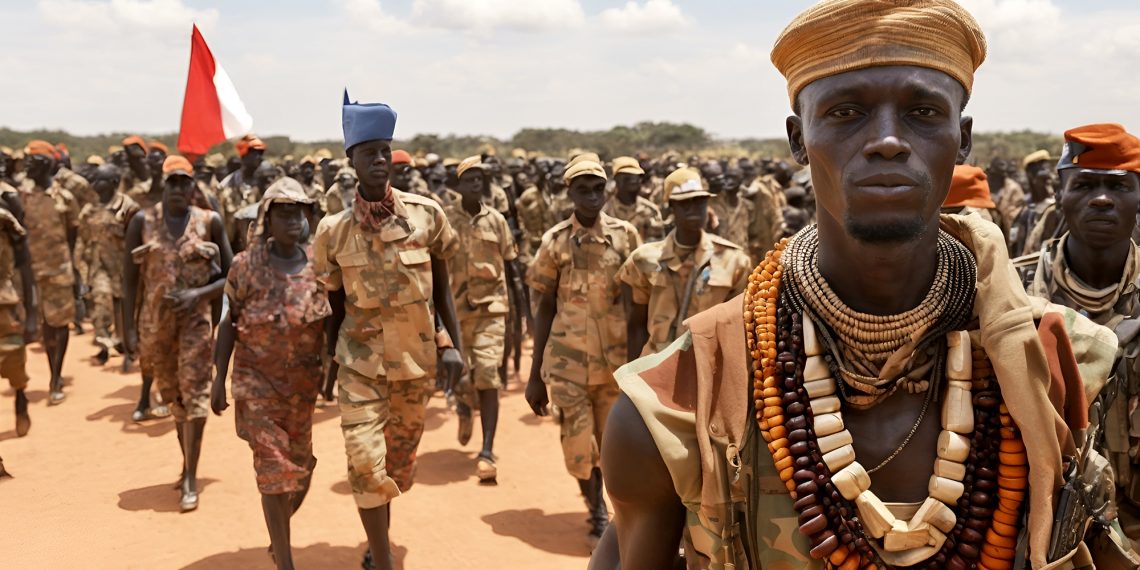
Following the announcement of President Emmanuel Macron on Sunday evening to end the two months arm wrestling fight with the new military authorities in Niamey, Niger. He announced to his fellow citizens on a prime time program during press talk with the two main national networks France2 and TF1, he said, that the French ambassador in Niamey will return to France in the coming hours, and the withdrawal of 1.500 French soldiers based in Niger by the end of the year 2023.
The rise of French anti-sentiment that has enflamed France’s presence and influence in the African Sahel was behind President Emmanuel Macon’s fait accompli complying. This anger and frustration of African masses, elite, and young military leaders and politicians is a part of a broader geopolitics dynamic in light of new geopolitics and economics imperatives and factors that are shaping the sub-regional order. As the emergence of a new generation, civil society, military, politicians, media and intellectual elite has shown its challenge toward the former colonizer who still looks as the sub-region as if it is his untouched back yard!
New challenge
Though there has been noticed that for three decades since France is no longer a solo regional and international power dominant in the Saharan region. Other regional and international actors did demonstrate their influence, becoming direct competitor to France’s national interest and domination; as a result, the thorny equation of dominated-dominator has shifted, creating a new paradigm that Paris did not take seriously until the waves coups strike in Guinea, Mali, Burkina Fasso, and last summer in Niger.
Thus, every French president since François Mitterrand has had rhetorically spoken about the end of Françafrique. Yet, years passed, France-Africa relationship was made up on special interests and influence for the former colonizer, initiating timid economic aid, while massive political, military supports, and protection to African leaders, who mostly acted like real protectors of France’s interest in the region, building up networks driven by strong men of influence and power in the respective capitals of these countries and Paris, installing military bases, and exploring all the natural resources.
Subsequently, the fundamental movement in which has been shaking Françafrique doctrine, leaving the sense that this 1960s doctrine coming to end — almost a quasi-institutional relationship set between large majority of African leaders and the former colonizer in the Parisian elite, political party leaders, and media on one hand, however, in light of the ambiguous relationship post-the coups’ waves that has reshaped the entire paradigm of this relation between France and West and African Sahel countries.
One could argue that education and information have raised awareness to the reality of unequal post-colonial exchanges, the unjust exploitation of natural resources of France’s former colonies in the region.
Failed policy or bad assessment
The failure of Serval and Barkhane Operations in 2013 and 2014, did put in question France’s military capabilities, and its “war on terror” in the harsh African Sahel. In this context French diplomatic and military decline area deal, has left the entire E.U. prestige policy alike in doubt — in the aftermath of the war in Ukraine that has deepened the gap between Paris who to some extent did believe it can continue to dictate its policy to West African and African Sahel countries’ leaders, and eventually masses who did not want to be seen as usual scape goats for a geopolitical fight that don’t have neither a say nor an action.
The decision of the end of Serval Operation, and the withdrawal of Barkhane Operation in 2022, decided by an inexperienced president on foreign policy and defense policy has made an end also to France’s Africa Realpolitik policy of Francois Mitterrand and Jacques Chirac. The French anti-insurgency campaign against supranational terrorist groups in Mali and Niger, which is an endless war like the U.S. war on terror that ended in a fiasco where it started in Afghanistan. So the end of France’s Barkhane Operation in Mali that hundreds of French troops were transferred to Niger, yet, the President Macron’s decision to withdraw his troop form Niger is also the end of the G5 a Sahelian military joint forces composed of Mauritania, Mali, Burkina Faso, Niger and Chad, how much leverage left for this irrelevant military group? None.
The military coups occurred in the region in last three years in the African Sahel has seen France’s military presence and influence as a solid alibi to end. After the obliged withdrawal of French troops from Mali and Burkina Faso, the pended of the 1.500 French troops stationed in Niger raises the question who will fill this security vacuum. Algeria did show its will to help and naturally fill the gap, though emerging regional powers and rising states like Turkiye did also demonstrate explicitly their desire to be a serious player in the new big game that is on the horizon.
Ankara, nonetheless, has been advancing its pawns, positioning itself as a credible partner. Turkiye has been engaging in Africa, using its Humanitarian and Education diplomacy as its African foreign policy determinants — therefore defense and economic cooperation with the new military authorities in Mali, Burkina Faso, and Niger in which for the latter would let Ankara to extend its African Sahel activities via the neighboring Libya that is also Algeria’s national security concern because Algeria does not want to see Libya turns into a failed state of militias’ state.
New partners
Hence, Algeria and Turkiye as new strategic partners both countries have the ability to act as stability forces in a tumultuous region left by the withdrawal of France from the African Sahel, leaving to Russia and China for the former as a military supplier to the new military leaders that would revive the golden age of the Soviet Union influence and the Cold War era. As for China, who sees the region a large lucrative market of investments, thus in this new international and regional unfair game the region is heading — Washington on the other hand, is keeping an attentive eye of Russia and China to contain their influence, an attitude that enhanced the isolation of Paris during its fiasco battle with the military authorities in Niamey, siding in a constructive dialogue with Algiers to push for a diplomatic solution in Niger.
The African Sahel is emblematic of a region suffering from multiple drivers of conflict, threats to stability that have diverse origins and take on many different forms. Radical armed and separatist groups, migrants afflux, cross border smuggling and trafficking networks, add to the challenges posed by extreme poverty and underdevelopment, rampant climate change, and weak governance. The unfolding of instability takes place against the background of a troubling post-colonial legacy.
In sum, France must end its Neo-colonization strategy via discredited leaders, and proxies; if France believes it can stand along in its war on terror in the African Sahel, it did not learn anything from Vietnam and Algeria wars or Afghanistan for the soviet in 1989, and later Iraq and Afghanistan again quagmire for the U.S post-9/11 strategy, but France’s West Africa strategy these days is more about a struggle for an exit and humiliated tragedy.