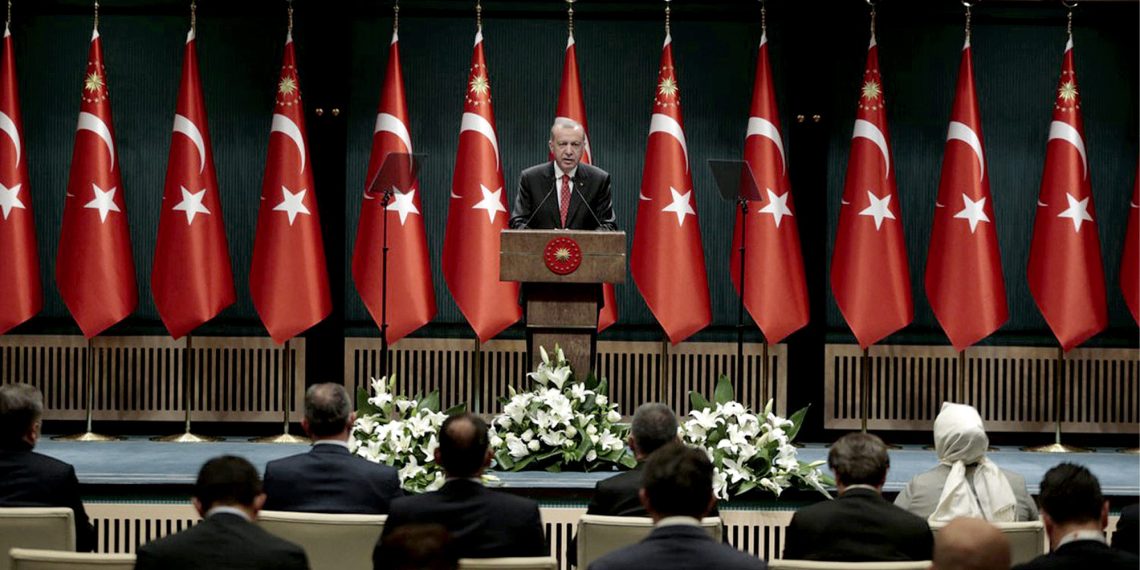
After the first round of parliamentary and presidential election on May 14, 2023 and the second round of presidential election on May 28, the “People’s Alliance” led by President R. Tayyip Erdoğan won both the parliamentary majority and the presidency. After his re-election, Erdoğan appointed new members to the cabinet.
It is understood that the new cabinet has paid special attention to economic and security policies. These issues requiring special attention were analysed in relation to Turkey’s security and foreign policy priorities.
The general situation in the field of economy and foreign policy before the election
In recent years, President Erdoğan has taken the economy as the country’s most important issue and intervened in the economic administration from time to time. Among these interventions, while significant gains were achieved for the Turkish economy on a global scale with examples such as the African opening, Asian opening, etc., the intervention in the independence of the Central Bank and the effort to play with interest rates did not bring the desired success. Instead of falling, inflation rose even more.
Erdogan, who proved to everyone that he is the indisputable regional power of the region by following an autonomous foreign policy despite the pressures and sanctions of the Western allies, especially the USA, and who provided very important services in Turkey’s construction, transportation, education, defence industry and fight against terrorism was able to win the presidential elections only in the second round.
Here the realities of economic science were confronted. When the system was loaded differently, the purchasing power of the people had dropped a lot, in other words, S.O.S. started to be given in people’s kitchens. Especially in October 2021, when the Governor of the Central Bank was changed after a short period of time and the interest rates were played with the middle pillar became poorer before the election and after the election were over, the exchange rates caught fire, revealing that the insistence on this policy was not correct.
In parliamentary systems, diplomatic relations are usually coordinated “single-handedly” through the Ministry of Foreign Affairs, whereas in a presidential system, they are predominantly directed by the President.
With the transition to the presidential system in 2018, the coordination and final say in foreign policy in Turkey has been vested in the President, while technical work can be carried out by the Ministry of Foreign Affairs, the Directorate of National Intelligence, the Ministry of National Defence or even the Ministry of Energy, depending on the situation.
With President Erdoğan, foreign policy was transformed from being coordinated by the Minister of Foreign Affairs to being coordinated by the President’s Spokesperson (Prof. Dr İbrahim Kalın), which the President insisted on.
In this new system, it was observed that sometimes rapid decisions were taken in foreign policy. Although “snap decisions” are not considered acceptable in foreign policy, it cannot be argued that a significant mistake was made due to President Erdoğan’s years of experience in statesmanship. On the contrary, despite the frowns of the allies, the “autonomous foreign policy” was insisted upon and significant progress was made.
New Cabinet emphasises economy and security
On June 3, the cabinet was announced by President Erdoğan himself, and the emphasis on economic and security policies was more clearly visible.
The importance given to the economy in the cabinet can be more clearly understood by the appointment of Cevdet Yılmaz as Vice President and Mehmet Şimşek as the Minister of Treasury and Finance.
As a matter of fact, even before the second round of the presidential election, the expectations that Mehmet Şimşek might be appointed to the aforementioned position or Vice President were enough to mobilise positive developments in the economic market.
The new Vice President and the Minister of Treasury and Finance “speak the same language” on the economy. It is also true that there is a perception that there are authorities who are more or less doctrinised on what needs to be done in order to extinguish the fire in the economy.
In his speech during the handover ceremony of the Ministry of Treasury and Finance Minister Şimşek signalled that the priority in extinguishing the fire in the economy is to correct the household economy and macroeconomic balances together.
MİT Director Hakan Fidan, who was appointed to the Ministry of Foreign Affairs, was in close contact with his predecessor Mevlüt Çavuşoğlu and Minister of National Defence Hulusi Akar. In recent years, it has been openly reported in the press that the MIT Directorate has made significant progress in establishing new diplomatic relations with countries such as Egypt, the United Arab Emirates (UAE) Saudi Arabia, Israel and Egypt, with which there had previously been diplomatic problems. In recent years, a concept called “Intelligence Diplomacy” has even been coined.
In this period, MİT’s work on the first contacts and reconciliation packages in foreign policy brought Hakan Fidan, the head of this organisation, to the position of Minister of Foreign Affairs. Moreover, in some Western and Eastern countries, the heads of intelligence units are appointed to the Ministry of Foreign Affairs.
For example, during the presidency of Donald Trump in the USA, CIA Director Mike Pompeo was appointed as the Minister of Foreign Affairs. In Germany, Klaus Kinkel, the leader of the FDP, who became Foreign Minister during Helmut Kohl’s chancellorship, was previously the head of the German intelligence agency Bundesnachrichtendienst (BND). Yevgeny Maksimovich Primakov was the head of Russia’s intelligence service between 1991 and 1995 after the end of the Cold War and was later appointed to the Russian Foreign Ministry.
Although there were some names mentioned for Fidan’s successor, the appointment of one of President Erdoğan’s most trusted people and someone who is familiar with highly confidential matters related to the state could not be considered a surprise.
This was the case and Presidential Spokesperson Ambassador İbrahim Kalın, who, like other senior security officials, is in close contact with MİT Director Fidan, was appointed to this position.
Yaşar Güler, Chief of General Staff, was appointed as the Minister of National Defence. Yaşar Pasha, who was the Chief of Intelligence of the General Staff between 2011-2013, was later promoted to the rank of major general and served as the General Command of Gendarmerie, the Land Forces Command, the Second Chief of the General Staff, and as the Chief of General Staff since 2019.
During this period, Güler played an important role in the fight against terrorist organisations, notably the PKK, DHKP-C, DAESH (ISIS) and FETO, and his commitment to the democratic legal order was clearly seen during the FETO coup attempt on July15, 2015 and he has become one of the living memories of the state in such counter-terrorism issues, at least as much as Hakan Fidan, the Head of MIT and the new Foreign Minister.
During Güler’s senior positions in the Turkish Armed Forces, while fighting against terrorism on the one hand, military operations were carried out in Syria at the same time, resulting in the largest military mobilisations since the War of Independence.
The “Trench Warfare (Armed Struggle in the City)” with the PKK terrorist organisation in the provinces and districts bordering Syria in the second half of 2015, and the Euphrates Shield, Zeytindalı and Peace Spring operations in northern Syria are the first ones that come to mind. The operations and control points in the Idlib region adjacent to Hatay also took place in the same period.
In the same period, maritime jurisdictions in the Eastern Mediterranean, the refugee problem with Greece in the Aegean, the Second Nagorno-Karabakh War in the Caucasus and finally the Russian-Ukrainian war in the Black Sea, Yaşar Pasha served as the most important advisory authority to President Erdoğan during all these security policy-oriented developments. At least since 2015, he has been one of the state’s most vivid memories at the highest level on security issues that directly or indirectly concern Turkey, and it is highly appropriate that he is the successor of his predecessor Hulusi Akar.
It would not be wrong to say that the Ministry of Interior is the most difficult ministry in Turkey, which has been faced with a complex and numerous set of difficult problems such as the fight against terrorism for a long time, being on the route of drug trafficking between the Far East and Europe, illegal migration and human trafficking in recent years, as well as frequent natural disasters.
Ali Yerlikaya, the Governor of Istanbul, who is known to be able to deal with the same issues, has been appointed to this very tiresome position where sleep and a peaceful day are almost impossible. Having served as a district governor and governor in provinces such as Urfa, Yozgat, Şırnak and Gaziantep in the past, Yerlikaya is a bureaucrat who knows both the field and the functioning of the state in Ankara.
Yerlikaya’s last duty was as the governor of Istanbul, one of the world’s largest metropolises. In such a huge city like Istanbul, with a population larger than that of many countries and even close to the total population of our two neighbours Greece and Bulgaria, he has had enough experience in solving the issues of the Ministry of Interior by facing almost every problem from drugs to human trafficking, from combating terrorists hiding in residential areas to various disasters.
Power gaps in Turkey’s neighbourhood and filling them
In recent years, power gaps have emerged in Libya, the Caspian basin (South Caucasus) and the geography of the Turkic World, as in Africa. Turkey, under the leadership of President Erdogan, took the initiative in Libya and became one of the powers that filled the power vacuum in this country by putting its weight despite the important countries of the Arab League (Egypt, S. Arabia, UAE) Russia and France.
In the South Caucasus, Turkey ensured the resolution of the Nagorno-Karabakh conflict to a significant extent by supporting Azerbaijan at a time when the Pashinyan government in Armenia, which came to power despite Russia at the end of the street demonstrations, was deteriorating its relations with Russia.
Subsequently, he took the wind that he played in the resolution of the Nagorno-Karabakh conflict with him and realised the establishment of the Organisation of Turkic States.
During the Russian-Ukrainian war in the Black Sea, Turkey as a neutral but regional power, put its weight in the Black Sea and filled this power vacuum by making good use of the ineffectiveness of the US and EU countries in the Black Sea. Turkey’s “Black Sea Initiative” was followed with interest and favour in the countries of the region, the Islamic World and Africa.
In the Middle East, which the US dominates with its military bases and arms sales in almost every country except Iran, the success of China’s mediating role in improving relations between Iran and Saudi Arabia has revealed the fact that there is a “power vacuum in the Middle East”.
Particularly during the Cold War, the US used to approach the geographies in which it had a power vacuum with economics. The grants of 3.5 billion dollars to Israel and 3 billion dollars to Egypt during the Camp David Treaty signed between Israel and Egypt in 1978 are the clearest examples of this.
Today, the US does not have any economic contribution in the Middle East, while it benefits from arms sales. On the other hand, the Gulf States, which are prone to trade, adopt China’s pragmatic and “win-win” approach to the region. In fact, China’s economic takeover of Africa has been realised in this way.
While China is progressing in Africa by transforming economic approaches into soft power, African countries, once known as “Francophone” countries and still using the French Franc while France has switched to the Euro, have started to distance themselves from France.
There is also no need for China to provide economic aid to the Gulf States. These countries aim to realise joint economic projects with China. The gap that the US could not fill with military bases has started to be filled with China’s economic policies.
In the near future, the expectation of a Russia-US rivalry in Syria and a US-China rivalry in Iraq is gaining weight.
Turkey’s foreign policy priorities with an emphasis on security policy
The US, which is gradually losing its economic and political power vis-à-vis China, is trying to encircle China on the one hand and weaken Russia economically and politically on the other by taking the EU, NATO and G7 countries with it.
In this situation, the polarization is sharpening and Turkey’s “autonomous foreign policy” (efforts to recognise the independence of the TRNC, remaining neutral in the Russia-Ukraine war despite insistence, open support to Azerbaijan in the Nagorno-Karabakh war, activities in the north of Syria despite the US “and Russia”, some close cooperation with Russia in the energy field and in Syria, etc.) are not approved by its allies and even lead to comments such as “Turkey is changing its axis”.
In this conjuncture where global polarisation is gaining momentum, Turkey’s foreign policy priorities with an emphasis on security policy are as follows:
a. The “autonomous foreign policy”, which has intensified with the presidential system, should be insisted on and this attitude should be established. There may be new attempts to dissuade Turkey in this regard. However, Turkey should not backtrack from this policy, which has made considerable progress.
b. Concentrating the energy on the recognition of the Turkish Republic of Northern Cyprus (TRNC) on the Turkish World, the Islamic World, the Eurasian geography and Africa instead of the US and the EU countries, whose attitude on this issue is known to be negative.
c. Improving relations with Syria, which returned to the Union with the last Arab League summit, is important in terms of border security, being on the trade route with Arab countries and the return of Syrian refugees to their homes.
Detailed cooperation with regional countries (such as the Arab League) as much as possible on the future and reconstruction of Syria is important.
In terms of the developments in Syria’s future, it is important that relations with Egypt and Saudi Arabia reach a level of cooperation and this cooperation can also help to remove the obstacles created by non-regional countries in the problems in the Middle East.
d. No significant improvement is expected in relations with the US and the EU, which insist on not understanding Turkey’s role in European defence and in ensuring the stability of its geography, and Turkey should not waste its energy on the EU’s stubbornness. As seen in the case of Russia and China, EU countries are almost forced to follow US policies.
e. Considering that energy can play an attractive role in relations with the EU, joint projects should be put on the agenda for the transport of Iranian gas, Turkmen gas, Iraqi and other Gulf States’ gas and gas extracted from the Eastern Mediterranean basin to Europe.
f. Natural gas exploration in the Eastern Mediterranean seabed, which has been suspended for some time, should be resumed.
According to the 1976 Berne Convention, seismic surveys are not carried out on the seabed of the international waters of the Aegean.
Considering that the exploitation of oil and then natural gas will be limited in the near future, it is necessary for both countries to come to an agreement in order to benefit from the economic blessings of this seabed as soon as possible. Preferably both countries together, or if there is no agreement, Greece should be persuaded to extract these economic values in partnership with a third party.
g. The establishment of the Turkey-Azerbaijan land/rail line (Zangezur Pass) is very important for the development of the Organisation of Turkic States. In this regard, the necessary support for the normalisation of Azerbaijan-Armenia relations should be continued and both countries should be convinced.
h. Turkey should resist as much as possible, or at least abstain, in NATO’s US-led projects targeting China. Care should be taken not to become a tool in the US-China conflict of interest.
i. Syrian asylum-seekers should be sent back to Syria, and Turkey, which has become a centre for asylum-seekers in recent years, should henceforth pursue a “selective” asylum-seeker policy like countries such as Germany, the UK and the USA.
j. Turkey, which is located in a major earthquake zone, has started to be exposed to natural disasters such as floods, forest fires, climate change, etc. more frequently in addition to such disasters. The establishment of a “Ministry of Natural Disasters” may be useful at least until the urban transformation is completed.
k. As the elections have clearly shown, there is a polarisation in Turkey which is even ahead of the 1970s. It is considered useful to reduce the fever of this polarisation, which is considered extremely dangerous for national unity and national security.