Starting Points:
The discussion of the “Jordanian narrative” could not have passed us by at the Arab Thought Forum without noticing and engaging with it, as it is a matter of belonging and identity, a theme the Forum adopted nearly five decades ago and reinforced through hundreds of fora, symposia, conferences, and intellectual activities. These activities addressed everything related to the essence of Arab-Islamic identity and the authenticity of the Christian presence in Jordan and the wider Arab world. Our most recent focus this year was on “Narratives of Arab Historical Writings,” and we will conclude the year (December 15-16, 2025) with a conference on “The Modern Nation-State: An Arab Perspective,” which, in its essence and objective, aims to weave narratives that accumulate knowledge of the components of the nation’s collective memory. Hence, given my personal passion for history and its narratives, I was impressed by this new Jordanian approach and quickly glanced over two sources; Sima Fuleihan, L. (2011), and Tweissi, B. & Frehat, M. (2016), which I consider important, to form the basis of this article. This serves as a modest introduction to a contribution that I may find time to expand upon in the future.
In the expansive and storied lands of the East, history evolves yet persists in remarkable and profound ways; an era will inevitably conclude, yet echoes of memories will always remain. Across numerous centuries and diverse civilizations, the intricate Jordanian narrative unfolds: a captivating story of continuity and adaptation, of deep engagement and strong belonging, and of a shared collective memory that ties generations together. Between one people and another, across different lands, faiths, and languages, there exists an enduring and vital connection with the earth and its abundant bounty. This bond binds Jordanians together through time into a singular, rich legacy that transcends epochs. Jordanian communities throughout the ages have inscribed their presence upon the landscape, continually writing their stories upon it, shaping its contours into a dynamic living archive. Simultaneously, the landscape and its substance speak in turn, framing and enriching a national biography that is inscribed not just in words but in place itself, a testament to history’s resilience and cultural richness.
The script of a diverse and resilient people unfolds at the early moments of dawn and emerges beautifully with the warming, golden glow of a bright new day. The cherished, treasured remembrances of ancestors are both strikingly vivid and hauntingly faint; the collective memory of this community neither emerges anew with every sunrise nor stands still, but rather pulsates and flows endlessly through time. Jordan’s blessed river, extensive trade routes, and historic migration paths all circulate within a long and rich tapestry of written record; each area of living space tells its own intricate and unique story. The majestic mountains, rolling highlands, vast steppes, and profound depths, along with their inviting and temperate climate, all richly enhance the lives of the inhabitants, these honored highlands of cultural heritage and wealth are where narratives beautifully unfold, laid down firmly in enduring rock, intricately woven within the very fabric of space and time. The names upon names, monuments honoring the many generations, find their voice through the ages.
Prologue: Echoes Across the Desert
In the first half of the twentieth century, the Jordanian narrative, much like the sweeping and overarching story of the entire Arab world; embarked on a significant and transformative new chapter in its historical trajectory. This pivotal moment followed the dramatic dissolution of the Ottoman Empire at the conclusion of World War I, which paved the way for the establishment of the British Mandate for Transjordan. This landmark event marked the beginning of a profound and transformative era in Jordan’s development. Under the visionary and inspiring leadership of King Abdullah I, and later, his son, King Talal I, there was a significant and marked emphasis on the creation and development of modern institutions, solid legal frameworks, and a state that actively embodied the imprint and aspirations of its leaders.
This transformative period spanned from the Rise of the Hashemites all the way to the end of the tumultuous and impactful 1967 Arab Wars, a time that reshaped the region in myriad ways. This historical precedent of state-building; led by the legendary King Hussein and HRH Prince Alhassan, not only left a profound and indelible heritage of struggle, resilience, and determination but also fostered the establishment of vital capacities; the capabilities to migrate, settle, resettle, mingle, and persist in a continuing existence; rests now under the leadership of King Abdullah 2, that has endured for long centuries. In conjunction with the significant establishment of the Nation State of Jordan, a dedicated and passionate Jordanian visionaries made a resolute and impactful decision to create a rich and engaging historiographic narrative of this Journey, showcasing the deep and direct link between the modern Jordanian state and its earliest historical framework.
This concerted effort served as yet another important reminder of the deep and enduring continuity that has existed since the earliest human settlements during the pre-historic eras, even long before the dawning of civilization as we come to understand it today. The clear and distinguishable “Markers of Identity” that date back thirty thousand years provide a fascinating glimpse into the past. Many of these significant markers are meticulously inscribed onto stone and rock carvings, which vividly tag the Route in a recognizable pattern that has continually emerged and re-appeared over countless generations and epochs. These are variations on a common core that encapsulates the enduring spirit and incredible tenacity of the Jordanian people and their rich, multifaceted historical tapestry. It is this vibrant heritage that has influenced and shaped their identity, preserving a legacy that is both profound and inspirational, serving as a testament to human resilience across the ages.
Dawn of Civilizations: Carved in Stone and Spirit
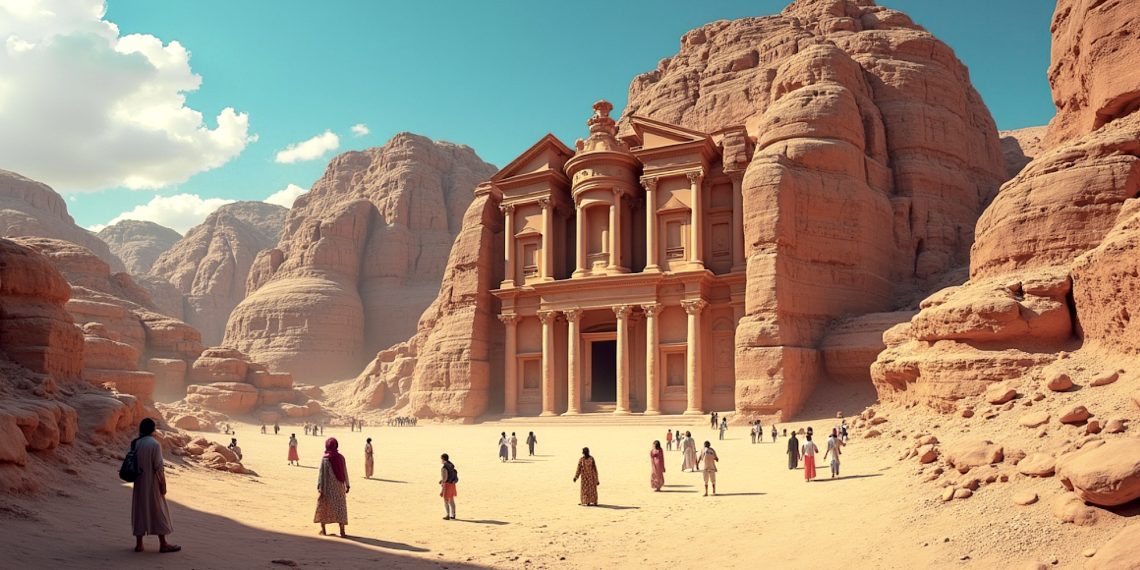
The cultural identity and collective memory of Jordanians are intertwined with the material remains of the first four centuries of the Holocene. Key periods are represented by Neolithic settlements and tombs, Nabatea and Petra, and the Roman Empire and cities like Jerash and Umm Qais. During these epochs, the Hashemite Kingdom of Jordan was not a political unit, but the people who left behind the remnants; significant and ordinary, are ancestors of today’s Jordanians. Recognizable characteristics define artifacts from the period, often linking objects of the same species across time. Unfamiliar symbols, inscriptions, languages, and monumental sites converge at similar points, appearing as messages open to interpretation by later generations of inhabitants, travelers, and visitors. Through resonance and relevance, the messages contribute to the formation of culture, identity, and collective memory.
The Jordan River, the tributaries that feed it and the valley that embraces more than one century of civilization, framed by fertile mountains, served as a corridor of intellectual and commercial exchanges for millennia. Other crossing routes, north-south and east-west, joined with the river and its tributaries to establish the Hashemite Kingdom of Jordan as a crossroads for beliefs and religions, allowing for convergence and syncretism. Pilgrims of the monotheistic faiths made their way through Jordan; the prophets and apostles travelled, preached, and delivered their messages; Saint Paul reached the heart of the Roman Empire, while the Prophet Muhammad ended his journey. The travels of the people of Jordan back and forth along these routes contributed to their cultural identity, the construction of their values and ethics, the shaping of their Jordanian narrative, and the formation of greater Jordanian memory. The ability to move helped create a national identity.
Rivers, Trade Routes, and Crossroads of Faith
The waterways that cut through the landscape and the trade routes that run alongside them have historically served as conduits for ideas, goods, beliefs, and ways of life; narratives that continue to unfold. The Jordan River and its tributaries have long provided the basic element of life for those who live in their vicinity. The coming and going over the ages of people guided by the currents of the river, whether Jews crossing from Babylon, Christian pilgrims, or Muslims making their hajj to the holy cities of Mecca and Medina, has added spiritual dimensions to this plain stream, reducing it to more than a line on the face of the map. The Old Testament not only recalls key moments in the history of the Christians but gives the river a special richness for both Jews and Arabs; not forget Islam. Three sources of spirituality converge over the river and its basin: the life-giving waters of the stream and the beliefs, and feelings these inspired.
Throughout the vast expanse of the land, alongside the winding river, there exists the ancient silk route along with its numerous branches, which have intricately dotted the landscape with a multitude of cities, vibrant towns, and quaint villages. This network has facilitated a continual flow of people and goods, alongside the exhilarating exchange of gossip, knowledge, and adventurous tales that those journeys have disseminated across regions. Here, words can be heard in countless dialects and diverse tongues, while goods and wares range from the simplest and most practical items to the most luxurious and ornate. Rich traditions and customs have been borrowed from the East, West, North, and South, melding into a beautiful mosaic. Additionally, the myriad inspirations drawn from the many religions, whose sacred sites and symbols are interspersed across the land, have all intertwined to become essential elements of the Jordanian heritage; a remarkably syncretic heritage that reflects the diversity and rich tapestry of cultures.
A People Shaped by Land: Memory, Land, and Identity
The Jordanian Narrative unfolds as a reflective, character-driven journey that blends memory, place, and history with emotional resonance and lyrical detail. The various historical epochs are defined by the prevailing governance, reflected in the architecture and heritage sites that have survived from each period, and the recollection of these successive civilizations constitutes a vital element of collective memory. In the regions chronologically corresponding to the broader historical narrative of Jordan, the same exploration of land, history, and identity unfolds through personal recollection and observation of the everyday rhythms of agrarian life and social interaction, intertwined with the imprint of the various civilizations that have passed through. Personal experience of the local landscape provides a complementary lens to the journey in wider Jordan, sharpening awareness of the evolving interplay of land and identity.
The people of Jordan have remarkably retained their deep connection to their ancestral land, even as their modes of life have undergone significant changes over time. Throughout the vast expanse of history, the population has consistently moved from one form of livelihood to another, sometimes experiencing these transitions very rapidly and with little warning. The common ground shared by different groups, along with the various transitional phases that have occurred along the long journey from the past to the present, have thus become crucial and indispensable elements for preserving the intricate social fabric of Jordanian society. This ongoing and enduring commitment to the land, characterized as an evolving identity that unfolds in a continuous exploration of self and community, remains nonetheless an important and integral part of what it means to belong to this rich heritage. The ability to adjust to these multifaceted changes without losing the deep attachment to the land and a coherent sense of self remains vital to the complex Jordanian identity. In this context, land, memory, and identity form a profound triptych that perpetually continues to shape and influence the distinctive Jordanian character as it navigates the challenges and opportunities of modernity.
The Jordanians Today: Continuity and Change
The current Jordanian population is clearly marked by a rich and remarkably vibrant diversity; despite the numerous and significant changes experienced in the political climate as well as the prevailing social status quo throughout the years, the overwhelming majority of modern-day Jordanians continue to remain deeply connected with their unique identity, their cultural heritage, and the land they call home, which holds a special place in their hearts. Meanwhile, the intricate process of modernity has placed Jerusalem at a significant juncture of high transformation and continuous evolution. This ongoing transformation not only influences the immediate surroundings and the environment but also resonates deeply with individuals from various backgrounds and communities, reinforcing the vital ties they have with their shared history and the broader region of the Middle East. This connection highlights and underscores the importance of preserving cultural traditions while effectively navigating the complexities of modern life. As Jordanians persist in adapting to the evolving world around them, their commitment to their roots and customs remains steadfast, creating a unique tapestry of experiences and memories that shapes their collective identity.
One can delve into the constantly evolving and intricate nature of the blended society from a variety of perspectives, whether viewed from the outside-in or seen from the inside-out. This exploration involves examining the favorable beaches that are frequently visited by migrants, which serve to establish vital connections or invaluable bridges among the diverse and multifaceted communities that inhabit this space. Furthermore, it becomes possible to intricately outline and meticulously map out the lived experiences of individuals in a manner that seeks permanence and depth. Jordan, due to its strategic geographical positioning, has provided a unique environment that emphasizes pre-navigation while simultaneously enabling mobility for its inhabitants. In this rich multidimensional space, people not only traverse the varied landscapes of their surroundings but also actively engage in intersecting narratives that weave together their stories and lived experiences along intertwined shared histories. This interplay not only highlights their individual journeys but also reflects the broader tapestry of culture and community that shapes and inspires them.
Narratives of Resilience: Stories Beneath the Olive Trees
In “Haret Ebb Wi Esh”, the summer wind gracefully wraps itself around the generations that have lived and thrived within the tall trunks of the ancient olive trees, as they sit knee-deep in the rich and intertwined stories of “Haret Ebb Wi Esh”. Such stories are synonymous with this small and vibrant village of “Haret Ebb Wi Esh”, a quaint village that has long served as home to countless families who have fought and valiantly resisted through the ages along the borders of the fertile land, all under the protective embrace of the tall and unpredictable trees that stand guard over their lives. The stories here are lovingly told by the trusty hands of Haret Ebb Wi Esh’s skilled artisans, weaving narratives that connect the past to the present; they are recounted by Haret Ebb Wi Esh’s hardworking farmers as they sow seeds and later reap the fruitful harvest from their cherished family lands, a process and tradition painstakingly passed down from their ancestors through generations; and they are recounted by the families who have always been part of this tapestry and who share a bond that runs deeper than blood, forming an unbreakable connection that enriches their lives and nourishes their spirits.
From Haret Ebb Wi Esh, the warm summer wind continues to sweep through the expansive and picturesque Jordan Valley, travelling along with the heartfelt stories told by the diverse families who inhabit this beautiful area. Haret Ebb Wi Esh is not just a place; it is enclosed and surrounded by the rich tapestry of stories woven by these families, serving as a powerful reflection of what they have endured and experienced throughout the many years. These narratives reveal the profound hardships of the land, the ongoing conflict, the unwavering resistance, the persistent hope, the remarkable perseverance, and, of course, the endless humor that punctuates their lives. All these stories are different reflections of a shared experience, branches of the same mighty tree, with roots buried deep inside the complex history of the land itself. The identity of these families has been profoundly defined for them by its rich and sometimes tumultuous history, and in their deep-seated awareness of the past lies their hope for a brighter future. They shape that future through their cherished memories and steadfast resistance, further enriching the stories that continue to flow like the wind, intertwining their lives with the very essence of the land they call home.
Guardians of History: Museums, Monuments, and Oral Tradition
Most of the natural and monumental treasures of Jordan experienced significant neglect during periods of history. This neglect can largely be attributed to the complicated and turbulent political situation in Palestine, which made it exceedingly difficult to adequately address or engage with the subject of Jordan’s rich cultural heritage. In the aftermath of World War II and with the establishment of UNESCO in 1946, Palestine was fortunately placed on the prestigious list of twenty sites recognized as deserving of immediate global attention. However, despite this positive recognition, Jordan unfortunately remained largely absent from the broader world narrative concerning cultural preservation and heritage conservation. The turning point for Jordan came following the tumultuous events of the 1967 Israeli-Arab war, which led to the introduction of the Department of Antiquities. Through this introduction, Jordan began to subtly yet effectively enter into a modern directive aimed at the emergency preservation of its previously neglected cultural heritage. It was during the 75th anniversary celebrations of the Department of Antiquities and the National Museum of Jordan that significant discussions took place. A remarkable special session, entitled “Currents in Cultural and Museum Policies in the Middle East”, was held, offering a valuable opportunity to map out the brief yet impactful history of the Jordanian national museum, along with its ambitious goals and diverse interests. The emphasis of this session was placed firmly on changing directions and exploring new orientations within the framework of cultural policy, while also discussing important recommendations and innovative cooperative strategies. One of the reintroduced themes that surfaced during these discussions focused particularly on the essential memory of oral history and its critical role in the formulation of a cohesive national narrative. This narrative was seen as evolving within a broader and immensely richer cultural scope. It is important to recognize that much of the institutional history, along with the accumulated oral testimony regarding this heritage, remains untapped and underutilized. Chosen extracts and notable names related to this heritage are often borrowed from a variety of visiting study tours, enriching the understanding and appreciation of Jordan’s cultural landscape. The fragments of history and the imaginative additions made to them by multiple owners and storytellers collectively constitute a timeless yet ever-changing narrative, one that stretches back to the very origins of the earth itself. Unless otherwise indicated, it is essential to note that the messenger conveying this rich cultural narrative remains anonymous, as does the narrative itself, which continues to evolve and adapt with the passage of time.
The Jordanian Narrative in Global Conversation
The Jordanian narrative firmly and unequivocally establishes its vital role and profound significance in the ongoing global conversation that spans across a remarkably wide variety of arenas and domains. This narrative not only holds a profound relevance within the broader framework of regional history but also showcases its extensive global significance in numerous contexts. Additionally, it claims an important and meaningful space in the rich and diverse intercultural dialogues that encompass various forms of art, literature, and diplomacy, making it a crucial contributor to these exchanges. Moreover, it thrives and flourishes through cultural exchange, which is an essential process that significantly enhances, enriches, and deepens the appreciation of local forms and expressions. Such interactions promote a greater understanding of cultural diversity, fostering mutual respect and collaboration among different cultures around the world, thus highlighting its enduring importance in both local and international spheres.
Jordan occupies a privileged position in the complex historical tapestry of the Middle East, linking the Mediterranean and the Gulf and at the heart of regional and global events. Its geography places it at the crossroads of diverse peoples, languages, and faith. As a result, many of its narratives resonate widely within Jordan, in neighboring Arab countries and beyond, and among broader international audiences. Several factors shape cultural production through the lens of Jordanian identity and a diverse array of contributors stimulate, curate, and amplify global dialogue. Intercultural engagement takes place at many levels; one-to-one exchanges, institutional collaboration, and the multifaceted networks of scientific research. These activities reflect a longstanding vision of Jordan as a mediator and conduit for the Arab world.
Artistic collaboration provides powerful opportunities for dialogue among cultures and civilizations. The Al-Balad Theater in downtown Amman, for example, regularly hosts initiatives that, while explicitly addressing regional issues, underscore universal contexts and encourage the exploration of common ground. When the Jordanian theatre collective Al-Balad participated in a series of performances, discussions, and workshops to address the aftermath of the Arab Spring, participants dedicated considerable time to seeking out trans-cultural themes relevant to the broader human condition. Similarly, Film Idea and the Royal Film Commission host an international artists’ residency for filmmakers to exchange ideas, test concepts, and forge partnerships. Outside institutional frameworks, independent foreign artists; including musicians, dancers, and surrealist painters—ventured to Jordan to explore cultural heritage, architectural spaces, and desert landscapes. Artistic initiatives, far from confined to the visual and performing arts, also extend into the domains of literature and translation.
Challenges on the Horizon: Preservation and Progress
Jordanians share a tense concern for the state of both tangible and intangible heritage: sites, structures, languages, practices, memories. While still abundant, sites and languages are shrinking and becoming popular touristic destinations. Interventions of urbanization do not always consider no-structures areas of heritage and local activity. Local community initiatives react as sort of defensive effort to conclude a more comprehensive valorization of heritage fulfilled by educated people half in interest with their history and half in creating a Euro-style journey destination for tourists, but at the present too culturally ambiguous to have a real potential. No walls, no buildings, no wars closely surround and condition the daily life and the private desires of the Jordanians. Life; in its authenticity, change, hope, and distress, grows cocooned among olive trees.
How to preserve the memory and the embodiment of this reality? The reflections and one-kilometer journey started more than three years ago after an album of black-and-white photographs inserted in the last scholastic memory of a cousin; it allows an interpretation of those last black-and-white photographs and a vision and memory reconstruction of those very close, simple, and naïve faces from which life and dignity emanated in looking at the lens. Is it interesting to find out what is going on in the same places, very close to the same society still doing the same activities, much more for the response of life than the value of the break point on the photograph? An album may be found for every family, with very close memory and identity, and use the photograph to find the hidden part of the story, but this time not with the aim of looking for a new beginning but simply for coloring back the story that continues to be and is going to form.
Doesn’t the album of life truly deserve as much thought, dedication, and effort as the cherished album of memory? A more complete and deeply profound “Yā Bānā Level Three” project has the potential to exceed mere surface-level approaches. This shift allows the project to avoid falling into the trap of being just another initiative aiming to create something limited or two-dimensional in the context of Jordanùa, where the Euro-centered journey often serves as a final destination. Instead, it can transform into a genuine, effective working tool for young Jordanians. These individuals are often half-passionate about their rich history and simultaneously engaged in a searching process; a quest for a path rooted in tradition, which can often feel surprisingly distant from their contemporary identities and more practical outlook on life. This project can facilitate the very proud movement that engages them in discovering the past through their photographs, providing a meaningful connection between their heritage and the present.
Epilogue: A Living History, A Shared Future
Nine decades; perhaps even nine centuries, have passed since the deeply thoughtful intellectuals immersed themselves in the profound contemplation of Jordan’s rich and intricate historical continuity and the inevitable transience of life, which has been intricately shaped by various forces but ultimately remains beyond human grasp and complete understanding. Gazing into the distance, however, through the vivid lens of memories and echoes of the past, vibrant and compelling stories begin to form, waiting patiently for sharing and connection, yearning to unfold and resonate with those who seek to appreciate the depth and the beauty of this extraordinary heritage. These narratives are like threads weaving the fabric of time, drawing together diverse experiences and emotions, creating a tapestry rich in culture and significance.
For example, “Yaa Shaykh, thus began the tale: ‘From Ar-Ramtha, a small and serene enclave, remarkably preserved from the relentless march of time, behold the ancient Nablus olive trees, vibrating with still-cherished past joys and sorrows that echo through the ages. Delegates at Jerash stand proudly under a firmament that is uniquely their own; the exquisite Madaba mosaic conveys a sense of closeness and unity among those who gaze upon it; at Al-Maghtas, the venerable Baptist calls out from the depths, his voice reaching into the hearts of those who listen; at Ma’in, the sweet petrichor beckons travelers and wanderers alike to pause and inhale the fragrant air; handwoven Axis-Mundi carpets cradle dreams and aspirations for far-off places like Mecca, Baghdad, Cairo, Beirut, and Amman, and the soft rajab mittens shade weary pilgrims as they journey en route, seeking solace and renewal…’”
‘Now unveils a different tale: ‘The Sanam entrance prominently embraces the vibrant city of Alexandria, a location renowned for its rich history and cultural diversity. Here, friend and foe alike gather with the Nabatean caravan soldiers, sharing meals filled with fragrant spices, exchanging tales of adventures and misfortunes, or facing death together in the shadow of shared destinies, while the echoes of the Via Nova Traiana resonate once more in its intricate mosaics, which symbolize the intertwined fates of the people. And here is you, an integral part of this living, breathing history, standing amidst the confluence of past and present!!! You witness the remarkable blend of cultures and traditions all converging at this historical crossroads, where every face tells a story waiting to be discovered and every corner is steeped in profound significance, inherently inviting you to delve deeper into its layered past, beckoning those with a thirst for knowledge and understanding.’
‘The story that captivates and engrosses us today reveals a wonderfully fascinating and intriguingly complex tale behind it: “Without a shadow of a doubt, there is indeed one and only one Jordan!” This truly unique and exceptional individual, whose remarkable and dynamic presence is undeniably felt by every single person who has the distinct privilege of knowing him, stands out in every conceivable way imaginable, leaving an indelible and lasting impression on everyone who has the good fortune to encounter him in any context or situation of life. His distinct character, captivating charm, and exceptional, engaging personality resonate deeply within the hearts and minds of those around him. This ensures that he is not only remembered fondly but also cherished deeply by all who cross paths with him throughout their lives, creating bonds that are cherished and held close in the hearts of those who have the honor of connecting with him, making his impact on their journeys truly unparalleled and profoundly significant in ways that are often hard to express but are always felt with sincerity and warmth.’
Such memories, along with the cherished recollections of these significant historical sites, alongside the breathtakingly expansive landscapes that surround them, together with the countless future generations yet to come and experience the wonders of this land, in conjunction with all of Jordan’s remarkable and significant living sites, serve to weave a rich tapestry of cultural heritage. The dedicated museum workers of today play a vital and integral role in this narrative; they are the storytellers of this remarkably diverse land. Their dedication and commitment, along with the memories of the countless generations that will follow us in time, overwhelmingly confirm that Jordan, indeed, is destined not only to become but also to remain one cohesive and unified entity. This entity is rich in culture and history, a vibrant tapestry that speaks to the heart of the nation. This is a fact, a profound truth, that both story-tellers and the Jordanians throughout history, alongside today’s society, along with the unfolding narrative of history itself, eagerly and resolutely affirm, embrace, and celebrate with immense pride and enthusiasm.
Conclusions:
The Jordanian Narrative powerfully affirms a rich and vibrant collective historical legacy, illustrating a profound and enduring relationship to the land that is marked by continuity, resilience, and adaptation over the ages. This reflective journey intricately blends both communal experiences and personal memories, capturing an ever-evolving identity that is continuously shaped by the defined rhythms of existence throughout the course of history. Such a dynamic and multifaceted legacy remains not just vital for Jordanians but is also immensely significant for understanding global history and the intricate interconnectedness of various cultures across the world. This narrative strongly emphasizes the importance of remembering, honoring, and learning from the past while simultaneously adapting to the myriad future challenges and opportunities that inevitably arise in our rapidly changing world.
The comprehensive and detailed analysis of site distribution, as well as monument preservation, strongly affirms and highlights our shared national heritage. These specific and significant narratives invite us to reflect more deeply on the intricate and multifaceted nature of both personal and collective histories, thereby nurturing and fostering a profound sense of intergenerational continuity and connection among diverse communities. The vital transmission of memory, when combined with the preservation of material artifacts, remains firmly grounded in a living and dynamic presence that resonates through time. This vital connection ensures that the past continues to play an important and influential role in shaping what is yet to come in our shared journey, offering guidance and insights for future generations as they navigate their own paths.
At the profound epilogue of Jordan’s reunion with Arab, Islamic, and human destinies, the intricate narrative reveals itself within the broader circuits of a shared collective experience that transcends any single realm or discipline. This deep connection is inseparable from an active future; an idea that is neither a heavy burden to resolve nor merely an asset to extract for immediate gains. Instead, it represents a complex and vibrant fabric that weaves together diverse threads and intricate patterns into mutually enriching stories that not only shape the present but also thoughtfully craft the voice of tomorrow in a harmonious manner. The ongoing interaction among individuals and societies forms a rich tapestry overflowing with potential and interwoven possibilities, inviting all to actively engage in the creation of shared aspirations, dreams, and meaningful endeavors as we navigate the endless paths of existence together; acknowledging that every interaction, no matter how small, contributes to the larger narrative of collective progress. This journey is not one of isolation but rather an embracing of the collective spirit that binds us, reminding us that our fates are intertwined, and each step taken together resonates within the continuum of our shared histories.
References:
Sima Fuleihan, L. (2011). Urban Nomads of Petra: An Alternative Interpretation of the Bedoul Bedouin’s Relationship with History and Space. [PDF]
Tweissi, B. & Frehat, M. (2016). The Media and the Path of Building the State of Jordan: An Analytical Study of the Transformations of Identity and Society. [PDF]
Thursday, December 11, 2025
Amman, Hashmite Kingdom of Jordan