The city of Tyre carries upon its land nearly five thousand years of accumulated human memory. It is one of the cities that helped to shape Mediterranean and world history, and one of the ports through which trade, knowledge, and cultural symbols travelled across continents and peoples. From this shore, ships sailed towards Cyprus, Greece, Carthage, the coasts of Europe, and North Africa, carrying commerce, ideas, and forms of human exchange. From this city emerged names that became part of the world’s collective memory, such as Cadmus, associated with the transmission of the alphabet, Elissa (Dido), the founder of Carthage, and Hiram, whose name is linked to one of the most flourishing periods of the ancient Near East. Within its harbours, ruins, and neighbourhoods, the layers of Phoenician, Roman, Byzantine, Arab, Mamluk, and Ottoman civilisations stand side by side. Its stones tell the story of humanity building cities, ports, markets, and networks of communication and knowledge. Its streets and quarters preserve successive layers of human time, accumulated generation after generation, until Tyre itself became a living record of humanity’s journey across millennia and an integral part of our shared human heritage.
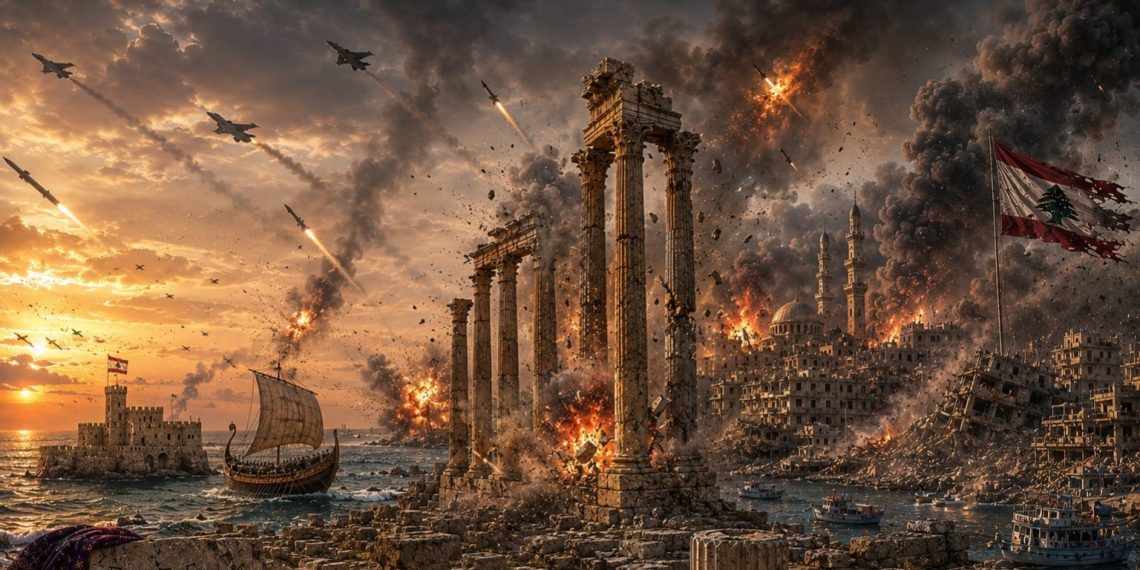
Today, the city of Tyre enters a cycle of destruction, displacement, and erasure before the eyes of the world. Within the cold language of justification — phrases such as “military escalation,” “improving negotiating leverage,” “exchange of messages,” and “balances of power” — an entire chapter of human experience disappears from view. A city that contributed to shaping Mediterranean civilisation is reduced to raw material for geopolitical analyses revolving around influence, deterrence, and strategic calculations. The harbours that once carried the alphabet, commerce, and knowledge across the Mediterranean are transformed into points on military operational maps. Streets that accumulated centuries of life, memory, and human experience become objects within a technical discourse that measures places and people according to the logic of power and domination alone. A history stretching back five thousand years finds itself confined within the vocabulary of an age marked by organised destruction, while the city continues to hold within its fabric a vast archive of civilisations, cultures, and human experiences that helped to shape the world as we know it today.
From this perspective, the issue transcends the boundaries of war itself and becomes a question about the meaning of contemporary civilisation: a question about the place of memory, the value of history, and the image of the human being in a world governed by power. The city of Tyre reveals a profound crisis within a civilisation that celebrates humanity’s cultural heritage and historical experience, and fills its discourse with concepts such as shared memory and global heritage, while the very forces that claim progress and leadership remain engaged in continuous wars that engulf human beings, places, time, and history alike. In this process, cities that have carried the memories, experiences, and civilisations of peoples across thousands of years are transformed into open arenas of destruction, erasure, and displacement. For this reason, the case of Tyre extends far beyond that of a Lebanese city facing danger. It is a question of civilisation, memory, and meaning. It is the story of a city that contributed to the making of human history and carried, across millennia, the journeys, dreams, knowledge, trade networks, myths, and accumulated experiences of countless peoples. The call to protect Tyre therefore carries a significance that goes far beyond the preservation of buildings, streets, and archaeological sites. It is a call to safeguard a portion of the memory that helped to shape the modern world, a portion of the history taught in universities, and a portion of the civilisation celebrated by museums and international cultural institutions. It is a call addressed to universities, research centres, cultural institutions, international organisations, and to all those who speak in the name of civilisation, humanity, and world heritage. For what is taking place in Tyre touches the very memory they claim to defend, the values they profess to represent, and the image humanity holds of itself, its past, and its future.
The protection of Tyre carries significance for the future of humanity itself. Every expansion of impunity enlarges the space of danger facing human beings, history, and civilisation. Every growing familiarity with scenes of destruction and erasure paves the way for a broader acceptance of the collapse of the standards and values that humanity has accumulated over centuries. Every silence in the face of the uprooting of a city that embodies such profound historical depth grants greater authority to power over memory and greater capacity for domination over the meaning of history, humanity, and civilisation. Tyre today stands on a fault line between memory and oblivion, between civilisation and barbarism, between a world committed to safeguarding its human heritage and a world that consumes that heritage under the weight of power. What is being decided in the fate of this city extends far beyond the boundaries of a Mediterranean coastal city. It reaches a question that confronts the entire world: What meaning remains for civilisation if it loses the ability to protect the cities that helped to create it? What meaning remains for human memory if its greatest repositories become vulnerable to erasure? And what future awaits humanity if impunity becomes the norm, historic cities become targets, and human history itself becomes subject to destruction? To save Tyre today is to defend a part of the world’s memory, a part of its humanity, and a part of its future.