This analysis examines the scale of military operations and the number of victims of attacks carried out by the Islamic State in several countries. The analysis is based on statistical information published in the weekly newspaper Al-Naba during January 2026. Occasionally, data published by the organization over a period of more than a month is also analyzed, as it reveals the extent of the security and military activity carried out by the organization in the cities and provinces of those countries. Often, we cannot verify the accuracy of what the organization publishes in its military statements.
However, it can be said that the statistics regarding the number of operations and the extent of material and human losses are largely accurate. Sometimes, the organization exaggerates the figures for material losses, which is typical for armed groups. Therefore, these figures can be used to infer the organization’s effectiveness and the extent of its global reach from the indicators we have compiled.
Our sample consisted of four issues of the weekly newspaper Al-Naba’ during January 2026, starting with issue number (528) and ending with issue number (531).
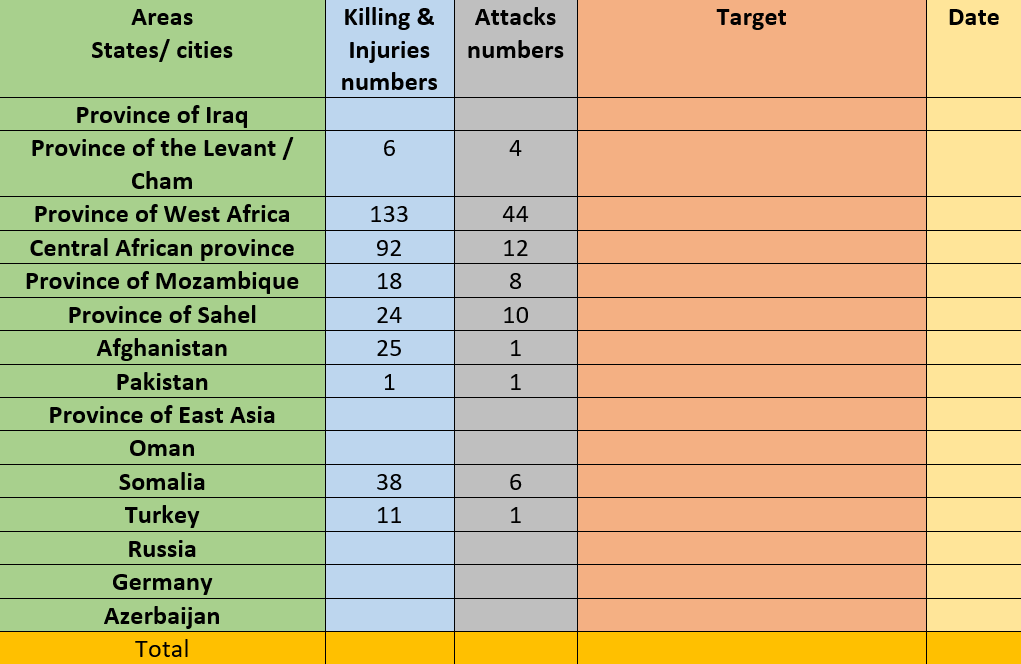
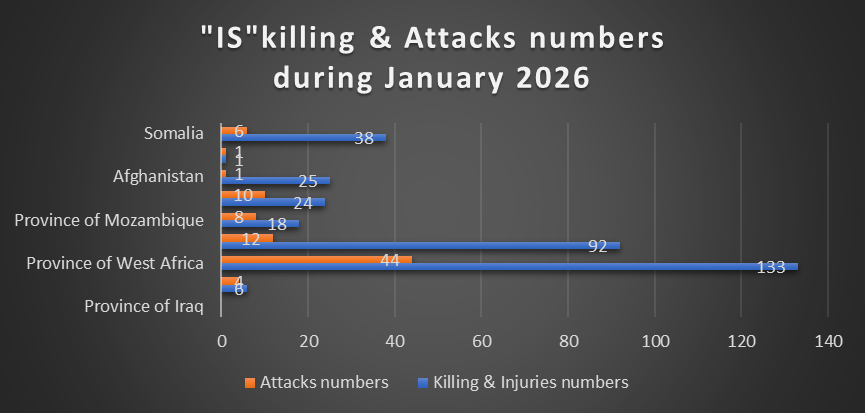
The following table and diagram show statistics that include a number of casualties and casualties in cities and towns that witnessed military operations practically and currently by the organization:
A statistical analysis report on attacks, deaths, and injuries by region
This report reviews data related to attacks, deaths, and injuries distributed across several regions and countries. The numbers refer to geographic ranges extending from the Middle East to Africa, Central Asia, and the Indian subcontinent. Based on the given table, the numbers will be analyzed, different regions compared in terms of number of attacks and human losses, and basic observations made.
The countries in which the organization previously carried out military and security attacks have not witnessed any operations since the beginning of the year: Russia, Oman, East Asia, European countries, America, Azerbaijan, and Iran.
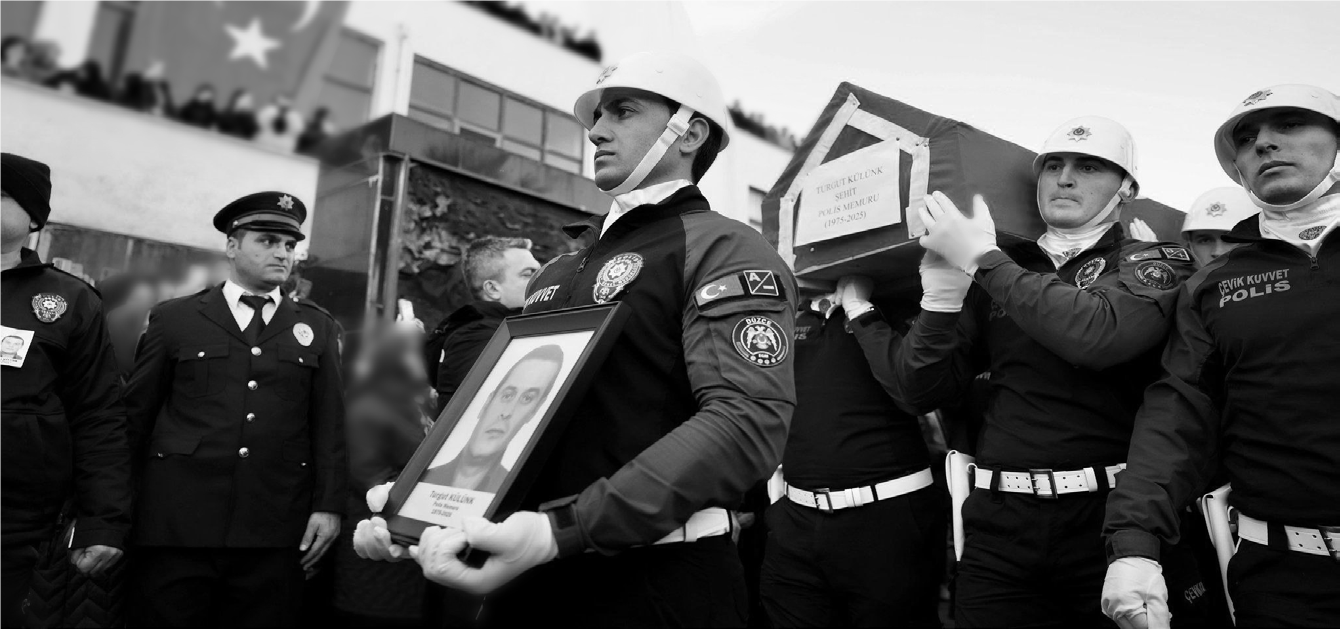
The “IS” carried out a clash with the Turkish army and security, northwest of Turkey, near the village of “Ilmalik”, in the “Yalova” region, located on the coast of Marmara. The clashes took place during the Turkish authorities’ attempt to arrest a cell belonging to the organization inside the country. They were inside a residential apartment and refused to surrender themselves. The clashes continued for six hours, as the Turkish forces in which the army, police and security services participated killed the six suspects. The number of wounded was not announced by the Turkish government. The dead were members of the Turkish police and army.
Iraq did not witness any attacks by the “IS” during January, and the process of transferring prisoners who were inmates in prisons supervised by the SDF will constitute a major legal and security challenge in the next stage, especially since most of them have spent long years in prisons since 2017. Here, will the foundations of justice and the right to defend the charges against them be taken into account during the trials for most of these inmates, and if the sentence of some of them ends, where will they go? To their countries or remain in Iraq under security supervision and house arrest?
In Syria, the organization continues to target the “SDF” forces through operations directed at the “SDF” forces in Deir ez-Zor and its countryside, and the continuation of the military campaign “in retaliation for the horror camp” targeting these forces, and members of the Syrian army, where (6) people were killed in the attacks during the month of January as a result of (4) attacks, and most of the attacks were concentrated in Deir ez-Zor, Al-Hasakah, and Raqqa, and often target the presence of these forces in the border areas and the main roads used to transport support. The organization claimed that three members of the Syrian army were wounded east of Aleppo on the Aleppo-Raqqa road, near the village of “Duirina.” Machine guns were used to carry out the attack.
One of the important developments that Syria has witnessed is the defeat suffered by the Syrian Democratic Forces and their withdrawal from the areas under their control within Syrian territory, including prisons, government centers and oil fields, where they left for the areas east of the Euphrates. However, this does not necessarily mean the end of the SDF problem, as it is still present in Ain al-Arab, as well as in several locations, and there is still a movement that refuses to integrate with the Syrian government, so the government gave it two weeks to decide to integrate it within state institutions and hand over weapons, or we will witness the return of the SDF. Clashes in areas where SDF is present.
The other development is the decision taken by the United States of America, in cooperation with the Iraqi and Syrian governments, to transfer inmates from prisons that were controlled by the Syrian Democratic Forces (SDF), especially those accused of belonging to the “Islamic State” organization, as well as taking control of the Al-Hawl and Al-Mawj camps. Here we must point out that the interim role and composition of the Syrian Democratic Forces contributed to the United States of America abandoning it, not to mention the refusal of the incubating environment to support it. This is what is usual in such a case of movements that arise on a political and military basis of interest. Their end comes with the end of the role they were playing, and the SDF missed a historic opportunity to be part of the new Syrian government, which is the only option left to it.

In the same context; The US Central Command (Centcom) carried out an air strike in northwest Syria on January 16, killing an Al-Qaeda leader, who had direct ties to the person responsible for an ambush that killed two American soldiers and an American translator on December 13, 2025. Abu Hassan Al-Nuaimi is considered one of the media leaders in the “Guardians of Religion” organization, and the United States of America continues to pursue the organizations’ members and leaders. Jihadism does not care about announcing its dissolution.
It was noted that the volume of military operations inside Syria declined during the month of January, after the organization received several strikes by warplanes on several potential targets within Syria.
In West Africa, the organization carried out several attacks and bombings, in various regions in Nigeria and Cameroon, including (11) villages distributed in “Adamawa”, “Yobe” and “Borno” in northern Nigeria, and “Maroua” in the far north of Cameroon.
These attacks in various West African countries amounted to about (44) attacks, resulting in the death and injury of (133) people, a three-fold increase from last month, and several vehicles and motorcycles were destroyed and damaged.
The organization still considers non-Muslims from Cameroon, Nigeria, and other African countries as legitimate targets, and they cannot avoid the organization’s attacks (whether by killing or burning homes) except by converting to Islam, or paying the jizya to the organization’s representative in West Africa.
In Central Africa, the organization carried out several attacks targeting Ugandan and Congolese forces and their affiliated militias, amounting to (12) attacks, which resulted in the killing and wounding of about (92) people, and the burning of dozens of homes.
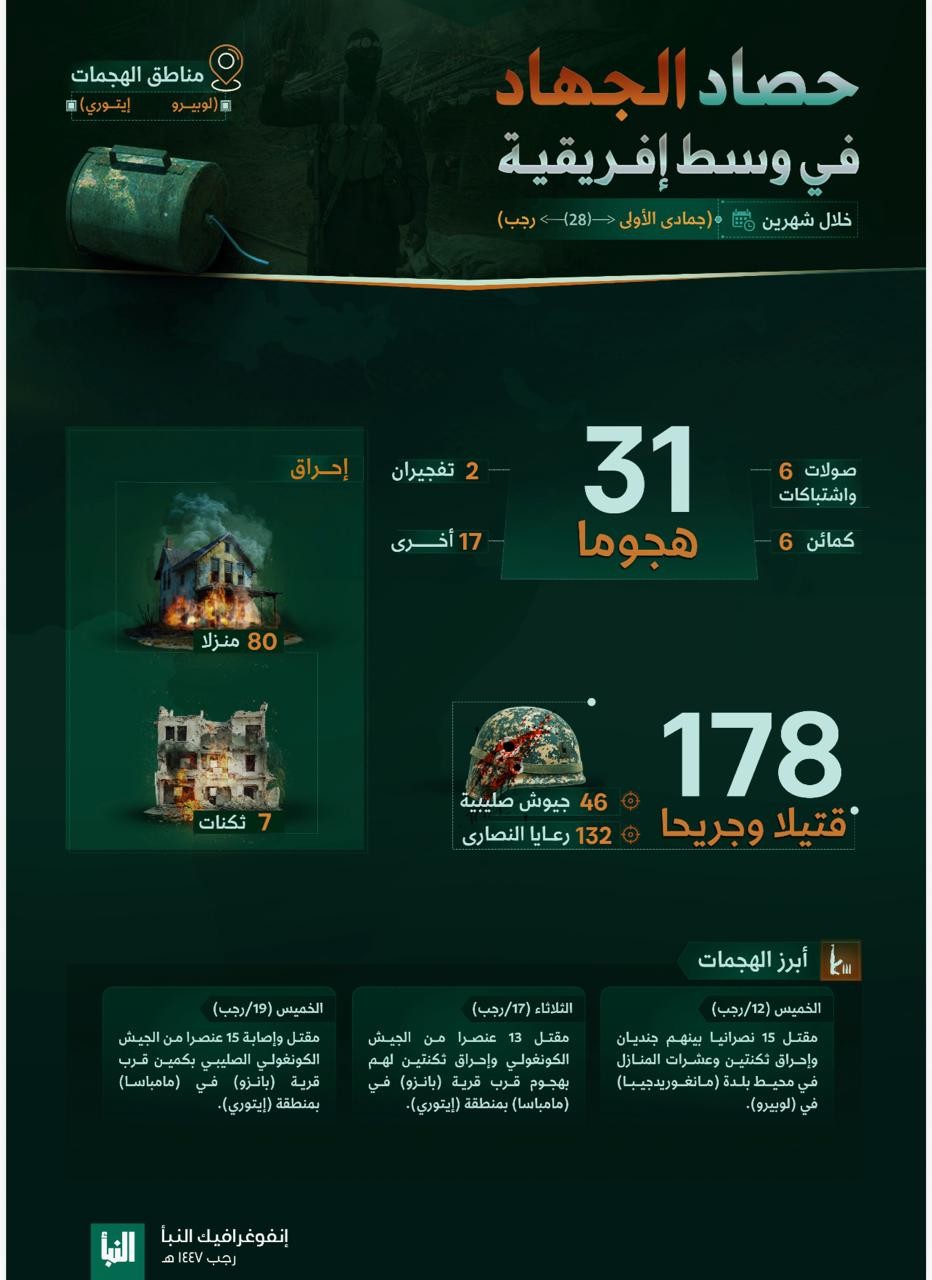
Al-Naba newspaper published statistics (infographic), in its issue No. 530, showing the number of attacks carried out by the organization during the two months of Jumada al-Awwal, Rajab, in Central Africa (Lubero and Ituri).
It carried out (31) various attacks (6 clashes, 6 ambushes, detonating two explosive devices, and 17 other attacks). While (80 houses and 7 military sites were burned and damaged), and (4 four-wheel drive vehicles, 74 motorcycles, and a quantity of weapons) were seized.
As a result of these attacks on the coast, 178 people were injured and killed.
It is clear that the Lubero region in Congo topped the list of areas most frequented by the organization’s activities and attacks in recent months.
In Mozambique, the organization targeted a Rwandan army naval patrol while it was trying to approach the beach near the village of Nabaj in the Mocimboa da Praia region, with weapons.
The organization also carried out an attack targeting a Rwandan army patrol, near the village of “Kugule” in the “Macomia” region.
During the month of January, the organization carried out about (8) operations, resulting in the death and injury of about (18) people, as the volume of these operations decreased compared to the previous month.
In the Sahel region, the “IS” carried out several attacks in the Sahel region, the number of which reached (10) attacks, resulting in the killing of (24) people. The organization carried out an attack targeting a base for the Group to Support Islam and Muslims in an area near the village of “Bandiaga”, in the “Sino” region. The organization also attacked with an explosive device a joint patrol of the Malian army and the Russian Wagner forces, near the city of “Menaka”.
A member of the “Khalas Azawad” militia, loyal to the Malian government, was killed near the city of “Menaka”, eastern Mali.
Al-Naba newspaper published statistics on the organization’s attacks in the Sahel, in its issue No. (528), in which it showed the scale of operations in Niger (Tillaberi, Dosso, Tawa), Burkina Faso (Odalan, Dori, Siba, Baga), and in Mali (Gao, Menaka), during one month, from 11 Safar to 11 Rajab 1447 AH.
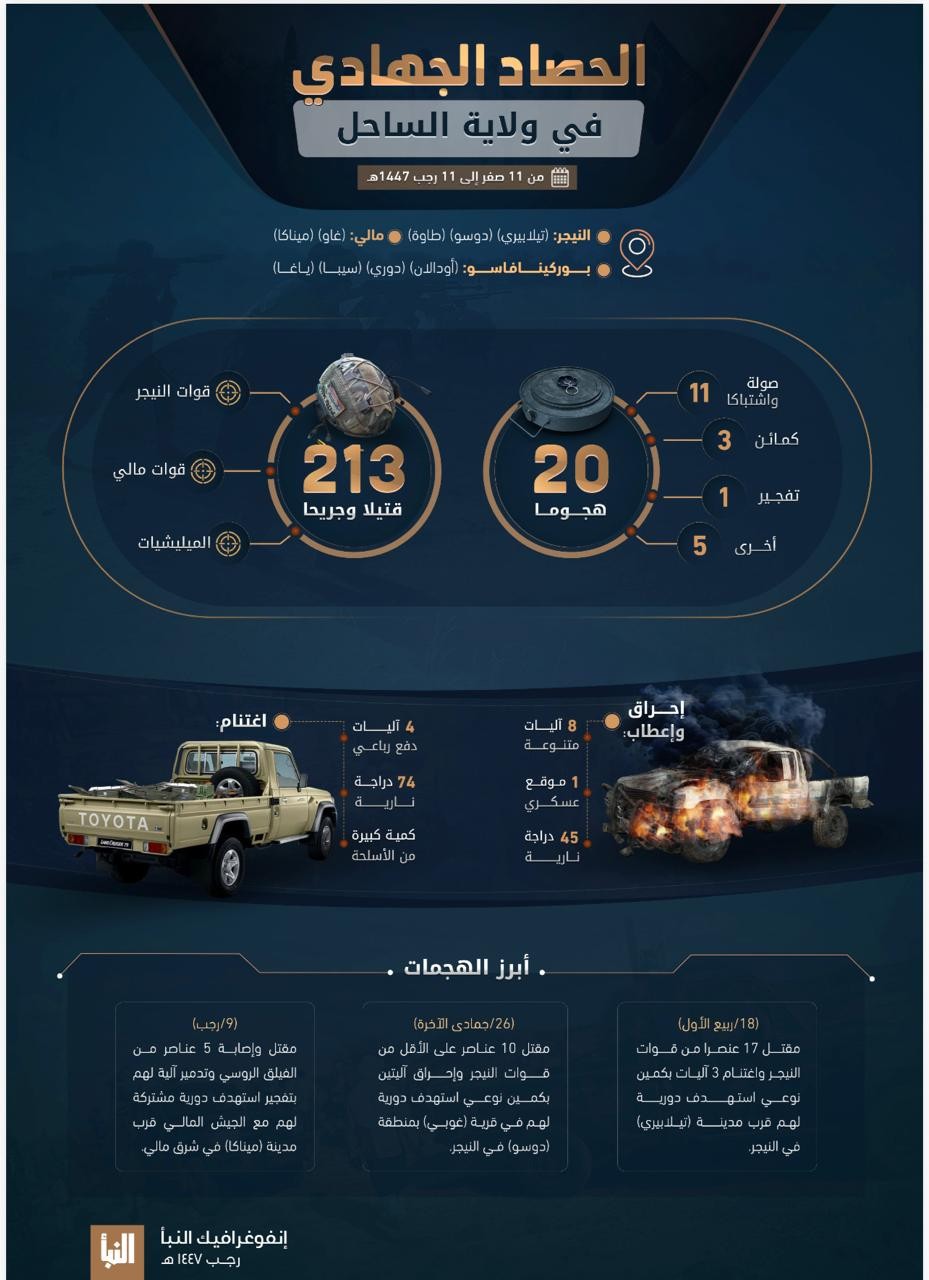
It carried out (20) various attacks (11 clashes, 3 ambushes, detonating one explosive device, and 5 other attacks). While (8 vehicles, a military site, and 45 motorcycles) were burned and damaged, and (4 four-wheel drive vehicles, 74 motorcycles, and a quantity of weapons) were seized.
As a result of these attacks in the Sahel, 213 people were injured or killed, targeting Niger and Malian forces, and pro-government militias in the countries.
In Afghanistan, the organization’s branch in Khorasan claimed responsibility for an attack carried out by the suicide bomber (Othman Al-Muwahid), targeting a Chinese restaurant, killing and wounding about (25) people, in the “Shahrno” area in the center of the Afghan capital, Kabul.
In Pakistan, the organization carried out an attack, targeting a leader (Muhammad Sultan), from the Association of Islamic Scholars, near the city of Wana, South Waziristan, using an explosive device.
In Somalia, the organization carried out several attacks targeting government forces in Puntland, in the northeast of the country, in Wadi Ja’il in the village of Tasan. The attacks resulted in the use of explosive devices.
The number of attacks reached (6), resulting in the death and injury of about (38) people. It is noticeable that the number of attacks and victims increased after the Puntland government normalized its relations with “Israel”.
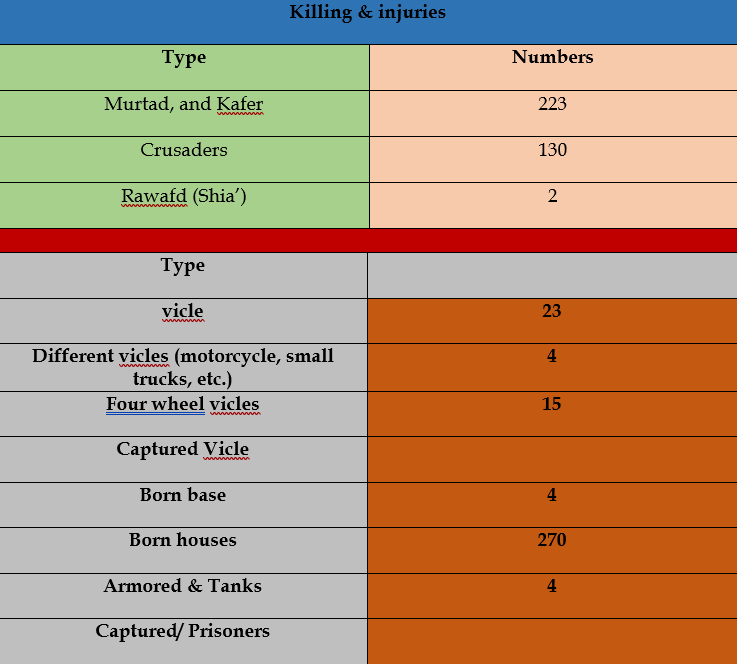
A statistical report on the extent of human and material losses resulting from ISIS operations in the world:
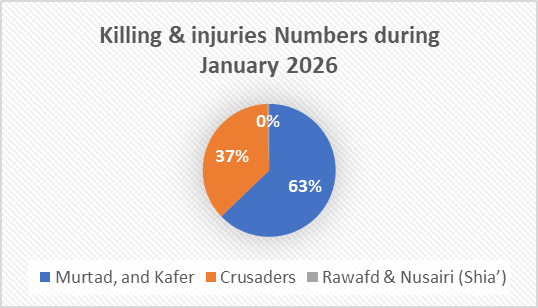
The organization killed what it describes as apostates and infidels (223) people, (130) Crusaders, meaning non-Muslims, and (2) two Shiite people in Iraq.
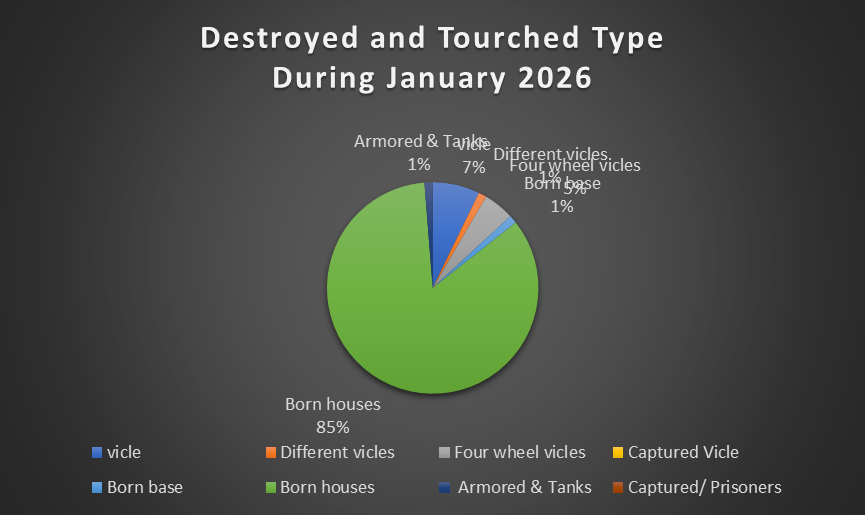
The organization destroyed and damaged (23) vehicles, (4) various vehicles, and (15) four-wheel-drive vehicles. It also burned (4) military bases, burned (270) houses, and destroyed two armored vehicles.