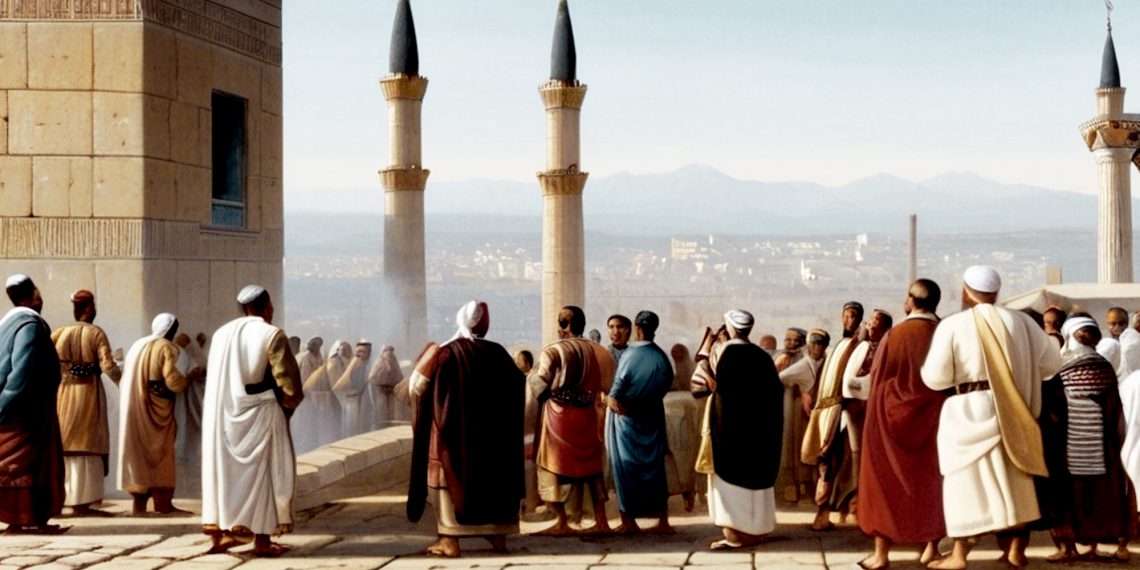
In terms of history, Jerusalem for Turks, is a place of the horizon that shows the periods of time that Turks have presented to humanity with justice and “humbleness”. If we make a comparison by considering the situation in the Israeli period, this fact will be seen more clearly. In this respect, if the reason we are interested in Jerusalem is to stand against oppression and injustice, if our offer is justice, there is nothing to question. Jerusalem was one of the places where Turks overcame the steep slope..
A system that honours religions and gives peace to the pious started in a process opened with Umar bin Khattab, a close companion of Prophet Muhammad and continued with the same understanding throughout the Turkish centuries of Jersalem.
In December 1917, when the Turkish soldiers left Jerusalem, did the mentality that said the Crusades were over now become history? The stones of Jerusalem and the tears of today’s oppressed are witnesses to this. Or did he defeat himself and stand at the gates of Jerusalem again…
Some cities in history are the guardians of the memory of civilisation. They become a centre of consciousness about the values and meanings of time, space and human beings that transcend time. In the time periods when history is reproduced, these cities whisper the codes of existence to the hearing ears and reveal them to the seeing eyes.
Jerusalem is a city of meaning for Muslims. On the other hand, the most valuable remedy to overcome differences is undoubtedly to remember the commonalities. In this sense, Jerusalem draws a common picture of our world of meaning in Arabic, Persian and Turkish languages. This city of memory, which witnesses the most basic concepts and memories of our existence, can also say a lot about our future. This process, which can be called the Jerusalem Criteria can again bloom the flowers of common meaning in this multilingual and cultured geography on this chaotic ground. As Mevlana Rumi said, “It is not those who speak the same language, but those who share the same feeling can understand”.
Aliya Izetbegovic makes valuable observations about Jerusalem and the unity of feeling about the presence of Muslims here: Jerusalem is not an ordinary city. It is a city which is sacred to the three great world religions. Who can ensure a free city of Jerusalem, completely open to all? Theoretically and practically, only Muslims can do it.
Theoretically, because only Islam recognises Moses, Jesus, the Bible and the Torah, whereas neither Christians nor Jews recognise Muhammad PBUH or the Qur’an. This is the element of Muslim superiority in this matter. Practically speaking, Jerusalem is located in the Muslim world. Any non-Islamic domination of Jerusalem would be an abnormal situation that can only be sustained by force, and a state of tension is never a state of freedom.
With these approaches, Aliya wants Jerusalem for everyone and answers the question of how to create a Jerusalem that is open to everyone by demonstrating that the possibility of its implementation is possible on the theoretical and practical grounds that Muslims possess. While expressing this, Aliya defends his thesis based on history.
With the words that history clearly confirms these theses, Aliya shows the relevance of his own claims with the “testimony of the process”. Jerusalem was a free city for all three religions during the Islamic rule. The lack of freedom in it corresponds to the absence of Muslim rule. This happened twice: the first time when the Crusaders captured it (1099-1187) and the second time today, when it is in the hands of Israel. (94) Aliya was one of the most prominent figures in the history of the Prophet Muhammad. Aliya states that Jerusalem has been ruled with the meaning he puts forward since the time of Umar and when Sultan Saladin recaptured Jerusalem from the Crusaders (1187) he allowed the Jews to return to the city and established a unique relationship between Muslims and Jewish children, between two different peoples, (95-96) he justifies his claims by recalling the incidents such as the destruction of the Syrian Catholic Church, the raid on the Orthodox Church of St. John the Baptist, the looting of the Coptic Church and the burning of the Aqsa Mosque after the Jews completely dominated Jerusalem after 1967, revealing the common distress experienced by all religions in this period.
Civilisation and denial: in Jerusalem, where mim is mercy..
Every civilisation leaves a mark on history in its own way. In this sense, Jerusalem is one of the places where the heart of history beats. History has witnessed many events here. Especially the occupation of this place during the Crusades revealed bloody and painful scenes that remind us of today. Fulcherius, who witnessed this occupation, describes the blood-curdling scenes as follows: “Most of the Muslims who tried to escape by jumping from the roof of the Temple of Solomon (Aqsa mosque) were shot with arrows and killed. About ten thousand Muslims were beheaded in this temple.
If you were here, your ankles would be stained with the blood of the slaughtered. All Muslims were slaughtered, women and children alike. Our knights and foot-soldiers, having discovered the tricks of the Muslims, disembowelled them as soon as they killed them, in order to disembowel them with Byzantine coins, which the Muslims had swallowed from their disgusting throats while they were alive.
For the same purpose they gathered the corpses in great heaps and burnt them, easily finding the gold among the ashes.
Our men, with their tired swords in their hands, travelled all over the city, killing even those who begged for mercy. People were losing their lives like rotten apples and acorns falling from shaking branches”.
Bishop Raymond d’Agiles, one of the eyewitnesses of the massacre, described the actions of the heroic conquerors(!) as follows: “Finally, after our men had captured the walls and towers, we witnessed some incredible events among the defeated, some of whose bodies were lying on the ground with their heads cut off.
This was indeed the best end they could have suffered. Others were hanging upside down from the castle towers, riddled with arrows; others were charred by the flames. The streets of the city were littered with severed limbs; the roads were so littered with corpses that it was impossible to pass through them. In the ancient Temple of Solomon, our people had shed so much blood that the corpses were floating in a crimson sea, drifting this way and that with the current.
Legs and heads floated here and there, sometimes sticking to another corpse. A disgusting chaos was everywhere. Our soldiers themselves, who had undertaken the task of slaughtering the people in that area, could not stand the stench of the dismembered corpses after a while”. Muslims were not the only victims of this great massacre. The Jews of the city were also burned in their synagogues, where they had taken refuge. Their offence was that they helped the Muslims.
In Jerusalem, Saladin’s time comes; the city, time and space change. This story is the subject of another chapter. Then, the Ottoman centuries and finally the painful retreat of the World War I years.
The British General Allenby, who entered Jerusalem, issued a declaration in Jerusalem.
Although it was not mentioned in the declaration this time that the British were not colonialists as in the 1917 Baghdad occupation, and that they had come as saviours from the Turks who exploited the Arabs against the mismanagement of the Turks and the German games, it was stated: “The defeat of the Turks by the forces under my command has resulted in the occupation of your city by my army. Therefore, I am now declaring martial law as a form of government here and this situation will continue as long as military conditions require.”
The insurmountable face of Islam called Turk was defeated. Allenby described the defence of our glorious army from the war days as “The Turks have a frightening, insane fighting power. They have completely lost their ability to fight, but they still continue to fight.
We are losing time because of the fact that a handful of Turks do not stop firing and fight, knowing that they are trapped in the trenches.” Yes, a handful of Turks; the generation of Asim was fighting. Dedicated to the confused minds obsessed with the Muslim Turk. In the words of the late Akif; “We have come and taught the world what nationality is!”.
Centuries have passed since the Crusades, Europe has become enlightened! But he did not give up his ongoing claim. Didn’t it? On December 11, 1917, British General Allenby, who entered Jerusalem, tapped the grave of Saladin Ayyubi and made a speech saying “Get up Saladin, we are here again” he was probably not in a different psychology. French General Giraud, after the Battle of Meyselun in 1920, tapped Saladin’s grave in Damascus, showing the Crusader spirit; “O Saladin! Listen, we are back” and the Greek commander Sofokles, who kicked the chest of Osman Gazi, were the current examples of which historical past. French Foreign Minister Gueant said: “I would like to say the following about the criticisms made against our President: Everyone is thankful that Sarkozy is there. Everyone was preparing to watch the massacre committed by Gaddafi on television.
Thank God that our President led the Crusade and mobilised first the UN, then the Arab League and the African Union.” He used the term Crusader as recently as yesterday. Israel and its historical and even mythological ambitions in Jerusalem today should be seen as another aspect of this historical actuality.
“Six hundred thousand lives are lost; faith is diminished by millions;
No one sees! And the fool who sees knows from Allah!” Says Akif…
When you compare the picture of Umar bin Khattab’s entry into Jerusalem with these, this is how history shows us the difference between the representatives of the civilisation of reverence, compassion and service and the others. Just as the Turks are endeavouring to adapt life to the Truth as a member of a cause of responsibility, the members of other historical visions are on their way as the cavalry of their own history.
This is one of the things we have learnt from Jerusalem; in the words of Akif, “One, what are we? Watch now and then think, what are we?”.
Unfinished Account with Saladin
The word “crusade” is a concept that has a magical effect in the East and the West. Since it is mostly read in ideological moulds, we can understand the reality of these campaigns at the level of those who perceive an elephant in the dark. For a Westerner who consecrates the Crusades, these campaigns are a reconquista, that is the recapture of Christian lands occupied by Muslims, while for a Muslim they are a defence of religion and homeland.
This movement, which initially targeted only Jerusalem, later became the name of operations carried out for holy purposes and even in the name of freedom and democracy in the secular spirit of modern times. However, it is necessary to see the spirit of the time and historical reality from authentic sources, even from the Crusader side.
Anna Komnena, the daughter of the Byzantine emperor who called the Crusaders to the east against the Turks, reveals the spirit of this holy retaking expedition with her observations that “pretending to go to war against the Turks to save the Holy Sepulchre, they had sold their lands [in fact] they were seeking to seize new lands and properties for themselves by force of the sword”.
Especially the disgraces experienced in the 4th Crusade revealed what the Crusader spirit was with all its nakedness. Yesterday it was holy, today it is democracy and although the concept has changed, the appetite for lands and riches has never diminished.
In modern times, a young mind reading about the Crusades in the Middle East or anywhere in Europe can have a mentality that will form a reference for its own world of action, a reference for its own world of action, a ground of thought for its facts and movements, beyond having ordinary historical knowledge when it reads the history of these campaigns as an “event”.
From this point of view, while it is possible to have a perspective on the cultural world in which he grew up, it is also possible to reach a critical interpretation with an alienated perception. The ground formed by many sources of information and perspectives on these events, from sources in different languages to copyrighted works, novels and films, makes these events a phenomenon in itself. History itself informs, but some phenomena can be constructive.
In this respect, a national mind should look at events by learning to look within its own metaphysical concepts and historical cycle. Sometimes, “O wind of the east that cools my forehead! O moon that keeps me company in the dark! My desires are an arrow, they surpass great mountains.” It is necessary to listen to the wish of Atsız. It is necessary to be self-conscious when thinking about the salibi that confronts the arrows of our ancestors who came from East to West with the crescent in their hands.
In modern times, the West rediscovers the Crusaders for various reasons. Walter Scott’s The Talisman, published in 1825 and Joseph François Michaud’s Histoire des croisades, published between 1812 and 1822.
The French invasion of Algeria in 1830 was portrayed as Louis IX’s last crusade to Tunisia in 1270.
The Crusades became one of the reference events for modern Western nationalism and imperialism. In the era of the French Revolution, the Crusades allowed the French to see themselves as the natural leader of Europe.
Personalities such as Fredrick Barbarossa for the Germans, Richard for the English, Godfrey of Bouillon for the Belgians became the proud historical precursors of the colonial activities they organised.
When the British entered Jerusalem, Punch magazine drew a caricature of the English King Richard and captioned it with the words “At last my dream has come true”. When the French commander Henri Gouraud took control of Syria, he said “Get up Saladin, we are back”. Finally, Thomas F. Madden’s A Concise History of the Crusades, in which the concept was reintroduced during the September11, 2001 process, new studies on the Crusades emerged and films such as Kingdom of Heaven (2005) were made, draws attention as a Western writer’s determinations on the effects of these crusades on the West. Here, it is best to leave the process from Anna Komnena to a modern historian to the reader’s judgement. What the French commander wanted from Saladin’s tomb is a question to be considered.
As can be seen, the Crusader phenomenon has an impact beyond being an ordinary history. In this respect, it emerges as a background on which nationalism is built in the context of event, phenomenon and mentality, as a ground for imperialist aims and finally as a discourse of legitimacy for current political operations. In this respect, while analysing the long-term struggle of the Turkish-Islamic world against the Crusaders, this constructive structure of the crusades must be taken into consideration by authors and readers.
The Crusades, for the Turks, one of the nations belonging to the Islamic world and especially for the Turks, are a matter of defence of the homeland, defence of religion, and finally the defence and recapture of Jerusalem, which is the symbol of the ideal of freedom and its symbol against the Westerners who have re-existed with their colonialist presence in modern times.
Another issue that urgently needs to be mentioned here is that it would be a modern mistake to see these expeditions as a matter of exchange and cultural communication.
Even if such a thing happened, it is possible to talk about the great contribution of Islamic civilisation, the civilisational geography of this time to the West, the third world of the era, in the great civilisational cycle together with Andalusia. Naturally, it should not be forgotten that the sources and works in different languages on this subject carry a perspective in this respect. It is certain that the Turkish-Islamic heroes of the great struggle from Kılıçarslan I to Saladin Eyyûbî and Sultan Baybars have a lot to say to the perceptions. It is certain that the account with Saladin is not over. What fascinates and at the same time overwhelms the West here is the incapacitating power of justice, mercy and virtue rather than defeat.
Power is sometimes the ability to bend the enemy’s heart as well as his wrist…
The “moment” when history shines: Jerusalem
The exceptional “moments” of history fly around us like a bee fertilising the flowers of our mind’s perception. Jerusalem, with its religious meaning and historical process, tells us about our founding cycle and our metaphysical principle.
In this respect, Jerusalem is a cornerstone that strengthens our personality with the memories of our resurrecting “moments”. For those who are able to read and hear the mazmun of its stones, in the breeze of the past, the wind of the soul, which turns knowledge into consciousness and realisation, makes the flowers of consciousness bloom.
In Walter Benjamin’s words, “the past carries with it a secret index that leads to salvation. Don’t we already feel a slight breeze from the air in which our predecessors lived? Among the voices we listen to, is there not also the echo of those who are now silent?” (Walter Benjamin, On the Concept of History, translated by Ahmet Cemal, Pasajlar).
Is there no echo in Jerusalem of the now silenced voices of the Prophet Muhammad, Umar bin Khattab, Saladin, Sultan Baybars, Yavuz, and Kanuni? Do not the breezes and echoes we feel with this enchanted state of the past invite us to resurrection by making us about Jerusalem? Jerusalem here becomes one of the main themes of origin. It becomes a place where the individuality is strengthened. The pulpit built by Nureddin Mahmud Zengî for Jerusalem, Saladin who placed it in the city and the radical who burnt it in 1965 were undoubtedly values that made it about this city.
By responding to this invitation, we are honouring our covenant, fulfilling our raison d’être and agreeing with the essence of our red apple, the mefkûûre we are waiting for. Benjamin said that “there is a secret agreement between past generations and ours. Then it means that we have been waited for in this world.” This means that we have taken the right place in this relationship of knowledge, thinking and understanding that will be established from the essence between the past and the future. In this respect, the issue of Jerusalem is not a mind that starts with Israel and is based only on those conditions for Muslim perception.
Just as the name of Umar bin Khattab and those in his decree are mentioned in Saladin Ayyubî’s edict as if there was a secret treaty between them, just as Yavuz Sultan Selim put the previous two in the Jerusalem decree, the minds united by the unifying air of the past have left this legacy of unity and continuity to the future.
Jerusalem has been transformed from a formal transference to a substantive one, and in Benjamin’s words, “each of its lived moments has turned into a quotation on the agenda”.
From this point of view, Jerusalem can be seen as one of the sources of meaning that leads us to eternity with its “moments” that merge in the process. At this point, insensitivity to the troubles experienced in Jerusalem will be an indication that we do not feel the breezes of the past that we cannot hear their voices and that we have broken the covenant between us and the past and fallen far from the place and reason we are expected. Jerusalem is a compass place that reminds us of the process and our principles regarding the process. The fight of the British and French generals with Saladin’s tomb in Jerusalem must undoubtedly be a result of the process of the metaphysical root that brought them into existence.
For those who market pluralism everywhere, especially in our country, the tendency to uniformise loses its meaning in Palestine for some reason, and the buts and buts begin. It would be enough to be surprised at this situation with Foucault’s words :
“If everyone looks alike in a place, it means that there is no one there”! In the Islamic-Turkish times, everyone in Jerusalem looked like himself.
To reach the revitalising principles of the enlightened and shining “moments” of the past is to meet eye to eye with Umar bin Khattab to sit knee to knee with Saladin to hold the hand of Baybars for a moment to meet Fatih Sultan Mehmed, Yavuz at a point at a place and this will bring us that revitalising air of the past/ancient that does not pass.
With Benjamin’s approach that “just as flowers turn their heads towards the sun, the past, under the influence of a hidden orientation towards the sun, endeavours to turn towards the sun that is rising today in the skies of history… The past can only be captured as an image at that moment when it appears to the eye, when it shines for a moment, never to return.” the orientation towards Jerusalem will be to establish a connection through history with what we want to resurrect today.
It is obvious that the mind that says “The Ottoman times have passed…” speaks from a very pejorative place, far from the realisation of the past where there are the breezes and sounds of the past that have not passed. Right here, Foucault’s words
“pay attention not only to the truth of what you say but also to the fact that the person you are talking to can endure this truth” warns that the needle and the stick should be inserted in the right place. Attempting to measure a city that exists with values with periods is like measuring water with a metre.
To know Jerusalem, to articulate its past historically is not to know that past “as it really was”. On the contrary, it means capturing Jerusalem in its position, in a moment when it shines in a moment of danger.
This sentence, which is based on W. Benjamin’s statement that “The ability to ignite the spark of hope in the past by fanning it can only be found in the historian who has assimilated the past”, should make us think that Jerusalem is the place of shining days of light as well as the times of haze.
The Prophet’s Jerusalem, Hz. Umar, the style and justice of Saladin’s entry into the city, and the management of the city with the approach of Ibrahim Halillulah are some of the “moments” that shine for us.
What will make Jerusalem a story of resurrection, beyond the deprivation among the sufferings of the Zionist era, is that we can hold this city in the hands of our experience that will guide our humanity/personality and create the virtue of looking to the future. Jerusalem is more than an ideological fuel, it is an existential ground. “Understanding” and “understanding” the “moment” means transforming the idea into contemplation and finding our place.
In terms of the elements of our metaphysics of history, without absolutising, Mecca, Medina correspond to the origin, Damascus, Bagdad, Cairo, Istanbul, Samarkand, Bukhara, Sarabosna, etc. correspond to the development in the process and Jerusalem corresponds to the goal. This article may not solve the problems related to Jerusalem, but as a conversation with the stones of time in Jerusalem, it may be a humble voice for the voiceless. By the way, Saladin does not come by waiting.